


Spending the same amount on marketing every month? It’s not efficient. Consumer demand changes throughout the year – some months are busier, others quieter. Ignoring these shifts can lead to wasted ad spend during slow months and missed revenue during peak times.
Here’s what matters most:
- Static budgets hurt performance. Overspending in low-demand months increases costs, while underspending during busy periods leaves money on the table.
- Seasonal adjustments drive results. Businesses that align budgets with demand trends capture up to 67% more seasonal revenue.
- Key strategies include: analyzing historical sales data, tracking customer behavior, and planning budgets around peak and off-peak seasons.
Seasonal Marketing: An Overview of How to Market in Your Peak and Off-Season | WebFX
sbb-itb-2ec70df
How to Analyze Seasonal Trends in Your Business Data
Before adjusting your marketing budget for seasonal shifts, it’s essential to pinpoint when demand peaks and dips. Instead of relying on assumptions about busy periods, dive into your CRM, sales records, or tools like Google Analytics to uncover the facts.
Review Historical Sales Data
Start by examining at least two to three years of historical sales data. This helps you identify recurring patterns while filtering out one-off anomalies. By comparing year-over-year performance for the same time periods, you can determine if a December spike or an April slowdown is part of a consistent seasonal trend. Look for clear peaks (high-demand times) and troughs (low-demand times) in your weekly or monthly sales figures. For instance, if November and December account for 18% of your annual revenue, it makes sense to allocate more of your budget during these months. Don’t forget to clean your data by excluding outliers, like flash sales, that could skew your analysis.
"Historical seasonal demand data can help give you a reasonable idea of what sales may look like in the current year, but it won’t tell the whole story."
- Jake Latham, StockIQ
This step lays the groundwork for aligning your budget with predictable seasonal trends.
Track Customer Behavior Patterns
While historical data shows trends, understanding customer behavior explains why these trends occur. Tools like Google Trends and Keyword Planner can reveal when interest in your products or services begins to rise. Dive deeper by analyzing data based on demographics, location, and device usage to uncover specific patterns. For example, if you sell outdoor furniture, you might notice search interest starts climbing in March – months before summer – indicating it’s time to ramp up your advertising.
Shifts in purchasing habits also play a role. Between November 1 and December 2, 2024, mobile spending hit $69.8 billion, illustrating how customers increasingly shop on mobile during peak seasons. Don’t overlook insights from your sales team, either. They might have valuable knowledge about B2B buying cycles or weather-driven demand that isn’t immediately obvious in your analytics.
Compare Against Industry Benchmarks
Your internal data is critical, but comparing it against industry benchmarks helps validate your findings and provides additional context. Benchmarks can reveal whether certain trends are unique to your business or reflect broader market behavior. For example, if your sales drop 15% in January but industry data shows a typical 20% decline, you’re actually performing better than expected.
Industry benchmarks also expose competitive dynamics. For instance, 86% of industries recently reported a 10% rise in cost-per-click (CPC). Such insights can prevent budget missteps and reduce wasted spend. Additionally, tools like Google Ads’ auction insights can alert you when competitors increase bids, signaling the start of a seasonal peak before your own data catches up.
"Calendar-based seasonal management leaves 67% of actual seasonal opportunity value on the table."
- Groas
How to Build a Seasonal Marketing Calendar
Use insights from seasonal data to create a clear marketing timeline. A well-structured calendar helps allocate your budget effectively based on seasonal trends.
Identify Key Seasonal Dates
Start by marking the fixed dates that shape your year – major holidays, industry events, and product launches. Include both widely recognized holidays and niche events relevant to your audience. For example, pet services can make the most of National Pet Day, while entertainment brands might focus on Star Wars Day. To put this into perspective, Americans planned to spend about $33.5 billion on Mother’s Day in 2024 alone. If your business operates internationally, tailoring to local events can make a huge difference.
Your internal teams can provide valuable insights that raw data might miss. Sales teams and regional managers often know when customer interest surges – whether it’s tied to school schedules or seasonal trends like weather-driven demand for fitness gear. For instance, U.S. shoppers spent a record $994.1 billion during the 2024 holiday season, with 41% starting their shopping as early as October.
"The first rule of Seasonal Planning is: you do have to talk about it before the season begins."
- Karola Karlson, Marketing Strategist
Estimate Seasonal Demand
Accurately predicting seasonal demand involves blending qualitative insights with hard data. Tools like Google Keyword Planner can help you track monthly search volumes for your main terms. Export this data into a spreadsheet and use conditional formatting to quickly spot spikes in interest. Google Trends is another great resource, showing when specific regions start searching for seasonal products.
To refine your strategy, calculate how much each month contributes to your annual growth. For instance, if July accounts for 22% of your yearly revenue – driven by events like Prime Day and back-to-school shopping, which brought in $39 billion in 2023 – you’ll know where to focus your resources. Below is an example of how retail sales vary throughout the year:
| Month | Retail Sales | Key Drivers |
|---|---|---|
| January | $600.94B | Post-holiday dip; "New Year, New You" themes |
| July | $615.96B | Prime Day; start of Back-to-School |
| November | $627.44B | Black Friday; Cyber Monday; Thanksgiving |
| December | $633.36B | Peak holiday gifting; highest monthly sales |
Prioritize your budget at the start of high-growth periods to capture early demand. Keep in mind that about 72% of companies use time-series or regression-based forecasting models, though these come with an average error rate of 12.4%. External factors, like viral TikTok trends or unexpected weather changes, can also shake up even the most well-thought-out plans.
"Seasonality should dictate pacing and bids before the curve hits, not after."
How to Allocate Budgets Across Seasonal Phases
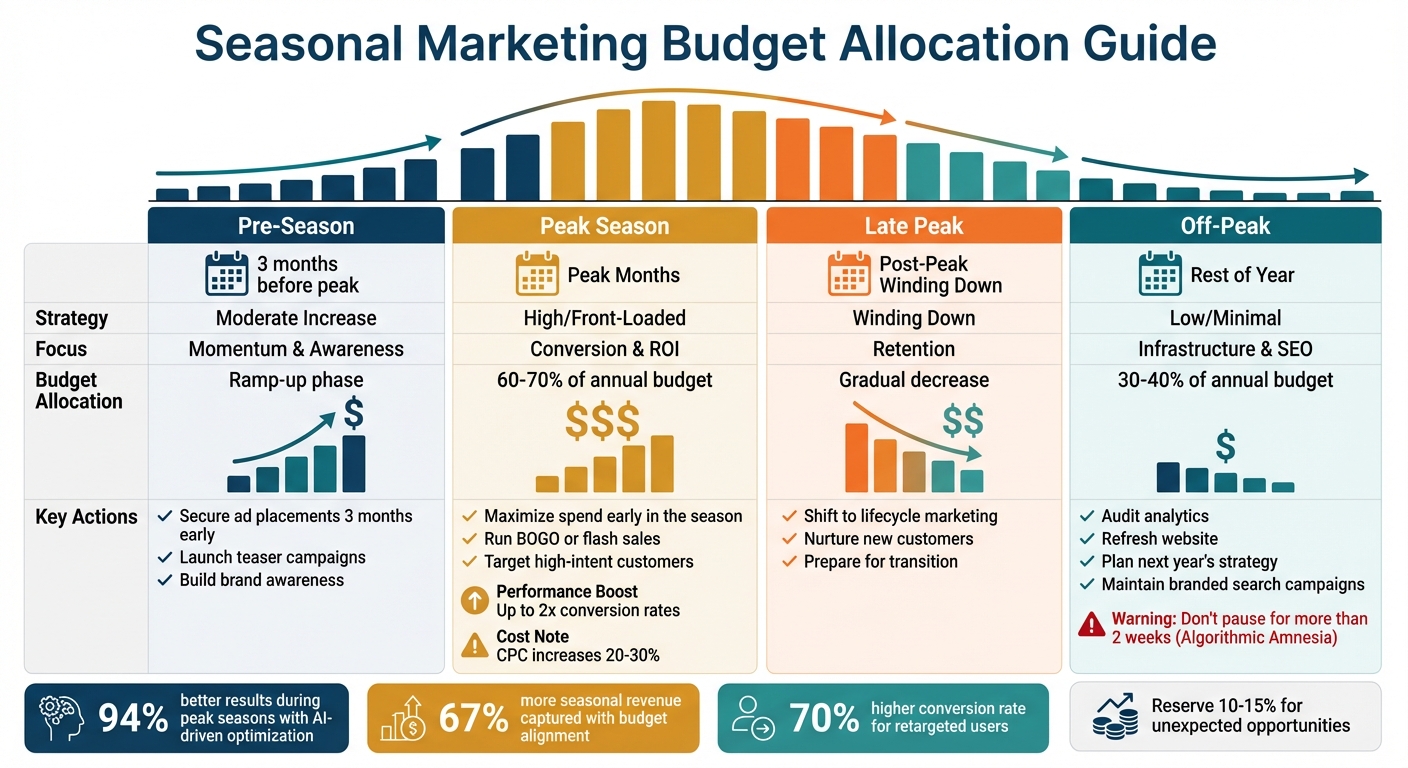
Seasonal Marketing Budget Allocation Strategy: Peak vs Off-Peak Spending
With your seasonal calendar in hand, it’s time to fine-tune your budget allocation to match customer demand. The key is simple: spend more during peak seasons and scale back during slower ones. An even distribution might seem logical, but it often leads to wasted resources during high-demand months and overspending when customers are less active.
Increase Spending at the Start of Peak Seasons
To make the most of peak seasons, focus your spending at the beginning. This strategy helps capture early momentum and keeps your brand top of mind as customers start making decisions. For example, if November drives a large chunk of your annual revenue, allocate the bulk of your seasonal budget to early November rather than waiting until mid-December, when many shoppers have already completed their purchases.
"If you invest an equal budget during all three months of the high season, you will lose out on the momentum that a higher initial investment would have brought."
- Karola Karlson, Founder, KarolaKarlson.com
Use metrics like new revenue or monthly recurring revenue (MRR) to calculate monthly growth percentages and align your budget accordingly. Keep in mind that during peak periods like Black Friday, advertising costs rise. For instance, Meta ads may cost 20% more per 1,000 views but deliver up to 45% higher buyer interest. Similarly, cost-per-click (CPC) often increases by 20–30% during these months, while conversion rates can double as shoppers are more eager to buy.
Most businesses experience two peak periods annually, such as back-to-school season and the winter holidays. Planning for these high-growth windows allows for a biannual "spending boost" strategy. Start preparing at least three months in advance to secure prime ad placements and creative resources. A good rule of thumb is to allocate 60–70% of your annual ad budget to peak months, leaving 30–40% for off-peak periods to maintain retargeting and data collection.
Reduce Spending During Off-Peak Periods
During slower months, adjust your budget to focus on long-term initiatives while cutting back on direct sales efforts. This approach helps avoid waste while building a foundation for future growth. For example, shift funds to projects like SEO improvements, website updates, or marketing analytics. However, avoid going completely silent – pausing campaigns for more than two weeks can disrupt bidding algorithms and harm Quality Scores.
Instead, maintain high-intent campaigns, such as branded search or ads for your top-performing products, while scaling back on lower-priority campaigns. Tailor your messaging to match the season. For example, an HVAC company might switch from "Emergency Repair" ads to promoting "Pre-Season Tune-Ups" or "System Replacement Financing". Retargeting during these periods also pays off, as users are 70% more likely to convert later.
Use this downtime to monitor your site rankings and ensure competitors aren’t gaining ground. Off-peak months are also ideal for auditing analytics, refreshing your website, and planning for the year ahead.
Use Planning Tools to Visualize Budget Allocation
To map out your spending, spreadsheets are a simple and effective tool. Build a model based on historical growth data to visualize how your budget should shift month by month.
Take advantage of tools like Google Ads’ Performance Planner to simulate budget scenarios and estimate their impact on conversions, CPA, and ROAS. Use the Insights Page to identify demand trends up to 90 days ahead, giving you a heads-up on market shifts. For short-term events like flash sales, apply Seasonality Adjustments to smart bidding algorithms, ensuring they account for expected changes in conversion rates.
Shared budget pools and portfolio bid strategies can also help by reallocating funds from underperforming campaigns to those thriving during seasonal peaks.
Here’s a quick comparison of budget strategies for different seasonal phases:
| Seasonal Phase | Budget Strategy | Primary Focus | Recommended Actions |
|---|---|---|---|
| Pre-Season | Moderate Increase | Momentum & Awareness | Secure ad placements; launch teaser campaigns 3 months early. |
| Peak Season | High/Front-Loaded | Conversion & ROI | Maximize spend early; run BOGO or flash sales. |
| Late Peak | Winding Down | Retention | Shift to lifecycle marketing; nurture new customers. |
| Off-Peak | Low/Minimal | Infrastructure & SEO | Audit analytics; refresh website; strategize for next year. |
Monitor your budget weekly during seasonal transitions to avoid underspending, which can lead to missed opportunities, or overspending, which can hurt your ROI. Set account-level caps as a safeguard to prevent exceeding monthly limits during volatile periods. Interestingly, 64% of organizations are now moving toward flexible budgets to adapt to unexpected demand surges.
Once your budget is aligned, the next step is optimizing your marketing channels to get the most out of each seasonal phase.
How to Adjust Marketing Channels for Seasonal Performance
Your budget is set, but where should you allocate it? The key lies in adjusting your channel mix to match your seasonal strategy. Customer behavior shifts throughout the year – during peak times, they’re ready to purchase, while slower months often see them browsing. Your marketing approach should reflect these patterns. By tailoring your channel strategies, you can make every dollar count.
Focus on High-Intent Channels During Peak Seasons
When demand is high, prioritize channels that attract customers already looking to buy. Search ads are a prime example – these target users actively searching for products or services like yours. The goal here isn’t to convince them they need you; it’s to show up when they’re ready to purchase.
Strive for an 80–90% Search Impression Share (SIS) during these times. Why? Conversion rates often double when customers are in buying mode. Use tools like Google’s Seasonality Adjustments to handle short-term spikes, such as Black Friday or flash sales lasting 1–7 days. This ensures Smart Bidding algorithms account for temporary surges without overreacting once things settle down. Tighten your negative keyword lists to weed out irrelevant searches and focus solely on high-intent queries.
"Instead of waiting for the algorithm to ‘learn’ from a sudden surge (like Black Friday), advertisers can proactively signal that performance will deviate from the norm."
- Michelle Morgan, Google Ads Expert
Invest in Brand Awareness During Slow Periods
Off-peak months aren’t about immediate conversions – they’re about staying visible and nurturing future customers. Channels like display ads, social media, and retargeting campaigns are ideal during these times. They’re typically less costly and help keep your brand top-of-mind. Plus, users exposed to retargeting ads are 70% more likely to convert later.
Tailor your messaging to fit the season. For example, an HVAC company could swap “Emergency Repair” ads for “Pre-Season Tune-Up” offers or financing options. The message should resonate with the time of year, focusing on relevance over urgency. This is also the perfect time to work on SEO updates, content creation, or website improvements – initiatives that strengthen your foundation for the next busy season.
Avoid going completely dark, even during slower months. Pausing campaigns for more than two weeks can lead to "Algorithmic Amnesia", where machine learning models lose critical data, causing Quality Scores to drop. Restarting later can cost more as you work to regain ad rank. Instead, keep branded search and top-performing campaigns running at reduced budgets to maintain momentum. Regularly track performance metrics to fine-tune your spending.
Make Real-Time Adjustments Using Pacing Data
Seasonal campaigns often move fast, so weekly budget reviews are crucial – monthly checks won’t cut it. If a channel starts burning through your budget without delivering results, shift those funds to higher-performing channels. Tools like portfolio bid strategies and shared budget pools can help automate these reallocations.
Keep an eye on your Search Impression Share and adjust bids as needed to maintain visibility. If rising CPCs begin eating into your budget, consider pausing lower-priority campaigns. Use Google Performance Planner to simulate different budget scenarios and predict their impact on conversions and ROAS.
Set aside a flex budget (10–15%) for unexpected demand spikes. This allows you to seize high-ROI opportunities without overextending your main budget. Businesses using AI-driven seasonal optimization have reported 94% better results during peak seasons and 67% improved efficiency in off-peak periods compared to static planning.
"The solution isn’t necessarily spending more money over the course of a year; it is about spending smarter."
How to Implement and Monitor Seasonal Budget Adjustments
Making seasonal budget adjustments work requires early preparation, consistent monitoring, and quick decision-making. Most businesses lock in their seasonal strategies by November or December to prepare for January peaks.
"The first rule of Seasonal Planning is: you do have to talk about it before the season begins."
- Karola Karlson, Founder, KarolaKarlson.com
Share Budget Plans with Teams Early
Getting your team aligned ahead of time avoids last-minute chaos. Your creative team needs time to craft seasonal messaging, and media buyers need early notice to secure the best ad placements. Waiting until the last minute often means paying higher prices and competing for scarce resources. Share your quarterly budget plans with teams and vendors at least three months in advance to lock in premium inventory and creative resources.
It’s also critical to align internal teams – like sales, product, and finance – on spending plans and performance goals. For example, if your strategy allocates 60–70% of your annual budget to peak months and just 30–40% to slower periods, finance needs to understand why spending patterns won’t be consistent month to month. This helps prevent budget freezes during high-spend periods when performance spikes are expected.
Once everyone is on the same page, shift focus to tracking performance in real-time.
Monitor Weekly Pacing and Performance Metrics
Relying on monthly budget reviews won’t cut it during fast-paced seasonal campaigns. Instead, track your budget pacing weekly to catch potential issues early. A good rule of thumb is to estimate monthly spend using your daily averages.
In 2025, Booyah Advertising achieved 99.9% data accuracy and cut daily budget-pacing update times by 50% for over 100 clients by switching to automated data pipelines. Alongside spend tracking, monitor performance metrics like Cost Per Acquisition (CPA), Return on Ad Spend (ROAS), and Conversion Rate. Use tools like conditional formatting in tracking sheets to flag pacing issues – red for overspending (above 105%), green for on-track (95–105%), and yellow for underspending (below 95%).
Automated alerts can help you stay ahead of problems. For example, set notifications for when Cost Per Click (CPC) spikes or budgets deviate significantly from plans. While daily overspends might happen, focus on monthly trends to maintain perspective.
With these insights, you’ll be ready to redirect funds as needed to optimize performance.
Reduce Waste by Reallocating Underperforming Budgets
If a campaign isn’t delivering, don’t let it drain your resources. Instead, reallocate funds to areas showing stronger results. Use metrics like "Search lost IS (budget)" to find campaigns losing opportunities due to limited funding, and "Search lost IS (rank)" to identify underperformance caused by weak ad quality or low bids. Shared budgets combined with portfolio bid strategies can automatically shift funds from low-performing campaigns to high-performing ones, all while staying within your CPA or ROAS targets.
Weekly reviews are key to reallocating budgets effectively. For instance, if display ads are driving clicks but not conversions during a peak season, redirect that budget to search ads, where user intent is typically higher. It’s also smart to set aside a flexible budget of 10–15% for unexpected demand spikes, allowing you to seize high-ROI opportunities without straining your overall budget.
Avoid shutting down campaigns entirely during slow periods. Pausing for more than two weeks can lead to "Algorithmic Amnesia", causing machine learning models to lose their optimization and forcing them into a volatile relearning phase when restarted. Instead, keep branded search and top-performing campaigns running at reduced budgets to maintain momentum. Traditional approaches to seasonal budgeting often leave 67% of potential seasonal value untapped – don’t let that happen to you.
Conclusion
Aligning your marketing budget with seasonal demand is a smart way to drive growth and efficiency. Businesses leveraging AI-driven seasonal strategies have seen 94% better results during peak seasons and 67% higher efficiency during off-season periods. This approach tackles the inefficiencies of static monthly budgets head-on.
Here’s the bottom line: dedicate 60–70% of your annual budget to peak months when consumer intent is at its highest. This flexible strategy avoids the pitfalls of static budgets and shields your campaigns from "Algorithmic Amnesia" – a term describing the performance dips that happen when ads are paused during slower periods.
To make this work, follow these steps:
- Analyze sales data and industry trends to identify demand spikes.
- Create a seasonal calendar to guide your spending.
- Adjust your channel mix by prioritizing high-intent platforms like search during busy months and focusing on brand awareness during quieter times.
- Monitor budget pacing weekly, not monthly, to detect underperforming campaigns early and reallocate funds to areas with stronger returns.
"The goal isn’t just to save money; it’s to hold your position in the market so that when demand returns, you’re already set up and in motion."
- Steve Bishop, 321 Web Marketing
This strategy ensures your business stays visible and ready to capture opportunities year-round. By syncing spending with actual demand, you can boost ROI during peak periods while maintaining momentum throughout the year.
FAQs
How do I identify my peak and slow seasons?
To identify consistent patterns in demand fluctuations, start by examining historical data. Look at year-over-year sales, website traffic, and conversion rates to pinpoint recurring trends – whether that’s spikes during certain months or noticeable dips. Analytics platforms can be incredibly helpful here, allowing you to compare data across different time periods and uncover these patterns.
Additionally, it’s a good idea to review the performance of past marketing campaigns. This can help you confirm which periods tend to be busier or slower, giving you the insights needed to fine-tune your marketing strategies. By aligning your efforts with these patterns, you can better capitalize on peak times and prepare for slower periods.
How much budget should I set aside for surprise demand spikes?
It’s a smart move to set aside a reserve budget – around 10–20% – to handle unexpected surges in demand. This way, your marketing campaigns can quickly capitalize on sudden spikes in consumer interest, ensuring you don’t miss out on valuable opportunities.
What’s the safest way to cut spend without hurting ad performance?
The best way to cut down on ad spend without hurting performance is by making smart, data-driven tweaks that align with seasonal patterns. Look at historical data to guide your decisions – boost budgets during high-demand periods and scale back during slower times.
Leverage automation tools to help you schedule these changes and keep a close eye on performance. Instead of making big cuts, go for small, gradual adjustments. This approach helps maintain steady results while keeping costs in check.