


Marketers often struggle to prove the real impact of their campaigns. Traditional tracking methods fail to capture the full buyer journey, especially in B2B sales cycles that stretch over months and involve multiple decision-makers. Enter LinkedIn Ads API – a solution designed to link ad performance directly to revenue outcomes.
Key Benefits:
- Improved Tracking: Server-to-server connections bypass ad blockers and cookie restrictions.
- Cross-Device Attribution: Tracks conversions across platforms and devices using hashed identifiers.
- Offline Integration: Connects CRM data (like in-person meetings and closed deals) to ad interactions.
- View-Through Conversions: Measures actions influenced by ad impressions, even without clicks.
- Better ROI Insights: Enables precise Return on Ad Spend (ROAS) calculations by syncing CRM data.
Why It Matters:
- B2B buying journeys average 211 days with 266 touchpoints – traditional models miss this complexity.
- 80% of B2B deals are labeled "unknown" due to untrackable buyer research.
- Advertisers using LinkedIn’s Conversions API report a 31% increase in conversions and a 20% drop in cost per action.
This tool equips marketers to track the entire sales funnel, optimize budgets, and prove campaign value with confidence.
LinkedIn Ads API Features That Improve Attribution
Conversion Tracking Across Platforms and Devices
The LinkedIn Conversions API (CAPI) tackles the challenges of cross-device tracking by creating a direct server-to-server connection between your systems and LinkedIn. This approach bypasses browser-based tracking, ensuring that ad blockers, cookie restrictions, and privacy settings don’t interfere with data collection.
What makes this system even more effective is its multi-identifier user matching. By leveraging data points like SHA256 hashed emails, LinkedIn First-Party Ad Tracking UUIDs (li_fat_id), and third-party IDs from providers like Acxiom and Oracle Moat, the API can link conversion events to LinkedIn profiles across multiple devices and platforms. This seamless integration ensures accurate tracking.
The numbers back it up: advertisers using the Conversions API reported an average 31% increase in attributed conversions compared to traditional tracking methods, along with a 20% reduction in cost per action. The API doesn’t stop at online actions like clicks or sign-ups – it also tracks offline activities such as phone sales, in-person meetings, and CRM opportunity progression. This comprehensive tracking gives you a full picture of the buyer’s journey.
View-Through Attribution Data
Most attribution models focus solely on conversions that occur after someone clicks your ad. But what about those who see your ad, don’t click, and convert later? LinkedIn Ads API addresses this gap by capturing view-through conversions, tracking actions that happen after someone views your ad impression – even if they never click.
This feature is especially useful for campaigns aimed at building brand awareness or influencing long-term decisions rather than driving immediate actions. You can customize view-through attribution windows from 1 to 90 days, and for key conversion types like PURCHASE, LEAD, ADD_TO_CART, QUALIFIED_LEAD, and SUBMIT_APPLICATION, you can extend the window up to 365 days. Considering that the average B2B sales cycle lasts 192 days, and revenue may be recognized over two years, these extended windows are invaluable.
Integration with CRM and Analytics Platforms
While view-through attribution provides upper-funnel insights, integrating LinkedIn Ads API with your CRM or analytics platform completes the attribution loop. This integration enables closed-loop reporting, connecting offline outcomes back to LinkedIn ad interactions. You can track how campaigns influence different sales stages in your CRM, from pipeline growth to closing deals.
"It is super critical for us to send backend CRM data to LinkedIn to optimize our campaigns and ads. Zapier’s integration with LinkedIn Conversions API gives us more confidence in which campaigns are bringing value to the business." – Borys Khodan, Head of Paid Media, Synthesia
Additionally, the API allows you to dynamically pass conversion values from your CRM, enabling precise Return on Ad Spend (ROAS) calculations by dividing total conversion value by ad spend. Real-time data streams replace slow, manual CSV uploads. The API also ensures deduplication of events, avoiding double-counting when data comes from both browser-based methods (like LinkedIn Insight Tag) and server-side tracking.
How LinkedIn Ads API Impacts Attribution in Practice
Case Study: Dramatic Improvements in Conversion Metrics
MarketerHire saw a 35% boost in conversion rates and slashed cost per qualified lead by 30% after integrating the LinkedIn Conversions API in August 2024. Morgan Clark, the company’s Product Analytics Lead, managed to connect the API with their HubSpot CRM using Zapier in just one afternoon.
Eftsure, an Australian fintech company, achieved even broader outcomes. By integrating LinkedIn Ads with Dreamdata‘s Conversions API connector and their HubSpot CRM, they reduced their cost per lead by 40% and increased return on ad spend by 10%. Marketing’s contribution to the sales pipeline jumped from 15–20% to 35–40% in the same period.
"The Dreamdata to LinkedIn Conversions API connection has enabled Marketing to be in the driver’s seat for budget conversations. We can now confidently track campaign impact through the entire funnel." – Luke Fielding, Head of Demand Generation, Eftsure
Beta testers of LinkedIn’s Intelligence API in September 2025 reported impressive results, including a 75% increase in marketing qualified leads, a 96% rise in sales qualified leads, a 43% drop in cost per acquisition, and a 287% surge in companies reached. These figures highlight how API integration can transform conversion performance across industries.
Faster Sales Pipeline Through Better Attribution
Improved attribution doesn’t just enhance conversion metrics – it also speeds up sales pipelines by connecting every interaction to measurable outcomes.
Sculpteo, a BASF brand specializing in 3D printing services, tackled its complex B2B sales cycles by integrating LinkedIn Ads with HubSpot CRM. This allowed them to track the entire customer journey, from the first ad interaction to purchase – a process that often took months. The result? A 145% increase in lead volumes and a 72% reduction in cost per acquisition.
Cognism leveraged the Revenue Attribution Report to show that LinkedIn touchpoints not only shortened sales cycles but also led to larger deals. In June 2025, Canberk Beker, the Group Global Head of Paid, increased LinkedIn’s share of the marketing budget from 55% to 62% after the company more than doubled its growth year-over-year.
"With the Revenue Attribution Report, we can see that when LinkedIn was a touchpoint in the customer journey, sales cycles are shorter and deal sizes are higher than our normal deals." – Canberk Beker, Group Global Head of Paid, Cognism
Further research revealed that LinkedIn-influenced opportunities were 39% more likely to close compared to those without LinkedIn involvement. One Enterprise Tech customer even reported that LinkedIn-influenced deals had average deal sizes twice as large as others. Additionally, LinkedIn’s internal marketing team saw a 150× increase in attribution credit for upper- and mid-funnel campaigns when switching from last-click to data-driven attribution. This shift contributed to an estimated 5% lift in marketing-driven revenue for fiscal year 2025.
Measuring What Matters – LinkedIn Ads New Measurement Tools
sbb-itb-2ec70df
Attribution Models With and Without LinkedIn Ads API
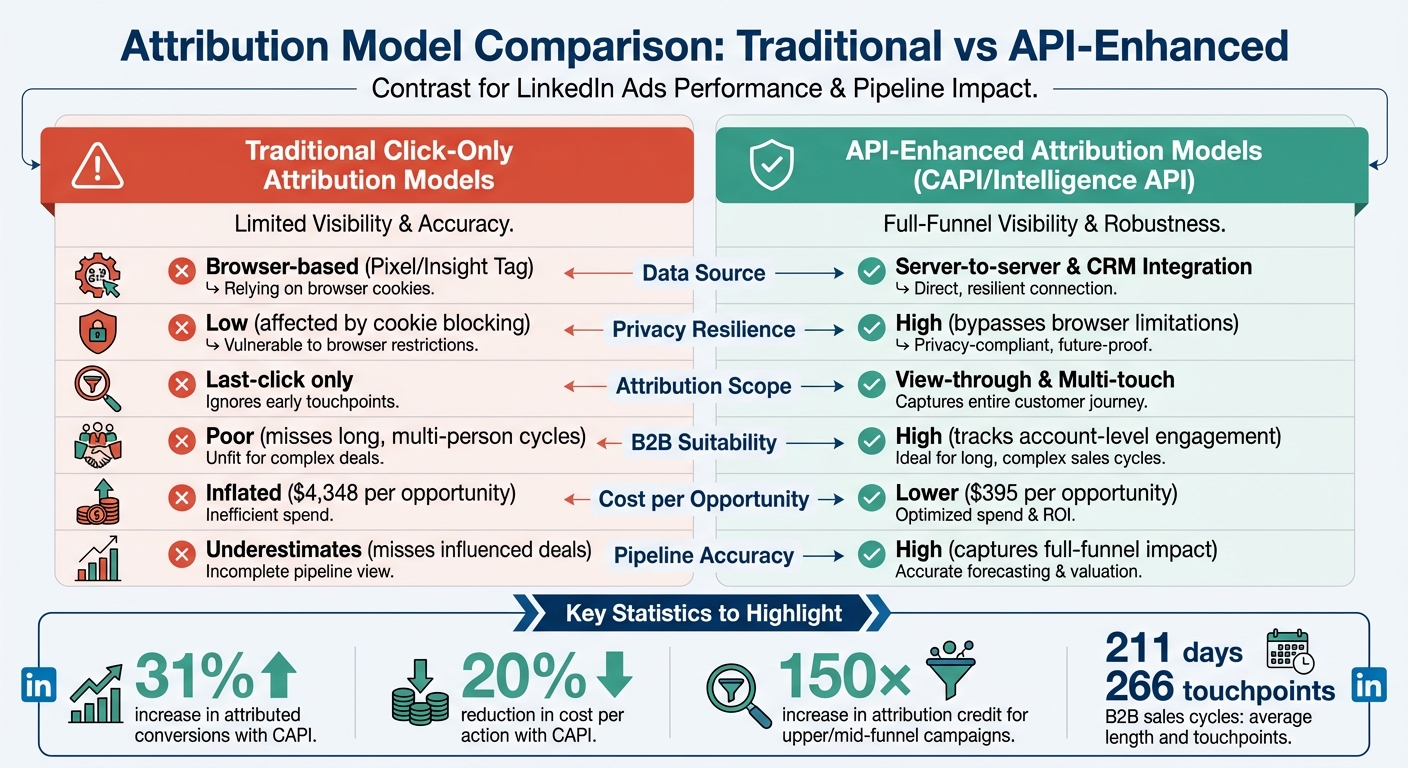
Traditional vs API-Enhanced Attribution Models for LinkedIn Ads
Problems with Click-Only Attribution
Let’s take a closer look at how attribution models perform with and without LinkedIn’s API integration, starting with the limitations of traditional click-only models.
Click-only models often fail to capture LinkedIn’s full impact on B2B campaigns. These models depend heavily on browser-based pixels and cookies, which are increasingly undermined by ad blockers and stricter browser privacy settings. For B2B companies, where the average sales cycle stretches over 211 days and involves an average of 266 touchpoints across 2,879 impressions, this creates large gaps in the data.
Last-click attribution, in particular, is problematic for B2B marketers. It ignores the role of buying committees and credits only the final click before a conversion, which can distort campaign performance metrics. This approach often inflates costs while undervaluing the role of awareness campaigns. For example, a study of an SME SaaS company showed that click-through attribution identified just one opportunity at a cost of $4,348. In contrast, view-through attribution uncovered 11 opportunities at a much lower cost of $395 each – making it nearly 11 times more cost-effective.
"Judging LinkedIn ads by clicks, sign-up, and the other conventional ad metrics alone will inevitably lead to disappointing results." – Factors.ai
Benefits of API-Enhanced Attribution
Enter the LinkedIn Conversions API (CAPI). This server-to-server integration addresses the shortcomings of traditional tracking methods. Advertisers using CAPI report an average 31% increase in attributed conversions and a 20% reduction in cost per action. Unlike pixel-based tracking, CAPI captures view-through conversions – when users see an ad but don’t click on it – offering a more accurate picture of LinkedIn’s influence.
Another game-changer is CAPI’s ability to integrate directly with CRM systems like HubSpot and Salesforce. This enables tracking of offline events such as demo requests, in-person meetings, and closed-won deals. LinkedIn’s own marketing team saw dramatic results when transitioning from last-click to data-driven attribution. The switch led to a 150× increase in attribution credit for upper and mid-funnel campaigns and contributed to an estimated 5% revenue lift for fiscal year 2025.
"When comparing both models for non-search channels, Modeled Attribution was able to recognize and deliver credit whereas Last Click remained flat." – LinkedIn
These improvements not only provide better pipeline visibility but also allow for smarter budget allocation. By revealing LinkedIn’s influence throughout the customer journey, marketers can make more informed decisions.
Attribution Model Comparison Table
| Feature | Traditional Click-Only Models | API-Enhanced Models (CAPI/Intelligence API) |
|---|---|---|
| Data Source | Browser-based (Pixel/Insight Tag) | Server-to-server & CRM Integration |
| Privacy Resilience | Low (affected by cookie blocking) | High (bypasses browser limitations) |
| Attribution Scope | Last-click only | View-through & Multi-touch |
| B2B Suitability | Poor (misses long, multi-person cycles) | High (tracks account-level engagement) |
| Cost per Opportunity | Inflated (e.g., $4,348) | Lower (e.g., $395) |
| Pipeline Accuracy | Underestimates (misses influenced deals) | High (captures full-funnel impact) |
This comparison highlights the importance of API-enhanced attribution for accurately measuring LinkedIn campaign performance. With LinkedIn’s benchmark CPC at $5.58 – much higher than Google’s $2.69 or Facebook’s $1.92 – traditional methods can make LinkedIn ads seem overly expensive. However, API-enhanced tracking allows marketers to demonstrate LinkedIn’s value in shortening sales cycles and boosting deal sizes, making the higher costs justifiable.
How to Implement LinkedIn Ads API for Better Attribution
Connecting the API with Your Marketing Stack
To get started with LinkedIn’s Conversions API, you can either use partner integrations (like HubSpot, Salesforce, Zapier, or Dreamdata) for a quicker setup or opt for direct integration. While partner integrations streamline the process, direct integration gives you complete control over data flows but typically requires two to four weeks of developer time and ongoing maintenance.
Before diving in, ensure your LinkedIn account has the necessary permissions: "rw_conversions" and "r_ads" access. Once authorized, you can create conversion rules via the /conversions endpoint, setting conversionMethod to CONVERSIONS_API. For better match rates, include multiple identifiers such as SHA256-hashed emails (formatted as lowercase without spaces), the li_fat_id click ID from landing page URLs, and additional user details like names or company information.
Real-world examples highlight the impact of this approach. In March 2025, Eftsure, a B2B payment protection company, used a partner integration with their HubSpot CRM to implement the Conversions API. This resulted in a 10% boost in return on ad spend and a 40% drop in cost per lead. Similarly, Markethire, a recruitment platform, tracked leads through their sales funnel with the API and saw a 35% improvement in conversion rates from initial form submissions to qualified buyers.
Once the integration is in place, thorough testing ensures the data flow works as expected.
Testing and Adjusting Attribution Models
Testing is crucial before launching your campaigns. Use LinkedIn’s Simulation Mode in Campaign Manager to verify that data flows correctly from your CRM to LinkedIn. Pay close attention to Match Rate status – if you see a "Low Match Rate" warning, it means LinkedIn isn’t receiving enough identifiers to reliably connect events to user profiles.
To prevent duplicate tracking, assign a unique eventId to each transaction. If duplicate IDs are detected, LinkedIn defaults to prioritizing the Insight Tag. Additionally, align your lookback windows with your specific sales cycle. For example, lead generation campaigns might use a 90-day window, while standard actions often rely on 30-day click and 7-day view windows. For key conversions, you can extend this up to 365 days.
LinkedIn recommends using the "Last Touch – Each Campaign" attribution model when working with the API. This model credits every campaign that had an ad interaction within the lookback window, offering a more comprehensive view of campaign performance. This is especially relevant for B2B sales cycles, which average 192 days.
These adjustments help ensure your campaigns are measured more precisely, giving you a better understanding of their effectiveness.
Using Multi-Touch Attribution for Complete Customer Insights
Once your setup is optimized, multi-touch attribution can provide even deeper insights into customer behavior. By streaming conversion events in real-time, LinkedIn’s API can handle up to 5,000 events per request and 600 requests per minute, ensuring your data stays current.
To gain a holistic view of customer interactions, integrate both online and offline signals through your CRM. This allows you to track everything from digital engagements to phone calls, in-person meetings, and closed-won deals. Borys Khodan, Head of Paid Media at Synthesia, emphasizes the value of this approach:
"It is super critical for us to send backend CRM data to LinkedIn to optimize our campaigns and ads. Zapier’s integration with LinkedIn Conversions API gives us more confidence in which campaigns are bringing value to the business".
Assigning conversion values is another step toward measuring ROI more effectively. Whether you use dynamic values based on deal size or static values for different conversion types, this method helps you understand the true impact of your campaigns beyond just lead volume.
Conclusion
LinkedIn’s Ads API is reshaping how B2B marketers track and measure campaign performance. By moving from browser-based pixels to server-to-server connections, it eliminates data loss caused by ad blockers and privacy restrictions. Additionally, the integration of offline events, like in-person meetings and CRM data, provides a more complete view of the sales funnel. Companies leveraging the Conversions API have reported a 31% increase in conversions and a 20% reduction in cost per action. Meanwhile, Intelligence API beta testers have seen impressive results, including a 287% increase in companies reached and a 43% reduction in cost per acquisition.
Adopting influence-based attribution over last-click models is critical for B2B sales cycles, which average 192 days and involve more than 62 touchpoints. LinkedIn-influenced opportunities have shown to be 39% more likely to close for some SMBs, while enterprise clients have experienced double the average deal size when LinkedIn is part of the journey.
"With the Revenue Attribution Report, we can see that when LinkedIn was a touchpoint in the customer journey, sales cycles are shorter and deal sizes are higher than our normal deals".
This shift in performance demands a fresh look at your tracking infrastructure. To fully capitalize on these benefits, audit your current tracking setup and connect your CRM – whether it’s Salesforce, HubSpot, or Microsoft Dynamics – to LinkedIn Business Manager for revenue attribution insights. If you’re looking for a quicker implementation, partner integrations like Zapier, Dreamdata, or Segment can simplify the process.
The key takeaway? Prioritize metrics that matter: pipeline generation, revenue, and win rates. By capturing both online and offline signals through LinkedIn’s API, you can clearly demonstrate marketing’s role in driving closed deals and confidently allocate your budget where it counts.
FAQs
How does the LinkedIn Ads API enhance cross-device tracking accuracy?
The LinkedIn Ads API improves tracking across devices by allowing smooth sharing of user-level data between them. This minimizes data fragmentation and makes it easier to identify and attribute user actions with greater accuracy.
Using features like user ID mapping and device graphs, the API provides a clearer, unified picture of user behavior. This means your campaigns can benefit from more dependable attribution insights.
How does integrating a CRM improve attribution accuracy with the LinkedIn Ads API?
Integrating a CRM with the LinkedIn Ads API can take your attribution game to a whole new level by directly linking your ad campaigns to actual revenue results. This connection gives you a clearer picture of the buyer’s journey, making it easier to pinpoint which ads are truly driving conversions and sales.
When you combine ad performance data with insights from your CRM, you gain the ability to track customer interactions more effectively. This alignment helps businesses refine their marketing strategies and make smarter, data-backed decisions to boost ROI.
What role do view-through conversions play in shaping B2B marketing strategies?
View-through conversions are an important piece of the puzzle in B2B marketing. They show how display ads can indirectly influence customer decisions, even when users don’t click on them immediately. For instance, someone might see your ad, remember your brand, and later visit your website or complete a purchase.
Including view-through conversions in your analysis gives a clearer understanding of ad performance and attribution. This ensures that campaigns contributing to long-term results get the recognition they deserve. It’s a smart way to refine marketing strategies and improve ROI, especially in the often lengthy and intricate B2B sales cycles.