
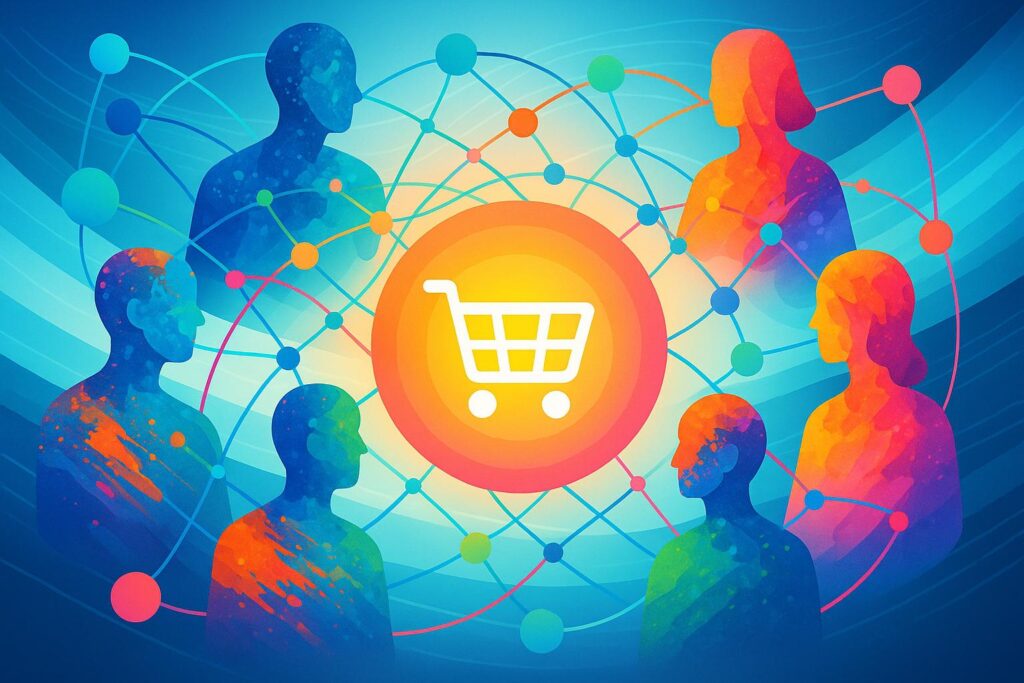
Collaborative filtering is a recommendation system that helps businesses increase sales by analyzing customer behavior. It identifies patterns in purchase history and browsing activity to suggest products customers are likely to buy. This approach accounts for 31% of e-commerce revenue, 35% of Amazon purchases, and 49% of unplanned buys, while boosting sales conversions by 10%-15%. Here’s why it works:
- Personalized recommendations: Matches customers with similar preferences to suggest relevant products.
- Two main types: User-based (finds similar customers) and item-based (finds related products).
- Scalable solutions: Handles large datasets effectively, improving recommendations as more data is collected.
- Matrix factorization: A technique that uncovers hidden patterns in sparse data, predicting upsell opportunities.
By integrating collaborative filtering into sales processes, businesses can offer tailored suggestions, improve customer experience, and increase average order value. Tools like post-purchase emails, product page suggestions, and cart recommendations make this strategy effective. Metrics such as AOV, upsell conversion rate, and CLV help track success.
Companies like Amazon and Netflix already see significant revenue contributions from these systems. For example, Netflix attributes 80% of viewer activity to its recommendation engine, while Amazon generates 35% of sales from similar tools. Collaborative filtering transforms how businesses approach upselling, making it a data-driven strategy to maximize revenue.
How Collaborative Filtering Works in Marketing
What Is Collaborative Filtering?
Collaborative filtering is a recommendation system technique that predicts what a user might enjoy based on the preferences and behaviors of others. Think of it as a digital version of asking friends for advice – but instead of people, the system identifies users with similar tastes and suggests products they’ve liked.
This method works by analyzing user interactions with items to uncover patterns of shared preferences. The idea is simple: if two users have shown similar preferences in the past, they’re likely to agree on future recommendations as well.
"Collaborative filtering is a technique for curating recommendations that maps the attributes of any given customer to those of many other similar customers and bases the recommendation on what products others have bought." – Negar Mokhtarnia 🚀, Growth, Product Management, Retention, Marketing Strategy
At its core, collaborative filtering relies on a user–item matrix and calculates similarities using vector space analysis. Amazon’s recommendation engine is a perfect example, analyzing customer data like purchase history and browsing behavior to deliver personalized suggestions.
Types of Collaborative Filtering
Collaborative filtering comes in two main flavors, each with its own approach to delivering recommendations.
- User-based collaborative filtering: This method identifies users with similar tastes and recommends items those users have liked but the target user hasn’t discovered yet. It assumes that people with shared preferences will continue to agree on new items. However, as the number of users grows, this method can struggle with sparse user-item interactions, reducing its effectiveness.
- Item-based collaborative filtering: Unlike the user-based approach, this one focuses on the relationships between items. It looks for items frequently liked together and suggests new ones based on the user’s past interactions. For instance, if you liked a specific book, this method might recommend others that share similar traits. Because there are usually fewer items than users, this approach is often more scalable and stable, especially when dealing with large datasets. Precomputed item-item matrices can also be reused, making it efficient.
Some systems use hybrid approaches, blending both user-based and item-based methods to strike a balance between accuracy and performance. Netflix, for example, employs such a strategy to cater to both niche interests and broader audience preferences.
These techniques form the backbone of strategies like recommending complementary products, which are essential for boosting upselling opportunities.
Why Collaborative Filtering Works for Upselling
Collaborative filtering is particularly effective for upselling because it identifies customers who are likely to purchase higher-value or additional products based on shared behaviors and purchase patterns. Unlike content-based systems that focus on item features, collaborative filtering can suggest items users might not have considered, opening up new possibilities.
This approach personalizes the shopping experience in a way that directly supports upselling strategies. The numbers speak for themselves: 91% of customers say they’re more likely to buy from brands that consistently offer relevant recommendations. Cross-selling efforts, powered by such systems, can achieve response rates 2 to 5 times higher than cold sales, with 30%-35% of e-commerce revenue coming from upsell and cross-sell strategies.
Collaborative filtering doesn’t just help users find new items – it enhances their overall shopping experience, even when there’s limited prior data on a customer. This can increase customer loyalty and drive revenue growth.
Real-world examples highlight its impact. In 2020, Spotify users streamed over 2.3 billion hours of their Discover Weekly playlists, which rely on collaborative filtering. Spotify analyzes listening habits, playlists, and streaming frequency, comparing this data with that of over 500 million users to create personalized playlists.
"The combined effect of personalization and recommendations save us more than $1B per year." – Carlos Gomez-Uribe and Neil Hunt, Netflix Product Executives
Marketers can integrate collaborative filtering into their strategies through tools like adaptive content recommendations, self-nurturing landing pages, and targeted exit-intent popups. This flexibility makes it a powerful tool for businesses aiming to maximize upselling opportunities at every customer interaction.
These successes also set the stage for advanced techniques like matrix factorization, which delve even deeper into customer behavior patterns.
Matrix Factorization: Finding Hidden Customer Patterns
What Is Matrix Factorization?
Matrix factorization is a method that breaks down customer interactions into smaller components, helping uncover hidden links between users and products. It’s a model-based collaborative filtering approach that simplifies the user–item interaction matrix into two smaller matrices. These matrices reveal latent features – the unseen factors that influence customer preferences and behavior.
Instead of analyzing countless individual transactions, matrix factorization represents users and items as vectors in a shared space. The dot product of these vectors estimates a user’s rating or preference. As Elie A., Lead Data Scientist at Kiliba, puts it:
"Think of latent features as hidden characteristics that influence user preferences and item attributes, like ‘quirkiness’ for movies or ‘trendiness’ for fashion items."
This method is particularly effective for sparse datasets, where customer interactions are limited. It can identify subtle preferences that traditional methods might miss. For example, in a movie recommendation system, matrix factorization might reveal that a user enjoys action films with intricate plots and strong female leads. Such insights are invaluable for crafting personalized upselling strategies, even with limited customer data.
How Matrix Factorization Drives Upselling
Matrix factorization takes collaborative filtering to the next level by refining customer insights and identifying upselling opportunities with precision. By analyzing customer ratings, reviews, demographics, and product attributes, it uncovers hidden preferences and patterns that help predict which customers are most likely to respond to specific upsell offers.
The results speak for themselves. Algorithm-driven recommendations are responsible for 35% of Amazon’s sales and influence 75% of the content streamed on Netflix. Back in 2012, Amazon’s collaborative filtering engine boosted sales by 29% in just one fiscal quarter.
This approach is especially effective at spotting customers ready for premium upgrades or complementary products. By identifying these hidden customer segments, companies can focus their efforts on targeted upsells, leading to higher conversion rates and increased average order values.
From a technical perspective, two key algorithms power matrix factorization: Alternating Least Squares (ALS) and Stochastic Gradient Descent (SGD). ALS alternates between optimizing the user and item matrices until they converge, while SGD updates the model incrementally, making it efficient for large datasets. These algorithms not only handle sparse data effectively but also scale better than memory-based collaborative filtering methods, enabling businesses to analyze millions of interactions with ease.
Success in leveraging matrix factorization often depends on integrating data from multiple sources. For instance, Netflix combines viewing history, search queries, interaction patterns, viewing times, device usage, and user ratings to build a detailed understanding of customer preferences. This comprehensive approach allows matrix factorization to uncover subtle patterns, leading to highly effective upselling recommendations.
Recommender Systems | ML-005 Lecture 16 | Stanford University | Andrew Ng

How to Set Up Collaborative Filtering for Upselling
To implement a collaborative filtering system for upselling, you’ll need to focus on three key areas: gathering quality data, building a strong model, and integrating recommendations seamlessly into your sales process. Here’s how to get started:
Collecting and Preparing Customer Data
The success of your collaborative filtering system hinges on the quality of your customer data. Start by gathering two types of information: direct feedback (like product ratings, reviews, and survey responses) and behavioral signals (such as browsing habits, time spent on products, cart additions, and purchase frequency). These insights come from customer interactions across all touchpoints.
At the core of this system is a user-item interaction matrix, where rows represent customers, columns represent products, and the cells reflect their interactions. Don’t worry if your matrix is sparse – this is common and doesn’t reduce the effectiveness of recommendations. For example, Instacart leverages purchase frequency data from millions of orders to power their recommendations.
Before diving into modeling, clean your dataset thoroughly. Remove duplicates, handle missing values, and normalize ratings for consistency. Address the cold start problem – which occurs when new customers or products lack interaction history – by incorporating additional data like demographics, product categories, or survey responses.
Enrich your data by adding details like seasonal trends, customer demographics, and product attributes. Once your data is clean and enriched, you’re ready to move on to building your recommendation model.
Building and Training Your Recommendation Model
The type of collaborative filtering you choose depends on your business needs and the nature of your data.
- User-based collaborative filtering works best when you have detailed customer profiles and want to identify similar users.
- Item-based collaborative filtering is ideal for rich product datasets, helping you recommend complementary items.
- Model-based approaches, like matrix factorization, are great for large datasets and can uncover hidden patterns in customer behavior.
Start by defining your upselling goals. Are you aiming to increase average order value, improve cross-sell rates, or boost customer lifetime value? Clear objectives will guide your choice of model and evaluation metrics.
Train your model using historical data, dividing it into training and testing sets to evaluate performance. Key metrics to monitor include:
- Precision: How many recommended items are actually purchased.
- Recall: How many relevant items your system identifies.
- Root Mean Squared Error (RMSE): How closely your predictions match actual outcomes.
For example, Spotify’s personalized recommendations led to a 20% increase in monthly active users in Q4 2022, adding 33 million new users.
To keep your system accurate and relevant, retrain your model regularly with fresh data. This ensures it adapts to shifting customer preferences, new product launches, and seasonal trends. Depending on your business’s pace, schedule retraining weekly or monthly. Once your model is ready, integrate its insights into your sales channels.
Adding Recommendations to Your Sales Process
Integrate upsell recommendations at moments when customers are most likely to act. For instance:
- Highlight complementary or upgraded products on product pages.
- Suggest frequently bought-together items in the shopping cart.
Post-purchase emails are another effective tool. After a customer completes a purchase, follow up with suggestions for accessories, related products, or premium versions. Timing is key – send accessory recommendations soon after the purchase, but wait a few weeks before suggesting replacements or upgrades.
Your website’s recommendation engine should update in real time as customers browse. This keeps suggestions relevant to their current session. Use A/B testing to fine-tune where and how recommendations appear, as well as the messaging and timing.
Context matters, too. For example, if a customer buys a camera, recommending lenses right away makes sense, but batteries or memory cards might be better suggested on a later visit. Thoughtful timing prevents recommendation fatigue and builds customer trust.
Finally, track how your recommendations perform across different touchpoints. Monitor metrics like click-through rates, conversion rates, and revenue from recommendations. Use these insights to refine your strategy and focus on the most effective channels.
sbb-itb-2ec70df
Tracking Results from Collaborative Filtering
Once you’ve launched a collaborative filtering system, it’s crucial to measure its impact on revenue and customer engagement. This helps you understand whether your upselling strategies are hitting the mark.
Key Metrics to Track
Start with metrics that reveal how personalized recommendations are influencing customer behavior:
- Average order value (AOV): This shows if tailored suggestions are encouraging customers to spend more per transaction.
- Upsell conversion rate: Tracks how often recommendations lead to additional purchases.
- Customer lifetime value (CLV): Offers insight into the long-term benefits of building stronger relationships with your customers.
By comparing these metrics before and after implementing collaborative filtering, you can gather actionable insights about your strategy’s effectiveness.
On the technical side, metrics like NDCG, MAP@K, and MRR are essential for evaluating the quality of ranked recommendations. These scores range from 0 to 1, with higher numbers indicating better performance.
Real-world examples highlight the importance of tracking these metrics. For instance, Bizim Toptan Markets saw impressive results after introducing collaborative filtering: a 26% boost in activity participation, a 49% jump in the average basket size, and an incredible 684% increase in turnover within six months. Similarly, a mid-sized healthcare retailer in India reported a 33.49% rise in average monthly revenue and a 32.79% increase in AOV.
These numbers set the stage for A/B testing, a key tool for refining your upselling strategy.
Testing Your Upselling Strategy
A/B testing is a powerful way to figure out which upselling tactics work best. By comparing a group that receives personalized recommendations to a control group that gets standard or random suggestions, you can eliminate guesswork and pinpoint what drives results.
Here’s how to get started:
- Run tests for two to four weeks: This helps account for seasonal shifts and ensures you gather enough data.
- Use large sample sizes: Aim for hundreds or thousands of customers per group to achieve statistically significant results.
- Test different scenarios: Experiment with where recommendations appear on product pages, the timing of follow-up emails, or the types of suggested products to discover what resonates most with your audience.
The potential payoff is huge. For example, news platforms using personalized recommendations have reported a 38% increase in clicks compared to generic systems. Keep an eye on metrics like click-through rates, conversion rates, and revenue per visitor to measure both immediate and long-term impacts.
Finally, document what works. Keeping a record of successful strategies – such as optimal timing or messaging – will be invaluable as you continue to refine and scale your collaborative filtering system.
Growth-onomics: Data-Driven Upselling Solutions
Growth-onomics leverages collaborative filtering and matrix factorization to craft upselling strategies that deliver measurable outcomes. By blending data analytics, customer journey mapping, and performance marketing, the agency creates well-rounded solutions aimed at driving revenue growth.
Their use of collaborative filtering is enhanced by advanced matrix factorization techniques, giving businesses a technical edge that leads to tangible improvements. For example, research from McKinsey highlights that personalized product recommendations can increase revenue by 40%, and nearly 75% of online retailers now rely on personalization to engage customers.
Growth-onomics strategically integrates personalized recommendations across various stages of the sales funnel. This approach has a profound impact: sessions without personalized engagement average an order value of $44.41, but a single personalized interaction can boost that value by an astonishing 369%.
The agency also emphasizes the importance of data quality and transparency. A notable 83% of customers are willing to share their data in exchange for relevant and tailored recommendations. By integrating collaborative filtering with existing marketing channels and tracking key performance metrics like Customer Acquisition Cost (CAC), Customer Lifetime Value (CLV), and churn rates, Growth-onomics ensures that every strategy is backed by actionable insights. It’s worth noting that companies like Amazon generate 35% of their revenue through upsells and cross-sells, while product recommendations typically account for 10–30% of revenue on e-commerce platforms.
To further enhance results, Growth-onomics advises combining recommendation systems with Product Information Management (PIM) systems to maintain accurate and reliable product data. This meticulous approach not only strengthens the effectiveness of collaborative filtering algorithms but also improves the overall customer experience.
Finally, Growth-onomics highlights the power of continuous A/B testing, which can lead to a 15%–45% improvement in conversion rates. By focusing on constant optimization, the agency ensures sustained growth and better performance for its clients.
Conclusion: Using Collaborative Filtering to Boost Upselling
Collaborative filtering and matrix factorization provide businesses with a way to elevate their upselling efforts and achieve tangible results. Companies that adopt effective cross-selling and upselling strategies can see sales rise by as much as 15%, with AI-driven recommendation engines delivering similar improvements in conversion rates. These numbers underscore the power of personalized recommendations in driving upselling success.
Take Netflix, for example: its recommendation engine accounts for 80% of viewer activity. Similarly, Amazon attributes 35% of its consumer purchases to algorithm-based product suggestions. These impressive outcomes are made possible by the detailed customer insights that matrix factorization uncovers.
Matrix factorization goes a step further by identifying subtle customer behaviors that traditional methods might miss. It’s particularly effective at handling sparse datasets, solving the cold start problem, and capturing individual user preferences. Plus, it can manage large-scale datasets with ease, making it a cornerstone of modern recommendation systems and their ability to drive upselling performance.
That said, execution is everything. Customers expect thoughtful, relevant recommendations, which means businesses must prioritize ethical AI practices and continuous improvement. Regularly auditing algorithms to prevent bias, training systems with diverse data, and respecting customer privacy are all essential. Over-personalization can backfire, so it’s critical to strike the right balance. Strong data integration and precise customer segmentation are key to putting these strategies into action.
For businesses ready to dive into collaborative filtering, the first step is ensuring high-quality data. Analyze customer behaviors, preferences, and purchase histories to build well-defined customer segments. From there, develop scalable recommendation systems that remain accurate and relevant as your business grows.
The long-term benefits are hard to ignore. Netflix, for instance, estimates that its personalization and recommendation systems save the company over $1 billion annually. These systems not only reduce customer acquisition costs but also enhance customer lifetime value. When executed properly, collaborative filtering transforms upselling from guesswork into a reliable, data-driven strategy that becomes more effective with every customer interaction.
FAQs
How is collaborative filtering more effective than content-based systems for upselling?
Collaborative filtering stands out when it comes to improving upselling strategies. By examining user behavior and spotting patterns across a broad customer base, it can deliver personalized recommendations. These suggestions often introduce users to products or services they might not have thought about, opening the door to new possibilities.
On the other hand, content-based systems take a different approach. They recommend items that are similar to what a user has already shown interest in. While this can be useful, it tends to stick closely to a user’s established preferences. This narrower focus might limit upselling potential, as it doesn’t encourage users to explore higher-value or complementary options.
What challenges do businesses face when using collaborative filtering for upselling, and how can they address them?
Businesses often face hurdles like the cold start problem, data sparsity, scalability issues, and popularity bias when using collaborative filtering for upselling. The cold start problem happens when there’s not enough data on new users or products, making it hard to generate recommendations. Data sparsity, on the other hand, limits the system’s effectiveness due to a lack of user interactions. As the amount of data increases, scalability issues can arise, straining the system’s performance. Additionally, popularity bias might lead to over-recommending well-known items, leaving niche products overlooked.
To address these issues, companies can turn to hybrid filtering methods, which blend collaborative filtering with other approaches like content-based filtering. Incorporating extra data sources, such as user demographics or browsing history, can further enhance the recommendation system. By fine-tuning algorithms for scalability, businesses can ensure seamless performance as their data grows, allowing them to deliver more personalized and impactful upselling opportunities.
How can businesses use collaborative filtering for upselling while maintaining ethical AI practices?
When leveraging collaborative filtering for upselling, it’s essential to prioritize customer privacy, respect boundaries in personalization, and maintain transparency about how recommendations are generated. Regular audits and clear policies on data usage can help ensure accountability and responsible AI practices.
It’s also important to adhere to data protection laws, ensuring customer information is managed with care. Taking these ethical steps not only strengthens trust but also enhances the overall customer experience, fostering loyalty and supporting sustainable growth.