

If you’ve got two proposals open right now, the price gap is probably the first thing finance asked about. Set it aside for a minute.
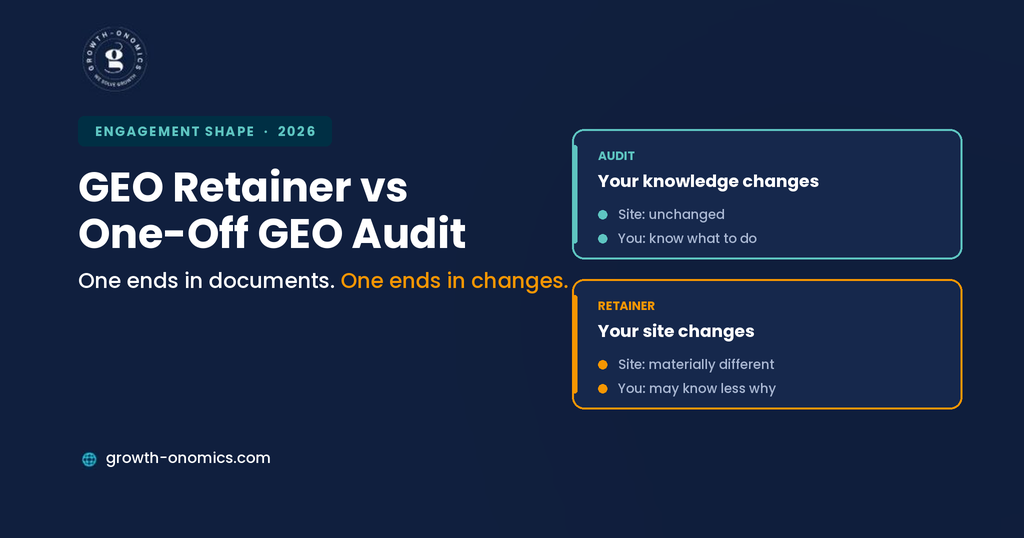
Better question: on the last day of each engagement, what’s changed? One answer is “we finally know where we stand and what to do about it.” The other is “eleven pages have been rewritten and our G2 profile now says what the product actually does.” Both are worth paying for. They’re worth paying for at different companies.
People buy the wrong one because proposals are written in nouns. Baseline, prompt set, citation analysis, roadmap. Nouns tell you what arrives. They don’t tell you what moves.
Table of Contents
- What Is the Actual Difference Between the Two?
- How Do They Compare Side by Side?
- What Do I Get in the Box With an Audit?
- What Do I Get in the Box With a Retainer?
- Why Do So Many Audits End Up Unused?
- What Do I Have to Supply Either Way?
- When Should I Buy an Audit?
- When Should I Buy a Retainer?
- What Should I Specify Before Signing an Audit?
- What Should I Specify Before Signing a Retainer?
- Conclusion
- FAQs
What Is the Actual Difference Between the Two?
One changes what you know. The other changes your site.
Both proposals will tell you what gets produced; neither tells you what gets changed, and that’s where the confusion lies.
An audit changes your knowledge. At the end, you know where you appear in AI answers, why, which sources are being cited instead of you, and what would need to happen to change that. Your site is exactly as it was on day one.
A retainer changes your site and your sources. At the end of a quarter, pages have been restructured, gaps have been filled, profiles have been updated, and threads have been corrected. You may know less about the theory than an audit would have taught you, and more has actually moved.
The trap is buying knowledge when you needed change, or paying monthly for change when what you lacked was direction.
Growth-onomics runs the diagnosis as a fixed engagement so that the decision gets made with evidence rather than at proposal stage; the audit tells you which of the two you need, which is a cheaper way to find out than committing to twelve months.
One clarification before the detail: this is not the pricing question in different clothing. A retainer can be scoped narrowly and an audit can be expensive. What separates them is whether the engagement ends with a document or a changed site.
How Do They Compare Side by Side?
| Dimension | One-Off Audit | Retainer |
| What you receive | Documents, data, a roadmap | Shipped changes and a running program |
| End state of your site | Unchanged | Materially different |
| Who executes | You | Mostly them, with your approvals |
| Your time commitment | A burst at start and finish | A steady drip throughout |
| Duration | Weeks | Quarters |
| Evidence of value | Something you can read on day one | A trend you wait for |
| Fails when | Nobody has capacity to act | Deliverables were never specified |
| Leaves behind | Knowledge and a plan | Assets, momentum, and dependency |
What Do I Get in the Box With an Audit?
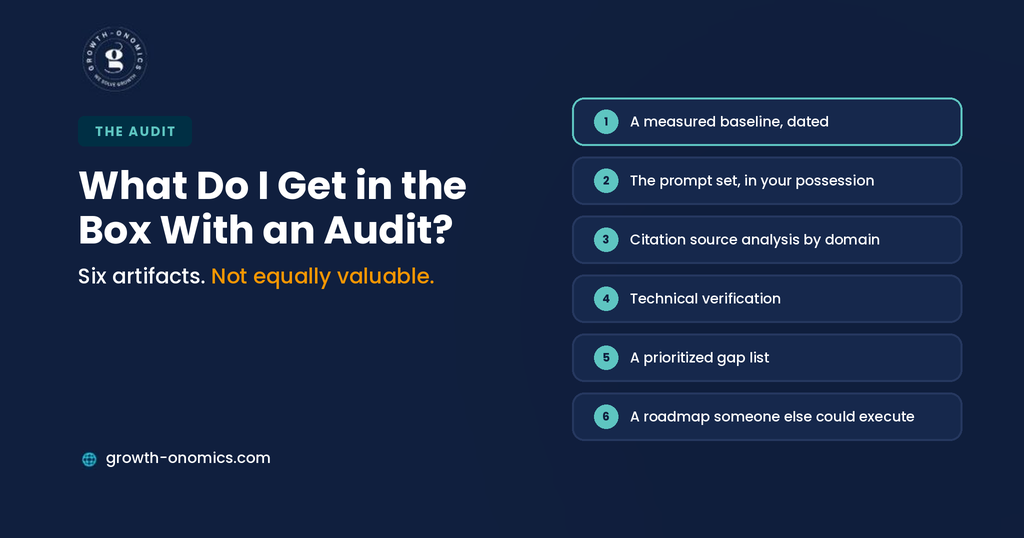
6 artifacts, and they are not equally valuable. Proposals list them flat, so it is worth knowing which ones you would fight to keep.
A measured baseline. Your visibility across a documented prompt set, per platform, on a stated date. This is the single most valuable thing an audit produces, because it cannot be recreated retrospectively, 6 months from now, there is no way to establish where you stood today, which makes it the one deliverable with a genuine expiry on its value.
The prompt set itself. 20 to 40 buying-stage questions built from how your buyers actually research. This should be yours to keep and re-run, and if it is not explicitly stated as a deliverable, ask.
Citation source analysis. Which domains answer your category’s questions today, classified into yours, shared, and independent. This is the diagnostic that turns a vague visibility complaint into a specific work list.
Technical verification. Whether machines can actually read your key pages like raw HTML, rendering, snippet eligibility, crawler access. This is the finding that invalidates everything else if it fails, which is why it belongs early.
A gap list with priority. Missing pages, stale profiles, uncorrected threads, structural problems, ranked by expected impact rather than by ease.
A roadmap you could hand to someone else. Specific enough that an internal team or a different agency could execute it without the author in the room.
What you do not get is any of it done. That is not a criticism; it is the definition.
The audit’s value sits entirely in the decisions it lets you make, which means its return is decided by your organization rather than by the agency that wrote it; an uncomfortable fact that both sides tend to leave unsaid at kickoff.
What Do I Get in the Box With a Retainer?
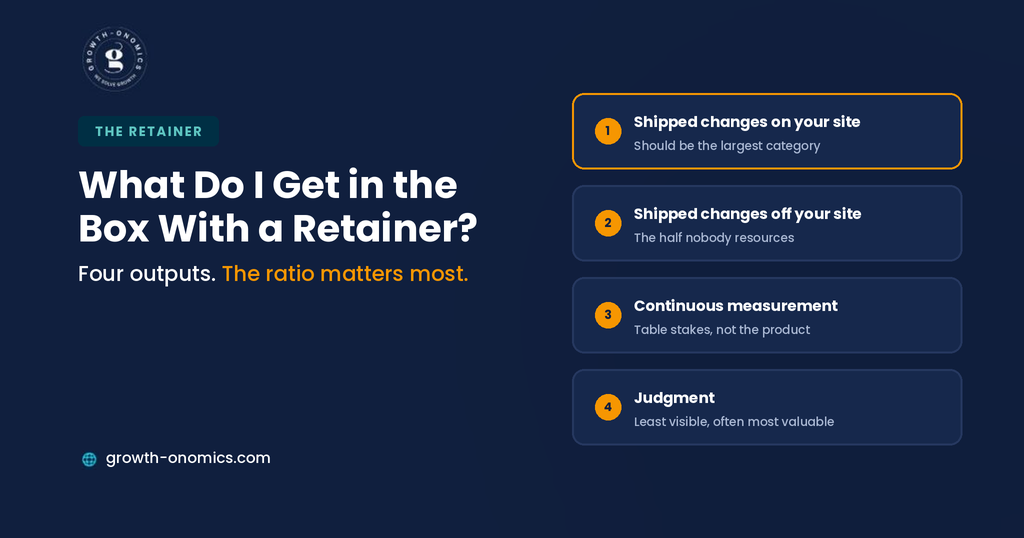
4 categories of output and the proportions between them tell you what you actually bought, regardless of what the proposal called it.
Shipped changes on your site. Pages restructured, gaps filled, schema implemented, technical issues fixed or specified for your engineers. This should be the largest category by some margin, and if it is not, you are buying a reporting subscription.
Shipped changes off your site. Review profiles updated, marketplace listings refreshed, community threads corrected, outreach conducted. This is the half most teams have never resourced and the half that moves evaluative questions.
Continuous measurement. The prompt set runs on schedule, per platform, with movement flagged. This is table stakes rather than the product.
Judgment. What the movement means, what to do next, what to stop doing. This is the least visible output and frequently the most valuable, because it is what an internal team cannot easily supply for itself.
What you do not automatically get is understanding. A retainer that ships work without explaining the reasoning leaves you dependent, which is comfortable while the relationship lasts and expensive when it ends. Ask for the thinking alongside the output, and for the working documents rather than just the summaries.
Why Do So Many Audits End Up Unused?
Because nobody scoped the handover. The audit gets specified in detail and the week after it arrives gets specified not at all, which is where the money quietly goes.
An audit ends with a document containing, typically, 12 to 20 recommendations. Some are content, some are technical, some are off-domain. They arrive with a marketing team that was already fully committed before the audit arrived.
Three things then determine whether anything happens. Whether a named person owns the roadmap rather than the team owning it collectively. Whether the technical items have an engineering commitment rather than a hope. And whether the off-domain items like review profiles, community threads, and outreach have an owner at all, since they usually sit outside every existing job description.
The most common outcome is partial execution. The easy content items get done, the technical items wait for a sprint that keeps slipping, and the off-domain items are never assigned to anyone. 6 months later, the visibility number has not moved, and the audit gets blamed for a diagnosis that was, in most cases, entirely correct.
The fix is to buy the audit when you have capacity not budget. These are different things and they rarely coincide. An audit delivered into a quarter with no slack is an expensive document. Delivered into a quarter where someone has been assigned to act on it, it is the cheapest intervention available.
If capacity genuinely does not exist and will not, that is a strong signal the constraint is execution rather than direction, which is the retainer case rather than the audit case.
What Do I Have to Supply Either Way?
More than either proposal will tell you, and the requirements differ enough between the two that the cheaper engagement is sometimes the more demanding one.
Both need product knowledge. Nobody outside your company knows what your product actually does, which limitations are legit, or what your buyers object to. This is unbuyable, and an agency that does not ask for it is producing content that reads like everyone else’s.
Both need access. Analytics, Search Console, the CMS, review platform admin. Provisioning delays are the most common cause of a slow start, and they are entirely avoidable.
An audit needs a burst. Kickoff, knowledge sessions, then a concentrated period of internal work when the recommendations land. If that burst has nowhere to go, the audit does not convert.
A retainer needs a drip. A regular call, ongoing approvals, someone available to unblock. Smaller per week and never stopping, and it needs a named owner rather than a rotating one, like programs where the internal contact changes every few months lose most of the context the retainer was accumulating.
Both need engineering time you do not control. Technical fixes sit with a team measured on product delivery rather than on marketing outcomes. Scope that dependency honestly at the start, because a program stalled waiting on a rendering fix is expensive under either model and blames the wrong party.
When Should I Buy an Audit?
When you can act but do not know what to act on. 4 conditions point this way, and if most of them hold, buy the audit and defer the retainer conversation entirely.
You have execution capacity but no direction. A content team shipping, a developer who responds, and no clarity about what to prioritize. The audit closes the only gap.
You are choosing between agencies. A well-scoped audit is the cheapest way to test judgment, communication, and output quality before committing to a longer relationship. Agencies confident in their work rarely object to this.
You need a baseline before anything else. Whatever you decide next, you cannot demonstrate improvement without a documented starting point. This argues for an audit early even if a retainer follows.
Leadership needs a diagnosis before approving spend. An audit produces something readable that supports a budget conversation. A retainer proposal at that stage is asking for commitment before evidence.
When Should I Buy a Retainer?
When you already know what needs doing and nobody has time to do it. 4 conditions, and they are the mirror image of the 4 above.
You already know the diagnosis and cannot act on it. You can name the missing pages, the stale profiles, and the uncorrected threads. Another document describing them changes nothing.
The work spans functions nobody owns together. GEO touches technical SEO, content, product marketing, and off-domain reputation. In most SaaS companies, those are staffed with four people, none accountable for the outcome. A retainer supplies the connective layer.
The compounding work has never started. Review generation cadence, community presence, outreach, content refreshes. These only produce results through repetition, and a project structure produces a burst followed by decay.
You need it faster than hiring allows. Building the capability internally takes a quarter to recruit and another to become productive, assuming the hire works out. A retainer buys time rather than avoiding the eventual hire, and framing it that way internally tends to make the budget conversation easier.
What Should I Specify Before Signing an Audit?
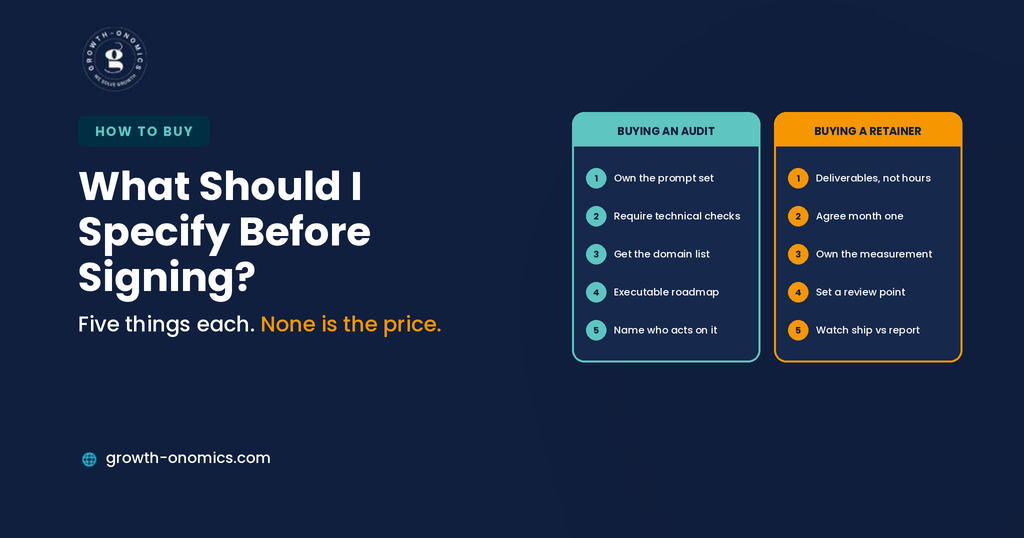
5 things, and none of them is the price. Get these into the scope and a mediocre audit becomes hard to deliver.
1. Insist the prompt set is yours. Documented, exportable, and re-runnable without the agency. This is the asset that makes every future measurement comparable.
2. Require technical verification, not just visibility scoring. An audit that reports a citation share without checking whether your pages render is measuring a symptom and skipping the cause.
3. Ask for citation source analysis by domain. Not summary but the actual list. That list is your work plan.
4. Require the roadmap to be executable by someone else. Specific enough that your team, or a different agency, could act on it without the author explaining it.
5. Agree who acts on it beforehand. Name the person, name the engineering commitment, and name an owner for the off-domain items. Don’t wait until the end of the project to do this, do it at the beginning.
What Should I Specify Before Signing a Retainer?
5 things again, and not one of them appears on the audit list. Different engagement, different failure modes, different protections.
Name deliverables instead of hours. Pages restructured, profiles updated, threads corrected, prompts tracked. “Ongoing support” is how a retainer becomes a monthly call.
Agree what month one looks like. No meaningful citation change will have occurred at 6 weeks, because none could have. Agree that in advance and both sides spend the early months working rather than defending.
Keep measurement in your accounts. The tool subscription, prompt sets, and historical data should survive a vendor change. It costs nothing to arrange at signing.
Set a review point with criteria. 3 or 6 months, with agreed standards for continuing. This gives the agency a fair window and gives you a decision that is a review rather than a cancellation.
Watch the ratio of shipping to reporting. If two consecutive months contain more dashboard review than delivered work, the relationship has changed shape. Growth-onomics reports shipped work alongside visibility movement for that reason; a report showing what moved without showing what was done is describing weather rather than work.
Conclusion
The honest summary is that an audit and a retainer are not competing products. One ends with you knowing what to do. The other ends with things having been done. Which you need depends on a question neither proposal asks: what happens the Monday after delivery.
If you have people who can act and no clarity about what to act on, buy the audit and buy it in a quarter when someone has capacity to execute it, because that is the variable that decides whether it converts. If you can already name the work and nobody has time to do it, an audit is an expensive restatement of a problem you have already diagnosed.
The sequence most mature programs land on is the obvious one and still worth stating: buy the diagnosis first at a fixed price, use it to decide what genuinely needs ongoing help, and retain only for the work that compounds. That costs less in total than either pure option, and it leaves you better informed at every decision point.
If you want a fixed-scope diagnosis that tells you honestly whether you need a retainer at all, Growth-onomics can run the audit and hand you a roadmap your own team could execute.
FAQs
What should a GEO audit include as a minimum?
6 things. A measured baseline on a documented prompt set, per platform, with a date. The prompt set itself, in your possession. Citation source analysis listing the actual domains being cited in your category. Technical verification of whether machines can read your key pages, including rendering and snippet eligibility. A prioritized gap list. And a roadmap specific enough that someone other than the author could execute it. An audit producing a visibility score and general recommendations has measured the problem without diagnosing it.
How long should a GEO audit take?
2 to 4 weeks for most B2B SaaS companies, and be cautious in both directions. Anything promising results in days is running a tool and formatting the output, which you could do yourself for the cost of a subscription. Anything taking 2 months is either scoping a retainer in disguise or blocked on access you have not provided. The bulk of the time goes into prompt-set construction, running it long enough to distinguish signal from variance, and the source analysis; the writing itself is the fast part.
Can we run the audit ourselves and skip that cost?
Partly, and it is a reasonable option for smaller teams. Manual prompt testing across platforms costs nothing but time, and a raw-HTML check on your key pages takes an afternoon. What is harder to self-supply is the comparative judgment of knowing whether your citation mix is normal for your category, which gaps matter commercially, and what usually works. A useful middle path is to run a rough baseline yourself first, then decide whether you need help interpreting it. You will be a much better-informed buyer either way.
Does a retainer include the audit?
Usually it should, as the first phase rather than a separate purchase, and it is worth asking explicitly. A retainer that begins executing without a documented baseline has no way to demonstrate what it changed, which hurts the agency as much as you. What to watch for is a retainer whose first two months are entirely diagnostic, since that is an audit being billed monthly. Ask what ships in month one, and expect a specific answer.
Should the same agency do both the audit and the retainer?
Often, but not automatically, the audit is the right moment to decide. An agency that produced a sharp diagnosis has already demonstrated judgment and absorbed your product context, which is worth investing against a cold start elsewhere. What should not happen is the audit functioning as a sales document like recommendations shaped by what the agency prefers to sell rather than what the evidence shows. The test is whether the roadmap is executable by someone else. If it is, the agency has earned the retainer honestly; if it only works with them in the room, that tells you something too.
What happens to the work if we end a retainer?
That depends entirely on what you negotiated at the start. Published pages and shipped fixes remain yours by default. What frequently does not is the prompt set, the historical measurement data, the tooling access, and the internal documentation such as briefs, source analyses, working notes. Specify at signing that all of it transfers, and keep measurement in accounts you own. Teams that skip this discover during offboarding that they have lost the ability to demonstrate a year of progress, which is an expensive thing to find out late.