

“AI search doesn’t work for enterprise software.”
You hear this from people who actually tried it, which is what makes it awkward to argue with. They ran a program, the visibility numbers moved, pipeline didn’t, and after three quarters they stopped.
The uncomfortable possibility is that they were right about the evidence and wrong about the conclusion. Nine-month cycles mean the deals an assistant influenced in February don’t close until November. Cancel in September, and you never find out either way.
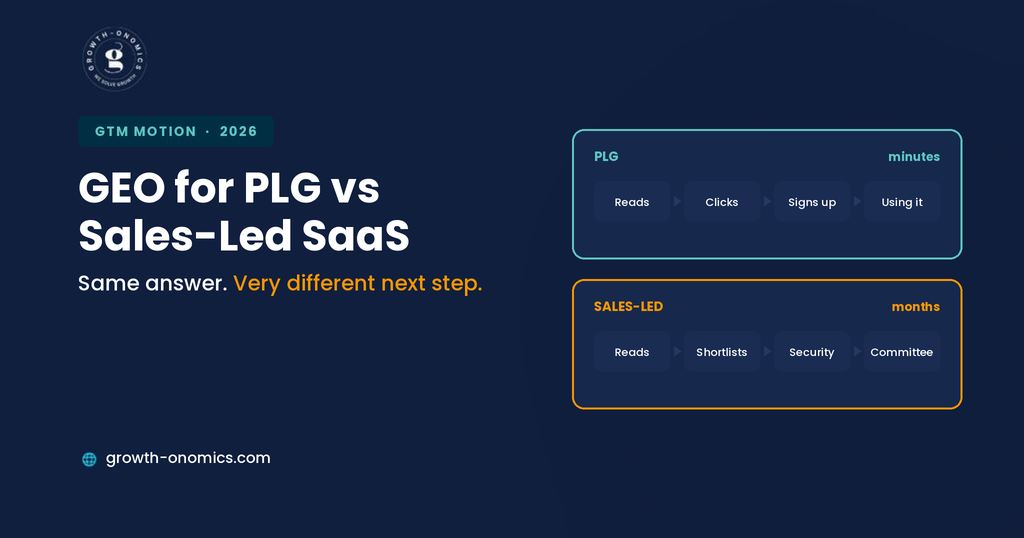
Product-led companies never hit this. Their buyer reads an answer and signs up the same afternoon, so a change in visibility appears in the product data almost immediately.
Same tactics on both sides. Wildly different evidence timeline, and it should change how the program gets built and what anyone agrees to measure before it starts.
Table of Contents
- Why Does the Buying Motion Change Anything?
- How Different Are They, Side by Side?
- Which Prompts Should I Track?
- Which Pages Should I Build First?
- Where Do My Buyers Actually Look?
- What Should I Be Measuring?
- What Stays the Same Either Way?
- What Does the PLG Playbook Look Like?
- What Does the Sales-Led Playbook Look Like?
- What If We Run Both Motions?
- What Should I Agree With Leadership Before Starting?
- Conclusion
- FAQs
Why Does the Buying Motion Change Anything?
Because 4 things about the purchase are different, and everything downstream inherits them.
Who asks the question. In PLG, the person asking an assistant is usually the person who will use the product and often the person who will pay. In an enterprise sale, the person asking may be a champion, an evaluator, a security reviewer, or someone doing background reading before a meeting; several different people asking different questions about the same purchase.
What happens after the answer. A PLG buyer can act immediately: read the recommendation, click, sign up, be using the product in minutes. An enterprise buyer adds you to a shortlist and does nothing observable for weeks.
How long the loop takes. PLG feedback arrives in days, which means a visibility change shows up in signups within a quarter. Enterprise feedback arrives in quarters, which means a program judged at 6 weeks is being judged on nothing.
What counts as a win. For PLG, the answer is activation. For sales-led, the answer is being on a shortlist which is invisible, unmeasurable directly, and the entire point.
Everything else follows from those 4. The prompts differ because the askers differ. The pages differ because the next step differs. The measurement differs because the loop length differs.
What does not follow is a different discipline. Both motions need pages machines can read, answers near the top, accurate facts, and third-party sources describing them correctly.
The shared foundation is still most of the work; the differences below decide where the remaining effort goes and, more importantly, what you agree to measure.
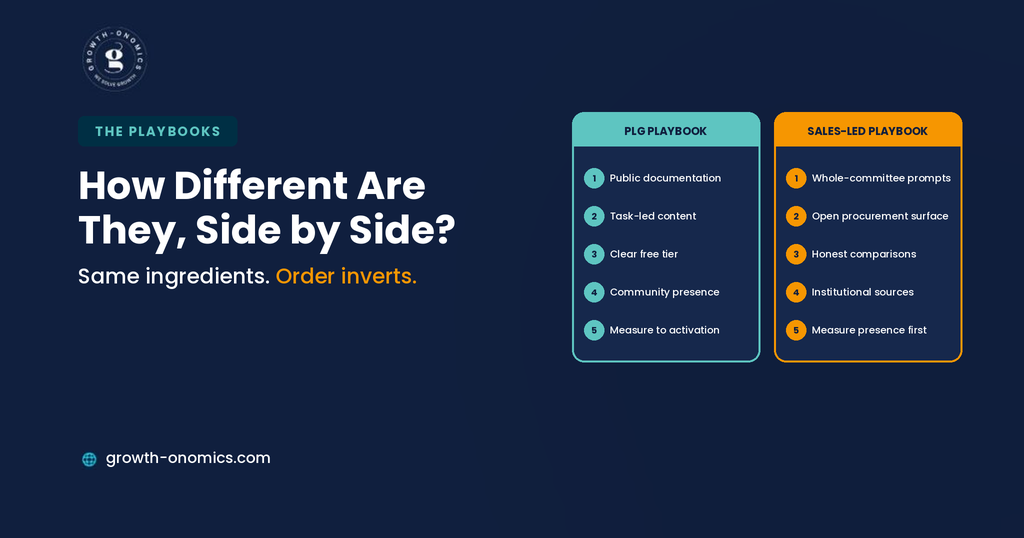
How Different Are They, Side by Side?
| Dimension | PLG | Sales-Led |
| Who asks | The end user, often the buyer | Champion, evaluator, security, finance |
| Prompt style | Task-specific, “how do I” | Category and vendor evaluation |
| Winning page types | Docs, free tier, integrations, use cases | Comparisons, security, ROI, implementation |
| Key third-party sources | Communities, developer forums, review sites | Analyst coverage, review platforms, roundups |
| Fastest signal | Signups from AI referrals | Citation presence on buying prompts |
| Realistic lag | Weeks | Quarters |
| Failure mode | Optimizing for evaluation nobody does | Measuring conversions that never happen |
Which Prompts Should I Track?
The ones your buyers ask, which sounds obvious until you see how differently the two groups phrase things. Get this wrong, and every number you report afterwards is measuring the wrong questions.
PLG prompt sets skew task-specific. Users ask how to do a thing, not which vendor to choose. “How do I sync Postgres to a warehouse,” “best way to schedule recurring reports,” “tool for tracking API errors.” The vendor recommendation is incidental to a task question, and the answer that wins is the one that solves the problem while happening to mention a product.
Sales-led prompt sets skew evaluative and multi-role. “Best enterprise platform for X,” “alternatives to [incumbent],” “is [vendor] SOC 2 compliant,” “how long does [category] implementation take.” These come from different people at different stages, and a prompt set covering only the champion’s questions misses the security reviewer entirely.
The overlap is smaller than teams assume. A prompt set built for one motion and applied to the other shows reasonable-looking numbers against questions your buyers never ask, which is worse than no measurement because it produces confidence in the wrong direction.
Growth-onomics builds the prompt set from the buying motion rather than from keyword data for exactly this reason; the questions a self-serve user asks an assistant and the questions a procurement committee asks are barely the same language, and averaging them produces a number that describes neither.
Which Pages Should I Build First?
Both motions need factual content. Which factual content, and in what order, differs sharply.
PLG rewards documentation disproportionately. Public docs, API references, quickstart guides, and integration pages get cited heavily for task-specific questions, and they double as the product experience. A developer arriving from an AI answer ends up in the docs and can use the product before ever seeing a marketing page. This makes documentation quality an acquisition metric rather than a support one.
PLG also rewards the free tier being legible. What is included, what the limits are, and when you have to pay. Assistants answer this constantly, and an unclear answer costs signups directly rather than costing a demo.
Sales-led rewards the procurement surface. Security documentation, compliance certifications, data residency, implementation timelines, and ROI framing. These answer the questions that stall deals, and they are asked by people the champion cannot answer for and often cannot predict.
Sales-led rewards comparison content more heavily. Enterprise buyers compare formally, often with a document, and comparison pages feed both the assistant and the internal justification.
The overlap is obvious; both need pricing clarity, both need integration pages, but the priority order inverts. A PLG company writing security whitepapers before fixing its docs has the sequence backwards, and so does an enterprise vendor optimizing its quickstart guide before publishing a SOC 2 summary.
Where Do My Buyers Look?
Somewhere other than your website, in both cases but not the same somewhere, and the difference decides where your off-domain effort goes.
PLG buyers live in practitioner communities. Reddit, Hacker News, Stack Overflow, developer Discords, and subject-specific forums. These are where “what do people actually use for X” gets answered, and they are cited heavily for task-oriented questions. Review platforms do matter, but rank below community presence.
Sales-led buyers rely on institutional sources. Analyst coverage, enterprise review platforms, industry publications, and formal roundups. A security reviewer researching a vendor is not reading Hacker News; they are checking whether the company appears in sources their organization already trusts.
Both need review profiles current, but for different reasons. In PLG, reviews signal whether the product actually works day to day. In enterprise, review volume and recency signal whether the company is established enough to be a safe choice, which is a question about the vendor rather than the software.
The practical consequence is that a PLG company’s off-domain effort concentrates on genuine community participation, which cannot be outsourced or automated without backfiring.
An enterprise vendor concentrates on analyst relations, review platform maintenance, and earning inclusion in the roundups procurement teams read.
What Should I Be Measuring?
Different things, and this is where most programs fail. The failure is symmetrical: one motion has a fast feedback loop and does not use it, the other does not have one and pretends it does.
PLG can measure outcomes directly. AI referral sessions to signups, activation rate by acquisition source, and time to first value. The loop is short enough that a visibility improvement shows up in product data within a quarter. This is a genuine advantage, and PLG companies should exploit it by treating AI referrals as a measurable acquisition channel rather than a brand exercise.
Sales-led cannot, and pretending otherwise destroys programs. The influence of an AI answer on a 9-month enterprise deal is evident and largely untrackable. Measuring it in conversions produces a number near zero for two quarters, which reads as failure and gets the program cancelled just before the pipeline it created starts closing.
Sales-led should measure presence and accuracy instead. Citation share on buying-stage prompts, whether the description is correct, whether competitors appear where you do not, and whether target-account traffic and branded search are moving. These are leading indicators; they move in weeks, and they are defensible.
Both should run self-reported attribution. A “how did you hear about us” field with an explicit AI assistant option catches the influence that leaves no trace, which matters more in enterprise but is useful in both.
What Stays the Same Either Way?
Most of it, which is worth knowing before you read two separate playbooks and assume they share nothing. 4 things are identical regardless of motion, and they account for the bulk of the work.
1. Technical readability. If your pages need JavaScript to render, most crawlers feeding AI answers never see them. This blocks both playbooks equally and invalidates everything downstream.
2. Answer-first structure. Passages get retrieved, instead of pages. A direct answer in the first two sentences beats a buried one for every question type in both motions.
3. Factual accuracy. Wrong pricing, deprecated features, or misstated integrations damage both, though differently; PLG loses a signup silently, enterprise loses credibility in an evaluation.
4. Entity consistency. Being described the same way across your site, profiles, and coverage helps every system place you correctly, whichever motion you run.
These 4 represent most of the available return. The differences that follow are existent, and they rest on top of the foundation rather than replacing it.
What Does the PLG Playbook Look Like?
Here are 5 priorities, ranked from most important to least.
Make documentation public and excellent. It is both your most-cited asset and your product onboarding. Gating it costs visibility and conversion simultaneously.
Answer task questions, not vendor questions. Build content around how to accomplish things, with your product as the mechanism rather than the subject. This is where PLG visibility is won.
Make the free tier unambiguous. Limits, included features, and the upgrade trigger, in crawlable text. Assistants answer this constantly and get it wrong when you are unclear.
Participate in communities honestly. Answer questions in the places your users already gather, with disclosure. This cannot be automated, and attempting to is reputationally expensive in exactly the communities that are relevant.
Measure to activation. AI referrals to signup to activation, by source, and compare the conversion rate against organic. You have a short feedback loop, which is a genuine advantage over enterprise programs; use it to justify the investment rather than reporting visibility scores.
What Does the Sales-Led Playbook Look Like?
5 priorities again, and only one of them overlaps with the list above.
Cover the whole committee’s questions. Champion, security, finance, and IT ask different things. A prompt set and content plan covering only the champion misses most of the evaluation.
Publish the procurement surface openly. Certifications, data residency, retention, sub-processors, and implementation timelines in crawlable text, not only inside a gated trust portal. A gated answer is no answer to an assistant.
Build comparison and alternatives content properly. Honest, dated, conceding where competitors are stronger. These feed both the assistant and the internal document your champion has to write.
Invest in institutional third-party presence. Analyst coverage, enterprise review platforms, and the roundups procurement teams really read. Slower than community participation and harder to shortcut, which is why it keeps adding up.
Measure presence, not conversions, for at least two quarters. Citation share, description accuracy, competitor comparison, target-account engagement, and branded search. Growth-onomics reports enterprise AEO against these leading indicators with influenced pipeline behind them, because a program judged on conversions inside a 9-month cycle will be cancelled before its first deal closes.
What If We Run Both Motions?
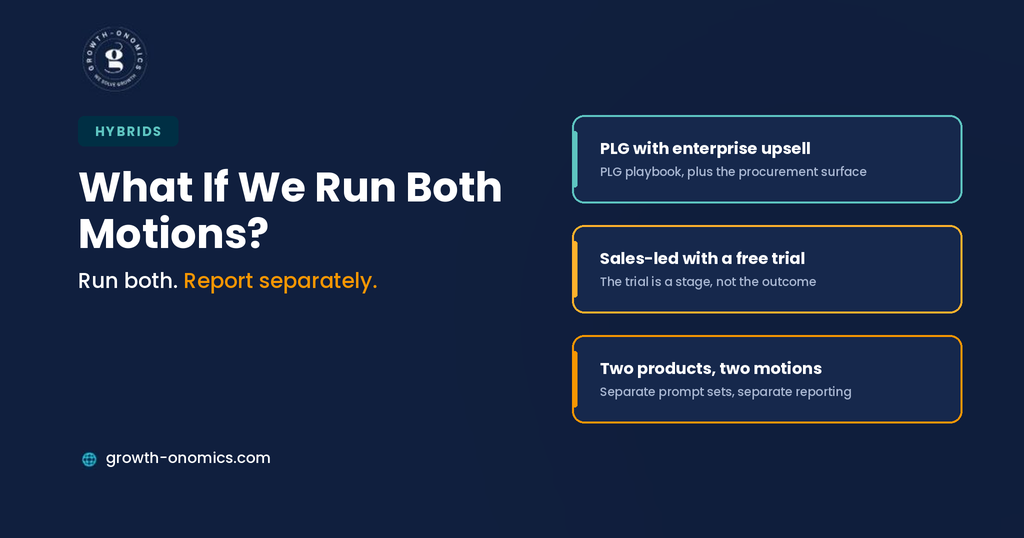
Then you run both playbooks and report them separately, which is less complicated than it sounds. There are 3 patterns that cover most companies.
PLG with an enterprise upsell. Self-serve acquisition feeding an enterprise sales motion. Run the PLG playbook for acquisition and add the procurement surface for the upsell conversation, since the security questions arrive later but still arrive.
Sales-led with a free trial. The trial is a sales tool rather than an acquisition channel. Do not measure it as PLG; the trial signup is a stage in a longer cycle, and treating it as the outcome produces the same misreading as counting form fills.
Two products, two motions. Some companies run a self-serve product and an enterprise platform in parallel. These need separate prompt sets and separate reporting, because blending them produces a visibility number that describes an average customer who does not exist.
The diagnostic question is straightforward: can the person asking the assistant become a customer without talking to anyone? If yes, PLG playbook. If no, sales-led.
If some can and some cannot, run both and report them separately.
What Should I Agree With Leadership Before Starting?
What the program will be judged on, and when. The most damaging failure in either playbook is a mismatch between what leadership expects and what the motion can deliver, and it costs exactly one conversation to prevent.
For PLG, agree that the number moves within a quarter.
Signups from AI referrals, activation rate by source, and the comparison against organic conversion. If those have not moved after two quarters of real work, something is wrong and the program deserves scrutiny. That is a fair contract.
For sales-led, agree that conversions are the wrong measure for at least two quarters.
Write down what will be reported instead: citation share on buying-stage prompts, description accuracy, competitor comparison, target-account engagement and get finance to acknowledge it before the first report. This is not a way of avoiding accountability; it is the difference between a program judged on evidence and one judged on a number that cannot exist yet.
For both, name what a disappointing outcome looks like. 6 months in, what result would mean this was not worth doing? Answering that at the start is the only way to evaluate the program honestly at the end, and it is the question most likely to reveal that the buyer and the payer expected different things.
Conclusion
The generic GEO playbook fails both motions in opposite directions. It under-invests in documentation and community for product-led companies, and it measures the wrong outcome for enterprise ones, then gets cancelled before the pipeline it built starts closing.
What actually differs comes down to 4 things: who asks the question, what they can do next, how long the loop takes, and therefore what you should measure. Everything else, like technical readability, answer-first structure, factual accuracy, and entity consistency is shared, and it is still most of the work.
The practical starting point is to write down your buying motion before your prompt set. Not the personas, the motion: can the person asking become a customer alone, or do they need four colleagues to agree? That answer determines which prompts to track, which pages to build first, which sources to invest in, and how long to wait before judging any of it.
If you want a prompt set and measurement framework built around your actual motion rather than a generic template, Growth-onomics can scope it against how your buyers really move.
FAQs
Does GEO work for enterprise SaaS with long sales cycles?
Yes, but it must be measured differently, or it will be cancelled prematurely. The influence of an AI answer on a 9-month deal is real and largely untrackable; a security reviewer forming an impression in month two leaves no attributable trace. Measuring that in conversions produces a number near zero for two quarters, which reads as failure. Measure citation presence on buying-stage prompts, description accuracy, competitor comparison, target-account traffic, and branded search instead. Those move in weeks; they are defensible, and they precede the pipeline rather than lagging it.
Should PLG companies gate their documentation?
No, and the cost is double. Public documentation is among the most heavily cited assets for task-specific questions, so gating it removes you from the answers where PLG visibility is actually won. It also blocks the acquisition path, since a developer arriving from an AI answer expects to land in docs and start building rather than hitting a form. If parts must stay private for security or contractual reasons, publish a public overview describing what exists. The instinct to gate documentation to protect competitive information usually costs more than it protects.
How do I build a prompt set for a buying committee?
Segment by role before writing anything. The champion asks category and comparison questions. Security asks about certifications, data residency, and sub-processors. Finance asks about pricing structure and total cost. IT asks about integrations, deployment, and support. Build a section per role, tag each prompt accordingly, and report coverage by role rather than as a single number. The most common gap is a prompt set covering only the champion’s questions, which produces healthy-looking visibility while the reviewer who can veto the deal finds nothing about you.
Which motion sees results from GEO faster?
PLG, by a wide margin, and the reason is structural rather than about effort. A product-led buyer can read a recommendation and sign up minutes later, so a visibility improvement shows up in product data within a quarter. Enterprise influence accumulates invisibly through a cycle measured in quarters. That difference should set expectations at the start of a program, not be discovered in month four and it is the single most useful thing to agree with leadership before the first report.
What if our buyers use AI but our category does not show up in answers yet?
That is a category timing question rather than a motion question, and it is worth diagnosing before spending. Run your main unbranded buying question and see whether the assistant produces a vendor list at all. If it answers with general education and no products, the category is not yet being resolved into recommendations, and the useful move is a cheap baseline plus a quarterly recheck rather than a full program. If competitors appear and you do not, the category is ready and the gap is yours.
Can one prompt set cover both motions?
Only if you segment it and report the halves separately. Task-specific questions from self-serve users and evaluative questions from procurement committees are barely the same language, so blending them produces an average that describes neither audience. If you run both motions, tag every prompt by motion, report two visibility numbers, and resist the temptation to combine them for a cleaner slide. The combined number will always look more stable than either half, which is exactly why it hides the movement you need to see.
