


Generating high-quality Forex leads is challenging due to the complexity of the market, high competition, and strict advertising regulations. To succeed, brokers must focus on targeted strategies that attract serious traders who complete KYC, make deposits, and actively trade. Here’s what works:
- Understand the Forex Funnel: Leads move through stages – Awareness, Consideration, and Conversion. Each step requires tailored messaging to build trust and reduce friction.
- Segmentation: Group leads by experience, device preferences, and location. Beginners need educational content, while experienced traders value advanced tools and insights.
- Paid Ads: Use platforms like Google for high-intent searches, LinkedIn for professional traders, and niche networks like Blockchain-Ads for finance-specific audiences.
- Educational Content: Webinars, e-books, and strategy guides establish credibility and nurture leads.
- Email Campaigns: Personalized, automated sequences guide leads from registration to deposits.
- Key Metrics: Track Cost per Qualified Lead (CPQL), Cost per First-Time Deposit (FTD), and retention rates to measure success.
The Forex Lead Generation Funnel Explained
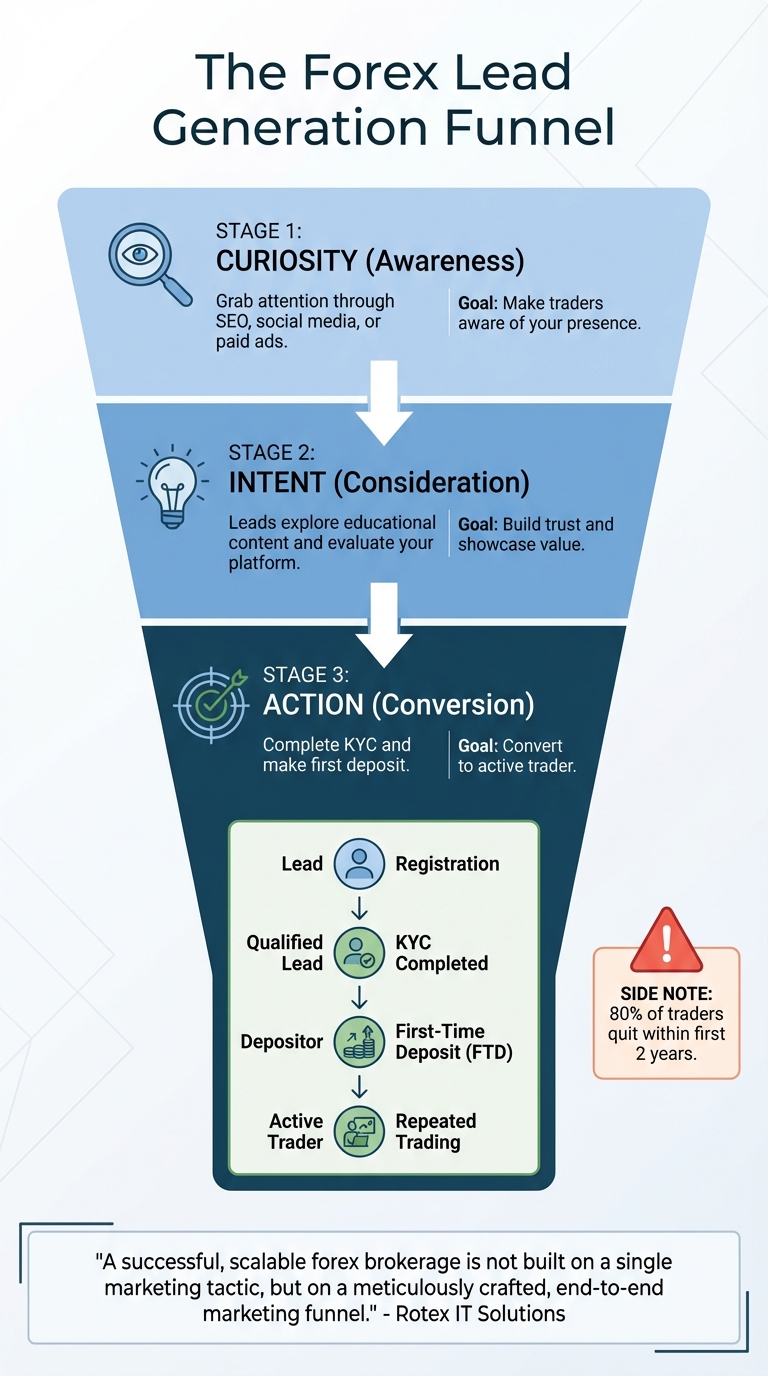
Forex Lead Generation Funnel: From Awareness to Active Trader
Understanding how traders move from initial curiosity to making a deposit requires a structured approach. The Forex lead generation funnel isn’t a straightforward path. Instead, it mirrors the mental and technical journey of someone deciding whether to take the plunge and trade with real money. This journey naturally splits into clear stages.
3 Stages of the Forex Funnel
The Forex funnel can be broken into three key stages, each requiring its own approach and messaging.
Curiosity (Awareness) is the first step. At this stage, your goal is to grab attention through SEO, social media, or paid ads. Potential traders here might not even be actively looking for a broker. The focus is simply on making them aware of your presence.
Intent (Consideration) is where interest starts to take shape. Leads begin exploring educational content and evaluating whether your platform meets their needs. This stage is all about building trust and showcasing your value – without coming across as pushy.
Action (Conversion) is the final stage. Here, a lead completes their KYC verification and makes their first deposit (FTD). The progression looks like this: Lead (registration) → Qualified Lead (KYC completed) → Depositor (FTD) → Active Trader (engaged in repeated trading). Each step requires precision. Any friction during onboarding can derail the process, so creating a smooth experience is critical.
"A successful, scalable forex brokerage is not built on a single marketing tactic, but on a meticulously crafted, end-to-end marketing funnel." – Rotex IT Solutions
Why Broad Marketing Strategies Don’t Work for Forex
Broad marketing tactics are a budget drain in the Forex world. The cost per lead in Forex is notoriously high, often surpassing that of other financial sectors. Combine this with the fact that 80% of traders quit within their first two years, and it’s clear that maintaining an active trader base demands a steady flow of high-quality leads.
Strict advertising rules make broad campaigns even less effective. Additionally, traders often hop between platforms, chasing short-term bonuses. Without targeted nurturing, building loyalty becomes nearly impossible.
"The cost per lead in forex marketing is notoriously high, often exceeding that of other financial sectors." – Devexperts
How to Segment Your Forex Trader Audience
Segmentation is what separates effective campaigns from wasted efforts. One of the best ways to segment your audience is by experience level. Beginners are drawn to educational content, such as "how-to" guides and demo accounts. On the other hand, experienced traders are more likely to engage with daily market updates and in-depth technical analysis. Sending irrelevant messages to the wrong group can quickly erode trust.
Device and location also play a huge role. In regions like LATAM and APAC, mobile-first usage dominates, while traders in the EU and UK still prefer desktop platforms. A clunky mobile onboarding process can cost you a significant number of leads in these high-growth markets. Geographic segmentation allows for more than just translating content – it means tailoring creatives to fit regional norms and payment preferences.
Between 2024 and 2025, major brokers like FXTM and Alpari leveraged Blockchain-Ads to target high-intent traders. By shifting away from generic social media campaigns and focusing on pre-built segments of active multi-asset investors, these firms achieved impressive returns on mid-five-figure budgets. This highlights the impact of precise targeting.
Proven Strategies to Generate Forex Leads
Use Paid Ads on High-Traffic Platforms
Paid ads are one of the fastest ways to connect with potential traders, but choosing the right platform makes all the difference. Google Ads is ideal for high-intent searches like "forex trading platform" or "forex demo account". Tools like Performance Max and Demand Gen can expand your reach across YouTube, Gmail, and Maps in a single campaign. Adding lead form extensions directly to your ads simplifies the process for users to share their information without leaving the platform.
Platforms like Facebook and Instagram work well for interest-based targeting (e.g., "technical analysis"), while TikTok is great for delivering quick, engaging market insights. For attracting high-net-worth individuals and institutional traders, LinkedIn stands out by leveraging thought leadership and professional networking.
"LinkedIn is a goldmine for attracting serious traders and institutional clients." – Itsrotex
Niche finance networks, such as Blockchain-Ads and PropellerAds, offer a way to bypass the broader reach of social platforms by focusing on finance-specific audiences. In 2025, FXTM and Alpari showcased the effectiveness of Blockchain-Ads by targeting users across 10,000+ finance-related websites. These campaigns used pre-built audiences of over 420 million finance users and blockchain-verified attribution to track first-time deposits, achieving a return on ad spend (ROAS) between 4.9x and 5.1x with mid-five-figure budgets.
Retargeting also plays a crucial role since over 90% of visitors don’t convert on their first visit. Offering incentives like a first-deposit bonus or free strategy session can re-engage these users. Optimizing campaigns for specific events, such as "KYC completed" or "funded trader", further improves conversion rates.
| Platform Type | Best For | Key Strategy |
|---|---|---|
| Search (Google/Bing) | High-Intent Leads | Target keywords like "forex broker review" |
| Social (Meta/TikTok) | Engagement & Volume | Custom interest targeting and visual storytelling |
| Professional (LinkedIn) | High-Net-Worth | Thought leadership and institutional outreach |
| Niche (Blockchain-Ads) | Verified Traders | Target users on 10,000+ finance sites |
| Push/Pop (PropellerAds) | Re-engagement | Push notifications for timely market updates |
Once you’ve captured attention with ads, the next step is to establish credibility through educational content.
Build Trust with Educational Content
Generating leads is just the beginning – building trust turns those leads into long-term clients. Educational content is a powerful way to establish credibility, especially with serious traders. To stand out, you need to go beyond basic information. Covering topics like advanced price action strategies, algorithmic trading (MQL4), and key economic indicators such as GDP can position you as an authority.
Webinars are particularly effective for building trust. In fact, 73% of B2B marketers consider webinars the best tool for generating high-quality leads. Hosting live trading sessions or Q&A webinars showcases real-time expertise and provides valuable social proof. These events also help qualify leads – attendees are more likely to convert compared to those consuming passive content.
"Content is no longer just a marketing tool, it’s the foundation of your authority." – Rotex
Lead magnets like e-books (e.g., "10 Forex Strategies for Consistent Gains") and whitepapers can also attract email subscribers. Addressing common pain points, such as "Risk Management for Volatile Markets" or "Overcoming Trading Psychology Biases", resonates with traders. Using official data from sources like the U.S. Bureau of Economic Analysis adds credibility to your content.
Tailor your content to different audience segments. Beginner traders often respond well to "how-to" guides and learning portals, while experienced traders prefer advanced strategy newsletters and daily market updates. Since 80% of traders quit within their first two years, providing ongoing educational support can also improve retention.
Once trust is built, segmented email campaigns can help convert these leads into active traders.
Convert Leads with Segmented Email Campaigns
After earning trust, segmented email campaigns are the next step to turn leads into active traders. Email marketing delivers one of the highest returns on investment in Forex, but its success hinges on personalization. Segmented campaigns can generate up to 760% more revenue than generic ones.
The most effective campaigns use nurture sequences to guide leads through critical milestones, such as completing KYC (Know Your Customer) and making their First-Time Deposit (FTD). Each email should provide value – whether it’s market updates, educational resources, or exclusive insights – rather than just pushing for a sale.
Automation is key here. By integrating your CRM with advertising platforms like Google and Facebook using tools like Zapier, you can track the entire lead-to-sale journey. This setup enables you to trigger specific email sequences based on user behavior. For example, if a lead registers but doesn’t complete KYC, they can receive a targeted sequence addressing common verification concerns.
Timing is everything. On average, consumers engage with 5.5 online touchpoints before filling out a lead form. Your email sequences should provide multiple touchpoints without overwhelming the recipient. Use A/B testing to experiment with different send times, subject lines, and content formats to see what resonates best with each segment.
sbb-itb-2ec70df
Tools and Analytics for Improving Lead Quality
After discussing lead generation strategies, the next step is to measure and refine lead quality to ensure your efforts translate into real results.
Key Metrics to Track for Forex Leads
To turn quality leads into active traders, certain metrics are crucial to monitor. Cost per Qualified Lead (CPQL), for instance, tracks how much you’re spending on leads that show genuine interest – like starting the KYC process – rather than just collecting signups that may never convert. Similarly, Cost per FTD (First Time Deposit) measures the cost of acquiring a trader who generates revenue, while the FTD/Lead Ratio highlights the percentage of leads that become paying customers.
Another critical metric is Customer Lifetime Value (CLV), which determines how much you can reasonably invest in acquiring a new customer. Paired with the Payback Period (calculated as LTV divided by CAC), it helps you assess whether your acquisition strategy will pay off in the long run. Don’t overlook Retention Rate, which measures how well you’re keeping customers engaged over time.
"You only create real value once a lead actually deposits, so everything starting from your traffic sources and targeting to your creatives and tracking, should be geared toward getting them to that point." – PropellerAds
Track Leads with CRM Tools
A Forex-specific CRM can make tracking and managing leads much simpler. Platforms like UpTrader, Fx Office, and Guava are tailored for brokers, offering features like lead profiling, automated onboarding, and advanced analytics. AI-powered tools such as Leverate‘s CRM go a step further by automating personalized messaging, ensuring prospects receive the right communication at the right time.
Integration is a game-changer. For example, linking your CRM to Google Ads using Enhanced Conversions for Leads or Google Ads Data Manager allows you to feed conversion data directly into your campaigns. This creates a feedback loop, helping ad platforms identify which traffic sources deliver the most valuable traders. According to data, advertisers using Enhanced Conversions report a 10% increase in conversions compared to those relying on standard imports. Regularly uploading conversion data – ideally daily – keeps bidding algorithms sharp and up-to-date.
Once you have a reliable tracking system in place, the next step is to refine campaign performance through A/B testing.
Optimize Campaigns with A/B Testing
A/B testing is an effective way to identify what works best. Instead of focusing on surface-level metrics like clicks, prioritize key actions such as KYC completion and FTDs. Test different landing page styles – ranging from minimalist designs to content-rich layouts – and experiment with the structure of your lead forms. Adding a couple of qualifying questions may lower the total number of leads but can significantly improve the quality of those who move forward.
Aim to elevate your ad strength to "Excellent", as this can boost conversions by 6%. To keep performance optimized, rotate creative assets every six weeks, allowing AI models to adapt and improve. For retargeting efforts, try different offers – like a free strategy session or a deposit bonus – to re-engage the 90% of visitors who don’t convert on their first visit.
Conclusion: Building a Scalable Forex Lead Generation System
Generating qualified Forex leads requires creating a well-connected system where different strategies work together. Educational content, paid advertising, and automation should complement each other to guide leads through the funnel. By 2025, the brokers seeing the most success won’t depend on isolated tactics. Instead, they’ll combine search ads, push notifications, social media campaigns, and educational webinars to engage traders at every stage of their journey. This multi-channel approach ensures a smooth transition from awareness to conversion.
Pay attention to key performance metrics like Cost per KYC, Cost per FTD, and the FTD/Lead Ratio. These numbers reveal where your funnel is performing well and where you’re spending on low-intent traffic. To refine your efforts, adopt value-based bidding, which prioritizes high-intent traders over sheer lead volume. By focusing on these metrics, you can shift your campaigns toward attracting quality leads rather than just increasing numbers. From there, keep fine-tuning each stage of your funnel for better results.
Consistent optimization is the key to success. Use segmentation to tailor your messaging based on a trader’s experience level. Add pre-landers or quizzes to filter out unqualified prospects before they even reach your registration form. Implement lead verification tools to block bots and fraudulent signups. Integrate your CRM with real-time data to analyze traffic sources effectively and make informed adjustments.
"In 2025, the most successful Forex businesses will not rely on a single, isolated forex lead generation strategy. They will build a cohesive ecosystem where content marketing feeds social media engagement, paid ads amplify your reach, and live events provide the final push for conversion." – Rotex
This quote emphasizes the importance of combining multiple channels into a unified strategy for maximum impact.
Automation and integration are essential for scaling your campaigns. Set up drip campaigns that trigger immediately after lead capture to guide prospects from KYC to their first deposit. Keep a close eye on your Payback Period (calculated by dividing LTV by CAC) to ensure your acquisition strategy remains profitable. With the automated trading market expected to hit $24 billion by 2025, brokers that focus on personalized service and expert guidance will stand out in an increasingly competitive environment.
FAQs
What are the main stages of a successful Forex lead generation process?
The process of generating Forex leads can be broken down into five essential stages:
- Awareness: This is where it all starts – getting on the radar of potential traders. Whether through targeted ads, SEO-driven content, webinars, or events, the goal is to spark interest and make your brokerage visible.
- Capture: Once you’ve caught their attention, the next step is to gather their information. Optimized landing pages, paired with clear calls-to-action, can help you collect contact details or encourage traders to sign up for demos.
- Qualification: Not every lead is the same, so it’s crucial to assess their potential. Factors like trading experience, deposit capacity, and engagement levels can help you determine which leads are worth pursuing. Tailored email campaigns or educational materials can help build trust during this stage.
- Conversion: Now it’s time to turn qualified leads into active traders. Offering perks like bonus credits or quick account approvals can make the transition from lead to customer much smoother.
- Retention: The work doesn’t stop after conversion. Keeping traders engaged is key to long-term success. Ongoing education, loyalty programs, and excellent customer support can help ensure traders stick around and even refer others.
By mastering these stages, Forex brokers can not only attract and convert leads but also build strong, lasting relationships that drive consistent growth.
How does audience segmentation improve Forex lead generation?
Segmentation is a powerful way to fine-tune your Forex lead generation efforts. By breaking your audience into specific groups – such as beginners versus seasoned traders, geographic locations, or preferred trading platforms – you can craft messaging and campaigns that speak directly to their unique needs. This makes your content more relevant and helps you connect on a deeper level, driving engagement.
Once you’ve identified these segments, you can focus your resources on the most effective channels for each group and adjust your strategy based on performance data. For instance, for beginners, you might highlight educational content like Forex basics or promote demo accounts to help them get started. On the other hand, experienced traders may respond better to advanced webinars or exclusive tools designed to enhance their trading. This kind of targeted approach not only boosts lead quality but also increases the chances of turning prospects into loyal, high-value clients.
Why is creating educational content important for building trust with Forex leads?
Educational content plays a key role in earning trust among Forex leads. It establishes your brand as a reliable and knowledgeable authority in a space often clouded by scams and misinformation. By offering expert insights, tutorials, or market analyses, you empower potential traders to make well-informed decisions.
Sharing meaningful content does more than just reassure skeptical traders – it shows that you truly understand their struggles and aspirations. This approach not only builds trust but also strengthens long-term relationships, which can lead to better-quality leads and improved conversion rates.