


Dynamic segmentation is a game-changer for businesses looking to optimize customer engagement. Unlike static lists, it uses real-time data to group customers based on current behaviors like purchase history, email activity, and browsing habits. This allows businesses to:
- Update customer categories instantly (e.g., "new user" to "VIP").
- Focus on high-value customers using metrics like Customer Lifetime Value (CLV) and RFM scores.
- Improve marketing ROI with tailored, timely campaigns.
For example, companies like Netflix and Spotify use dynamic segmentation to keep users engaged, while brands like Blacklane and Floward have seen conversions rise by over 190% and customer engagement improve significantly by using this approach. By automating updates and leveraging AI, businesses can act on customer intent in real time, boosting retention, sales, and overall satisfaction.
Whether you’re targeting "Champions" with exclusive perks or re-engaging "At-Risk" customers with win-back offers, dynamic segmentation ensures your marketing efforts are always relevant and effective.
Benefits of Dynamic Segmentation for Marketing
Dynamic segmentation changes the way businesses connect with customers by moving away from static data and embracing real-time insights. This approach enables sharper personalization, smarter spending, and the ability to quickly adapt to evolving customer behaviors. These strengths pave the way for more targeted marketing, improved ROI, and faster, more effective adjustments.
Better Personalization
Today’s consumers expect experiences tailored to their preferences. Dynamic segmentation makes this possible by leveraging real-time data – such as browsing habits, purchase history, and email engagement – to instantly update customer groups. For instance, a customer categorized as "active" one week might shift to "at risk" the next, prompting timely, relevant outreach.
Companies like Netflix and Spotify excel at this. They use real-time behavior to segment users dynamically, keeping engagement levels high and encouraging consistent content consumption.
Higher Return on Investment (ROI)
Dynamic segmentation ensures marketing budgets are spent wisely by focusing on the right customers at the right time. For example, a European telecom used real-time machine learning to send targeted SMS messages, resulting in a 10% boost in engagement.
The financial upsides are clear. Personalized marketing can increase conversion rates by over 200% compared to generic campaigns. Additionally, targeted promotions can drive a 1% to 2% lift in sales and improve profit margins by 1% to 3%. As one strategist aptly put it:
"Let AI predict ‘who’ and ‘when,’ while your team defines ‘why,’ ‘what,’ and ‘how.’"
Real-Time Adjustments
Customer intent can change in an instant, and opportunities to act on it are often short-lived. Take an abandoned cart, for example – addressing it quickly can mean the difference between a recovered sale and a lost one. Dynamic segmentation updates customer data within minutes, enabling swift reactions. If a customer shows high-intent behavior over a short period, the system can immediately respond with tailored offers or outreach.
This level of responsiveness pays off. Research shows that 80% of consumers are more likely to complete a purchase when they receive personalized interactions. Segmented campaigns also perform better overall, achieving 30% higher open rates and 50% higher click-through rates compared to non-segmented efforts. Plus, automation eliminates the time-consuming task of manually building lists. As Matt Schlicht, CEO of Octane AI, puts it:
"The brands that will thrive in the coming years will be the ones that have a strategy for understanding their customers at the individual level and creating personalized experiences based on that understanding."
Key Metrics for Customer Value Segmentation
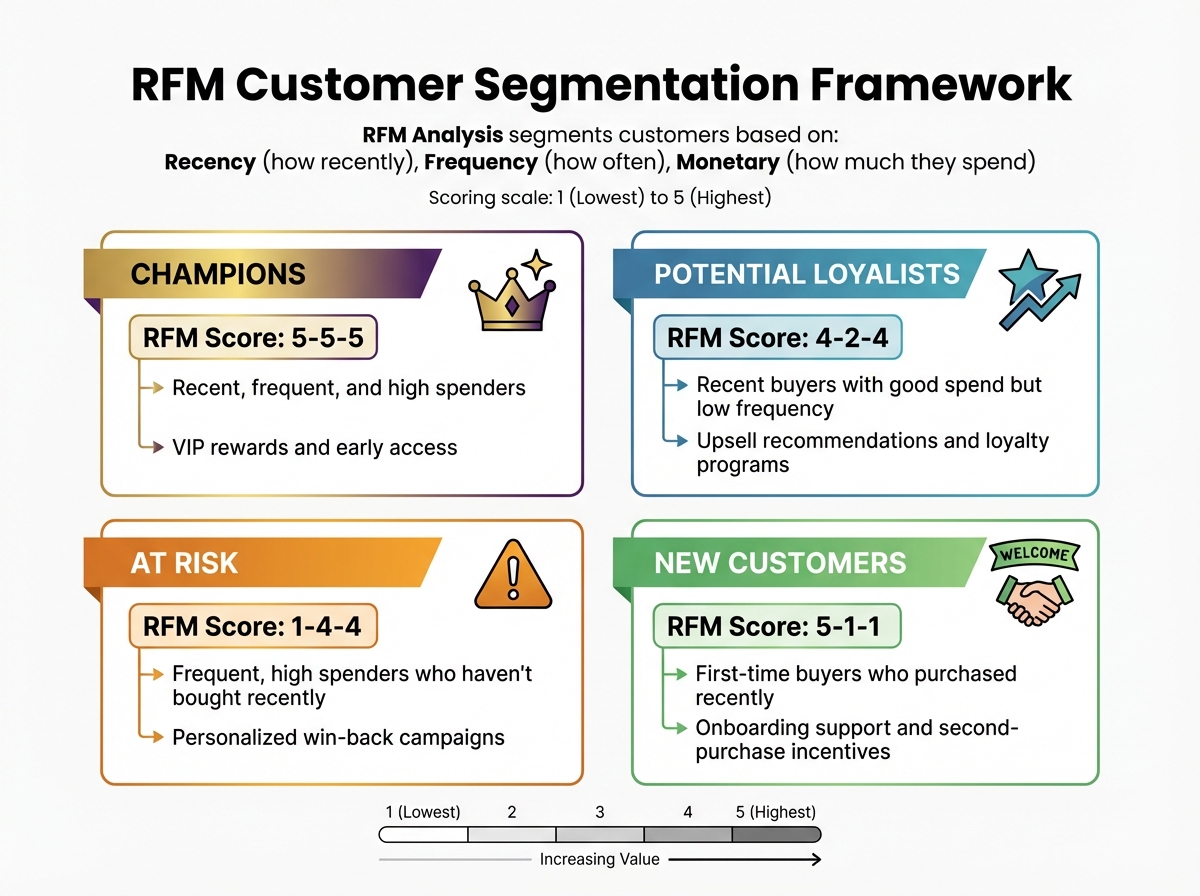
RFM Customer Segmentation Framework with Scores and Marketing Strategies
Metrics play a crucial role in identifying profitable customers, predicting future purchases, and optimizing resource allocation. Three primary approaches stand out: Customer Lifetime Value (CLV), Recency, Frequency, Monetary (RFM) scores, and behavioral engagement data. These metrics work together to provide a well-rounded understanding of customer value, allowing businesses to allocate resources for the best possible outcomes. They also serve as the foundation for dynamic segmentation strategies.
Customer Lifetime Value (CLV)
CLV estimates the total revenue a customer will generate during their relationship with a company. Unlike metrics that focus on individual transactions, CLV emphasizes the value of long-term relationships. It’s calculated using factors like customer acquisition cost (CAC), average order value (AOV), purchase frequency, and retention rates. Predictive models take it a step further by analyzing past behaviors, demographics, and purchase patterns to forecast future spending. This helps businesses identify untapped high-potential customers.
By calculating Customer Equity – the present value of future cash flows – businesses can determine how much to invest in acquiring or retaining specific customer segments. When integrated into dynamic segmentation, CLV allows for real-time updates to customer prioritization strategies.
For example, Neptune.AI used RFM analysis alongside their CRM to target customers with high recency and frequency scores. By offering educational content, they saw a 20% increase in engagement, a 15% drop in churn, and a 10% rise in overall CLV.
Recency, Frequency, Monetary (RFM) Scores
RFM analysis builds on CLV insights by segmenting customers based on three key behaviors: how recently they made a purchase, how often they buy, and how much they spend. Customers who are recent, frequent, and high-value buyers are more likely to respond positively to personalized offers. Monetary value, in particular, helps distinguish high spenders from less profitable segments.
Most businesses use a 1–5 scoring system, dividing customers into quintiles for each metric. A "5–5–5" score, for instance, identifies a Champion – someone who is highly engaged and spends significantly. As Jimmy Kim, CEO of Royal Prospect, puts it:
"Why am I sending the same offers to a $20 customer that I would give my $100 customer?"
RFM scores also support the 80/20 rule: 80% of revenue typically comes from 20% of customers. A great example is Floward, which used RFM analysis for a Valentine’s Day campaign in February 2025. By sending personalized messages via WhatsApp, push notifications, and email, they boosted positive reviews by 21% and captured a 99.1% share of voice among competitors.
| Segment Name | RFM Score | Traits | Approach |
|---|---|---|---|
| Champions | 5–5–5 | Recent, frequent, and high spenders | VIP rewards and early access |
| Potential Loyalists | 4–2–4 | Recent buyers with good spend but low frequency | Upsell recommendations and loyalty programs |
| At Risk | 1–4–4 | Frequent, high spenders who haven’t bought recently | Personalized win-back campaigns |
| New Customers | 5–1–1 | First-time buyers who purchased recently | Onboarding support and second-purchase incentives |
Behavioral and Engagement Metrics
Transactional data tells only part of the story. Engagement metrics – like email open rates, click-through rates, session counts, app logins, and browsing habits – add depth to customer profiles. These metrics help identify “Hot Prospects,” or customers who show interest by browsing but haven’t yet made a purchase.
Combining RFM scores with engagement data creates a more robust segmentation model. For instance, a customer with high recency and frequency but low email engagement may need a different strategy than someone who engages with emails regularly but rarely buys.
Ani Ghazaryan, Head of Content & Marketing at Neptune.AI, explains the challenge:
"Getting clean, consistent data required significant upfront effort, especially as customer data was scattered across multiple systems."
The effort pays off. Personalization driven by segmentation leads to customers spending an average of 38% more, and 56% of consumers are more likely to become repeat buyers when they experience tailored interactions. Automated scoring further streamlines the process, keeping segments updated as customer behavior evolves in real time.
How to Implement Dynamic Segmentation Step-by-Step
Dynamic segmentation relies on connected data, tailored models, and real-time automation. To get started, centralize your data so you can create informed, up-to-the-minute customer segments.
Step 1: Gather Real-Time Data
The first step is to bring together your first-party data from sources like your CRM, transaction history, website analytics, and mobile app interactions. Use SDKs to track in-product behaviors – such as an "abandoned cart" – as they happen. APIs can sync data from platforms like Shopify or HubSpot. What sets dynamic segmentation apart from outdated batch processing is its ability to refresh segments instantly. For example, when a customer completes a tutorial or clicks on a product, their segment updates in real time.
A unified data layer, often built using a Customer Data Platform (CDP), ensures you view the same customer across email, web, and mobile. This is crucial because 71% of customers expect personalized interactions, and 76% report frustration when brands fail to deliver. By leveraging real-time data, brands can respond immediately to customer actions, improving campaign outcomes.
Step 2: Select Appropriate Segmentation Models
Choose segmentation models that align with your business goals. For retention efforts, RFM scoring is a great starting point. This method ranks customers on a 1–5 scale for Recency, Frequency, and Monetary value. A "5-5-5" customer is a Champion, while a "1-2-2" customer is At-Risk and may need a win-back campaign. For acquisition, demographic or propensity models work well, while cross-sell opportunities benefit from product affinity and journey modeling, which can uncover patterns you might not see otherwise.
Rule-based segmentation uses simple "if-then" logic (e.g., "spent > $500"), but it can be limiting. AI-driven models, on the other hand, use clustering and classification to find hidden opportunities, such as identifying "rising star" customers based on predicted Customer Lifetime Value (CLV). As Kuma explains:
"Let AI predict ‘who’ and ‘when,’ while your team defines ‘why,’ ‘what,’ and ‘how.’"
Keep your segments manageable – four to eight high-impact groups are ideal. This ensures your campaigns remain actionable without overwhelming your creative team. Once your models are in place, focus on automating the process for scalability.
Step 3: Automate the Segmentation Process
Manual list-building isn’t scalable. Instead, use automation tools like Braze, Amplitude, or your CRM platform to score and regroup customers in real time. AI models can process millions of profiles within minutes, updating segments as customer behavior changes. Automate syncing between your database and platforms like Meta, Google Ads, or email tools such as Klaviyo and HubSpot to eliminate manual uploads and reduce the risk of data errors.
Automation also creates feedback loops, where campaign performance data feeds back into AI models to refine future predictions.
Step 4: Define and Categorize Customer Segments
Once your models are running, label each segment with actionable, clear names. Common categories include Champions (5-5-5), Loyalists (4-5-4), At-Risk (1-2-2), and New Promising (5-3-3). These labels should directly inform your marketing actions. For instance, Champions might receive VIP rewards, At-Risk customers could get win-back offers, and New Promising users might enter nurture campaigns.
A segment is only effective if it prompts a change in your messaging, offers, or investment levels. If it doesn’t influence decisions, reconsider its value. Aim for segments that are targeted enough to enable personalization but broad enough to remain profitable. For performance-driven campaigns, refresh segments daily to keep pace with customer intent.
Step 5: Test and Refine Strategies
Testing is key to making dynamic segmentation work. Use A/B testing to experiment with messaging, offers, and timing. Monitor metrics like open rates, click-through rates, conversion rates, and revenue per segment to see what resonates. If a segment isn’t responding, tweak the criteria or try a new approach.
Set up your segments to update automatically as customer behavior changes. For example, if an At-Risk customer makes a purchase and becomes a Champion, they should immediately receive messaging tailored to Champions. This keeps your campaigns relevant and avoids outdated outreach. As your data grows, revisit your models quarterly to account for seasonal trends, new product launches, or shifts in customer behavior.
sbb-itb-2ec70df
Using Dynamic Segments in Marketing Campaigns
Dynamic segmentation can take your marketing efforts to the next level by enabling real-time updates across channels. Instead of relying on past behaviors, this approach tailors campaigns to reflect what customers are doing right now, creating a more personalized and timely experience.
Behavioral Targeting
Behavioral targeting focuses on customer actions in real time to determine the next step in communication. For instance, if someone browses multiple product pages without making a purchase, they might be identified as a "window shopper." These shoppers often respond well to exclusive sign-up offers, while more engaged visitors benefit from browse abandonment emails that include educational content and customer reviews.
If a customer repeatedly views a specific product, it’s a clear sign of intent. In such cases, sending a message with an urgent discount or a limited stock alert can drive action. JOBKOREA, a South Korean recruitment platform, used Braze to create dynamic segments based on user behavior and custom attributes. By using Liquid to personalize messages, they saw a 4–5× increase in average click-through rates.
"Braze has allowed me to try different things as a CRM manager… being able to configure personalized messages with Liquid, A/B test with color and creative variations, diversify campaigns, and review performance reports without having to ask the development team has made my job more efficient." – Eunpa Han, CRM Manager, JOBKOREA
These strategies not only enhance immediate engagement but also set the stage for broader lifecycle marketing efforts.
Lifecycle Marketing Strategies
Lifecycle marketing ensures your messaging aligns with where customers are in their journey. New visitors might need onboarding materials or first-purchase incentives, while prospects in the research phase benefit from detailed product benefits and social proof. Triggered messages can acknowledge key milestones – like celebrating a user’s first interaction with a core feature – or re-engage customers when activity starts to wane.
Real-time segmentation is a cornerstone of these efforts. For example, Showmax, a video subscription service in South Africa, used Braze to segment users by lifecycle stage and content preferences. By delivering personalized messages across email, push notifications, and in-app channels, they achieved a 204% increase in subscribers, a 71% retention rate, and a 37% boost in ROI.
For high-value customers, focus shifts to retention and deepening loyalty. Champions – those with high Recency, Frequency, and Monetary (RFM) scores – can receive VIP perks like early product access or exclusive beta invitations. On the other hand, at-risk customers require immediate attention, with outreach triggered as soon as engagement metrics start to dip, rather than waiting for prolonged inactivity.
Real-Time Triggers and Offers
Real-time triggers are all about seizing high-intent moments. Automated actions, like abandoned cart reminders featuring free shipping or discounts, can make the difference between a lost opportunity and a conversion. Too Good To Go, for example, used API-triggered campaigns to notify users the moment "Surprise Bags" became available nearby. By segmenting users based on session activity and purchase history, they saw a 135% increase in purchases attributed to CRM efforts and doubled their message conversion rates.
Timing is everything. As Team Braze explains, "audiences update off that live data. If someone abandons a cart… that behavior can move them into a different audience straight away". Predictive scoring further enhances this by ranking customers based on their likelihood to take specific actions within the next two weeks. This allows marketers to focus offers on the top 10% most likely to convert.
Work with Growth-onomics
To make the most of dynamic segmentation, you need more than just the right tools – you need a solid, data-driven strategy. That’s where Growth-onomics comes in. They specialize in helping businesses turn customer behavior into actionable marketing outcomes. Their Data Analytics services ensure your customer data is clean, unified, and ready for real-time segmentation. Meanwhile, their Performance Marketing expertise translates these segments into campaigns that deliver measurable results.
Whether you’re just starting out with an RFM model or scaling up to predictive, AI-driven segmentation, Growth-onomics provides the guidance and support you need. Visit growth-onomics.com to learn how their team can help you transform customer data into revenue.
Conclusion
Dynamic segmentation forms the backbone of modern marketing, allowing businesses to respond to customer needs in real time.
Key Takeaways
Gone are the days of static lists. Dynamic segmentation groups customers based on real-time behaviors, enabling marketers to act quickly on key moments like cart abandonment or early signs of churn. This shift aligns with what 71% of customers now demand: interactions tailored to their preferences.
The benefits are clear. Segmented email campaigns, for instance, achieve 14.31% higher open rates and 100.95% more clicks compared to generic ones. By concentrating resources on high-value segments, businesses can maximize their ROI. With real-time updates, you can adapt instantly – whether it’s converting a "window shopper" into a buyer or retaining a VIP customer. Considering that 45% of consumers will jump to a competitor after one impersonal experience, dynamic segmentation helps prevent such costly losses.
This strategy also encourages a shift from short-term goals to long-term Customer Lifetime Value (CLV). By focusing on the total value a customer brings over time, every marketing dollar is spent more effectively. AI-powered clustering further enhances this approach by uncovering patterns that would otherwise go unnoticed, such as identifying new users who mirror the habits of your most loyal customers.
These insights empower immediate, meaningful action.
Next Steps
To fully leverage dynamic segmentation, take calculated, measurable steps.
Start with RFM scores (Recency, Frequency, Monetary) to pinpoint your most engaged and high-value customers. As you gain confidence, incorporate lifecycle stages and behavioral triggers. Use these metrics as the foundation of your segmentation strategy, and audit your first-party data from tools like your CRM, Shopify, or analytics platforms before introducing more complex AI models. Be clear about your goals – whether it’s reducing churn among specific groups or increasing order values for new customers. Only create segments that directly inform your messaging, channel strategies, or budget decisions.
Establish an operating rhythm to keep your strategy fresh. Review segment performance monthly and update models quarterly to reflect changing customer behaviors. Automate audience updates by syncing your segmentation platform with ad channels like Google, Meta, and TikTok, as well as CRM tools like Klaviyo or HubSpot, to ensure daily updates without manual effort.
If you’re ready to move beyond manual processes and embrace predictive, AI-driven segmentation, Growth-onomics can guide you. Their Data Analytics services will ensure your customer data is clean and unified, while their Performance Marketing expertise transforms those segments into impactful campaigns. Visit growth-onomics.com to learn how they can help you take your marketing strategy from setup to scale.
FAQs
How does dynamic segmentation help create better customer engagement?
Dynamic segmentation takes customer engagement to a new level by constantly updating customer groups using real-time data and behavior. Unlike static lists that stay the same, this method adjusts to reflect customers’ current needs and preferences.
With dynamic segmentation, businesses can deliver more tailored and timely communication, ensuring marketing efforts resonate with their audience. By relying on fresh insights, companies can create stronger connections with customers and see improved outcomes in their campaigns.
What are the key metrics for successful dynamic customer segmentation?
Successful dynamic segmentation hinges on a few critical metrics: recency, frequency, and monetary value (RFM). These metrics shed light on how often customers engage, how recently they interacted, and how much they spend. But that’s not all – tracking behavioral patterns like browsing habits, purchase motivations, and preferred communication platforms can reveal even more about your audience.
With AI-powered tools, businesses can analyze these metrics in real-time, enabling them to adjust strategies on the fly. This makes it possible to deliver highly personalized, targeted campaigns. By embracing this data-driven approach, you can craft customer segments that not only improve marketing performance but also support long-term business growth.
What’s the best way for businesses to start using dynamic segmentation in their marketing strategies?
To dive into dynamic segmentation, businesses should prioritize leveraging real-time data alongside advanced analytics tools. This approach allows customer segments to evolve based on behavior and preferences rather than remaining fixed to static demographic lists. It’s about embracing AI-driven techniques that adapt to how customers interact, shop, and engage over time.
Pulling data from multiple sources – like social media activity and market trends – can provide a richer picture of your audience. With this insight, companies can craft campaigns that are sharply focused and relevant. Tools like machine learning and predictive modeling are incredibly helpful for experimenting with and fine-tuning these segments, keeping them aligned with shifting customer needs. The best way to start? Begin with clear objectives, gather the right data, and implement systems to automate updates to your segments. These steps ensure dynamic segmentation can scale effectively and deliver results.