


AI generated content is everywhere now.
Blogs. Landing pages. Product descriptions. Newsletters.
And writers have started asking a fair question.
Not whether AI can write. We already know it can.
They are asking if:
Google knows the article was generated using AI, and will it rank the article?
That concern has grown exponentially since AI companies started adding watermarks to generated text.
Claude is doing it.
Gemini already has its own system.
More providers are likely to follow.
So naturally writers and SEOs are wondering whether they should continue using these tools to write content at all.
The following Reddit thread reflects this concern reasonably.
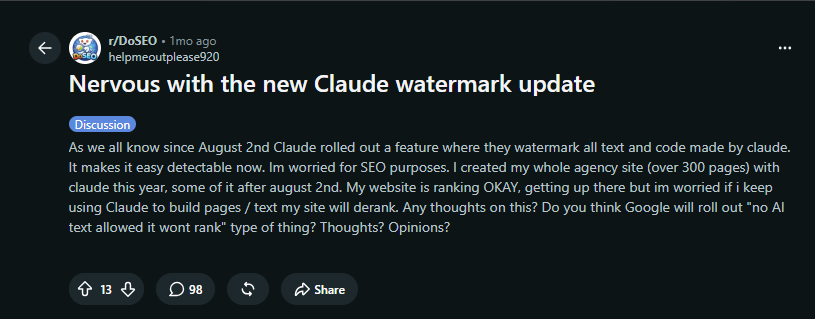
That’s a fair concern, but it’s confusing two different issues.
Can AI generated text be identified?
Yes.
Does Google automatically mark down a page because AI helped write it?
Google says no.
Those aren’t the same thing.
Does Google penalize AI-generated blog content?
Google has been surprisingly clear about this.
Its Search guidance says:
“Our focus on the quality of content, rather than how content is produced…”
Google also directly answers the question of whether AI content is against its guidelines.
It isn’t.
Appropriate use of AI and automation is allowed. What Google does not allow is using automation primarily to manipulate search rankings.
I need you to think of 2 websites.
The first one asks ChatGPT:
“Write 500 articles about accounting.”
The company publishes all 500 with almost no review, research, or original input.
The second company uses Claude to write its first draft. Probably someone with accounting experience who then checks the arguments, corrects the information, adds situations they have experienced, removes generic portions, and rewrites large parts of it.
Both companies used AI, but they came up with different results.
Google’s newer guidance says generative AI can be useful for researching topics and adding structure to original content. The problem begins when businesses use these tools to generate large numbers of pages while adding little value.
Google names that “scaled content abuse”.
Its current spam policy includes using generative AI to produce many pages without adding value as an example of scaled content abuse.
Interestingly, Google doesn’t limit this rule to AI.
Automated rewriting, scraping, synonym swapping and other methods can fall under the same policy. It’s the output that’s problematic not tool.
We analyzed multiple studies that were pointing in different directions
This is probably the best part of the discussion.
If Google was simply identifying AI text and suppressing it, you would expect most large studies to show roughly the same thing. While they don’t.
Look at the consequences of changing the methodology.
Ahrefs looked at 600,000 ranking pages
Ahrefs used 100,000 keywords and analysed roughly 600,000 pages appearing in top 20 results.
Their detector classified:
- 4.6% as purely AI
- 13.5% as purely human
- 81.9% as some mixture of human and AI
Which means 86.5% of the ranking pages showed at least some AI involvement, according to their detector.
More interestingly, Ahrefs calculated the relationship between estimated AI usage and ranking position and the correlation was 0.011.
If Google really followed (the more AI, the lower the ranking rule), this is definitely not the pattern you would expect to see. And that’s only one dataset.
The other one by Semrush takes a different tack.
Semrush analysed 42,000 blog posts and found something else
They collected 20,000 keywords, retrieved the top 10 results and eventually analysed 42,000 blog pages using a tool named GPTZero.
At position one, 80.5% of pages were classified as human-written, compared with roughly 10% classified as AI-generated.
That’s a large gap, but it narrowed on page one. From position 5 onwards, AI was much closer to human content. The survey part has its own appeal.
72% of the SEO professionals Semrush surveyed believed AI content performs as well as or better than human content.
Yet only 19% of them said AI improved content quality.
70% said the key benefit was efficiency.
That probably describes how most content teams really use AI.
It helps them produce faster.
It does not automatically make the article better. And those are two completely different benefits.
Then there’s SE Ranking experiment
SE Ranking adopted an unconventional approach.
Instead of looking at existing ranking pages and determining whether they were AI-written, they started from scratch. 100 articles per site on 20 completely new domains.
2,000 AI-generated articles altogether.
No human editing, backlinks, or meaningful internal linking.
No images or established brand.
They just published the articles and waited.
Within 36 days, Google indexed 1,419 of the 2,000 pages (70.95%). So much for the idea that Google simply sees an AI article and refuses to index it.
Google evidently indexed them.
And they initially received impressions until the situation deteriorated.
Within several months, search visibility collapsed across most of the sites. After about 3 to 6 months, very few pages remained visible in the top 100, and long-term performance remained weak.
That experiment tells us something much more useful than: “Google hates AI” despite being willing to index the content.
The problem came afterwards.
The sites had no authority.
No expertise or first-hand experience.
No unique information or proper site ecosystem supporting the content.
Google gave those pages a chance but most didn’t earn much beyond that.
New data from Ahrefs makes this even more interesting
Ahrefs ran another large analysis in 2026.
And this time they pulled one million pages from the top 10 results across 100,000 SERPs. Around 150,000 had enough text available for AI classification.
Among pages ranking in the top 3:
5.3% were classified as 100% AI generated.
Around 9% showed 80% or more AI content.
So yes.
Pages classified as fully AI-generated ranked positions 1 to 3.
They were already ranking. But the data also had a flip side.
82.2% of the top-3 rankings contained less than 50% AI content, and pages with lower estimated AI use generally received substantially more impressions than those with very high AI use.
Ahrefs themselves warned against interpreting this as proof of a Google AI penalty.
There are too many other variables.
Older domains may use less AI.
Established businesses may have better writers.
Better websites may have more backlinks.
Businesses already performing well may have less reason to publish large quantities of AI content.
Which brings us to the part that most reports skip.
These studies are measuring correlation instead of watching Google’s algorithm
None of these companies has access to Google’s ranking system.
They can’t see the switch labelled: AI CONTENT PENALTY: ON
They take ranked pages. They run them through AI detectors.
Then they look for patterns.
That’s useful but it has limits.
AI detectors are statistical systems as well.
Ahrefs openly says its detector deals in probabilities rather than certainty.
Academic work has found the same problem.
One 2025 study tested 1,000 pieces of academic writing across GPTZero, ZeroGPT and another detector. The systems were reasonably good at separating AI from human writing overall, but none reached 100% reliability and false positives remained a concern.
So when a study says:
83% human or 10% AI read that as:
“The detector classified this amount of content that way.”
Not:
“We have proven exactly who wrote every page.”
That sounds like a boring distinction. It isn’t.
It actually stops you from drawing conclusions that the data cannot support.
So what does all this research essentially reveal?
So, after placing these datasets next to each other, my top five takeaways would be as follows.
Google does index AI content.
The SE Ranking experiment proved that neatly.
AI-assisted content ranks everywhere.
Ahrefs found some level of AI involvement in 86.5% of its 600,000-page ranking sample.
Pure AI content can rank.
The newer Ahrefs study found pages classified as 100% AI ranking in the top 3.
Pure AI content doesn’t appear to be the strongest long-term strategy.
Semrush found a very strong human-content skew at position one, while SE Ranking’s completely untouched AI sites lost most of their early visibility.
And finally:
None of this proves that an AI watermark itself causes a ranking loss.
That’s the part I would be very careful about claiming.
There’s currently no public Google Search documentation saying that.
What about Claude’s new text watermark?
Because something genuinely changed.
AI companies are starting to make generated text machine-detectable.
And no, this doesn’t mean adding something like:
Written by Claude at the bottom of your article.
It is much more subtle than that.
Claude now watermarks generated text
Anthropic announced Claude text watermarking in August 2026.
The watermark isn’t a strange character you can find in Notepad.
There isn’t an invisible line sitting between 2 paragraphs or a piece of HTML to delete before publishing.
Anthropic says nothing is added to the text and there are no hidden characters.
Instead, Claude slightly changes how it chooses between possible words while generating a response.
Those choices build a statistical pattern across the text.
A detector with the correct key can then look for that pattern.
That also means something writers need to understand:
Copying Claude content into Notepad does not automatically clean it.
The watermark exists in the pattern of the generated language itself.
Anthropic says it can travel when the text is copied and pasted and may survive some editing.
So, using Claude-generated content with Notepad and WordPress isn’t a reliable watermark removal process.
Notepad can remove formatting but it cannot magically change how Claude selected the words.
Gemini has already been doing something similar
Claude isn’t the first major system to watermark text.
Google DeepMind developed SynthID-Text, which changes the token selection process while the model generates text.
Google says SynthID is used to watermark text produced through the Gemini app and web experience.
And this was not tested on 50 responses in a laboratory.
The research behind SynthID-Text involved roughly 20 million Gemini responses.
Researchers compared responses generated with and without the watermark.
The difference in positive user feedback was around 0.01%, while the difference in negative feedback was around 0.02%. Neither difference was statistically significant.
In other words, users could not meaningfully tell that watermarking had changed the output quality.
That’s an interesting result for a number of reasons.
The text doesn’t need to look strange for a statistical watermark to exist.
You are not going to read an article and suddenly spot “the watermark sentence.”
There isn’t one.
Could Google use the watermark against you later?
Maybe. It’s possible that Google can identify more AI-generated material over time.
Google already has sophisticated language systems and its own watermarking technology.
There’s a big gap between:
Google can identify machine-generated text
and:
Google lowers a page’s ranking because it identified machine-generated text.
We have evidence for the first being technically possible but we don’t have public evidence for the second being Google’s policy.
In fact, Google’s stated policy says the opposite: useful, original content can rank regardless of how it was produced.
This is exactly what SEOs are arguing about on Reddit right now.
Some people are worried Claude’s watermark could eventually make scaled-content enforcement easier.
Others point back to Google’s existing position: AI itself is not what Google says it cares about.
Nobody in those threads has Google’s ranking code.
So I need you to treat it as a concern rather than evidence.
Google has already told us what it wants less of
In 2024, Google rolled out major changes aimed at low-quality and unoriginal results.
Google initially expected those changes to reduce this type of content by around 40%.
After rollout, it said the actual reduction was closer to 45%.
Notice the language.
Low-quality. Unoriginal.
Created mainly for search engines.
Google didn’t say:
“We removed 45% of AI content.”
That’s a very different claim.
And Google’s 2026 guidance is even clearer about where things are heading.
It tells publishers trying to appear in traditional Search and Google’s generative AI experiences to produce valuable, unique, non-commodity content.
“Non-commodity” is probably the word writers should spend more time thinking about.
Because most untouched AI content is commodity content.
The information already exists. The model rearranges it.
You publish it and so does your competitor and another competitor ….
Now 20 pages are saying essentially the same thing in different words.
Why should yours be first?
This is where writers should stop trying to “bypass AI detection”
There are countless guides promising to teach you how to bypass AI detectors.
Swap words. Change punctuation. Remove em dashes. Increase “burstiness.” Run it through a humanizer. And all of that completely misses the SEO problem.
You may even get an AI detector to say:
97% Human Written
Great. But if you article is sounding like:
“Choosing the right CRM is important for business success. Consider ease of use, features, price and integrations.”
You still have a rubbish article and Google doesn’t need a Claude watermark to work that out.
If you want AI content to rank, change what’s inside the article
This is the editing habit I would build into every content workflow.
If Claude gives you:
“Companies should carefully evaluate several factors when choosing office space in Malta.”
Delete it and talk to someone who actually deals with Malta offices:
Ask what companies get wrong.
Maybe parking in Sliema causes more problems than expected.
Maybe quoted rents exclude common area costs.
Maybe employees simply refuse to commute to certain areas.
Maybe redundant internet connections factor enormously in for gaming or fintech companies, but not for a small consultancy.
Now you’ve something Google loves.
Suddenly the page contains information Claude could not have produced from a generic prompt.
That’s the distinction.
Your existing draft already moves in this direction by asking whether the finished article contains anything that would not exist if you had simply asked Claude for 1,500 words.
I would make that the editorial rule.
A practical AI publishing workflow
Do not use:
Prompt → generate → humanizer → publish
Use:
Research → AI draft → SME input → concrete examples → fact checking → structural edit → SEO edit → publish
Claude can still save time.
You can definitely use it to find different angles.
Use it to organise notes or to interrogate a dataset.
Use it to turn an SME interview into possible sections.
Use it for the first ugly draft.
What it shouldn’t do is make every final decision.
Semrush’s survey data supports this too.
64% of surveyed SEO teams said they were already using a human-led, AI-assisted workflow.
That feels much closer to where serious content production is heading. Not human versus AI.
Human using AI, then deciding what deserves to be published.
Can editing remove an AI watermark?
It can weaken watermark detection.
But do not confuse that with improving content.
Research from Kirchenbauer and colleagues tested watermarked text after human rewriting, machine paraphrasing and mixing AI text into human-written documents.
The watermark became weaker after rewriting.
But it did not necessarily disappear immediately.
In one experiment, even strongly human-paraphrased material remained detectable after researchers observed roughly 800 tokens on average, using a false-positive threshold of 1 in 100,000.
Nature has also pointed out that watermark robustness remains an open technical problem. Paraphrasing, translation and rewriting can interfere with statistical signals, which is one reason watermarking remains an active research area.
So swapping crucial with (important) isn’t a serious strategy.
Neither is deleting every em dash, and neither is pasting everything through a random “AI humanizer.”
Should writers stop using AI for blog content?
Obviously not.
But the days of workflows such as prompt → copy → WordPress → publish are over.
Not because Google has announced some secret Claude penalty.
It hasn’t.
But because AI companies are getting better at identifying AI-generated output while Google keeps repeating the same message to publishers:
Give people something useful, something original.
Something that wasn’t simply reconstructed from what already exists.
Use AI for the boring parts if it saves you time.
Then do the part it cannot do without you.
Add what you have actually seen.
Challenge the obvious advice. Remove the generic sections. Double-check the facts.
Talk to someone who knows the subject.
Add actual examples.
Say what normally goes wrong.
And publish something that could not have existed from the prompt alone.
That’s the safest SEO strategy.
Not because it tricks Google into believing a person typed every sentence.
But because it gives Google, and the person reading the article, an innate reason to choose your page instead of the hundred other versions of the same answer.
If you want to build a stronger content library around your services, products, or target searches, Growth-onomics can manage the full writing process and deliver content ready to publish.
