

Customer journey mapping helps businesses understand how customers interact with them from start to finish. By focusing on customer actions, feelings, and needs, businesses can improve experiences, reduce friction, and drive growth. Here’s why it matters:
- 88% of customers value experiences as much as products.
- 71% switched brands in the past year due to poor experiences.
- Companies using journey mapping have seen 15% revenue growth, 20% cost reductions, and improved satisfaction scores.
Key stages of the journey include:
- Awareness: Solve customer problems with helpful content.
- Consideration: Showcase your unique value through guides and case studies.
- Decision: Remove barriers with demos, trials, and clear processes.
Real-world examples like Blinkist and Ticketek show how journey mapping increases conversions and revenue. To succeed, use data (quantitative, qualitative, and behavioral) to identify key touchpoints, prioritize fixes, and create actionable maps. Regular updates ensure your map stays relevant and effective.
If you’re ready to improve retention, optimize marketing, and streamline operations, journey mapping is a must. Start small, measure results, and scale your efforts for long-term growth.
Customer Journey Mapping Tutorial
sbb-itb-2ec70df
The Main Stages of the Customer Journey
The customer journey is a structured, data-rich process that helps businesses understand how to guide potential buyers from initial interest to making a purchase. By breaking it into three key stages – Awareness, Consideration, and Decision – you can pinpoint where to focus your efforts for the greatest impact.
Awareness Stage
At this stage, potential customers are just beginning to identify their problems and look for solutions. They’re not searching for your brand specifically – they’re searching for answers. Your role here is to position yourself as a helpful resource by offering educational content like blog articles, social media posts, and videos that address their questions and concerns.
The challenge is to stand out in a crowded space without coming across as overly promotional. Instead of generic messaging, focus on creating content that directly addresses their pain points. Use keywords that reflect the actual terms people type into search engines, and ensure your content is clear, specific, and genuinely helpful.
Consideration Stage
Once potential customers understand their problem, they begin exploring specific solutions and comparing brands. This is your opportunity to showcase what sets you apart. Content that works well in this phase includes comparison guides, case studies, and webinars – anything that highlights your unique value.
This stage is all about differentiation. Customers are evaluating features, pricing, and reviews to determine the best fit. If you can’t clearly communicate what makes your offering stand out or show measurable results, they’ll likely choose a competitor. Trust is critical here, so focus on being transparent and backing up your claims with evidence.
Decision Stage
By the time customers reach the Decision stage, they’re ready to purchase – but they may still have lingering doubts. Your goal is to remove any obstacles and provide reassurance. Tools like product demos, free trials, consultations, and even well-timed abandoned cart emails can be the deciding factor between securing a sale or losing it by utilizing professional lead generation services.
This is also the stage where technical issues can have the biggest impact. A buggy website, a complicated checkout process, or unclear pricing can quickly turn a warm lead cold. Simplify the buying process and address any potential concerns to keep the momentum going.
| Journey Stage | Customer Goal | Recommended Content/Action | Measurement Focus |
|---|---|---|---|
| Awareness | Find a solution to a problem | Educational blogs, social media, videos | Traffic sources, engagement rates |
| Consideration | Compare available options | Case studies, comparison guides, webinars | Time on page, content downloads |
| Decision | Finalize purchase | Demos, free trials, consultations, discount codes | Conversion rates, cart abandonment |
Up next, we’ll explore how to create a data-driven customer journey map that leverages these insights for even better results.
How to Create a Data-Driven Customer Journey Map
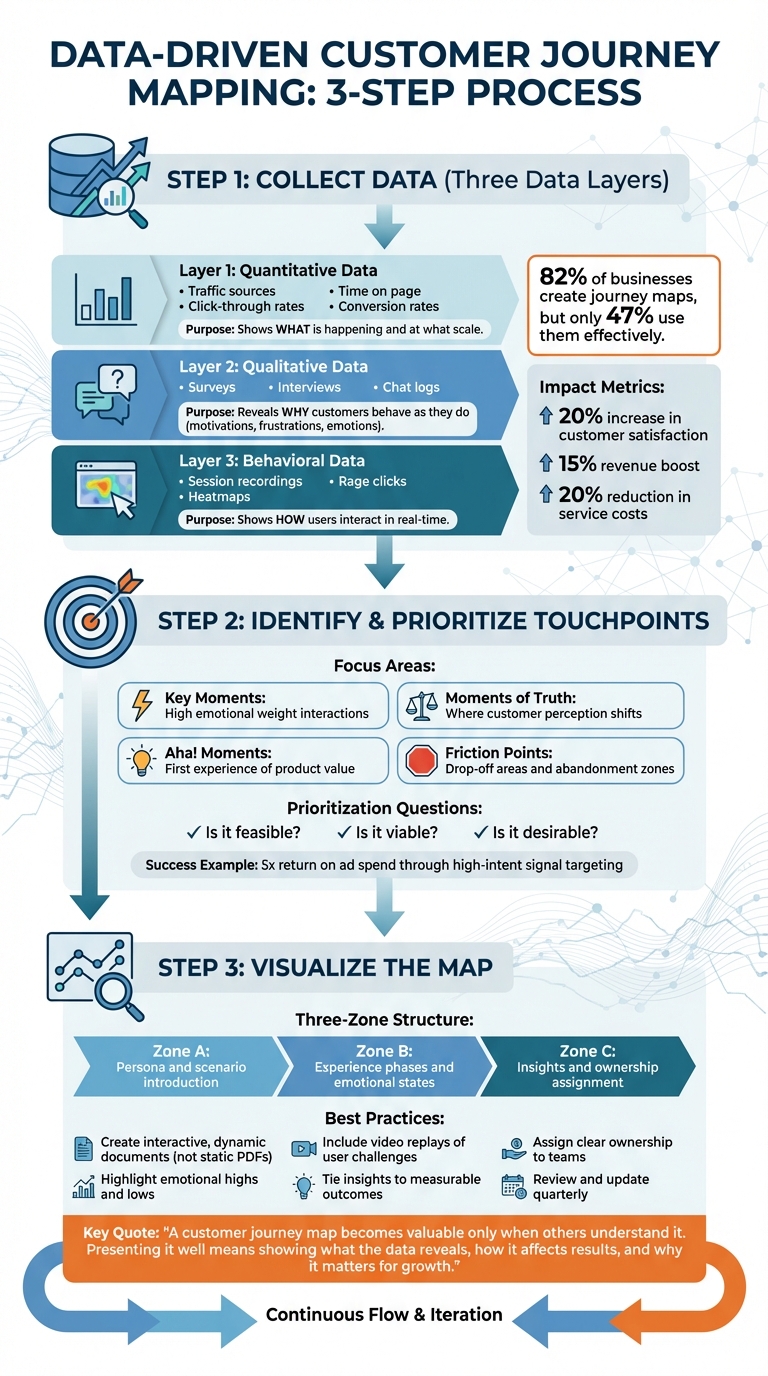
3-Step Data-Driven Customer Journey Mapping Process
Creating a customer journey map isn’t just about imagining what your customers might do – it’s about uncovering their real behavior through data. The difference between a map that collects dust and one that delivers results lies in how you gather, prioritize, and present the information.
Step 1: Collect Quantitative and Qualitative Data
To paint an accurate picture, you’ll need three layers of data. Quantitative data – like traffic sources, click-through rates, time on page, and conversion rates – shows you what’s happening and at what scale. Qualitative data – from surveys, interviews, and chat logs – dives into the why, capturing customer motivations, frustrations, and emotions. And behavioral data, such as session recordings, heatmaps, and "rage clicks", reveals how users interact in real-time, highlighting areas of friction.
By combining survey feedback with analytics data, you can uncover the reasons behind customer actions. While direct feedback offers valuable sentiment insights, it’s prone to recall bias and low response rates. On the other hand, behavioral data shows actual actions but can be harder to interpret without AI tools. Layering these data types together gives you a well-rounded understanding of your customers.
Keep your map up-to-date by regularly integrating data from analytics platforms and Customer Data Platforms (CDPs). McKinsey reports that optimizing customer journeys can boost satisfaction by 20%, increase revenue by 15%, and cut service costs by up to 20%. However, while 82% of businesses create journey maps, only 47% use them effectively.
Once you’ve gathered the data, the next step is identifying the most critical touchpoints.
Step 2: Identify and Prioritize Key Touchpoints
Data is only useful if it leads to actionable insights. Focus on identifying the touchpoints that matter most. These "Key Moments" are the interactions that carry the highest emotional weight and shape how customers perceive your brand. These moments often include first-time product setups or support calls during a problem.
Behavioral analytics can help you spot pivotal moments, such as "moments of truth" where a customer’s perception shifts, or "Aha! moments" when they first experience your product’s value. Pay attention to friction points and drop-off areas where users abandon the journey. For example, one case study showed that targeting remarketing efforts based on high-intent signals led to a 5x return on ad spend.
Prioritize touchpoints that align with your business goals, like boosting conversions, reducing churn, or driving revenue. When considering improvements, ask three key questions: Is it feasible? Is it viable? Is it desirable?. This ensures you focus on impactful changes rather than surface-level tweaks.
Step 3: Visualize the Journey Map
A journey map is only effective if stakeholders can grasp its insights quickly. Structure your visualization into three zones: Zone A introduces the persona and scenario, Zone B maps the experience through phases and emotional states, and Zone C outlines insights and assigns ownership. Highlight emotional highs and lows to pinpoint areas of excitement or frustration, guiding UX improvements.
Start by organizing your data, then design visuals that are easy to understand. Instead of a static PDF, create an interactive, dynamic document that updates as new data becomes available. When presenting your map, include short video replays or snippets from behavioral tools to show real users encountering challenges – this builds empathy far more effectively than numbers alone.
"A customer journey map becomes valuable only when others understand it. Presenting it well means showing what the data reveals, how it affects results, and why it matters for growth." – Agata Olbrycht, Content Marketing Specialist, CUX
Tie every insight to measurable outcomes. For instance, show how simplifying a step increased purchase intent or how fixing a friction point reduced cart abandonment. Clearly assign ownership of each touchpoint to specific teams to ensure accountability for improvements. Review and update your map quarterly to reflect changes in customer behavior, market trends, or product updates.
With a well-structured, actionable map, you’re equipped to turn insights into strategies that drive growth.
Using Customer Journey Maps to Drive Growth
Customer journey maps are a powerful tool for uncovering critical friction points that can directly impact revenue. These insights help businesses improve retention, fine-tune marketing strategies, and streamline operations.
Improving Customer Retention
Retention hinges on identifying and addressing moments where customers feel frustrated or disengaged. Journey maps pinpoint these high-stakes touchpoints – often referred to as "Moments that Matter" – where a poor experience can significantly damage brand perception. By distinguishing between "dissatisfiers" (issues that push customers away) and "satisfiers" (factors that encourage loyalty), businesses can tackle key pain points and reduce churn.
Take Telus, a Canadian telecommunications company, as an example. Their journey mapping revealed that customers renewing mobile contracts faced a fragmented experience, bouncing between phone calls, online research, and in-store visits. This not only frustrated customers but also increased operational costs. To address this, Telus introduced an AI-driven personalization tool that unified these channels. The result? Customer satisfaction scores jumped by 20%, and usage of lower-cost digital channels rose by 25%. This kind of intervention is crucial in a market where 71% of consumers have switched brands at least once in the past year.
Once businesses smooth out these retention barriers, they can use the same journey insights to craft marketing campaigns that convert engagement into sales.
Optimizing Marketing Campaigns
Journey maps take the guesswork out of marketing by aligning campaigns with the specific needs of customers at different stages. By using these insights, businesses can deliver highly targeted messaging and assign the right channels to each phase of the customer journey, leading to better campaign performance and return on investment.
For instance, Ticketek, an Australian ticketing platform, used journey mapping to understand how customers make decisions. They personalized weekly newsletters with event suggestions tailored to each customer’s journey, resulting in a 228% increase in click-to-convert rates and a 49% boost in sales from opened emails. Similarly, Blinkist, a subscription app, analyzed the behavior of free users to identify the "Aha!" moment when the app’s value became clear. This led to a 64% increase in premium subscription purchases.
Global travel company TUI took it a step further by mapping five distinct phases of their customer journey: onboarding, inspire and book, pre-departure, travel, and retain. They replaced siloed campaigns with 40 automated, real-time messages across mobile and email channels. This approach drove a 118% increase in app bookings and a 205% rise in sales of ancillary products like travel insurance and parking. Notably, post-acquisition marketing efforts are 2.3 times more likely to surpass management expectations.
Improving Business Efficiency
Customer journey maps don’t just enhance customer engagement – they also reveal inefficiencies within a business. By layering internal processes and systems onto the customer journey, businesses can uncover redundant handoffs, misallocated resources, and bottlenecks that inflate costs.
When teams share a unified view of the customer experience, organizational silos naturally break down. In fact, 79% of companies that invest in journey mapping report becoming more customer-focused. This shift can drive efficiency gains across departments. According to McKinsey, optimizing customer journeys can reduce service costs by up to 20%, while simultaneously increasing customer satisfaction by 20% and boosting revenue by 15%.
The key to these efficiency gains lies in prioritizing high-impact projects over minor tweaks. By focusing on "Moments of Truth" – those pivotal experiences that shape brand perception – businesses can allocate resources where they’ll make the greatest difference. Companies that link customer satisfaction metrics to business outcomes are 29% more likely to see increases in their customer experience budgets.
Growth-onomics Services for Customer Journey Mapping
Growth-onomics’ Customer Journey Mapping Solutions
Growth-onomics takes customer journey mapping to the next level by transforming static maps into dynamic, actionable tools. Their three-layer data integration approach blends key performance metrics with real-time behavioral insights, creating an adaptable map that evolves as customer behavior shifts.
One standout feature of their process is the use of cross-channel attribution, which connects the dots between various customer touchpoints. While many businesses use journey mapping, they often fail to fully tap into its potential. Growth-onomics addresses this by layering hard data onto every touchpoint, turning traditional maps into living documents that respond to real-time changes.
Their approach focuses on what they call "Moments that Matter" – those critical points in the customer journey where emotional stakes are high and friction can lead to drop-offs. By employing behavioral analytics, they identify hesitation signals and drop-off areas that might otherwise go unnoticed. With these insights, they develop testable strategies to improve the customer experience. This method has proven results: optimizing these key touchpoints can boost revenue by 15% and reduce service costs by 20%. This comprehensive framework not only deepens customer insights but also lays the groundwork for broader growth strategies.
Additional Services for Complete Growth
Growth-onomics enhances journey mapping by weaving in their expertise in performance marketing. They use campaign sequencing and channel orchestration to maintain customer retention and build awareness throughout the journey. Their multi-touch attribution system pinpoints which interactions provide the most value.
To further refine strategies, they offer services like SEO and analytics to close content gaps at every stage of the journey. Their UX optimization ensures a smooth and consistent experience across all platforms – whether it’s a mobile app, desktop site, or physical store. This cohesive approach highlights the importance of customer retention as a cost-effective growth engine. With every interaction optimized for impact, Growth-onomics turns customer journeys into measurable, growth-driven outcomes.
Conclusion and Next Steps
Customer journey mapping isn’t just about understanding your audience – it’s about turning those insights into real growth opportunities. Consider this: retaining just 5% of your existing customers can increase profits by 25% to 95% – a statistic that speaks volumes about the value of customer loyalty. By mapping out the actual customer experience instead of relying on assumptions, you can pinpoint areas of friction, fine-tune your marketing spend, and align your team around what genuinely matters. These insights become the foundation for smarter, more strategic decisions across your organization.
To make the most of your journey map, keep it dynamic and evolving. Incorporate a mix of quantitative data, qualitative insights, and behavioral trends to create a well-rounded view of your customers. Regularly validate your map to uncover any gaps that data alone might miss. And don’t stop there – tie your findings directly to measurable business outcomes like improved conversion rates, reduced churn, or increased product adoption. This approach not only strengthens your strategy but also helps leadership clearly see the ROI of your efforts.
Want to get started? Begin with a single persona’s first-purchase journey. Layer in real-time metrics – such as conversion rates, time spent at each stage, and drop-off points. Assign clear ownership of the process, and review it quarterly to keep everything on track.
Here’s why this matters: 88% of customers say the experience they have is just as important as the product itself, and 71% admit to switching brands recently due to unsatisfactory experiences. Optimizing every touchpoint isn’t optional – it’s essential.
If you’re ready to take things further, Growth-onomics offers comprehensive customer journey mapping solutions that turn insights into actionable strategies. Their approach combines hard data with customer feedback and behavioral analysis to uncover bottlenecks and drive real, measurable growth. With Growth-onomics, static maps become tools for dynamic change, helping businesses transform customer signals into tangible results.
FAQs
How can customer journey mapping help businesses boost customer retention?
Customer journey mapping allows businesses to clearly see the full customer experience – from the first moment of awareness to interactions after a purchase. It highlights key moments where customers either stay engaged or drop off, revealing areas where improvements can lead to better retention.
To get the most out of journey mapping, rely on real-world data like transaction records, app usage patterns, and customer feedback. This keeps the map relevant and adaptable to changing customer behaviors. Once you identify pain points, focus on practical solutions such as streamlining the onboarding process, offering timely support, or customizing communication based on where customers are in their journey.
At Growth-onomics, we take this approach a step further by blending data insights with UX design and performance marketing strategies. This helps businesses transform insights into measurable results, building long-term customer loyalty and driving growth.
What types of data are essential for building a data-driven customer journey map?
To build a meaningful, data-driven customer journey map, it’s essential to gather the right information that sheds light on how customers interact with your brand and what drives their decisions. Here are the key types of data to focus on:
- Behavioral data: This tracks user actions such as clicks, page views, navigation patterns, and time spent on your website or app. It helps you understand how customers engage with your platform.
- Transactional data: Purchase history, cart abandonment details, and order values link customer behavior to revenue, offering insights into buying patterns.
- Customer data: Demographics like age, location, and loyalty tier, along with past interactions, allow you to tailor insights for specific segments of your audience.
- Feedback data: Surveys, reviews, and support tickets provide direct input on customer motivations, challenges, and overall satisfaction.
- Social sentiment data: Social media mentions, comments, and sentiment analysis reveal how customers feel about your brand and what factors influence their decisions.
Bringing these data sources together paints a clear picture of the customer journey. This approach helps you pinpoint areas of friction, identify opportunities for improvement, and create tailored strategies to elevate the customer experience while driving business success.
How can customer journey mapping improve marketing campaigns?
Customer journey mapping allows businesses to see exactly how customers engage with their brand at every stage of their experience. It highlights pain points that might be causing frustration and reveals opportunities to improve. By digging into these insights, companies can craft more tailored content, make smarter decisions about where to spend their marketing dollars, and experiment with strategies that can lead to better engagement and higher conversions.
This approach doesn’t just make things smoother for the customer – it delivers real results. It helps businesses achieve measurable growth, boost ROI, and ensure that their marketing aligns perfectly with what their customers are looking for.