


When advertising budgets are tight, every dollar needs to count. Yet, nearly half of marketing strategies still rely on intuition rather than data. That’s where customer funnels and predictive models come in – they help businesses make smarter, data-driven decisions.
Here’s the big idea:
- Customer funnels map the journey from awareness to purchase, showing where potential customers drop off.
- Predictive models use historical data and machine learning to forecast outcomes, like identifying customers likely to buy or leave.
For example, one retailer boosted conversions by 15% using predictive models to target high-intent visitors. Similarly, an e-commerce site increased revenue per visitor by 60.3% by addressing a specific funnel drop-off point.
These tools help businesses focus on what works – like prioritizing high-value leads or preventing churn – rather than guessing. Whether you’re refining your funnel or using predictive analytics, the goal is the same: improve efficiency and grow revenue.
Attribution Weights + Cross Channel Credit + Funnel Understanding for Marketing Efforts
sbb-itb-2ec70df
Common Predictive Modeling Techniques for Funnels
Predictive models play specific roles in funnel optimization: regression estimates numerical outcomes like revenue, classification helps identify risks such as churn, and clustering segments audiences for tailored strategies.
Regression Models for Conversion Forecasting
Regression models measure how different factors – like ad spend, pricing, or seasonality – impact conversion rates. Multiple regression allows marketers to analyze several variables at once, such as search ads, email campaigns, and discounts, to uncover which efforts drive the most results.
"Each input gets a regression coefficient – a number that estimates the impact of a one-unit change in that input, holding all other variables constant."
– Christopher Van Mossevelde, Head of Content, Funnel
These models are designed to reflect real-world marketing complexities. For example, Adstock accounts for delayed effects of campaigns, such as TV ads that influence future sales. Lag effects capture the long lead times common in B2B sales, while diminishing returns highlight how initial ad spend often delivers better results than subsequent investments.
To ensure accuracy, marketers validate these models using techniques like holdout testing and metrics such as R² (how well the model explains variance) and MAPE (mean absolute percentage error). Tools like VIF help detect multicollinearity when related inputs – like Meta and Instagram ad spend – move together, making it hard to isolate their individual effects. Additionally, a p-value below 0.05 confirms that a variable significantly impacts the outcome.
While regression focuses on predicting numerical outcomes, classification models are better suited for binary decisions, such as identifying churn risks or conversion likelihood.
Classification Models for Identifying Churn Risks
Classification models answer "yes or no" questions, such as "Will this customer churn?" or "Will this lead convert?" Unlike regression, which predicts a continuous value, classification assigns prospects into categories.
These models are especially useful in lead scoring, where they help identify high-risk or low-risk prospects quickly. They also flag customers who might churn by analyzing behaviors like reduced logins, fewer purchases, or declining engagement. This early detection allows teams to take proactive steps to retain these customers.
Data points such as email opens, website visits, support ticket activity, and purchase frequency feed into these models. The results are straightforward – typically a probability score or a simple risk label (e.g., "high risk" vs. "low risk") – making it easy for teams to act without needing to interpret complex statistics.
Clustering for Audience Segmentation
clustering groups customers based on shared behaviors or traits to map and optimize the customer journey, enabling more personalized marketing strategies. Instead of treating all customers the same, clustering reveals distinct segments – like "bargain shoppers" who wait for discounts versus "loyal buyers" who purchase at full price.
This segmentation sharpens funnel strategies by directing resources to the most impactful areas. For instance:
- Affinity analysis identifies products frequently bought together, improving cross-selling and recommendations.
- Response modeling forecasts how specific segments will react to campaigns, such as new product launches or holiday promotions.
By focusing on high-value segments – like customers with high Lifetime Value (LTV) – businesses can allocate resources more effectively. For example, if one segment consistently buys premium products and has low return rates, retention efforts can focus there, while lower-value groups might receive automated, lighter-touch strategies.
Keeping data clean and up-to-date ensures accurate segmentation. This also supports automated campaigns, such as sending personalized win-back emails to clusters identified as at risk of churning.
How to Apply Predictive Models in Customer Funnels
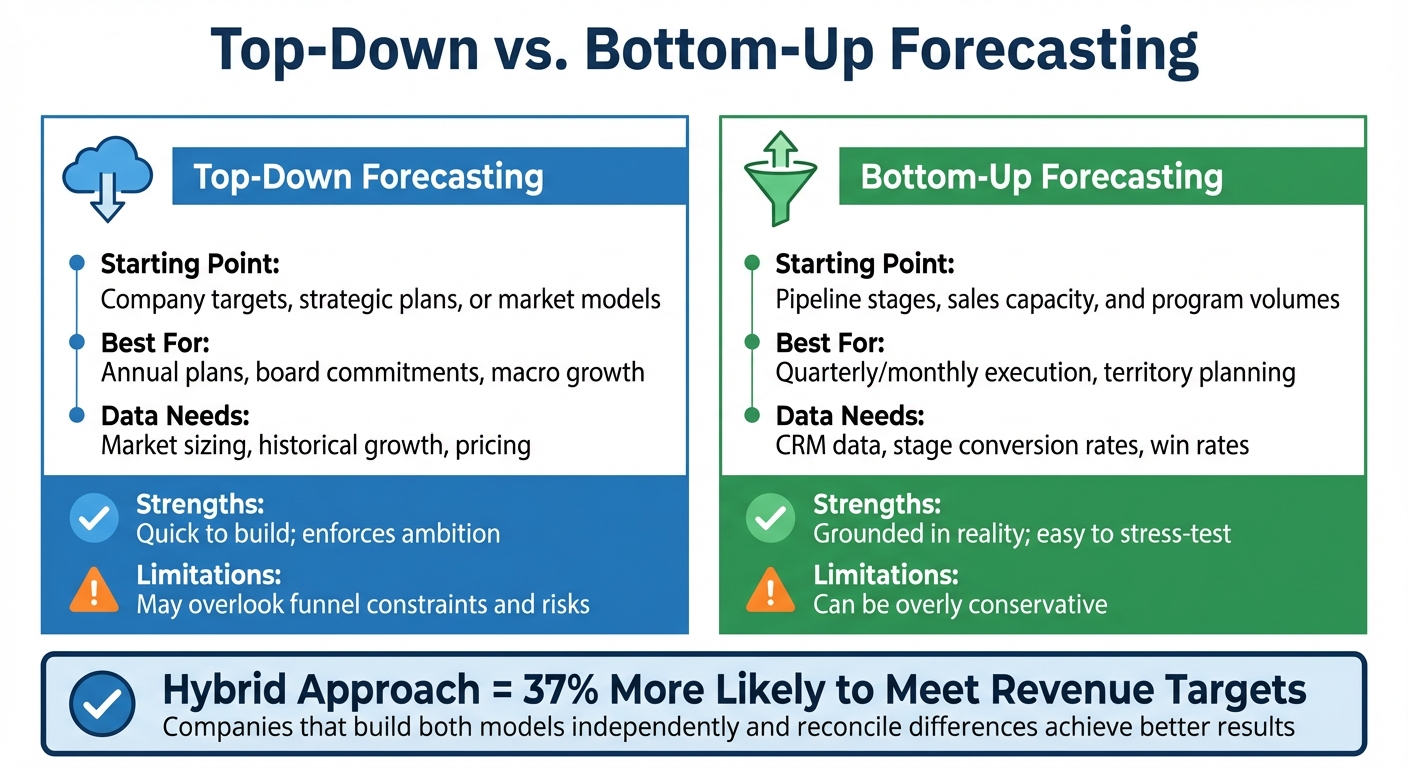
Top-Down vs Bottom-Up Forecasting: Key Differences and Benefits
Using predictive models at each stage of the customer funnel can refine your marketing strategy, often with the help of a specialized AI-performance marketing agency. For example, at the top of the funnel, historical campaign data helps forecast channel performance. In the middle, lead scoring prioritizes high-intent prospects. At the bottom, purchase propensity models guide promotion timing, while churn signal classification triggers retention efforts after conversion. With these insights in mind, let’s dive into the differences between top-down and bottom-up forecasting approaches.
Top-Down vs. Bottom-Up Forecasting
Top-down and bottom-up forecasting serve distinct purposes, and understanding their strengths and limitations can help you choose the right approach – or combine both for better accuracy.
Top-Down Forecasting
- Starts with market size and strategic goals.
- Ideal for annual planning and investor presentations.
- Quick to develop and aligns with ambitious financial targets.
- May miss funnel constraints or execution risks.
Bottom-Up Forecasting
- Focuses on pipeline stages, sales capacity, and CRM conversion rates.
- Best suited for quarterly or monthly execution and campaign planning.
- Grounded in operational realities and easily stress-tested with scenarios.
- Could be overly cautious, potentially underestimating new opportunities.
Interestingly, companies that adopt a hybrid approach – building both models independently and reconciling the differences – are 37% more likely to meet their revenue targets.
| Feature | Top-Down Forecasting | Bottom-Up Forecasting |
|---|---|---|
| Starting Point | Company targets, strategic plans, or market models | Pipeline stages, sales capacity, and program volumes |
| Best For | Annual plans, board commitments, macro growth | Quarterly/monthly execution, territory planning |
| Data Needs | Market sizing, historical growth, pricing | CRM data, stage conversion rates, win rates |
| Strengths | Quick to build; enforces ambition | Grounded in reality; easy to stress-test |
| Limitations | May overlook funnel constraints and risks | Can be overly conservative |
For example, a B2B technology company used bottom-up forecasting to identify a 14% pipeline coverage gap three quarters in advance, allowing them to adjust their strategy in time. Similarly, Deuba, a German e-commerce company led by Mark Prediger, used predictive modeling to reveal that social media was undervalued by 80% in their last-click attribution model. By adjusting their Google Ads bidding, they improved both cost per acquisition and overall ROI.
Using Fourier Transforms for Trend Prediction
Fourier transforms are a powerful tool for identifying seasonal and recurring sales trends. By breaking down sales data into these patterns, businesses can better plan media strategies and anticipate demand spikes. Think of December’s holiday shopping rush – understanding these cycles helps optimize campaigns and predict how external factors, like economic shifts, might influence conversions.
For instance, Twinings partnered with Keen to create a predictive model that analyzed the financial impact of digital, online, and trade channels. By optimizing weekly spending and rethinking seasonality, they achieved a 16.5% increase in sales volume, a 28% revenue boost, and unlocked $4 million in additional marketing investment.
Data Sources for Predictive Accuracy
Accurate forecasts rely on integrating robust datasets. Combining historical performance data – such as past purchases, basket sizes, buying cycles, and campaign metrics – with real-time behavioral signals like website clicks, app activity, and email engagement creates a solid foundation for predictive modeling. External data, like competitor activity or economic trends, adds an extra layer of precision.
One standout example is the B2B SaaS company awork. By using marketing mix modeling, they discovered that paid social channels drove more downstream conversions than Google Analytics had indicated. This insight led them to reallocate 30% of their budget, which reduced acquisition costs and quadrupled performance.
"We could raise our bids and outbid the competition in the important placements while saving our resources on campaigns that contribute less."
– Tobias Hagenau, Co-founder and CEO, awork.io
Centralizing data from platforms like Google Analytics, Shopify, Salesforce, and ad networks into a unified system is key. This eliminates inconsistencies and ensures that predictive models generate reliable forecasts.
Challenges and Variance in Predictive Funnel Models
Even the most advanced predictive models can encounter challenges that impact their accuracy. Recognizing the sources of variance – and knowing how to address them – can make the difference between a reliable forecast and one that misleads your strategy.
Major Sources of Variance
One of the biggest issues is data imbalance. Marketing funnels naturally filter audiences at each stage, resulting in rare conversion events. For example, in digital advertising, the final conversion rate might be as low as 0.005% – just 5 conversions out of 100,000 impressions. In such cases, a model could achieve 99.9% accuracy simply by predicting "no conversion" for every case, which is clearly unhelpful for decision-making.
"In marketing, imbalance is not a bug; it is a feature." – Joe Domaleski
Another challenge is data fragmentation, where systems like CRMs, web analytics, and ad platforms operate independently. This siloed data creates an incomplete view of the customer journey, leading to misattributed performance and flawed funnel analysis. Issues like cookie loss, tracking restrictions, and cross-device behavior further compound the problem, causing significant signal loss that weakens model performance.
Over-engineering can also create problems. Over-segmenting data into too many categories can lead to sparse datasets, which are particularly vulnerable to noise. This issue is amplified by temporal factors like weekends or seasonal trends.
| Variance Source | Business Impact | Key Indicator |
|---|---|---|
| Data Imbalance | Inflates accuracy by predicting "no conversion" in most cases. | High accuracy but zero identified conversions |
| Data Fragmentation | Misattributed ROI due to incomplete customer journey data. | Disconnected systems and inconsistent metrics |
| Over-Engineering | Sparse data weakens predictive signals. | Tiny sample sizes from excessive segmentation |
| Signal Loss | Tracking inefficiencies degrade model performance. | Gaps from cookie restrictions and cross-device behavior |
| Model Degradation | Forecast accuracy declines as market conditions change. | Shifting consumer behaviors and evolving trends |
Currently, only 53% of marketing decisions are influenced by analytics, leaving nearly half of strategies reliant on guesswork. Addressing these sources of variance is key to improving predictive accuracy.
Strategies for Reducing Variance
To improve reliability, focus on strategies that directly address the primary causes of variance. Here’s how:
Start by tackling class imbalance. Instead of leaning on overall accuracy, use a confusion matrix to measure recall (how many actual conversions are identified) and precision (how accurate the predictions are). Weight your model to give more importance to rare conversion events.
Next, centralize and standardize your data. Integrating CRM records, campaign metrics, and behavioral data reduces noise and minimizes tracking gaps. Use standardized UTM parameters, adopt Conversion APIs (CAPI) for server-side tracking, and establish clear identity resolution rules.
"The sophistication isn’t in the complexity of your model, it’s in understanding the problem well enough to choose the right level of complexity." – Nate Robinson, Snowpack Data
Keep your models straightforward. Start with simple approaches and only add complexity when necessary. Techniques like Lasso or Ridge regression, combined with cross-validation, can help prevent overfitting. For longer sales cycles, focus on reducing aggregate bias over time rather than chasing daily precision, which can fluctuate significantly.
Finally, monitor and retrain models regularly. As market conditions and consumer behaviors evolve, models can lose their edge. Set up automated alerts, validate predictions with triangulation methods (like Marketing Mix Modeling or incrementality testing), and update your models frequently to maintain performance.
Conclusion
Predictive models are reshaping how businesses approach customer acquisition, turning what was once guesswork into precise, data-driven strategies. By moving beyond descriptive analytics to predictive forecasting, companies can plan weeks – or even months – ahead. This approach allows businesses to concentrate their budgets on high-intent users rather than scattering resources broadly and hoping for results.
Tools like AI-powered value-based bidding focus on lifetime value instead of simple conversion counts. For example, Google’s Smart Bidding adjusts hourly to incorporate new data, enabling thousands of micro-optimizations every single day. Muhammed Tufekyapan, Founder of Growth Suite & MarketingLib, highlights the impact of this shift:
"Predictive funnel analytics can give you a real competitive edge in e-commerce. By forecasting which shoppers are likely to buy, which campaigns will deliver the best ROI, and even how to price certain products, you can allocate resources more effectively".
What’s exciting is that these advanced tools are no longer reserved for large enterprises. Platforms like Shopify and Google Analytics 4 are bringing predictive modeling to smaller businesses, making it easier than ever to harness these insights. The starting point? Clean, well-organized data and a clear goal – whether that’s identifying customers most likely to purchase within a week or spotting high-value leads based on browsing patterns.
As Amanda Bianca Co from Growth Rocket puts it:
"AI algorithms are only as intelligent as the data they consume."
Predictive modeling isn’t just about improving today’s campaigns – it’s about building a foundation for long-term success. Businesses that thrive treat predictive analytics as an evolving process, continually refining their models, aligning attribution windows with customer behavior, and adapting to market changes. This commitment ensures their forecasts stay sharp and their strategies stay ahead of the curve.
FAQs
Which predictive model should I use for my funnel goal?
When it comes to choosing the right predictive model, it all comes down to your specific funnel goals and the data you have on hand. For account segmentation, machine learning models such as decision trees or neural networks are great options because they can adjust to shifts in buyer behavior. If your focus is on SaaS conversions, logistic regression or neural networks are effective for analyzing engagement signals. On the other hand, to forecast customer lifetime value (LTV), AI models like LSTM are particularly strong, as they help identify churn risks and fine-tune retention strategies. The key is aligning your model choice with your objectives and the data you’re working with.
What data do I need to build accurate funnel predictions?
To make reliable funnel predictions, you’ll need three key types of data: transactional, demographic, and behavioral.
- Transactional data includes details like purchase dates, order values, and frequency of transactions.
- Demographic data focuses on attributes such as age, gender, and location – helping you understand your audience better.
- Behavioral data captures patterns like website activity, clicks, and overall engagement.
For the best results, ensure the data is accurate and consistent. Pull information from sources like CRM tools and analytics platforms. This integration helps refine your forecasts and fine-tune customer strategies.
How do I handle low conversion rates in predictive models?
If your predictive models are underperforming, the first step is to focus on data quality. Without clean, relevant, and sufficient data, even the best algorithms will struggle to deliver accurate predictions. Make sure your model has access to enough meaningful data to learn effectively.
Next, consider using advanced techniques like decision trees or neural networks. These algorithms can handle complex patterns and relationships in data, which can significantly improve accuracy.
Don’t forget to keep a close eye on your model’s performance over time. Regular monitoring allows you to spot issues early, adjust parameters, and introduce fresh data to keep the model aligned with current trends. Performing routine audits of signal quality and data inputs is also crucial. This ensures your model remains reliable and continues to improve its predictive capabilities as conditions change.
