


Your customers use multiple devices – smartphones, desktops, tablets, and even smart TVs – throughout their buying journey. The average U.S. household owns 17 connected devices, and 30-50% of conversions now involve multiple devices. Yet, many businesses still fail to connect these interactions, leading to fragmented data and wasted resources.
By 2026, cookie-based tracking is nearly obsolete, making cross-device user journey mapping more important than ever. This process links customer actions across devices to create a unified view of their journey. Businesses that adopt this approach report a 20-35% increase in ROAS and a 15-25% decrease in CAC, with mobile-to-desktop users proving 3x more valuable than single-device customers.
Here’s why it matters and how to implement it:
- Why It’s Critical: Without cross-device tracking, you risk misattributing conversions and undervaluing key channels like mobile or lead generation services.
- Key Steps: Collect data across devices, match user identities (via logins or probabilistic methods), and reconstruct the customer journey.
- Challenges: Privacy laws, low login rates, and fragmented data make tracking harder, but first-party data and server-side tracking are effective solutions.
- Benefits: Improved attribution accuracy, smarter ad targeting, reduced ad fatigue, and higher customer lifetime value.
Businesses that prioritize cross-device tracking will better understand their customers and make smarter marketing decisions. The future of marketing depends on seeing the full customer journey – not just isolated device interactions.
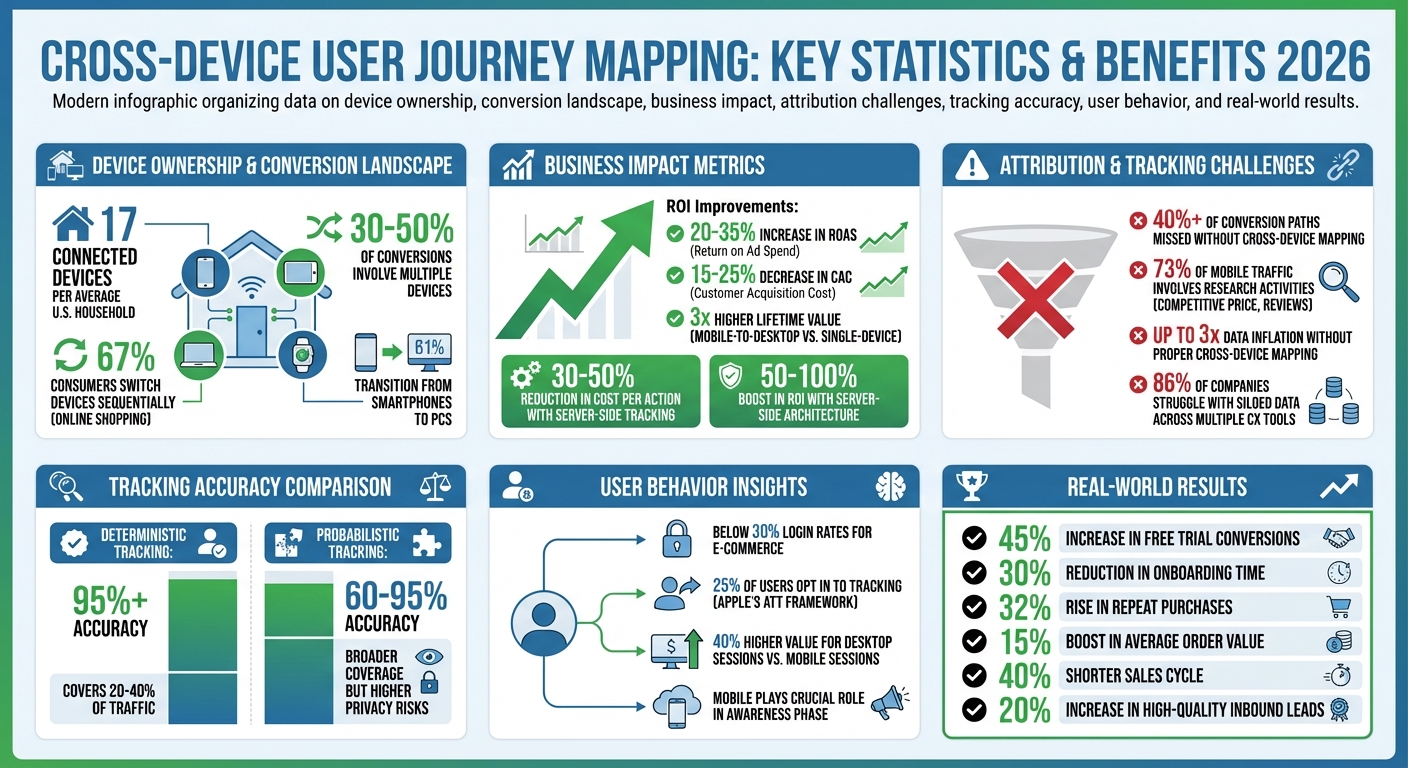
Cross-Device User Journey Mapping Statistics and Benefits 2026
Benefits and Challenges of Cross-Device Mapping
Benefits of Cross-Device Journey Mapping
Cross-device mapping can deliver big wins for businesses, including a 20–35% boost in ROAS and a 15–25% drop in CAC. But the real game-changer lies in how it sharpens attribution accuracy.
Accurate attribution is crucial because traditional analytics often miss the full picture. For instance, without cross-device mapping, over 40% of conversion paths can go unnoticed. Mobile campaigns, in particular, are frequently undervalued since many users don’t finalize purchases on their phones. Instead, they use mobile for research – 73% of mobile traffic involves activities like price comparisons and reading reviews before completing purchases on desktop. Connecting these dots ensures you’re not underestimating the channels driving awareness and can reallocate your budget where it counts.
Another advantage? Recognizing users across devices allows for smarter frequency capping, which reduces ad fatigue and improves personalization. This synchronization extends to shopping carts and user sessions, creating a seamless experience.
Cross-device users also prove to be more valuable. Customers who start their journey on mobile and finish on desktop have a 3x higher lifetime value compared to single-device users. Identifying these patterns helps you zero in on your most profitable customer segments and refine your funnel for better results.
While the benefits are clear, implementing cross-device mapping comes with its fair share of challenges.
Common Challenges in Cross-Device Tracking
Despite its potential, cross-device tracking isn’t without obstacles. Traditional cookies are tied to specific devices, fragmenting the user journey into disconnected data silos. And with changes like Safari’s 7-day cookie limit and Chrome phasing out third-party cookies by 2026, this issue has only grown.
Privacy regulations further complicate things. Laws like GDPR and CCPA classify identifiers such as IP addresses as personal data, requiring explicit user consent. Meanwhile, Apple’s App Tracking Transparency framework has led to only 25% of users opting in to tracking. This limits the data available for probabilistic matching. Platforms like Google and Meta offer deterministic tracking within their ecosystems, but their "walled gardens" restrict access to cross-channel data, making it tough to get a full view of the user journey.
The biggest challenge, however, is user identification. Login rates for e-commerce hover at below 30%, leaving most traffic anonymous. Without authentication, marketers must rely on probabilistic matching, which provides 70–85% accuracy, compared to the 95%+ accuracy of deterministic methods. This gap creates uncertainty, making it harder to act confidently on the insights.
Another major risk is data inflation. Without proper cross-device mapping, a single user interacting across three devices might be counted as three separate individuals, inflating success metrics by up to 3x. This distortion can make ROI calculations unreliable and lead to poor investment decisions for your marketing efforts.
sbb-itb-2ec70df
Step-by-Step Guide to Cross-Device User Journey Mapping
Define Objectives and Customer Personas
Start by setting clear goals for your cross-device mapping efforts. Are you aiming to boost retention, cut ad spending, or drive overall growth? Defining these objectives upfront not only helps you focus but also secures leadership support for the project. Additionally, decide the scope of your work – whether you’re addressing a specific issue or revamping the entire customer experience.
Bring together a cross-functional team with members from marketing, sales, customer success, and engineering. Each team offers unique insights into customer interactions, and combining these perspectives creates a richer understanding of how users engage with your brand across devices. Breaking down departmental silos is especially important, as 32% of marketers cite decentralized data as a top challenge.
When creating customer personas, rely on real data from tools like your Customer Data Platform (CDP) or CRM instead of assumptions. Different customer groups will have distinct behaviors – think mobile-first app users versus desktop researchers. Focus on your most common customer types or those associated with your highest-value products to maximize your impact. Ask meaningful questions like, “What problem is this customer trying to solve?” or “Why do they choose us over competitors?”. These insights will help you build personas that reflect real-world behavior.
Once you’ve nailed down your objectives and personas, it’s time to map out every customer touchpoint across devices.
Identify and Analyze Cross-Device Touchpoints
Mapping touchpoints effectively starts with unified data collection. This means gathering information from all interactions – whether it’s website visits, app sessions, ad clicks, or email engagements across mobile, desktop, and tablet. A comprehensive view is critical, especially with the increasing number of connected devices in households today.
Look for patterns by sequencing interactions. For example, many users research products on mobile but switch to desktop when it’s time to make a purchase. Understanding this "mobile-to-desktop" trend helps you value each touchpoint appropriately, particularly during the awareness phase. While desktop sessions typically deliver 40% higher value than mobile sessions, mobile often plays a crucial role in driving initial interest.
To dig deeper, server-side tracking can bypass browser restrictions and ad blockers. Pair this quantitative data with tools like session recordings or heatmaps to uncover why users drop off at certain points. For instance, unclear shipping costs or clunky mobile forms are common issues. Annotate your journey maps with key metrics like "time between steps" and "device mix" to identify where high-intent users are abandoning the process.
With a clear picture of cross-device touchpoints, the next step is linking user identities across these devices.
Unify User Identities Across Devices
To fully understand your customers, you need to connect their interactions across all devices. This requires robust tracking methods.
Deterministic tracking, which uses known identifiers like login credentials, offers over 99% accuracy but typically covers only 20–40% of traffic. Probabilistic tracking, on the other hand, uses data like IP addresses and device types to extend coverage with 60–95% accuracy, though it comes with higher privacy risks. As one privacy expert puts it:
"A device graph is only as legally clean as the consent layer that feeds it." – Secure Privacy
The best long-term approach is building a first-party identity graph. This involves using authenticated data from your CRM, such as hashed emails and user IDs. Encourage users to create accounts early by offering perks like saved preferences or access to exclusive content. Use a Consent Management Platform (CMP) to ensure that privacy preferences sync seamlessly across all devices. Stick to data minimization principles – only link devices when absolutely necessary, and prioritize deterministic methods over probabilistic ones wherever possible.
Best Practices and Tools for Cross-Device Journey Mapping
Best Practices for Effective Mapping
To build a reliable cross-device journey map, start by anchoring your tracking efforts in first-party data. Use authenticated identifiers like email hashes or CRM IDs to create a durable device graph. Encourage voluntary logins by offering value-exchange moments, such as personalized recommendations or loyalty rewards. As Amplitude aptly puts it:
"Privacy-first design and accurate measurement aren’t opposed; they’re complementary".
Switch to server-side tracking. By moving data collection from browsers to your servers, you can bypass ad blockers, ensure data quality, and verify consent signals. This strategy doesn’t just protect data integrity – it also reduces costs per action by 30–50% and can boost ROI by 50–100%. Additionally, server-side architecture ensures seamless data synchronization across platforms like GA4 and Meta, providing consistent and high-quality data for analysis.
Treat journey maps as dynamic assets. Update them quarterly or after major campaign launches and regulatory changes to keep them relevant. Use multi-layered visualizations to optimize your customer journey and tie your data to KPIs like ROAS, LTV, and CAC. Keep in mind that 86% of companies using multiple CX tools struggle with siloed data, so breaking down these barriers is critical for success.
Once you’ve established these best practices, the next step is selecting tools that can integrate seamlessly into your workflow.
Recommended Tools for 2026
The right tools can simplify even the most complex customer journeys. Here are some standout options for 2026:
- Improvado: This platform consolidates data from multiple sources into a single, unified view, helping to solve the fragmentation problem that many organizations face.
- Treasure Data: Ideal for enterprise-level automation, it specializes in identity resolution.
- MoEngage: Known for its ability to visualize and automate cross-channel customer journeys effectively.
For ensuring data integrity and identity resolution, Ingest Labs (with Ingest ID/IQ) offers server-side solutions that remain accurate even as privacy regulations evolve. Tools like Amplitude excel at connecting authenticated users across devices, making it easier to reconstruct journeys. It’s earned a 4.5/5 rating on G2 for its behavioral cohorts and retention analysis features.
Pair these quantitative tools with Hotjar, which starts at $32/month. Hotjar provides heatmaps and session recordings to uncover friction points in the customer experience. For creating formal, persona-based journey maps that teams can collaborate on, Smaply is a great choice, starting at $19/month.
To avoid data fragmentation, make sure your tools integrate across your CRM, ad platforms, and analytics systems. A unified view of your data ensures you can deliver consistent and actionable insights.
Cross device tracking
How Growth-onomics Supports Cross-Device User Journey Mapping

Growth-onomics employs a well-rounded approach to simplify cross-device tracking, blending customer journey mapping, data analytics, and performance marketing. Their strategies are tailored to align with CMS capabilities, target audiences, and business goals. This is particularly important as 67% of consumers switch devices sequentially when shopping online, with 61% transitioning from smartphones to PCs.
To unify user identities and eliminate data silos, Growth-onomics uses a comprehensive set of tools. Google Analytics handles attribution modeling across devices, Hotjar reveals friction points through heatmaps and session recordings, HubSpot CRM ensures a unified view of customers as they move between devices, and Zapier automates workflows for smoother transitions. These efforts have led to impressive results, such as a 45% increase in free trial conversions and a 30% reduction in onboarding time.
Regular monthly audits ensure that journey maps stay relevant by adapting to changing user behaviors and market trends. Growth-onomics focuses on optimizing key transitions – like moving from mobile to desktop – which are critical for improving conversion rates. For instance, an e-commerce client saw a 32% rise in repeat purchases and a 15% boost in average order value by implementing dynamic remarketing and segmenting VIP customers.
The agency offers flexible pricing plans to meet varying business needs. The Starter plan at $999/month includes monthly audits and behavior analysis. The Advance plan at $1,599/month adds insights and CMS analysis, while the Full Site Audit at $1,900 provides an in-depth evaluation of key pages. These options allow businesses to scale their cross-device tracking efforts as needed.
Beyond mapping, Growth-onomics turns insights into actionable strategies. By using tools like behavioral email automation, personalized in-app messaging, and automated lead scoring, they help businesses deliver consistent cross-device experiences. For example, a B2B client revamped its lead nurturing approach, shortening the sales cycle by 40% and increasing high-quality inbound leads by 20%.
Conclusion: The Future of Cross-Device Journey Mapping
Cross-device journey mapping has become a necessity for businesses in 2026. With the average U.S. household owning 17 connected devices and 30% to 50% of all conversions involving multiple devices, companies that fail to see customers as part of a unified journey are missing major opportunities. The numbers speak for themselves: effective cross-device mapping can increase ROAS by 20–35% and reduce CAC by 15–25%, all while moving away from outdated cookie tracking toward first-party and server-side solutions.
Deterministic matching, driven by authenticated experiences, now achieves over 95% accuracy. Meanwhile, AI-powered identity resolution bridges the gaps for anonymous users. Privacy-preserving tools like differential privacy and data clean rooms strike a balance between accurate attribution and compliance with privacy regulations. These advancements mark a clear shift from traditional tracking methods to privacy-first, modern approaches.
"In 2026 and beyond, the winners won’t be those with the biggest marketing budgets – they’ll be those who understand the complete, multi-device customer journey and optimize for the reality of how people actually shop." – Denise Cullom, Operations Lead, SegMetrics
This perspective highlights the urgency of adapting tracking strategies. Encourage authentication by offering meaningful value – loyalty programs, personalized recommendations, or exclusive content that motivates users to log in. Embrace server-side tracking to overcome browser restrictions, ensure seamless experiences across devices, and adopt multi-touch attribution models that capture the entire journey, from mobile discovery to desktop purchase.
Recognizing cross-device behaviors – especially the higher lifetime value of mobile-first users – and optimizing for these patterns is no longer optional. It’s the cornerstone of marketing success in 2026 and beyond.
FAQs
How can I map journeys without third-party cookies in 2026?
Mapping user journeys in a world without third-party cookies by 2026 calls for methods that respect privacy while still delivering insights. Techniques like cookieless attribution, anonymized data, and data clean rooms are key players here. Tools such as Google Analytics 4 (GA4) leverage features like User-ID tracking, Google Signals, and device IDs to connect activity across multiple devices.
The spotlight is now on first-party data, robust consent management systems, and privacy-first frameworks. These approaches not only align with regulations like CCPA and GDPR but also allow businesses to effectively map customer journeys in a cookieless landscape.
What’s the best way to connect users across devices with low login rates?
To link users across different devices with minimal login activity, blend deterministic tracking (which relies on login data) with probabilistic methods (like examining IP addresses, browser configurations, and device attributes). Platforms such as Google Analytics 4 (GA4) and privacy-focused identity resolution tools can help refine user mapping. This strategy builds unified customer profiles, even for users who remain anonymous, giving businesses deeper insights into multi-device journeys without depending heavily on logins.
How do I measure cross-device impact on ROAS, CAC, and LTV?
To get a clear picture of how cross-device behavior affects metrics like ROAS (Return on Ad Spend), CAC (Customer Acquisition Cost), and LTV (Lifetime Value), start by using cross-device analytics to unify user data across different devices. Activate User-ID tracking and Google Signals to link user activities across devices, especially for logged-in users.
Focus on tracking key indicators, such as user counts, engagement rates, and multi-touch attribution models. These tools help you accurately attribute conversions to the right devices, giving you deeper insights into how each device plays a role in driving conversions and shaping these critical metrics.