


Cross-channel journey mapping helps businesses understand how customers interact across different platforms, like websites, apps, social media, and physical stores. By mapping these journeys, companies can identify pain points, improve customer experiences, and drive growth.
Here’s what you need to know:
- 73% of consumers expect brands to understand their needs, but 43.6% of marketers struggle to pinpoint gaps in the customer journey.
- Companies using journey mapping have reported up to a 15% revenue increase, reduced churn, and improved customer satisfaction.
- The process involves integrating data, identifying friction points, and creating smoother customer experiences.
This article explores how five companies – Hotjar, Rail Europe, Rewind, Emirates, and Airbnb – used journey mapping to solve challenges and achieve measurable results. From streamlining travel bookings to improving pre-sales processes, these examples show how mapping customer journeys can transform business outcomes.
How to Map a Real Customer Journey
sbb-itb-2ec70df
Case Study 1: Hotjar‘s Analytics-Driven B2B Journey Mapping
Hotjar, a platform trusted by more than 1.3 million websites across 180+ countries, managed to map out its focused product testing journey in just 2–3 days.
To achieve this, Hotjar combined two key data sources: quantitative data from tools like Google Analytics and its own features (such as heatmaps and session replays) with qualitative insights gathered through surveys and user interviews. This mix of hard numbers and personal feedback offered a well-rounded view of the user experience.
Before moving to a digital approach, teams from UX, development, engineering, and customer success came together to create empathy maps. These maps helped identify major issues like usability challenges and journey friction, technical bottlenecks, and customer support pain points.
The finalized journey map captured emotional highs and lows – from the frustration of navigating complex data to the "aha moments" when users realized the product’s value. This clarity helped teams prioritize improvements and replicate what worked.
Case Study 2: Rail Europe‘s Multichannel Travel Booking Journey
Rail Europe faced a challenge familiar to many in the travel industry: customers rarely stick to a straightforward buying process. Studies reveal that travelers trying to make a single reservation online typically switch between different websites and mobile platforms nearly six times on average. This behavior called for a fresh approach to understanding and improving the customer journey.
To address this, Rail Europe developed a customer journey map that broke the experience into three primary phases: before the trip, during the trip, and after the trip. The map captured the non-linear nature of how customers moved between channels, emphasizing frequent transitions among researching, planning, and shopping. By categorizing interactions into "research and planning", "shopping", and "booking", the company could better handle the complexity of multichannel data. They also mapped out travelers’ thoughts, emotions, and frustrations, including stress points tied to travel. These insights became the foundation for targeted improvements.
Each stage of the journey was evaluated based on satisfaction, helpfulness, and relevance, which revealed pain points like issues with physical ticket delivery.
On an organizational level, the mapping process clarified team roles and responsibilities, breaking down silos between departments. The resulting journey map became a standalone tool that fostered better cross-departmental understanding and collaboration.
Case Study 3: Rewind‘s Pre-Website B2B Buyer Journey
Rewind, a SaaS backup solution, wanted to dig deeper into what drives potential customers before they ever land on its website. While sales calls and CRM data provided insights into customer behavior after the first contact, they left a blind spot: the initial stages of the buyer’s decision-making process. To bridge this gap, Rewind conducted direct customer interviews and aligned the findings with a well-defined Ideal Customer Profile (ICP).
Rather than leaning solely on surveys, Rewind opted for interviews to uncover specific triggers – like data loss incidents or new compliance requirements – that pushed customers to seek out backup solutions. They also discovered that many high-intent leads were coming from unexpected sources, such as app marketplaces and professional forums – channels their marketing efforts had largely overlooked. These revelations led to a major shift in their approach.
With this new understanding, Rewind made strategic adjustments. As Ryan Paul Gibson, Founder of Content Lift, pointed out, buyers typically prefer to research independently before engaging with sales and value a chance to try a product before committing. Rewind responded by removing barriers like mandatory demos and credit card requirements for trials, making the experience more seamless for potential customers.
The results were striking: Rewind doubled its product installations, unearthed a new market segment centered on data compliance, and fine-tuned its strategy to better align with buyer motivations and ensure stronger internal alignment with their ICP.
Case Study 4: Emirates Airline’s Multi-Channel Travel Experience
Emirates faced a major challenge: thousands of disconnected customer interactions spread across reservations, kiosks, call centers, mobile apps, and onboarding processes. To fix this, the airline carefully mapped out every customer touchpoint – from the moment someone thought about booking a flight to the moment they stepped onto the plane. By unifying the systems behind these interactions, Emirates laid the groundwork for smarter, data-driven operations.
The airline took a massive step by consolidating around 10,000 data pipelines into a single analytics platform. This platform became the go-to resource for over 12,000 global users, offering a unified view of customer behavior. Emirates also introduced a virtual contact center to ensure consistent service across all channels. This streamlined system became their "single source of truth", helping the airline better understand and respond to customer needs.
"Data is the new gold, and it’s a part of our DNA in every department. It is the central pillar that drives all the transformation we do today." – Naveed Memon, Vice President of Enterprise Data & Analytics, Emirates
The results were impressive. Emirates revamped its mobile app, allowing customers to check in as quickly as six seconds. Meanwhile, after optimizing emirates.com for mobile users, the website saw a 20% drop in bounce rate. In October 2020, the airline rolled out 48 biometric-enabled self-service kiosks at Dubai International Airport. These kiosks, equipped with over 600 screens, were built using the same unified system that powered both their web and mobile platforms. This contactless experience not only improved safety but also sped up the travel process.
One standout innovation was Emirates’ predictive meal recommendation model. By analyzing passenger data, the airline achieved an impressive 95% accuracy in predicting travelers’ first meal choices. This not only added a personal touch to the in-flight experience but also significantly cut down on food waste while boosting customer satisfaction.
Case Study 5: Airbnb‘s Cross-Platform Social Media Journey
In 2020, Airbnb made a bold move by shifting from paid performance marketing to a strategy centered on PR-driven brand awareness. This decision allowed Airbnb to cut its marketing budget to zero while still retaining 95% of the traffic it had seen the previous year.
This approach became the backbone of Airbnb’s impressive organic growth. By turning its name into a verb and focusing on branded SEO, Airbnb managed to rack up 713.5 million visits and inspire over 500,000 PR articles in 2020 – all without spending on paid media. Its PR efforts gave the company a share of voice that rivaled major travel brands.
To refine its strategy further, Airbnb leaned into programmatic SEO by creating localized landing pages, such as "Airbnb in [City]", to target high-intent searches. For example, in Ireland, monthly searches for "Airbnb in Ireland" (over 27,000) far outpaced those for "hotel in Ireland" (14,800). Additionally, Airbnb’s website amassed more than 640 million backlinks, with organic SEO driving 24% of its traffic.
In less saturated markets like Latin America and Asia, Airbnb adopted a localized marketing approach to grow its presence. By fine-tuning channels and targeting the right audiences, the company demonstrated how understanding customer journeys can lead to tailored engagement. By mapping where branded searches originated and identifying cross-platform touchpoints, Airbnb focused on building trust and awareness rather than simply chasing clicks.
Airbnb’s success shows how mapping customer journeys across platforms can fuel growth through organic, trust-based connections.
Key Takeaways from Cross-Channel Journey Mapping
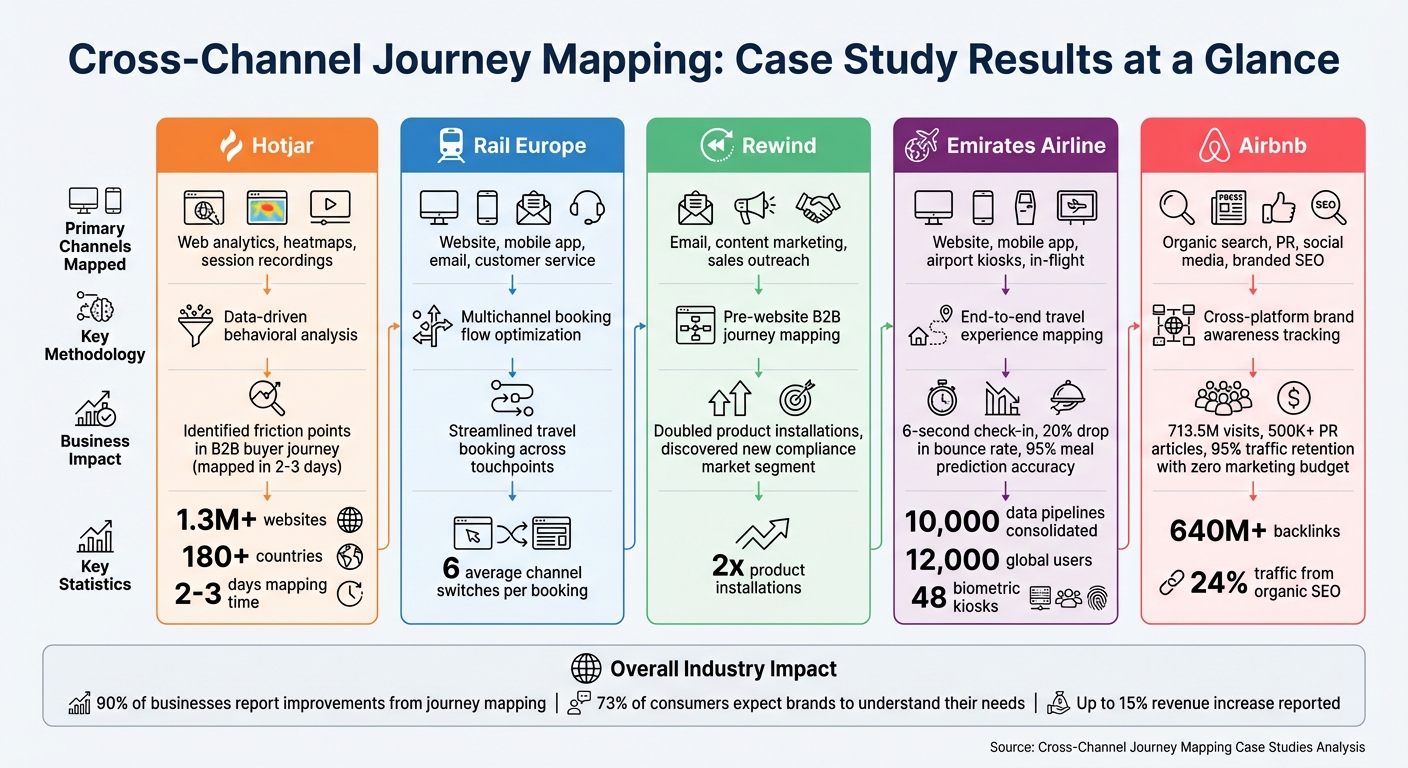
Cross-Channel Journey Mapping Results: 5 Company Case Studies Comparison
These case studies highlight that effective journey mapping starts with integrating data and ends with personalized actions. Companies leading the way in this area rely on a unified identifier to connect data from web, mobile, and offline channels, creating a single, person-level profile instead of relying on device or cookie tracking. This process, known as identity resolution, is essential for understanding how customers move seamlessly between channels.
The process typically begins with current-state maps to identify gaps and churn points. From there, organizations develop future-state maps to design smoother, more engaging experiences. Techniques like empathy mapping and service blueprinting help align customer emotions, business objectives, and behind-the-scenes processes.
The results speak for themselves. Nearly 90% of businesses that use customer journey mapping report improvements, including higher customer satisfaction and reduced churn. Additionally, more than half of customers now interact with three to five channels during a single journey.
One key takeaway from these case studies is the importance of focusing on high-impact journeys. Start by prioritizing the top two or three journeys that matter most. Tools like customer shadowing or diaries can provide valuable insights into real-world experiences, helping identify friction points such as repetitive login requests.
Modern Customer Data Platforms (CDPs) have transformed this process by offering a real-time, unified 360-degree view of customers – something legacy systems struggle to achieve. This isn’t just about being present on multiple platforms; it’s about ensuring that data flows with the customer. For example, saved carts should persist across devices, and support agents should have access to recent browsing history.
The comparison table below summarizes the results from several case studies.
Comparison Table of Case Study Results
| Company | Primary Channels Mapped | Key Methodology | Business Impact |
|---|---|---|---|
| Hotjar | Web analytics, heatmaps, session recordings | Data-driven behavioral analysis | Identified friction points in the B2B buyer journey |
| Rail Europe | Website, mobile app, email, customer service | Multichannel booking flow optimization | Streamlined travel booking across touchpoints |
| Rewind | Email, content marketing, sales outreach | Pre-website B2B journey mapping | Validated product-market fit before launch |
| Emirates Airline | Website, mobile app, airport kiosks, in-flight | End-to-end travel experience mapping | Delivered a seamless experience from booking to landing |
| Airbnb | Organic search, PR, social media, branded SEO | Cross-platform brand awareness tracking | Enhanced cross-channel brand awareness |
Conclusion
Cross-channel journey mapping has become a critical strategy for businesses aiming to remain competitive. Customers today expect smooth, interconnected experiences across all channels, and failing to meet these expectations can lead to losing their loyalty. In fact, recent data reveals that 71% of consumers switched brands at least once in the past year.
The results from companies that have embraced this approach are hard to ignore. For instance, NA-KD reported a staggering 72x return on investment within a year and boosted customer lifetime value by 25% through unified omnichannel efforts. Generali managed to triple its lead generation and cut its sales cycle by 20%. Meanwhile, Telus saw a 20% improvement in customer satisfaction and a 25% increase in the use of cost-effective digital channels.
These outcomes highlight the power of breaking down silos, unifying data, and addressing key areas of customer friction. Start small by focusing on one or two impactful journeys, walking in your customers’ shoes to identify pain points, and leveraging a Customer Data Platform to gain a complete perspective. As Adam Justis of Adobe Marketing Cloud aptly states:
"Relationships aren’t about isolated interactions. They are about a series of interactions that are increasingly happening across multiple channels, devices, and departments".
For businesses ready to take the next step, Growth-onomics offers services to help map customer journeys, unify fragmented data, and create seamless experiences. By combining expertise in data analytics, user experience, and performance marketing, Growth-onomics helps transform disconnected touchpoints into cohesive journeys that fuel growth.
FAQs
How does cross-channel journey mapping improve customer experience and boost revenue?
Cross-channel journey mapping enables businesses to deliver a smooth and consistent customer experience by linking every interaction – whether it’s a social media ad, a mobile app, a website visit, or an in-store purchase – into one cohesive path. This approach helps companies spot and fix problems, like abandoned shopping carts or mismatched product details, before they escalate into lost sales. Plus, by tailoring messages in real time based on customer actions, businesses can boost conversions and see revenue increases of 5%–15%.
For customers, this seamless experience translates to greater satisfaction and loyalty. When messaging is clear and offers are timely and relevant, interactions feel more meaningful, which builds trust and enhances the overall experience. Companies that successfully implement journey mapping often notice fewer drop-offs, higher average order values, and more repeat purchases – all of which support long-term growth. Growth-onomics specializes in leveraging data-driven journey mapping strategies to help U.S. businesses achieve these impactful outcomes.
How can businesses identify customer pain points across different channels?
To get a clear picture of customer pain points across different channels, start by developing a cross-channel journey map. This tool visually lays out every step of the customer’s interaction with your brand, highlighting emotional reactions and unmet needs. It’s especially useful for spotting problem areas, like discrepancies between online and in-store experiences or lost cart data when users switch devices.
Next, dig into behavioral data from all touchpoints – whether it’s your website, mobile app, physical store, or support channels. Combine this data with qualitative feedback, such as customer surveys or interviews, to gain deeper insight into where users encounter obstacles and why those issues arise.
Finally, focus on solutions that will have the biggest impact. For instance, you might prioritize reducing checkout abandonment rates or making transitions between channels smoother. Keep your journey map updated regularly and track key metrics to stay on top of emerging issues and ensure your customers enjoy a seamless experience.
How do companies like Airbnb and Emirates use cross-channel journey mapping to improve customer experiences?
While the specifics of how Airbnb or Emirates have applied cross-channel journey mapping to improve customer experiences aren’t outlined in the available sources, this approach is commonly used to pinpoint issues, simplify interactions, and ensure smooth experiences across various platforms.
For a deeper dive into how businesses use this method effectively, take a look at the case studies featured in the article. They highlight strategies that have successfully boosted growth and enhanced customer satisfaction.
