


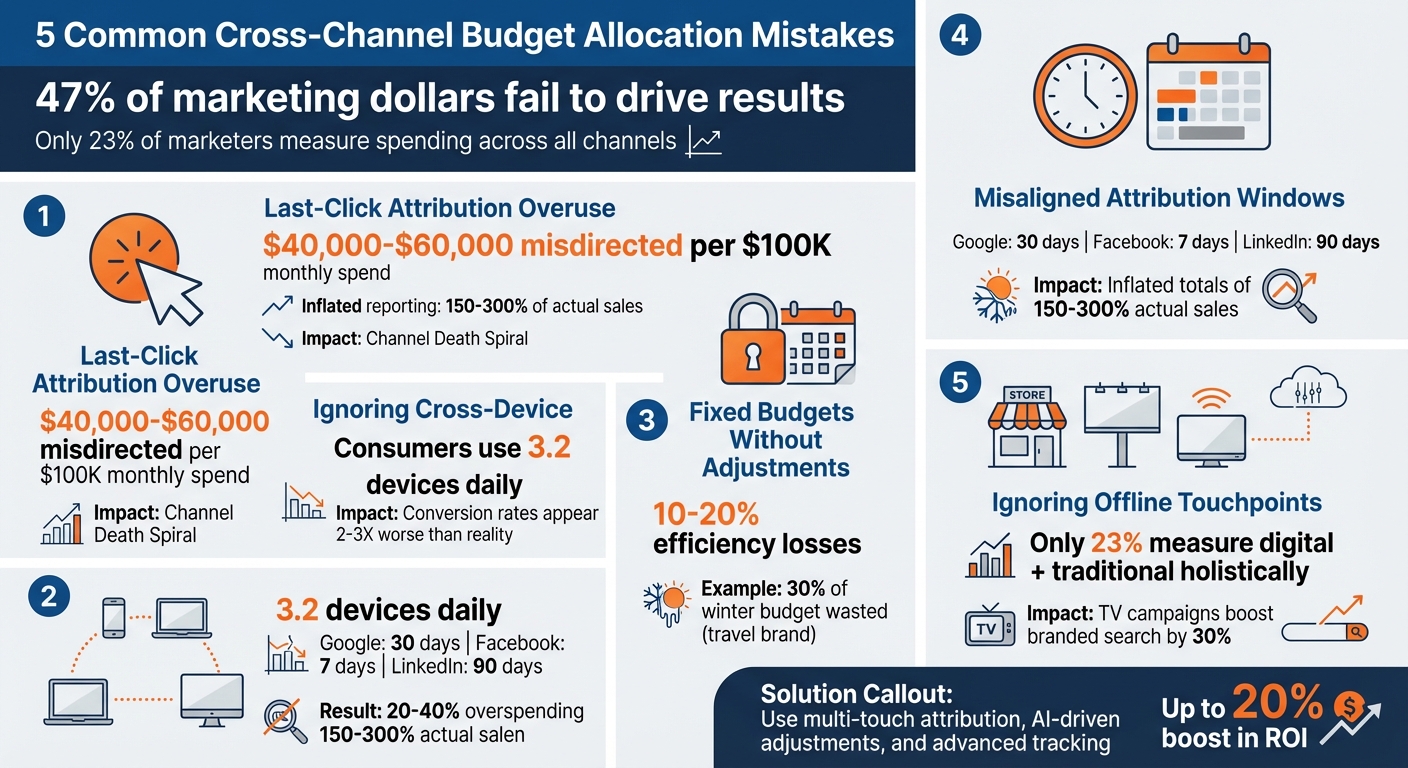
Most businesses waste nearly half their marketing spend due to poor budget allocation. This happens because they focus on the wrong channels, rely on outdated attribution models, and fail to account for how customers interact across multiple touchpoints. For example, 47% of marketing dollars fail to drive results, and only 23% of marketers measure spending across all channels. The result? Misallocated budgets, wasted resources, and declining ROI.
Here are the five most common mistakes businesses make when allocating marketing budgets:
- Last-Click Attribution Overuse: Gives all credit to the final touchpoint, ignoring the role of awareness and demand-building channels.
- Ignoring Cross-Device Journeys: Fails to track how users switch between devices, leading to inaccurate data.
- Fixed Budgets: Locks spending into ineffective channels, ignoring changes in market conditions.
- Misaligned Attribution Windows: Uses timeframes that don’t match the sales cycle, skewing channel performance data.
- Neglecting Offline Touchpoints: Overlooks the impact of non-digital interactions like TV ads or in-store visits.
The solution? Use multi-touch attribution models, advanced tracking tools, and AI-driven budget adjustments to ensure every dollar works harder. Businesses that adopt these strategies can see up to a 20% boost in ROI and prevent wasted spend. By tracking the full customer journey and reallocating funds to underutilized channels, companies can create a more effective and balanced marketing strategy.
5 Common Cross-Channel Marketing Budget Allocation Mistakes
How to allocate budget in multi channel marketing?
sbb-itb-2ec70df
Common Mistakes in Cross-Channel Budget Allocation
Understanding where budget allocation goes wrong is a key step in addressing inefficiencies. These five common mistakes can quietly drain marketing budgets, often without businesses realizing until the damage is done.
Mistake 1: Relying Too Much on Last-Click Attribution
Last-click attribution gives all the credit for a conversion to the final channel a customer interacted with, ignoring the earlier touchpoints that played a role. For example, a customer might first see your brand through a LinkedIn video, research further using organic search, and then click a retargeting ad to make a purchase. Last-click attribution would credit only the retargeting ad, overlooking the channels that built awareness and interest.
This misattribution often leads to the "Channel Death Spiral." If last-click data shows that social media or display ads aren’t directly converting, businesses may cut their budgets. However, these channels are often responsible for creating demand that other channels, like branded search, capitalize on. When top-of-funnel channels are underfunded, even the "best-performing" channels start to falter. For a company spending $100,000 monthly, this flawed model can misdirect $40,000-$60,000 to the wrong channels.
Another issue is inflated reporting when platforms claim overlapping credit for the same conversion, often totaling 150-300% of actual sales. It’s no wonder 51% of CTOs and Chief Data Officers express distrust in advertising platform data.
"We were spending $200K monthly on Google Ads with a reported 4.5X ROAS. When we implemented first-party attribution, the true ROAS was 2.1X. We’d been losing money for 18 months." – VP of Marketing, $50M e-commerce brand
Billy Footwear offers a real-world example. In 2025, the brand adopted multi-touch attribution through LayerFive. They discovered that Meta awareness campaigns were driving 3X more downstream conversions than last-click data suggested. By shifting budget from overfunded Google Shopping to these underfunded awareness campaigns, the company increased ad revenue 72% year-over-year with just a 7% increase in ad spend – achieving a 10.3X improvement in efficiency.
Last-click models also ignore the "halo effect", where one channel amplifies another. For instance, a TV campaign might boost branded search traffic by 30%, but last-click attribution assigns no value to the TV spend. Similarly, up to 95% of purchases can involve view-through conversions (impressions) that last-click models completely miss.
Mistake 2: Ignoring Cross-Device and Cross-Channel Customer Journeys
Modern consumers use an average of 3.2 devices daily to browse the internet. A single customer might see your ad on their phone during their commute, research your product on a work laptop, and complete the purchase on a home desktop. Without proper tracking, this multi-device journey might appear as separate users, skewing your data.
This creates an "Attribution Black Hole." When you fail to connect the dots between devices and channels, your conversion rates can seem 2-3X worse than they actually are. Poor cross-device tracking leads to inaccurate metrics and misinformed decisions, often resulting in 20-40% overspending on acquisition efforts.
The ripple effects are significant. Many companies underfund awareness-building channels by 30-50% because their impact is harder to measure. For example, a mobile ad might spark interest, but if the purchase happens days later on a desktop, the mobile channel gets no credit. This can lead to budget cuts for channels that are actually driving sales.
"If you stripped out a channel from your plan, conversions in other channels would also go away because those other channels are now less effective." – Jesse Math, Keen
Privacy changes have made tracking even harder. Safari, for instance, now expires some first-party cookies after just seven days, breaking the link between early interactions and final conversions. This makes returning visitors appear as new users, further distorting your understanding of customer journeys.
Mistake 3: Using Fixed Budgets Without Adjustments
Fixed budgets might make planning easier, but they can lock you into inefficient spending. Markets evolve, customer behavior shifts, and channels hit saturation points – yet fixed budgets often fail to account for these changes.
For example, once a channel reaches its effective reach, additional spending yields diminishing returns. Fixed budgets, however, continue to pour money into these saturated channels while leaving others underfunded. This can lead to 10-20% efficiency losses. A travel brand that spreads its budget evenly across the year might waste 30% of its winter budget, which would have been far more impactful during peak spring booking season.
"Marketing spend is capital… marketers must forecast returns the way investors do: expected value, risk, time horizon." – Angela Winegar, Head of Growth, Carta
Fixed budgets also ignore the synergies between channels. For instance, a TV campaign might boost digital performance by 15%, but rigid allocations prevent marketers from capitalizing on such opportunities. Similarly, when a channel underperforms, fixed budgets don’t allow for quick adjustments to minimize losses.
Mistake 4: Using Misaligned Attribution Windows
Advertising platforms often use different default attribution windows – the timeframes during which they claim credit for a conversion. For example, Google Ads might use a 30-day window, Facebook a 7-day window, and LinkedIn a 90-day window. If these windows don’t align with your actual sales cycle, the data becomes unreliable.
For B2B companies with 6-month sales cycles, a 7-day attribution window misses most of the journey. On the other hand, for impulse purchases completed within hours, a 90-day window inflates the channel’s value. This inconsistency makes it nearly impossible to compare performance across platforms.
Misaligned windows can create misleading impressions. A channel with a longer window might appear to outperform others simply because it captures more conversions by default. Conversely, a channel with a shorter window might seem ineffective, even if its long-term impact is significant. When platforms overlap, the problem worsens, with multiple platforms claiming credit for the same conversion, often inflating reported totals to 150-300% of actual sales.
Mistake 5: Ignoring Offline and Untracked Touchpoints
Digital attribution tools are limited to online interactions, but customers often engage with brands in the physical world. They see billboards, hear radio ads, visit stores, attend events, and talk to sales reps. Ignoring these offline touchpoints leads to incomplete ROI calculations.
Shockingly, only 23% of European marketers measure both digital and traditional media spending holistically. The rest rely on incomplete data, undervaluing channels that drive real results but don’t fit neatly into digital tracking systems.
For example, a TV campaign might significantly boost brand awareness, driving customers to search for your brand online and convert. However, last-click attribution would give all the credit to the search ad, leading you to believe the TV campaign was ineffective. Similarly, word-of-mouth referrals and in-store experiences often go untracked, even though they play a critical role in purchase decisions.
"Traditional reporting can’t capture these dynamics because it measures channels in silos rather than as an interconnected system." – Analytical Alley
This misalignment creates a cycle where easily trackable channels receive more funding, while harder-to-track but impactful channels are neglected. Over time, your budget allocation reflects only what’s visible, not what’s truly effective.
Solutions to Avoid Common Budget Allocation Mistakes
Now that we’ve outlined the common pitfalls, let’s dive into actionable solutions. These strategies aim to address the root causes of misallocated budgets, helping you make smarter, data-driven decisions.
Solution 1: Use Multi-Touch Attribution Models
Multi-touch attribution (MTA) assigns credit to every touchpoint in a customer’s journey, giving you a clearer picture of each channel’s contribution. Unlike single-touch models that overemphasize the final click, MTA recognizes the role of multiple interactions. This approach ensures you don’t undervalue upper-funnel activities while avoiding over-crediting lower-funnel channels like search.
The best attribution model depends on your sales cycle. For example:
- Linear Attribution: Distributes credit equally across all touchpoints, offering a basic overview.
- Time Decay: Prioritizes recent interactions, ideal for shorter sales cycles.
- W-Shaped Attribution: Highlights key milestones like awareness, lead creation, and conversion, making it a strong choice for B2B companies.
A SaaS company that adopted W-shaped attribution alongside other methods reported a 31% improvement in marketing ROI and reduced payback periods by 2.5 months.
"MTA gives you the microscope, MMM gives you the telescope, and single-touch still has a place as a simple directional compass." – Jack Browning, Northbeam
MTA also helps pinpoint diminishing returns. By calculating each channel’s marginal return, you can prioritize high-performing programs and shift budgets away from saturated channels. This method has been shown to boost marketing ROI by 15%-20%.
Steps to take:
- Choose an attribution model that aligns with your sales cycle.
- Regularly reconcile attribution data with actual spend and bookings. Use incrementality testing to validate each channel’s contribution.
Once your attribution model is in place, the next step is integrating data sources to map the entire customer journey.
Solution 2: Implement Advanced Tracking and CRM Integration
To address gaps in attribution and fully capture the customer journey, you’ll need centralized tracking that connects online and offline interactions. Start by standardizing your data definitions – ensure metrics like "conversions" in Facebook align with "goals" in Google Analytics before integrating systems. Then, use ETL (Extract, Transform, Load) tools to consolidate data from platforms like Google Ads, social media, and your CRM into one central hub.
Identity resolution is key. By linking fragmented user identities (e.g., mobile device IDs and CRM email addresses), you can create unified customer profiles. Without this step, interactions across multiple devices might appear as separate users, skewing your metrics. Consolidate this cleaned data into a centralized warehouse like BigQuery or Snowflake for faster analysis.
"Improvado helped us gain full control over our marketing data globally… It saves us about 90 hours per week and allows us to focus on data analysis rather than routine data aggregation." – Jeff Lee, ASUS
To ensure no interaction is missed, deploy tracking pixels and UTM parameters across all channels. Integrate your CRM (e.g., Salesforce or HubSpot) with analytics platforms to track the entire lifecycle – from awareness to conversion and beyond. This integration has shown that customers are 3.5× more likely to buy when recognized across multiple channels, and average order values increase by 13% when messaging adapts to prior touchpoints.
Steps to take:
- Audit your media mix from the past 6–12 months to identify blind spots or saturation points.
- Ensure compliance with data privacy regulations like GDPR and CCPA to avoid invalidating data.
- Use bi-directional APIs to automate optimized budget allocations across platforms.
Solution 3: Automate Budget Adjustments with AI
AI-driven platforms can dynamically adjust budgets across channels in real time, moving beyond manual adjustments. These tools analyze data from sources like GA4, server events, and CRMs to predict the marginal revenue per dollar for each channel. They then prioritize spending based on Customer Lifetime Value (LTV) forecasts.
For instance, an ecommerce brand redirected 15% of its budget from Meta to TikTok using AI and saw a 22% improvement in its Marketing Efficiency Ratio (MER) without increasing total spend. Similarly, a SaaS company shifted funds from Google Search to LinkedIn and reduced its Customer Acquisition Cost (CAC) by 19%.
"AI budget optimization doesn’t replace marketers – it frees them from spreadsheet shuffles to focus on creative and positioning." – RevenueXpress
However, AI requires oversight. Set minimum and maximum spend thresholds to respect business constraints. Review AI recommendations weekly, retrain models monthly to prevent data drift, and update guardrails quarterly. Use scenario planning to test "what-if" scenarios before committing funds, with modern MMM platforms offering forecasts accurate within a 4% margin of error.
Steps to take:
- Implement server-side tracking and event deduplication to ensure accurate AI inputs.
- Standardize UTM parameters across channels to improve AI’s ability to compare performance metrics.
Solution 4: Customize Attribution Windows
Aligning attribution windows with your sales cycle is vital. Using default windows can lead to misattributed value. For example, a 7-day window might miss key interactions in longer B2B sales cycles, while a 90-day window might inflate the value of channels for quick purchases.
Start by mapping your customer journey into four stages – Awareness, Consideration, Conversion, and Loyalty – and assign specific KPIs to each. Awareness campaigns might focus on brand lift, consideration channels on engagement, and conversion channels on incremental ROAS (iROAS).
Once you understand the typical time between touchpoints, adjust your attribution windows accordingly. For instance, use a 14-day window if most conversions occur within two weeks, or extend it to 90 days for longer cycles.
Steps to take:
- Analyze 6–12 months of historical data to understand your sales cycle.
- Reconcile attribution data with financial data monthly to ensure accuracy.
Solution 5: Include Offline Touchpoints in Data Analysis
Offline interactions – like events, billboards, and in-store visits – are often overlooked in digital attribution. To bridge this gap, tag offline activities with unique identifiers (e.g., promo codes for radio ads or QR codes for billboards) and integrate this data with digital metrics. For example, CRM data can track in-store purchases and sales rep interactions, revealing how offline channels influence online conversions.
This approach can also uncover the "halo effect." For instance, a TV campaign might boost branded search traffic by 30%, even though last-click attribution wouldn’t credit the TV spend.
Steps to take:
- Map the customer journey across all stages and align KPIs to each.
- Use unique identifiers to connect offline and online interactions, ensuring a complete view of your marketing efforts.
Advanced Optimization Strategies for Cross-Channel Budgeting
Take your budget allocation to the next level with advanced strategies that blend cutting-edge technology and expertise. These methods aim to make every marketing dollar work harder, starting with the power of machine learning for real-time spend adjustments.
Using Machine Learning for Budget Optimization
Machine learning (ML) offers a smarter way to identify diminishing returns on marketing spend by focusing on incremental revenue rather than average returns. Why does this matter? A channel that looks great overall might hit a saturation point where additional spending yields little benefit. ML can pinpoint these saturation levels by analyzing market-response models across channels. For instance, it can show how TV ads boost branded search traffic – something traditional last-click attribution might miss.
Currently, only 17.2% of marketers use AI/ML in their strategies, but this is projected to grow to 44.2% within three years.
"Machine learning shifts the focus from reactive, performance-only reporting to proactive, ROI-centered allocation." – Eliya
AI tools also save significant time, cutting manual budget analysis from 12–18 hours to just 2–3 hours. They help prioritize spending based on Customer Lifetime Value (LTV) predictions instead of short-term gains. To make this work, ensure your data is clean and accurate – this is critical for training effective ML models, as outlined in tracking and CRM integration practices.
How to get started:
- Use at least 12–18 months of stable historical data on spend and performance.
- Set minimum and maximum spend limits for each channel to keep AI recommendations practical.
- Refresh your models monthly to account for seasonal trends and market shifts.
In addition to ML, scenario planning can help you visualize potential outcomes before committing your budget.
Scenario Planning and AI-Driven Budget Shifting
Scenario planning allows you to test hypothetical budget adjustments without spending a dime. AI platforms can simulate "what-if" scenarios, like reallocating 10% of your budget from one channel to another, and predict outcomes with up to 95% confidence.
This works because AI focuses on marginal Return on Ad Spend (ROAS) instead of average performance. Unlike older models that rely solely on historical data, AI systems use reinforcement learning to make real-time budget adjustments within preset boundaries. However, human oversight remains essential. You’ll need to set clear rules, such as maintaining minimum brand visibility, respecting geographic limits, and capping channel allocations.
A great starting point is the 70/20/10 framework:
- 70% goes to proven performers.
- 20% targets promising opportunities.
- 10% supports experimental channels.
AI can fine-tune these allocations based on actual performance. To stay on track, review AI recommendations weekly, refresh models monthly, and adjust guardrails quarterly.
"The biggest ROI gains do not come from better dashboards, but from systematically putting dollars into the most productive channels." – Single Grain
Before making major changes – like during product launches or promotions – run simulations to account for variables that might not show up in historical data.
Working with Growth-onomics for Expert Guidance
While AI tools are powerful, expert guidance ensures they align with your broader business goals. Growth-onomics (https://growth-onomics.com) specializes in performance marketing and data analytics, helping businesses master cross-channel budget optimization. Their services include Data Analytics, Performance Marketing, and Customer Journey Mapping.
Consultants can guide you in choosing the right modeling approach:
- Marketing Mix Modeling (MMM) for long-term planning.
- Multi-Touch Attribution (MTA) for more detailed, digital-focused adjustments.
They also audit your data to ensure accuracy, implement server-side tracking, and prevent issues like model drift that could undermine AI results. With marketing budgets shrinking – down 7.7% relative to company revenue – every dollar must be accounted for. Growth-onomics bridges the gap between CMOs and CFOs by tying marketing spend directly to revenue goals, ensuring measurable ROI. Smarter budget decisions can yield a 140–400% ROI over three years.
"In 2025, the most efficient advertisers will trust AI with allocation while steering it with clear goals and guardrails." – RevenueXpressUSA
When to seek expert help: Consider hiring professionals if:
- Paid media accounts for more than 30% of your marketing budget.
- You’re new to AI-driven optimization.
- You struggle to align attribution data with business outcomes.
Experts can also help allocate 10–15% of your budget to testing new channels while managing risk.
Conclusion
Achieving effective cross-channel allocation is within reach, but it requires avoiding five common pitfalls: relying on last-click attribution, ignoring cross-device journeys, sticking to fixed budgets, misaligning attribution windows, and neglecting offline touchpoints. These mistakes often arise from viewing marketing channels in isolation rather than as interconnected pieces of a broader strategy.
Addressing these issues calls for practical, data-focused solutions. Integrated attribution models can reveal the true value of each channel, including the "halo effect", where investments in top-funnel channels enhance bottom-funnel performance. Advanced tracking tools and CRM integration ensure access to clean, actionable data, while AI-driven automation pinpoints saturation points to reduce wasted spending. Tailored attribution windows and incorporating offline data help capture the full customer journey.
"Optimization is the difference between defending last year’s budget and earning the credibility to grow it." – Analytical Alley
Data-driven strategies turn budget planning into precise, revenue-focused actions. For example, reallocating just 15% of your budget based on causal insights can lead to an 18% profit increase in the next quarter. Similarly, shifting more resources to high-performing channels can boost marketing ROI by 15–20%.
To amplify these results, advanced techniques like machine learning, scenario planning, and expert support from Growth-onomics (https://growth-onomics.com) can make a big difference. Their Data Analytics and Performance Marketing services help businesses build strong measurement systems, audit data quality, and align marketing investments with revenue goals. The key to sustained success lies in continuous analysis and dynamic reallocation. Brands that focus on incrementality instead of vanity metrics – and commit to testing, measuring, and adapting – will position themselves for long-term growth.
FAQs
How does multi-touch attribution help maximize marketing ROI?
Multi-touch attribution is a method that assigns credit to each touchpoint in a customer’s journey, helping you better understand how various channels and interactions contribute to conversions and revenue. It’s like piecing together a puzzle to see the full picture of what drives your audience to take action.
With this approach, marketers can make smarter decisions about where to allocate their budgets. By identifying which channels perform best, you can direct resources to the areas that deliver the most impact. This strategy ensures your spending is more effective, leading to stronger results across your marketing efforts.
How does AI improve budget allocation across marketing channels?
AI takes budget management to a whole new level by leveraging real-time data and machine learning to fine-tune spending across various marketing channels. It doesn’t just analyze performance metrics – it predicts return on ad spend (ROAS) and adjusts budgets dynamically to get the most out of every dollar. This means businesses can quickly adapt their media strategies to align with shifting market trends and consumer behavior.
One of the biggest advantages? AI helps marketers avoid common pitfalls, like depending on outdated or fragmented data. Instead, it empowers them to make smarter, more proactive decisions. By cutting down on wasted spending and improving overall ROI, this data-driven approach builds a more flexible and responsive marketing strategy – one where every cent is working toward achieving key business objectives.
Why should businesses track offline interactions in their marketing efforts?
Tracking offline interactions is essential because it gives a complete picture of the customer journey. Offline touchpoints – like in-store visits, phone calls, or events – play a key role in influencing conversions. Understanding these interactions helps businesses make smarter decisions about how to allocate their budgets across different channels.
This approach leads to more precise attribution, allowing businesses to get the most out of their marketing investments while developing strategies that drive success in both online and offline spaces.