


In a privacy-first world, third-party cookies are becoming obsolete. With regulations like GDPR and CCPA and browser changes (e.g., Chrome blocking third-party cookies as of July 2024), marketers are shifting to cookieless attribution. This approach uses anonymized, aggregated data to track ad performance without compromising user privacy.
Key takeaways:
- Why it matters: 96% of iOS users opted out of tracking after Apple’s privacy updates, creating blind spots in customer journey tracking (up to 72% incomplete).
- How it works: Cookieless methods rely on tools like cryptographic hashing, differential privacy, and data clean rooms to protect identities while analyzing aggregated trends.
- Challenges: Implementation requires server-side setups and developer resources. Noise in the data can reduce accuracy for smaller campaigns.
- Benefits: Cookieless systems achieve compliance with privacy laws and offer reliable insights (up to 95% accuracy) for cross-device tracking.
If you rely on cookies, it’s time to rethink your strategy. Start building first-party data and test server-side tagging to future-proof your marketing efforts.
Cookieless Measurement and Attribution Tactics – The Future of ROI
sbb-itb-2ec70df
1. Cookie-Based Attribution
To truly grasp the shift toward newer, privacy-conscious models, it’s important to first understand how traditional cookie-based attribution works. For years, this approach has been the backbone of digital marketing. It relies on small files, or cookies, placed in a user’s browser to track their activity across websites. These third-party cookies gather data to support tasks like cross-site user identification, view-through conversion tracking, frequency capping, and retargeting. When a user clicks on an ad, visits a landing page, or completes a purchase, cookies capture each step, assigning credit to marketing touchpoints using models such as first-click, last-click, linear, or time decay.
Privacy Compliance
The rise of privacy regulations has turned third-party cookies into a legal minefield. Laws like GDPR and CCPA now demand explicit user consent before any personal data can be collected. And consumers are making their preferences clear. Following Apple’s rollout of App Tracking Transparency, a staggering 96% of iOS users opted out of tracking. Surveys further reveal that 84% of consumers want stricter government oversight of data collection practices, and 64% would switch providers if a privacy breach eroded their trust.
This global push for stronger privacy protections – often referred to as the "Brussels Effect" – has led many companies to adopt GDPR-level standards worldwide, rather than manage separate data systems for different regions. The impact has been substantial. For example, in the online travel sector, GDPR implementation caused a 12.5% reduction in the amount of data companies could collect. As Guy Aridor, Assistant Professor of Marketing at the Kellogg School of Management, puts it:
"Regulators have to trade off curbing the market power of [Apple and Google], maintaining a healthy advertising ecosystem that small businesses can use to acquire customers, and protecting consumer privacy".
Data Granularity
Cookies don’t track users – they track browsers. This means switching devices disrupts continuity unless users log in persistently. As a result, marketers face major blind spots. Safari’s Intelligent Tracking Prevention (ITP) now limits the lifespan of first-party cookies to as little as 7 days – or even 24 hours – making it nearly impossible to track longer sales cycles effectively. For B2B organizations, where sales cycles can stretch from 6 to 18 months, cookies often expire long before a deal closes. This leads to misattribution, with credit going to the final touchpoint instead of the original lead source.
Adding to the complexity, platforms like Facebook and Google Ads operate as "walled gardens", offering only partial, aggregated data instead of a full view of the customer journey. Since 2021, the effectiveness of traditional identity resolution has dropped by 42%, and 72% of customer journeys now have major tracking gaps. Looking ahead, it’s estimated that by 2026, 78% of all web traffic will occur in environments that restrict traditional cross-site tracking.
Accuracy
The decline of third-party cookies has taken a toll on attribution accuracy, with reductions ranging from 31% to 47%. Tracking gaps have ballooned, increasing from 23% in 2020 to 59% today. These blind spots now affect 68% of customer journeys, significantly undermining traditional multi-touch attribution models. Dr. Kate Cheng, a Privacy Researcher at the Berkeley Center for Law and Technology, highlights the challenges:
"Server-side tracking isn’t a silver bullet. It solves some problems but introduces new complexities that traditional attribution models aren’t equipped to handle".
These limitations underscore the need for anonymized, cookieless solutions that can address the weaknesses of traditional approaches.
2. Cookieless Attribution Using Anonymized Data
Cookieless attribution shifts the process of matching ad data from servers to the user’s browser. Instead of tracking individuals across multiple sites, the browser handles attribution locally and shares only aggregated, anonymized data. This approach eliminates the need for cross-site identifiers while still giving marketers useful insights into campaign performance. It addresses privacy concerns while introducing a fundamentally different way of operating compared to traditional cookie-based systems.
Privacy Compliance
Privacy in cookieless attribution is safeguarded through techniques like differential privacy, data encryption, and Trusted Execution Environments (TEEs). These measures ensure that only aggregated statistics are generated, with no individual user data exposed. As outlined in the W3C Working Draft:
"The goal is to produce aggregate statistics about how advertising leads to conversions, without creating a risk to the privacy of individual web users".
The system is designed to comply with regulations like GDPR and CCPA by ensuring identifiable personal data never leaves the browser. Privacy budgets further limit how much information a single browser can contribute to aggregated data, preventing potential exploitation through data exhaustion attacks.
Data Granularity
Cookieless systems provide two main types of reports, each with its own strengths and limitations:
- Event-level reports offer a direct link between ad clicks and conversions but limit the data to just a few bits to differentiate conversion types. These reports are delayed by 2 to 30 days to prevent associating conversions with specific user sessions.
- Summary reports (also called aggregatable reports) provide richer data through flexible aggregation keys, such as campaign IDs or geographic details. These reports are encrypted, delivered in randomized bundles with up to a one-hour delay, and require decryption and processing by a TEE-based Aggregation Service. According to the W3C:
"This document avoids cross-context recognition by ensuring that attribution information is aggregated using an aggregation service… trusted to compute an aggregate without revealing the values that each person contributes".
| Feature | Event-Level Reports | Summary Reports |
|---|---|---|
| Privacy Mechanism | Noise and limited data bits | Encryption, TEEs, and Differential Privacy |
| Data Detail | Low (minimal data) | High (flexible metadata via keys) |
| Delay | 2 to 30 days | Randomized within 1 hour |
| Primary Use Case | Ad spend optimization | ROI analysis and campaign reporting |
Accuracy
To protect user privacy, cookieless attribution intentionally introduces noise into the data. However, as the volume of reports grows, the signal-to-noise ratio improves, resulting in more accurate aggregate insights. Google’s Privacy Sandbox documentation highlights this balance:
"To preserve user privacy by limiting the joining of user identity across sites, conversion-side data is very limited, and the data is noisy".
For smaller campaigns, the higher noise levels can be challenging. Aggregating reports into daily or weekly batches can help improve accuracy.
Implementation Complexity
Setting up cookieless attribution requires work on both the client and server sides. On the client side, browser APIs must be configured to register attribution sources (like ad clicks or views) and conversion triggers. On the server side, an Aggregation Service using cloud-based TEEs is needed. This dual setup demands additional developer resources.
A practical approach is to use both report types strategically: summary reports for high-level ROI analysis and campaign reporting, and event-level reports for optimizing bids, despite their limited data. Designing effective aggregation keys is also critical – marketers should include all necessary dimensions and test various structures to balance detail with the impact of noise.
Scalability
For long-term success, the system must be scalable. Scalability relies on efficient batching strategies. Reports can be processed in hourly, daily, or weekly batches, depending on the need for timely insights versus the need for cleaner data. Weekly batches often produce the most accurate results, while hourly batches provide faster feedback but with more noise.
Another key feature is the use of contribution budgets, which limit how much data a single conversion can add to the overall dataset. This prevents budget exhaustion and ensures the system maintains the mathematical principles of differential privacy. Marketers should carefully allocate their privacy budgets to prioritize their most critical measurement goals.
Advantages and Disadvantages
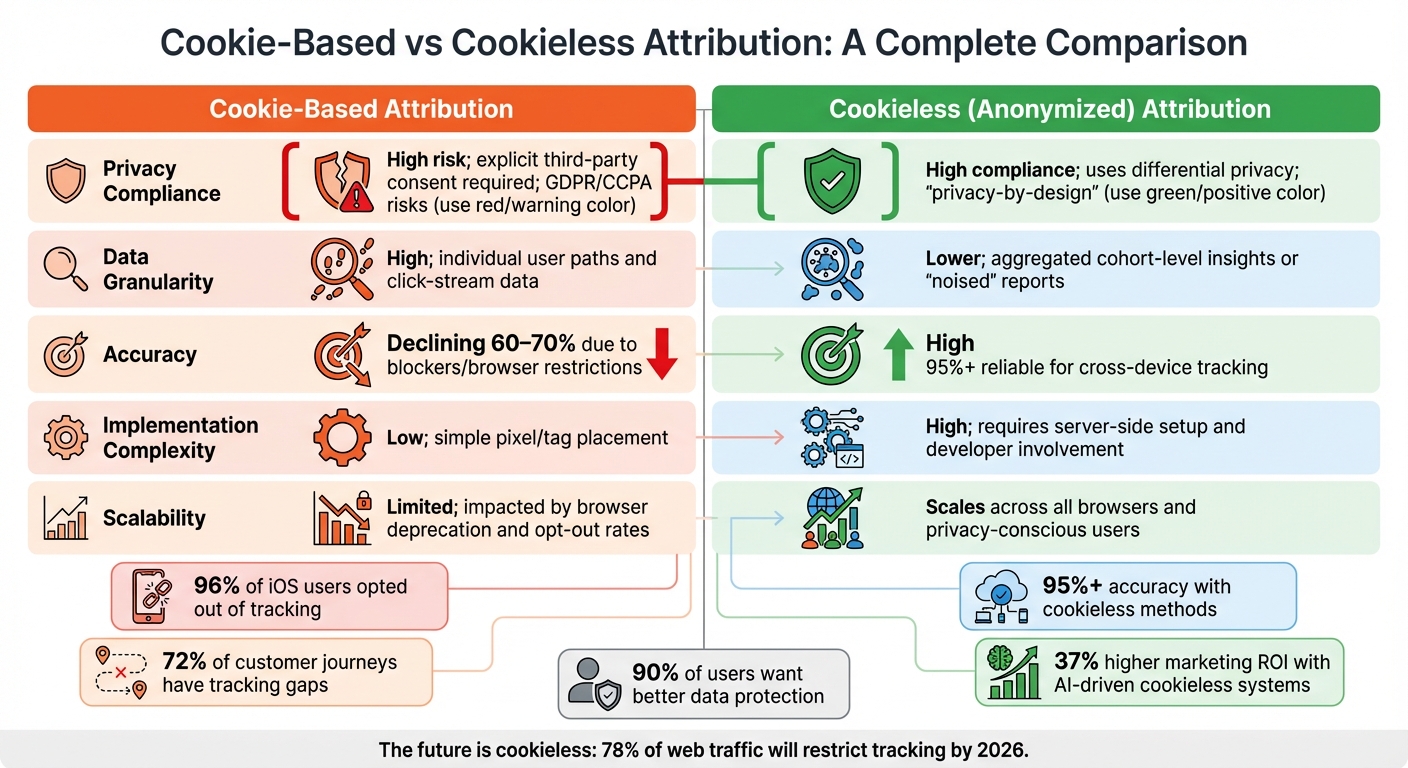
Cookie-Based vs Cookieless Attribution: Privacy, Accuracy, and Implementation Comparison
After breaking down each method, let’s dive into the advantages and disadvantages of cookie-based and cookieless attribution systems.
Attribution methods come with clear trade-offs. Cookie-based systems are known for their simplicity and detailed tracking capabilities, but they face growing scrutiny due to privacy concerns and declining accuracy. On the other hand, cookieless approaches prioritize compliance and are better suited for a privacy-conscious future. However, they require significant technical investment and may not offer the same level of data precision.
Privacy Considerations
The gap in privacy between these methods is striking. Cookie-based tracking has long been criticized for its privacy risks, often relying on third-party data collection that leaves users exposed. In contrast, cookieless attribution is designed with privacy in mind, leveraging techniques like differential privacy and data aggregation to protect user information. This shift aligns with consumer expectations – 90% of users believe companies should do more to safeguard their data, and 84% support stronger government regulations on data collection.
Accuracy and Reliability
Accuracy is another area where these methods diverge. Traditional cookie-based tracking struggles with accuracy, achieving only about 60–70% reliability due to ad blockers and browser restrictions. Meanwhile, server-side cookieless methods can achieve 95% or higher accuracy, offering a more dependable view of user behavior across devices. While cookieless methods might report fewer conversions, they provide cleaner, more trustworthy data. As AttributionApp puts it:
"Cookieless attribution may show fewer conversions, but those conversions are more trustworthy. What you lose in volume, you gain in integrity and compliance."
Implementation and Scalability
The complexity of implementation is another key factor. Cookie-based systems are relatively easy to set up, often requiring just simple pixel or tag placement. Cookieless attribution, however, demands a more robust setup, including server-side integrations, APIs, and developer resources. Despite this complexity, the effort can pay off – organizations using AI-driven cookieless attribution systems have reported 37% higher marketing ROI.
Comparison Table
| Feature | Cookie-Based Attribution | Cookieless (Anonymized) Attribution |
|---|---|---|
| Privacy Compliance | High risk; explicit third-party consent required; GDPR/CCPA risks | High compliance; uses differential privacy; "privacy-by-design" |
| Data Granularity | High; individual user paths and click-stream data | Lower; aggregated cohort-level insights or "noised" reports |
| Accuracy | Declining (60–70%) due to blockers/browser restrictions | High (95%+); reliable for cross-device tracking |
| Implementation Complexity | Low; simple pixel/tag placement | High; requires server-side setup and developer involvement |
| Scalability | Limited; impacted by browser deprecation and opt-out rates | Scales across all browsers and privacy-conscious users |
This comparison highlights the growing preference for privacy-first attribution models, which we’ll explore further in the next section.
Conclusion
The move toward cookieless attribution is reshaping how marketers evaluate success. While cookie-based systems have historically allowed detailed tracking, they come with notable drawbacks – such as intrusive data practices, difficulty maintaining accuracy across devices, and increased regulatory risks. Cookieless approaches, which leverage anonymized data and server-side tracking, offer a more privacy-conscious solution without compromising data reliability. This shift demands immediate adjustments to your attribution strategy.
Developing a strong first-party data approach is essential. Without it, marketing expenses could increase by 10–20%. Dr. Sinan Aral from MIT‘s Initiative on the Digital Economy emphasizes this point:
"The future of attribution isn’t about finding ways to track more, it’s about getting smarter about modeling with the data we can ethically collect".
Start by auditing your current tracking tools to identify dependencies on cookies and any gaps in attribution, particularly with platforms like iOS or Safari. Strengthen your first-party data collection efforts through value-driven methods such as interactive quizzes, gated content, or loyalty programs that encourage users to willingly share their information. Additionally, begin implementing server-side tagging alongside your current systems to validate its effectiveness before fully transitioning.
To stay ahead, it’s crucial to act now and refine your data strategy. Growth-onomics offers tailored solutions to help you navigate cookieless attribution. Their expertise in performance marketing and data analytics can equip you with the tools needed for privacy-focused measurement while maximizing your marketing ROI.
The era of invasive tracking is coming to an end. By embracing anonymized data today, you’ll be well-positioned to succeed in a privacy-first landscape.
FAQs
How does cookieless attribution protect user privacy while ensuring accurate data for marketers?
Cookieless attribution prioritizes user privacy by keeping interaction data securely within the user’s browser, avoiding the need to send identifiable information to external servers. Here’s how it works: when someone interacts with an ad – whether through clicks or views – those events are logged directly on their device. Similarly, any resulting conversions, like purchases, are recorded locally. Before any of this data is shared, it’s anonymized, aggregated, and encrypted. A layer of statistical noise is also added to ensure individual identities remain protected while still maintaining the integrity of broader trends.
This method allows advertisers to access accurate metrics, such as conversion counts and attribution insights, without ever handling raw, individual user data. By matching interactions and conversions directly on the user’s device, the system delivers precise reporting while safeguarding personal information. It also aligns with privacy regulations like GDPR and CCPA, offering businesses a way to evaluate marketing performance while respecting user privacy. This approach not only complies with legal standards but also helps build trust with consumers in the U.S. market.
What challenges do marketers face when adopting cookieless attribution?
Marketers making the shift to cookieless attribution are encountering some big challenges. One of the most pressing issues stems from privacy regulations like GDPR and CCPA, coupled with browser updates that have eliminated third-party cookies. This has left significant blind spots in tracking, making it harder to measure the full customer journey. To adapt, marketers now need to lean heavily on first-party data, anonymization methods, and tools like data clean rooms. However, using these tools demands new technical expertise and stricter data management practices.
Another obstacle lies in moving away from cookie-based models to more advanced approaches like probabilistic attribution. Without cookie identifiers, deterministic methods lose their reliability. Probabilistic models, on the other hand, require vast datasets and advanced machine learning to make sense of the gaps. While this shift may result in fewer reported conversions, the data tends to be more accurate and aligns better with privacy standards.
Adding to the complexity, platforms such as Google, Meta, and Apple restrict cross-channel data sharing, which makes piecing together a complete customer journey even tougher. To address this, marketers are turning to solutions like server-side tracking and identity graphs, all while ensuring their strategies prioritize privacy. Growth-onomics helps businesses tackle these hurdles by blending first-party data strategies with AI-powered, privacy-focused attribution models.
Why is a strong first-party data strategy essential in a cookieless world?
With third-party cookies fading away due to tighter privacy rules and browser changes, having a solid first-party data strategy is now essential. First-party data offers better precision in insights while aligning with privacy regulations, allowing businesses to uphold consumer trust.
Leveraging first-party data enables marketers to design budget-friendly campaigns that are specifically tailored to their audience. This not only helps businesses stay ahead in the shifting digital world but also reinforces long-term connections with their customers while respecting privacy.