

Want to improve your marketing ROI? Here’s how: Align your SEO, PPC, and sales funnel strategies into one cohesive plan. Businesses that connect these efforts see up to a 70% boost in ROI and reduce wasted ad spend. The key is creating content tailored to each stage of the customer journey – awareness, consideration, decision, and post-purchase – while leveraging data to optimize performance.
Key Takeaways:
- Match content to intent: Informational content works best for early-stage awareness, while pricing pages and demos drive conversions at later stages.
- Use PPC to refine SEO: Paid campaigns reveal high-converting keywords and messaging, which can inform organic content strategies.
- Build content hubs: Organize related content around central topics to improve visibility and engagement.
- Track the right metrics: Measure success by focusing on traffic, conversions, and revenue – not vanity metrics like page views.
- Integrate teams: Align SEO, PPC, and sales teams through regular collaboration to avoid budget waste and missed opportunities.
By combining these strategies, you can create a marketing approach that attracts, engages, and converts customers effectively, all while maximizing ROI.
How to Build an Integrated Content Marketing Program: Tracey Wallace (Klaviyo)

How to Match Content to Each Sales Funnel Stage
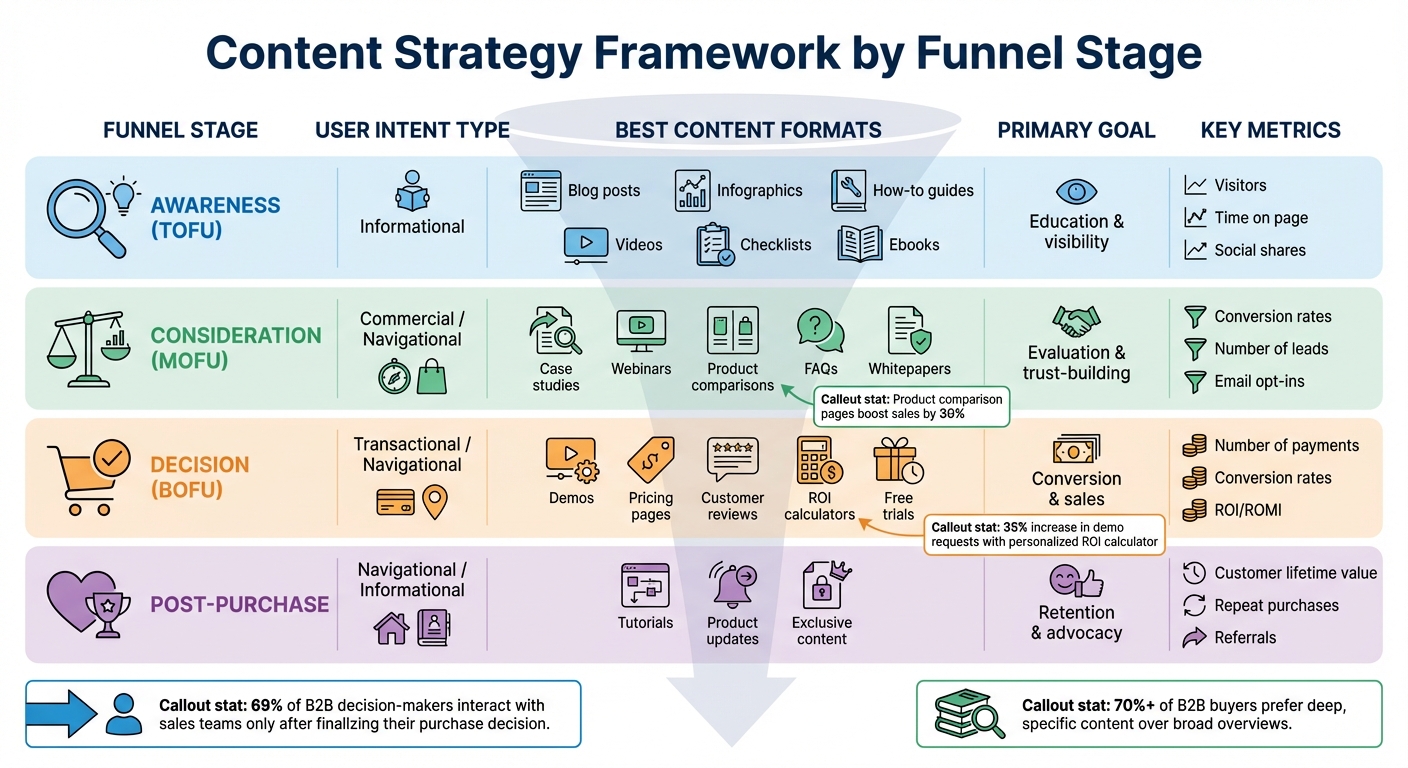
Content Strategy by Sales Funnel Stage: Formats, Intent, and Metrics
To effectively match your content to different stages of the sales funnel, start by understanding your audience’s decision-making process. For example, someone searching "what is project management software" is likely in the early stages of research, while someone Googling "Asana vs Monday pricing comparison" is closer to making a purchase. Your content needs to reflect these varying levels of intent.
The sales funnel typically has four stages: Awareness (TOFU), where people recognize their challenges; Consideration (MOFU), where they explore potential solutions; Decision (BOFU), where they select a vendor; and Post-purchase, where they may become brand advocates. A 2024 study revealed that 69% of B2B decision-makers interact with sales teams only after finalizing their purchase decision. This means your content must guide them through the journey effectively.
Let’s break down how user intent aligns with each funnel stage.
User Intent Types and Funnel Stages
User intent plays a critical role in determining the type of content you should create for each stage of the funnel:
- Informational intent dominates the awareness stage. People are looking for answers, not sales pitches. Trying to sell too early can push them away.
- Commercial intent becomes relevant in the consideration stage, where users compare solutions and evaluate brands.
- Transactional intent signals readiness to buy. At this stage, users seek pricing details, product demos, and customer reviews.
- Navigational intent often overlaps with the consideration and decision stages, as users search for specific brand or product information.
To determine intent, analyze Google’s search results for your target keywords. If blog posts and guides dominate, the intent is informational. If you see pricing pages and product comparisons, it’s transactional. Interestingly, over 70% of B2B buyers prefer content that dives into specific topics rather than broad overviews. Tailor your depth and detail accordingly.
Best Content Formats for Each Funnel Stage
Different funnel stages call for different content formats. Here’s how to align your content with user needs:
- Awareness (TOFU): At this stage, focus on educational content like how-to guides, infographics, checklists, and ebooks. These formats inform without being overly promotional.
- Consideration (MOFU): Build trust with product comparisons, case studies, webinars, and whitepapers. For instance, a well-designed product comparison page can boost sales by 30% compared to a standard product page.
- Decision (BOFU): Remove barriers to purchase with pricing pages, customer reviews, free trials, and live demos. In 2024, emma, a cloud management platform, introduced a personalized ROI calculator to address pricing concerns. According to CMO Dirk Alshuth:
"This worked because it tackled a major purchasing objection with real, personalized data."
This approach led to a 35% increase in demo requests.
- Post-Purchase: Keep customers engaged with tutorials, product updates, and exclusive content that enhances loyalty.
Here’s a quick reference table summarizing the best content formats and goals for each stage:
| Funnel Stage | User Intent Type | Best Content Formats | Primary Goal |
|---|---|---|---|
| Awareness (TOFU) | Informational | Blog posts, infographics, how-to guides, videos | Education & visibility |
| Consideration (MOFU) | Commercial / Navigational | Case studies, webinars, product comparisons, FAQs | Evaluation & trust-building |
| Decision (BOFU) | Transactional / Navigational | Demos, pricing pages, customer reviews, ROI calculators | Conversion & sales |
| Post-Purchase | Navigational / Informational | Tutorials, product updates, exclusive content | Retention & advocacy |
Metrics That Matter at Each Funnel Stage
To gauge success, track performance metrics tailored to each stage of the funnel:
- Awareness (TOFU): Monitor visitors, time spent on page, and social shares to measure reach and engagement.
- Consideration (MOFU): Focus on conversion rates, the number of leads, and email opt-ins. If traffic is high but leads are low, your content might lack a clear call-to-action or fail to align with commercial intent.
- Decision (BOFU): Measure metrics like the number of payments, conversion rates, and ROI/ROMI. For example, Kaplan Financial Education saw over $1 million in sales by creating a how-to article tailored to the "Series 7 license" keyword. This success came from addressing user pain points and aligning content with the buyer’s journey.
If organic traffic is growing but leads remain stagnant, the issue might be misaligned content – such as pushing sales in the awareness stage or not creating urgency at the decision stage. Regularly analyze and optimize your content, especially when launching new products or seasonal campaigns.
Creating a Content Framework That Works for SEO and PPC
A documented strategy – used by 80% of successful content marketers – eliminates the guesswork of identifying topics that deliver results. The secret lies in creating connected content that serves both SEO and PPC efforts, rather than treating them as separate entities.
One effective way to structure this is by using a hub-and-spoke model. This approach organizes content around a central pillar topic, supported by related pieces. Kaplan Financial Education is a great example of this strategy in action. They created a "Career Corner" content hub aimed at financial services professionals. By shifting from purely factual writing to a conversational tone that incorporated insights from students and instructors, they tackled their audience’s high-turnover challenges. This approach, led by Alli Berry, resulted in over $1 million in sales from leads.
When planning your framework, focus on grouping related keywords into clusters instead of targeting single terms. While about 20% of searches are for popular "fat head" terms, the remaining 80% – long-tail keywords – are ideal for supporting content. This strategy allows you to address searcher intent more thoroughly while creating multiple entry points for organic traffic and paid campaigns.
How to Build Topic Clusters and Content Hubs
Start by identifying your pillar content. Use keyword research tools to find high-volume terms with moderate competition – these will form the foundation of your hub. Then, publish supplemental content pieces around the same time to create a network of internal links. Chris Giarratana from StrategyBeam emphasizes the importance of this tactic:
"There’s no better way to bolster the visibility and rankings of a pillar piece of content than by adding internal links from supplemental content."
Before creating new hubs, audit your existing content to find topics that already generate traffic and conversions. This helps you focus your clusters on proven performers. Use exact-match anchor text for internal links to strengthen these connections.
Blue Bottle Coffee illustrates this strategy well. They developed a content hub featuring guides and videos tailored to everyone from beginners to coffee enthusiasts. Their "how-to" videos target search queries about brewing and storing coffee, building trust in their brand while driving users toward product purchases. This dual-purpose strategy supports both organic search intent and paid promotion efforts.
To maximize your content’s effectiveness, align your clusters with the marketing funnel stages – Discovery (TOFU), Consideration (MOFU), and Conversion (BOFU). For instance, educational blog posts are ideal for top-of-funnel awareness, while interactive tools like calculators or demos work well for bottom-of-funnel conversions.
Another key tactic is consulting subject matter experts, such as your customer service or sales teams, to uncover audience pain points that keyword tools might miss. As Alli Berry explains:
"The problem with solely using keywords to drive your content strategy is that not all of your audience’s content needs are captured in search."
This audience-focused approach ensures your content hub stands out by addressing gaps your competitors may overlook.
Using PPC Data to Guide SEO Content
Once your content hubs are in place, PPC data can refine your strategy by identifying which topics lead to conversions. PPC performance data reveals what drives results, not just what generates traffic. This is especially valuable for pinpointing "Bottom of Funnel" (BoFu) keywords, which often have lower search volume but can convert up to 10X better than high-volume, top-of-funnel terms.
Use tools like the Model Comparison Tool in Google Analytics to track which content pieces and keywords contribute to leads and revenue, not just clicks. This data highlights the specific problems or "pain points" that motivate users to take action. Build your SEO content around these proven triggers rather than generic industry topics.
Paid campaigns are also a great way to test different "content tilts" or unique angles on a topic. For example, if PPC data shows that "project management for remote teams" performs better than "project management software", you can create SEO content tailored to the remote teams angle.
PPC insights can also reveal subtle differences in keyword intent. Someone searching for a "tracking app" has different needs than someone looking for a "GPS app." Creating separate SEO pages for these variations can improve rankings and boost Quality Scores for your paid campaigns by ensuring a strong match between ads and landing pages.
Designing Landing Pages for SEO and PPC
Landing pages need to work for both search engines and paid traffic. The foundation is message match – your landing page headline should align closely with your ad copy and target keywords. This reassures users and improves your Quality Score.
For SEO, focus on fundamentals like keyword-optimized title tags, meta descriptions, headers, and image alt text to ensure search engines can crawl and index your page effectively. Internal links are crucial for SEO, but PPC-focused pages should minimize external navigation to keep users on track toward conversion.
Page speed is another critical factor – landing pages should load in under 2 seconds. Slow load times increase bounce rates and negatively impact both Ad Rank and organic rankings. Optimize speed by hosting videos externally and cutting unnecessary scripts.
To drive conversions, include a clear, above-the-fold Call-to-Action (CTA), social proof (like testimonials or trust badges), and visual cues to guide users. Keep lead capture forms simple – asking only for an email address can significantly boost sign-ups. As Seth Godin puts it:
"Landing pages have specific, measurable offers. You can tell if they’re working or not. You can improve the metrics and make them work better."
If your product offers a better Unique Selling Proposition (USP) than competitors, consider creating comparison pages targeting "alternative to [competitor]" searches. These pages can attract both SEO and PPC traffic.
Comparison: SEO-First vs PPC-First vs Integrated Approaches
Your choice of SEO-first, PPC-first, or an integrated approach depends on your goals, budget, and timeline. Each strategy has its pros and cons:
| Approach | Primary Goal | Speed to Results | Cost Structure | Scalability | Best For |
|---|---|---|---|---|---|
| SEO-First | Build rankings and authority | 3–6 months | Low ongoing cost after setup | High – compounds over time | Long-term growth with limited ad spend |
| PPC-First | Immediate conversions (ROAS) | Immediate | High ongoing cost (per click) | Budget-limited | Launches, seasonal campaigns, quick validation |
| Integrated | Organic traffic + conversions | 1–3 months (PPC) + 3–6 months (SEO) | Moderate | Very high | Competitive markets needing sustained growth |
An SEO-first strategy is ideal for long-term growth. It requires patience and consistent content creation but delivers compounding returns over time, making it a good fit for businesses with limited advertising budgets.
A PPC-first strategy delivers quick results and valuable conversion data. It’s perfect for product launches, seasonal promotions, or validating demand, but the traffic stops as soon as the budget runs out.
An integrated approach combines the strengths of both. Use PPC for immediate revenue and insights, while building your organic SEO foundation. Over time, strong SEO rankings can reduce reliance on paid traffic, making this the best option for sustainable growth in competitive markets.
By blending these methods, you create a seamless strategy that connects SEO, PPC, and your sales funnel. As Margarita Loktionova from Semrush explains:
"A content strategy ensures that your content creation efforts are aligned with your business objectives and resonate with your target audience."
sbb-itb-2ec70df
Tracking and Improving Content Performance with Analytics
If you’re not measuring your content’s impact, you’re essentially flying blind. To make your content strategy truly effective, it needs to connect directly to revenue – not just surface-level metrics like page views.
Core Metrics for SEO, PPC, and Sales Funnels
Every channel’s metrics should align with business goals. For SEO, focus on organic traffic, keyword rankings, and impressions from tools like Google Search Console. As AI-driven search evolves, tracking AI visibility – such as your brand’s presence in ChatGPT or Google’s AI Overviews – can provide additional insights. For example, Wikipedia experienced an 8% drop in traffic in 2024 due to shifts in AI search behavior.
For PPC, the key is efficiency. Metrics like click-through rate (CTR), cost per acquisition (CPA), and Quality Score help determine whether your paid campaigns and landing pages are driving meaningful outcomes – not just clicks.
Metrics also vary depending on where users are in the sales funnel. At the top, focus on brand awareness through new users and social shares. In the middle, track engagement with metrics like average time on page, scroll depth, and downloads of resources like whitepapers. At the bottom of the funnel, measure success through lead generation, conversion rates, and actual sales. Ultimately, the most impactful metrics tie content directly to revenue, such as content-influenced deals, Customer Acquisition Cost (CAC) by channel, and ROI. For instance, a $500 content investment that generates $2,000 in revenue delivers a 300% ROI.
| Metric Category | Key Metrics to Track | Purpose |
|---|---|---|
| SEO & AI | Organic Traffic, Keyword Rankings, AI Visibility, Backlinks, Search Visibility | Understand search engine and AI prominence. |
| Engagement | Avg. Engagement Time, Bounce Rate, Social Shares | Gauge how well content resonates with users. |
| PPC | CTR, CPC, Quality Score, CPA, Paid Sessions | Evaluate the cost-effectiveness of paid campaigns. |
| Conversion | Leads, Conversion Rate, Goal Volume, Form Submissions | Track content’s impact on sales and lead generation. |
| Revenue | Content ROI, Content-Influenced Revenue, CAC by Channel | Connect content performance to profitability. |
The next step is identifying which metrics translate content performance into revenue.
Setting Up Cross-Channel Tracking
Cross-channel tracking is essential for understanding how content from different platforms works together to drive conversions. Start by using UTM parameters on every shared link – whether it’s in emails, social media posts, or paid ads. These parameters help you pinpoint the exact campaign, source, and medium that brought visitors to your site.
Then, integrate GA4 with Google Search Console and your CRM to track the entire journey from discovery to conversion. This is especially important since organic search often involves multiple touchpoints – on average, nearly 10 interactions are needed to close a sale.
When it comes to assigning credit for conversions, move beyond last-click attribution, which only credits the final touchpoint. Instead, use multi-touch attribution to understand how top-of-funnel content contributes to conversions later on. For example, first-click attribution works well for brand awareness campaigns, while U-shaped models (giving 40% credit to both the first and last touches) are better suited for longer buyer journeys.
In GA4, set up Key Events to track specific actions, like demo requests or downloads of lead magnets. Use "starts-with" rules for Thank You page URLs to ensure accurate tracking. For instance, one campaign revealed that mobile traffic accounted for 70% of lead magnet opt-ins, far exceeding the site-wide average of 33% – a discovery made possible through detailed tracking.
With tracking in place, the next step is consolidating these insights into actionable dashboards.
Building Dashboards That Connect Content to Revenue
Dashboards should focus on the metrics that matter most, without overwhelming users with unnecessary details. Start by creating a single source of truth – document your naming conventions and measurement windows to ensure consistency across teams.
For example, in November 2025, marketing agency Fluentica partnered with ABA Matrix, a practice management software provider, to refine their content strategy. By analyzing performance, they discovered that "how-to" guides and training articles outperformed compliance-focused content. They expanded those content clusters and supported them with PPC campaigns, which helped ABA Matrix grow to over 34,000 monthly organic visits and generate leads beyond their initial Florida market. Amy Perez, Co-Founder of Fluentica, shared:
"ABA Matrix scaled to 34,000+ monthly organic visits, improved its competitive positioning against national players, and began generating leads beyond Florida, fueling its visibility and expansion goals."
Customize dashboard views based on the audience. Executives need high-level insights like ROI and revenue metrics, while marketing teams benefit from tactical data like keyword rankings and bounce rates. Companies like Growth-onomics specialize in creating dashboards that update daily, enabling real-time adjustments based on current performance rather than outdated data.
Track both output metrics (like organic sessions and revenue) and input metrics (like page speed and crawl accessibility) to understand not just what changed, but why. Set up automated alerts to flag issues such as spikes in 404 errors or sudden drops in non-brand clicks within 24 hours. These alerts help catch problems early, preventing them from escalating into revenue losses.
Putting the Strategy into Action with Growth-onomics
Once you’ve nailed down a tracking and metrics strategy, the next step is execution. But even the best plans can flop without proper coordination, open communication, and effective support systems. Let’s dive into how to bring everything together.
Coordinating Teams for Better Execution
All too often, SEO, PPC, sales, and analytics teams operate in isolation. This lack of collaboration can lead to wasted budgets and missed opportunities. For instance, PPC teams might spend money bidding on branded keywords that already rank #1 organically, or SEO teams might churn out content without understanding which topics actually drive conversions based on paid campaign insights.
The solution? Regular cross-channel meetings. Weekly or monthly syncs allow teams to align their goals, share performance data, and identify opportunities. For example, if the PPC team notices that certain keywords are driving high conversions, the SEO team can focus on creating organic content around those terms. Similarly, if SEO spots pages with high traffic but low conversions, PPC can experiment with new messaging to see what resonates before making site-wide changes.
Kyra Kuik, Former Head of Content at Siteimprove, summed it up perfectly:
"A holistic search strategy is key to a competitive and cost-effective search program."
Centralizing data is another critical piece of the puzzle. Integrated dashboards that combine KPIs from paid and organic channels make it easier to track progress and uncover areas for improvement.
Creating a Feedback Loop Between Channels
To get the most out of your strategy, treat SEO and PPC as partners, not competitors. PPC can act as your testing ground – run short-term paid campaigns to see how well certain keywords convert before investing time and resources into SEO. If a keyword performs well in PPC, you can confidently create organic content around it. If not, you’ve avoided wasting months on a topic that wouldn’t deliver results.
This feedback loop works both ways. PPC search query reports can highlight high-converting terms that should be prioritized for organic content. Likewise, SEO performance data can help PPC teams avoid spending ad dollars on areas where organic rankings are already strong. To put it in perspective, about 27% of all website traffic comes from paid search, while 53% comes from organic. Understanding where each channel excels ensures smarter resource allocation.
PPC is also a great way to test headlines, calls-to-action (CTAs), and keyword themes through A/B testing. Once you find a winning combination, apply those insights to your SEO efforts. Just make sure to use "noindex/nofollow" tags on PPC landing pages to prevent SEO cannibalization while keeping Quality Scores high.
Aiden from Theia Media Agency captured this idea well:
"SEO content shouldn’t just attract traffic – it should also convert."
This continuous feedback strengthens the integrated strategy and keeps both channels working in harmony.
How Growth-onomics Delivers End-to-End Support
Growth-onomics builds on this integrated approach by connecting content performance directly to revenue outcomes. Their suite of tools spans SEO, UX, customer journey mapping, performance marketing, and data analytics, making it easier to see how every piece fits together.
One standout feature is Funnel Stage Tracking, which evaluates content performance across three stages: Reach (bringing in traffic), Nurturing (engaging visitors), and Leads (converting visitors via lead forms). The Impact Score metric takes this a step further by measuring how well individual content pieces contribute to the nurturing stage, helping teams pinpoint which assets are driving conversions.
Another powerful tool is the Users Flow Report, which tracks traffic sources – such as organic search, paid campaigns, and social media – to identify which channels and content types bring in the most engaged users and leads. This insight allows teams to allocate budgets more effectively.
Growth-onomics also offers automated Insights and Alerts that monitor performance changes over 30 days. These alerts flag issues like pages with high traffic but low engagement or bounce rates and suggest actionable fixes. This proactive approach helps teams address problems early and seize new opportunities without sifting through endless reports.
Finally, their Content Format and Length Analytics tool breaks down performance by content type – like guides, lists, and how-tos – so you can see what resonates most with your audience at each funnel stage. By focusing on formats that deliver results, you eliminate guesswork and ensure your efforts are well-spent.
Conclusion
As outlined earlier, combining SEO, PPC, and funnel mapping is key to creating a successful content strategy. The focus should always be on delivering the right content at the right time. By aligning your efforts with clear business goals and user intent, you can move beyond vanity metrics like pageviews and start achieving tangible results – think leads and revenue. For instance, keywords with high purchase intent can convert up to 10 times more effectively than high-volume, top-of-funnel terms. That’s the difference between content that simply looks good on paper and content that drives real business growth.
Timing your content strategically is what sets the stage for a multi-channel approach that works. SEO and PPC should be treated as complementary tools rather than separate silos. Use paid campaigns to test what resonates with your audience, and then expand your organic content based on those insights. As Ron Willingham wisely said:
"You’re not selling products or services, you’re selling solutions, gratifications, rewards and enjoyment. In other words – end result benefits."
Your content should embody this philosophy at every stage of the customer journey.
Let data be your guide. Establish SMART goals, map out keywords to minimize overlap, and track conversions alongside traffic. Research shows that over 70% of B2B buyers prefer content that dives deep into relevant topics rather than skimming the surface with generic overviews. This reinforces the importance of prioritizing quality and relevance over sheer volume. High-intent keywords, for example, can consistently outperform top-of-funnel terms in driving meaningful conversions.
Tools like Growth-onomics make this integrated approach much simpler by bringing together SEO, PPC, customer journey mapping, and analytics into one streamlined system. Features such as Funnel Stage Tracking, Impact Scores, and automated performance alerts provide clear visibility into how your content contributes to revenue. This eliminates guesswork and helps you optimize your strategy in real time, ensuring you get the best return on investment.
For businesses looking for a unified, data-driven framework that delivers measurable results, Growth-onomics offers the support you need. It’s not just about creating content; it’s about creating content that works.
FAQs
How can I effectively align my SEO and PPC strategies?
To bring SEO and PPC strategies together, start by building a shared keyword plan. Categorize keywords based on intent – like informational, navigational, and transactional – and connect them to the right stages of your sales funnel: awareness, consideration, or decision. Tools such as Ahrefs or Google Keyword Planner can help ensure your paid and organic campaigns are targeting the same terms. For instance, use broad, informational keywords for top-of-funnel SEO content, and pair them with affordable awareness ads that echo the same themes. When it comes to the decision stage, align transactional keywords across both channels, directing PPC traffic to SEO-optimized product pages. This approach not only boosts relevance but can also lower your cost-per-click (CPC).
Another key step is setting up a feedback loop between SEO and PPC. Leverage PPC data, like click-through rates and conversion metrics, to uncover high-performing keywords that could benefit from more SEO focus. On the flip side, use organic search insights to identify gaps where PPC ads could step in. By tracking both channels together, you can fine-tune bids, improve ad copy, and enhance SEO content in harmony. When these two strategies work hand in hand, you’ll increase visibility, cut customer acquisition costs, and attract more qualified leads throughout your sales funnel.
What types of content work best for each stage of the sales funnel?
At the awareness stage, aim to create content that grabs attention while offering helpful information. Think blog posts that answer common questions, quick and engaging videos, eye-catching infographics, or social media posts that spark curiosity. The goal here is to introduce your brand and address initial questions or interests.
When moving to the consideration stage, shift toward content that builds trust and provides deeper insights. This could include detailed guides, webinars, whitepapers, or case studies. These resources help potential customers see the value in what you offer and encourage them to learn more.
For the decision stage, focus on content that supports conversions. Tools like ROI-focused case studies, product demos, comparison guides, and customer testimonials work well to address any lingering doubts and guide prospects toward making a purchase.
How can I use PPC data to strengthen my SEO content strategy?
PPC data can be a treasure trove for refining your SEO content strategy. By digging into the top-performing keywords from your PPC campaigns, you can pinpoint the terms that consistently drive conversions. Incorporating these into your organic content ensures you’re focusing on keywords that already show strong potential.
But that’s not all – PPC data also gives you a window into shifting audience behavior and intent. This means you can keep your content aligned with what people are actively searching for. Plus, it highlights which content formats your audience engages with the most, helping you tailor your SEO content to match their preferences. Using insights from PPC, you can fine-tune your content to draw in the right audience and see better results.