


Here’s the bottom line: your website’s performance matters, and industry benchmarks help you understand where you stand. Whether you’re in ecommerce, SaaS, or finance, comparing metrics like monthly sessions, bounce rates, and conversion rates can reveal areas for improvement.
Key Takeaways:
- Ecommerce: Average 24,572 monthly sessions; bounce rate 35-55%; conversion rate ~1.8%.
- SaaS: Average 21,410 monthly sessions; higher engagement (1 min 45 sec per page); conversion rate 2.5-7.3%.
- Finance: Lowest traffic at 8,921 monthly sessions; bounce rate 50-68%; mobile accounts for 41-53% of visits.
Trends to Watch:
- Mobile-first: Over 53% of traffic comes from mobile devices.
- AI-driven traffic: Growing 1% monthly, with double the conversion rates of traditional sources.
- SEO focus: Top search results capture 28.5% of clicks – optimize for positions 6-20 for quick wins.
Ready to improve? Focus on SEO, mobile optimization, and AI visibility to stay ahead.
New Ways to Benchmark and Track Your Competitors
Traffic Benchmarks by Industry
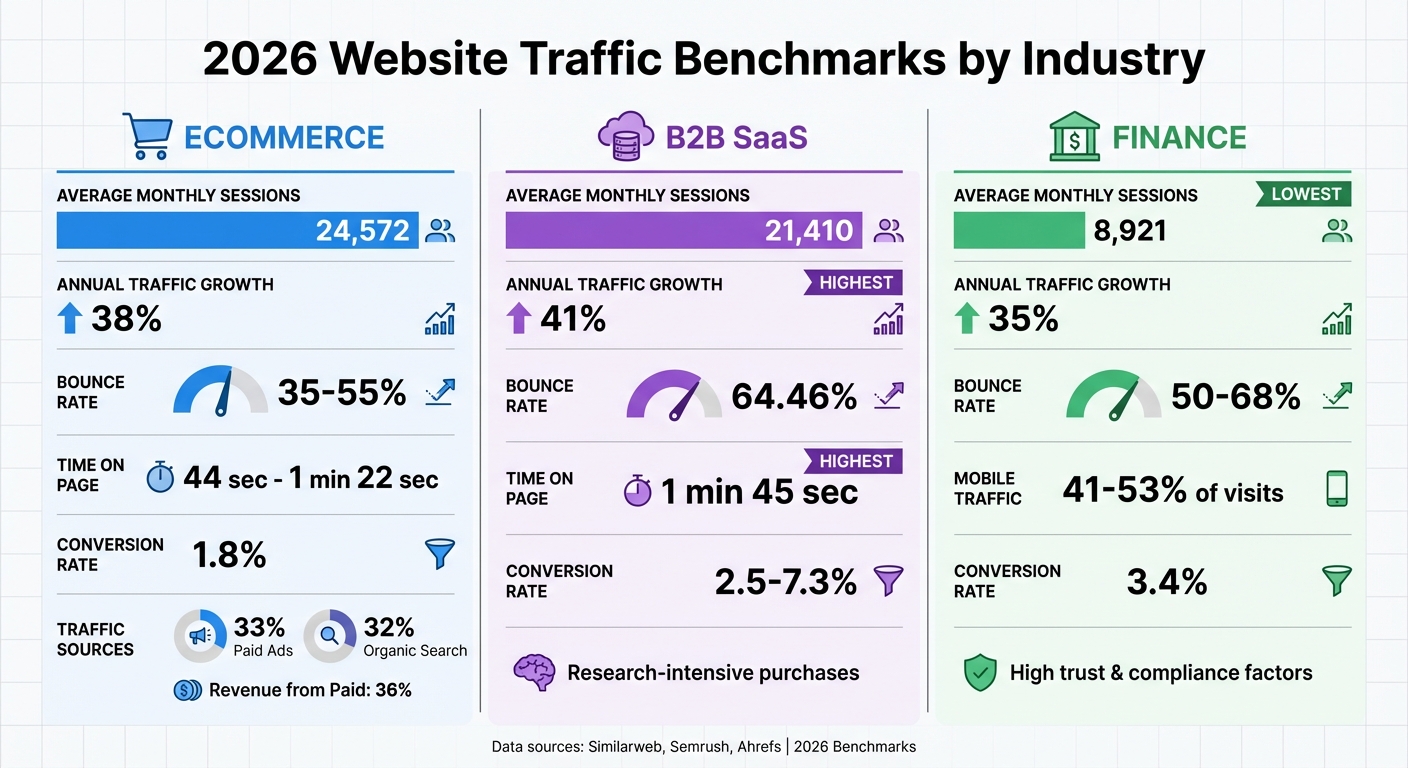
2026 Website Traffic Benchmarks by Industry: Ecommerce vs SaaS vs Finance
Understanding traffic benchmarks across industries can help you assess your website’s performance more effectively. Each sector operates under unique dynamics, so comparisons should take those differences into account.
Ecommerce Industry
On average, ecommerce websites see 24,572 monthly unique sessions. Smaller sites typically attract between 4,000 and 12,000 sessions, while medium-sized ones range from 25,000 to 80,000 sessions. Organic traffic for this industry has grown by 38% annually.
Traffic sources are fairly balanced, with 33% coming from paid ads and 32% from organic search, although paid channels drive 36% of total revenue. Bounce rates fall between 35% and 55%, and users spend an average of 44 seconds to 1 minute 22 seconds per session. Conversion rates hover around 1.8%.
Interestingly, while SaaS websites report similar traffic volumes, they tend to engage users for longer periods.
SaaS Industry
B2B SaaS companies average 21,410 monthly unique sessions. Smaller SaaS vendors attract 1,000 to 6,000 sessions, whereas growth-stage companies see anywhere from 10,000 to 80,000 sessions. The SaaS sector leads in traffic growth, with a projected 41% annual increase.
User engagement is notably higher for SaaS sites compared to ecommerce. Visitors spend an average of 1 minute 45 seconds per page, reflecting the research-intensive nature of SaaS purchases. The median bounce rate is 64.46%, as users often explore multiple options before committing. Trial signup conversion rates range between 2.5% and 7.3%.
Finance Industry
Financial services websites average 8,921 monthly unique sessions, making it the lowest among the major industries. Small firms typically see 800 to 3,000 sessions, while medium-sized firms attract 5,000 to 25,000 sessions. The sector experiences 35% annual traffic growth.
Mobile traffic is particularly significant in finance, accounting for 41% to 53% of visits. Bounce rates are higher, ranging from 50% to 68%, likely due to the stringent trust and compliance factors that influence user behavior. Landing page conversion rates average 3.4%.
| Industry | Avg. Monthly Sessions | Annual Growth | Bounce Rate | Conversion Rate |
|---|---|---|---|---|
| Ecommerce | 24,572 | 38% | 35%–55% | 1.8% |
| B2B SaaS | 21,410 | 41% | 64.46% | 2.5%–7.3% |
| Finance | 8,921 | 35% | 50%–68% | 3.4% |
These benchmarks provide a clear snapshot of traffic performance across industries, helping businesses identify patterns and set realistic goals for growth.
Cross-Industry Trends
Mobile traffic dominates across industries, with 53% of SEOs and marketers identifying mobile devices as the primary source of traffic. This underscores the importance of prioritizing mobile-first content, fast load times, and seamless user experiences.
Adding to the mobile shift, AI-powered search is changing how brands are discovered. While it currently drives just 1.08% of total website traffic, it’s growing steadily at a rate of 1% month-over-month. What’s even more striking? AI-driven traffic converts at twice the rate of traditional sources and requires one-third fewer sessions to achieve conversions. ChatGPT alone accounts for an impressive 87.4% of these referrals.
"AI hasn’t replaced search – it’s replacing your website as the first touchpoint. The brands showing up in AI answers today are shaping the new customer journey." – Seth Besmertnik, CEO and Co-Founder, Conductor
Semantic content strategy has become the new standard, overtaking traditional keyword-focused approaches. Modern search engines, including Google and AI platforms, now emphasize the relationships between ideas rather than just keyword density. For example, connecting topics like "digital marketing", "customer journey", and "conversion optimization" creates a richer, more relevant content experience. One early adopter leveraged AI-powered topic research to secure an impressive 91% market share. This approach signals a shift toward more interconnected and strategic content creation.
To improve performance, multimodal optimization is key. With tools like Gemini 2.0, integrating images, videos, audio, and text has become essential. Notably, YouTube ranks highly in AI-generated "how-to" answers, making it a valuable platform for visibility. Additionally, tracking AI visibility metrics – such as brand mentions and citations – provides a fresh way to measure impact alongside traditional ranking metrics.
sbb-itb-2ec70df
Methodology and Data Sources
This report’s traffic benchmarks are built on insights from three key competitive intelligence platforms: Similarweb, Semrush, and Ahrefs. Each tool brings a unique perspective to the table. Similarweb focuses on "deduplicated audience" metrics, ensuring that users accessing a site from multiple devices are counted as a single visitor, thus avoiding inflated numbers. Semrush’s Traffic & Market Toolkit analyzes raw data from over 200 million internet users, utilizing AI algorithms to deliver detailed insights into user behavior and the evolving landscape of AI-driven traffic. Ahrefs contributes with its vast database spanning 171 countries and its Batch Analysis feature, which allows analysts to compare up to 200 websites at once instead of one-by-one assessments.
To ensure accuracy for U.S.-specific trends, Semrush’s "USA States" dashboard and Similarweb’s country-specific filters were employed. These tools, combined with data from a HubSpot survey of over 400 web traffic analysts, helped establish reliable benchmarks based on self-reported insights. These localized filters provide a clear and actionable view of domestic traffic patterns.
Industry professionals emphasize the importance of these tools:
"We use Similarweb to better understand the categories our clients operate in, their share of those categories, and how it might have changed over time. That benchmarking can help to diagnose issues with brand health." – Duncan Nichols, Director of Strategy and Planning, Croud
To ensure fair comparisons, competitors are categorized into three groups: "Giants" (top 10), "Challengers" (11–100), and "Up-and-Comers" (101–500). This segmentation prevents skewed results when analyzing traffic data. Additionally, the methodology tracks AI visibility – monitoring brand appearances in tools like ChatGPT, Gemini, and Perplexity – alongside traditional search rankings.
For businesses looking to replicate this approach, it involves using market overview dashboards, breaking down traffic by channels, and cross-referencing third-party data with Google Analytics 4 to identify potential performance gaps. This method also aligns with the growing focus on AI visibility metrics discussed earlier.
Conclusion and Recommendations
Costs are going up, but performance is following suit. As Cliff Sizemore from LocaliQ puts it:
"Costs are rising, but so is performance – 65% of industries saw better conversion rates in 2025. The main takeaway here is that a smart strategy beats cheap clicks".
The numbers back this up. While the average cost-per-click (CPC) jumped by 12.88% across industries, conversion rates improved for 65% of sectors. This shows that thoughtful, strategic optimization can deliver results even with higher upfront costs. It also highlights the importance of search positioning in driving traffic.
Consider this: the top search result grabs 28.5% of all clicks, while positions 2 and 3 drop to 12.5% and 8.5%, respectively. That steep drop-off means climbing from position 12 to the top 5 can significantly boost your traffic. Focus on keywords ranking between positions 6 and 20 – this is where optimization pays off the fastest. To counteract zero-click searches, implement FAQ schema and rich snippets, which can increase click-through rates (CTR) by around 8–10%.
As AI tools like AI Overviews reshape the search landscape, 83% of web professionals report stable or even increased traffic post-launch. To stay ahead, optimize for AI-driven search engines alongside traditional ones. Highlight first-hand experience and insights that AI can’t mimic, and prepare for multimodal optimization as platforms like Gemini 2.0 prioritize visual and audio content.
To stay competitive, aim for top-tier performance benchmarks: conversion rates of 3% or higher for ecommerce, 4% for professional services, and 5% for SaaS. For growth-stage brands, publishing 4–12 new pages monthly and securing 8–20 new referring domains can make a measurable difference. Stay on top of your progress by conducting weekly rank checks, monthly traffic reviews, and quarterly comparisons to identify and address gaps early.
For turning these insights into actionable strategies, Growth-onomics offers expertise in SEO, performance marketing, and customer journey optimization to help you achieve measurable growth.
FAQs
How can I use industry benchmarks to boost my website’s conversion rates?
To improve your website’s conversion rates, it’s essential to start by understanding how your site compares to typical performance metrics in your industry. For example, e-commerce websites generally see conversion rates around 1.8%, with top-performing sites reaching 3–5%. B2B lead generation sites tend to average between 2–6%, while SaaS trial or signup pages often convert at 3–7%. By comparing your current numbers to these benchmarks, you can pinpoint areas where your site may need improvement.
Once you have a clear picture, focus on refining key aspects like user experience, call-to-action (CTA) clarity, and page load speed. For instance, ensure your landing pages are easy to navigate, visually appealing, and free of unnecessary distractions. Make your value proposition stand out and guide visitors through a smooth, logical journey. Regularly tracking your site’s performance against these benchmarks can help you set achievable targets, fine-tune your approach, and measure progress over time.
How does AI-driven traffic help improve conversion rates?
AI-powered tools are transforming how businesses drive conversions by boosting brand visibility and making it easier for potential customers to find them across digital platforms. With AI integrated into search engines and marketing tools, companies can connect with highly targeted audiences – people whose behaviors and intentions suggest they’re ready to take action.
One standout advantage of AI is its ability to deliver real-time personalization. By analyzing user preferences and behaviors, AI can tailor content, recommendations, or offers to match individual needs. This creates a more engaging experience, prompting users to click, sign up, or make a purchase. Beyond that, AI optimizes strategies by pinpointing the best-performing keywords, fine-tuning ad campaigns, and simplifying customer journeys – all of which lead to stronger conversion rates.
Why is mobile optimization important for website performance in 2026?
Mobile optimization is crucial for website performance in 2026, as most web traffic now comes from mobile devices. A site designed with mobile users in mind allows visitors to easily browse and interact with content on their smartphones or tablets. This not only keeps bounce rates low but also encourages higher conversion rates. On the flip side, a poorly optimized mobile site can frustrate users, often driving them away.
Search engines like Google also favor mobile-friendly websites in their rankings, making it essential for businesses to prioritize mobile optimization to stay visible and competitive. Whether in retail, professional services, or technology, delivering a smooth mobile experience meets user expectations, boosts engagement, and supports revenue growth.