


If you’re wondering how to outperform competitors in search rankings, here’s the key takeaway: Content depth matters. Search engines reward pages that thoroughly address a topic, anticipate user questions, and provide detailed answers.
Here’s what you need to know:
- What is content depth? It’s how well a piece of content addresses user needs, including explicit and implied questions.
- Why it matters for SEO: Search engines prioritize detailed pages that align with user intent. Pages with higher word counts (1,500+ words) and more subtopics often rank higher.
- The impact of deep content: Longer, detailed articles drive up to 4x more traffic, attract more backlinks, and rank for multiple keywords.
- How to analyze competitors: Use tools like Semrush, Ahrefs, and Clearscope to identify gaps in your content compared to top-ranking pages.
If you want to rank higher, focus on creating detailed, well-structured content that covers all aspects of a topic. This approach not only improves search rankings but also boosts user engagement and social shares.
Jina Semantic Reach Analyzer: Measure Intent Alignment & SEO Content Depth Like a Pro
Research Findings on Content Depth and SEO Rankings
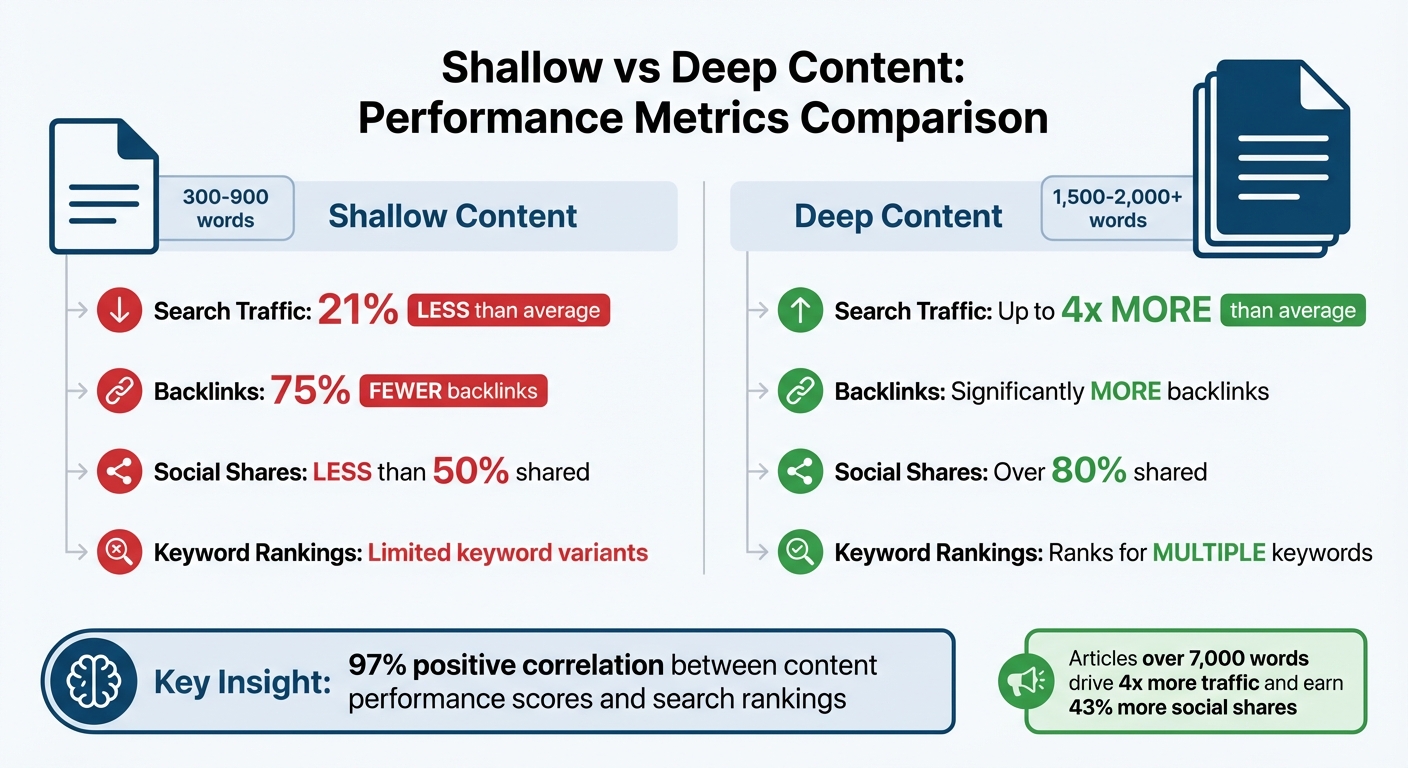
Shallow vs Deep Content Performance: Traffic, Backlinks, and Social Shares Comparison
Content Length and Search Rankings
Research consistently shows that longer content tends to perform better in search rankings. On average, the first-page results on Google feature articles containing between 1,447 and 1,500 words. While word count alone isn’t a direct ranking factor, longer articles naturally provide more context, cover a wider range of subtopics, and include more relevant keywords.
In fact, top-ranking pages are, on average, 3.5 times longer than lower-ranking ones, with a 45% length difference between the top three results and those ranked at position 20. Articles exceeding 7,000 words are especially impactful, driving nearly four times more traffic and earning 43% more social shares compared to shorter articles of 900 to 1,200 words.
A great example of this comes from Bill Sebald, founder of Greenlane Agency, who optimized a client’s #5 ranking page by improving its "Content Performance" score from 51 to 74. Through 4–6 iterations aimed at filling semantic gaps, the page climbed from #5 to #2 on Google in just 24 hours. Cornelia Cozmiuc, a digital marketer at cognitiveSEO, highlighted the importance of this approach, stating:
"The higher the content performance score, the better the rankings"
These findings emphasize the stark advantages of detailed, well-developed content over superficial articles.
Performance Comparison: Shallow vs. Deep Content
The difference in performance between shallow and deep content is striking across all major metrics. Shorter posts (300–900 words) generate 21% less traffic and 75% fewer backlinks compared to longer pieces. In contrast, articles with over 1,000 words are more likely to rank for multiple keywords, giving them a broader reach in search results.
| Metric | Shallow Content (300-900 words) | Deep Content (1,500-2,000+ words) |
|---|---|---|
| Search Traffic | 21% less than average | Up to 4x more than average |
| Backlinks | 75% fewer backlinks | Attracts significantly more backlinks |
| Social Shares | Fewer than 50% shared | Over 80% shared |
| Keyword Rankings | Limited keyword variants | Ranks for multiple keywords |
This data highlights the undeniable edge that deep content provides in terms of traffic, backlinks, and keyword rankings.
Regression analysis further supports this, revealing a 97% positive correlation between content performance scores and search rankings. In other words, the more thorough and comprehensive your content is, the better it performs. For "Your Money or Your Life" (YMYL) topics like health and finance, this depth becomes even more critical. Google’s algorithms are particularly attuned to the thoroughness of content in these highly sensitive areas.
How Content Depth Improves User Engagement
Effects on Bounce Rates and Time on Page
Creating detailed content that thoroughly addresses user questions helps keep visitors on your site longer. This reduces bounce rates and boosts session durations. For instance, research highlights that 37% of bloggers who publish posts exceeding 2,000 words report stronger engagement, compared to only 20% for posts in the 1,000–1,500 word range. One Moz community member shared that a guide exceeding 3,000 words achieved a bounce rate of 40% and an average session duration of 3 minutes. Jeff Baker, Director of Digital Marketing Strategy at Brafton, emphasizes the importance of balancing depth with readability:
"You have to balance readability with depth in order to keep people on the page".
Detailed content also encourages users to explore related articles. By linking to supporting resources and anticipating follow-up questions, you create a network of content that keeps users engaged and increases pages per session. This not only enhances dwell time but also sets the stage for greater social sharing.
Social Sharing and Page Engagement
In-depth content doesn’t just retain visitors – it also drives more social interactions. Articles between 1,000 and 2,000 words receive 56% more social shares, while those exceeding 7,000 words see a 43% increase in shares, with sharing rates surpassing 80%, compared to less than 50% for shorter posts.
When your content becomes a one-stop resource for a topic, users are more likely to share it. Why? Because it saves others the hassle of searching through multiple sources. These metrics underline the role of comprehensive content in boosting engagement and staying competitive in SEO strategies.
sbb-itb-2ec70df
Case Studies: Companies That Succeeded with Deep Content
The power of in-depth content to boost engagement and search rankings is undeniable. Let’s take a closer look at some companies that have turned this approach into measurable success.
Documented Success Examples
The numbers speak for themselves: deep content delivers results. Take Airmason, for example. By focusing on "employee handbooks" and creating topical maps, they published 100 human-edited, AI-assisted articles monthly. The result? A 17x increase in daily clicks and a staggering 1,300% jump in organic traffic within just seven months.
Flyhomes took a similar approach, expanding their site from 10,000 to 425,000 pages with detailed cost-of-living guides. This effort led to a jaw-dropping 10,737% increase in traffic and over 1.1 million monthly visits in just three months.
Another standout is marketing agency Brafton, which turned a simple blog post into a powerhouse of information. By expanding it from 666 words to 2,125 words using MarketMuse, they addressed content gaps and saw the page jump from position 10 to 5 in just eight hours. Jeff Baker, CMO at Brafton, explained:
"Google understood which topics were important to that keyword based on other ranking web pages and rewarded us when we did a better job of addressing the topics we were missing".
Similarly, The Links Guy saw their organic clicks double and impressions grow by 356% in six months by producing 4,000-word comprehensive guides, including a deep dive into "relationship link building". Meanwhile, Aquarium Store Depot boosted their monthly visitors from 52,000 to 400,000 in nine months by tackling information gaps across 700+ articles.
These examples highlight the transformative potential of deep, well-structured content.
What to Learn from Competitor Approaches
So, what can we take away from these success stories? First, topic clustering emerged as a critical strategy. Airmason’s method of organizing content around central themes with supporting articles not only built authority but also improved internal linking. Similarly, Flyhomes’ comprehensive guides underscore the importance of creating content that’s both detailed and highly useful.
Updating existing content is another key takeaway. Brafton’s experience shows how filling content gaps can lead to rapid ranking improvements – sometimes within hours. AI tools can be invaluable here, helping you identify topics your competitors cover that you don’t, so you can systematically address those gaps.
Finally, programmatic SEO proved to be a game-changer for some. For instance, KrispCall achieved a 1,969% year-over-year growth by creating targeted landing pages, such as those focusing on individual area codes. The common thread across these examples? Success comes from combining thorough content coverage, strategic organization, and consistent updates.
Tools and Metrics for Analyzing Competitor Content Depth
Metrics for Evaluating Content Depth
To assess the depth of competitor content effectively, you need to focus on metrics that gauge performance, length, and user engagement. One standout metric is the Content Performance Score, which rates pages on a scale of 0–100 based on how well they leverage semantic search, latent semantic indexing (LSI), and TF*IDF. A study of 3.7 million pages revealed a striking 97% positive correlation between this score and Google rankings.
Word count also plays a pivotal role. Research suggests that pages ranging from 1,600 to 2,000 words – aiming for around 1,700 words – are most likely to secure a spot in Google’s top 10 results. Beyond length, engagement metrics like time on page, bounce rate, and scroll depth provide insights into how users interact with the content.
Authority metrics, such as Domain Authority (DA) and Page Authority, offer a broader view of a competitor’s overall strength. These indicators, combined with content depth metrics, provide a clearer picture of competitive positioning. Additionally, the concept of topical authority has gained traction. By using "entity maps", you can assess how thoroughly a competitor addresses an entire customer journey or related concepts. Another useful signal of semantic depth is tracking how many distinct queries generate impressions in Google Search Console.
These metrics form the backbone for choosing the right tools to analyze and refine your content strategy.
Tools for Content Analysis
Armed with these metrics, several tools can help you dig deeper into competitor content and identify opportunities. CognitiveSEO, for example, uses its proprietary Content Performance Score to pinpoint key focus keywords that drive high rankings. A notable case study by Greenlane agency illustrates this: they improved a client’s score from 51 to 74 by iterating on the copy four to six times, which led to a ranking leap from #5 to #2 within just 24 hours.
Clearscope offers a Term Map that visualizes semantic keywords used by competitors and extracts their heading structures, making it easier to identify gaps. Tools like Semrush and Ahrefs go a step further with their Keyword Gap and Content Gap analyses, highlighting topics competitors cover that you might be missing. These platforms also come with flexible pricing options to suit various needs.
For backlink analysis and identifying high-performing competitor pages, Moz’s Link Explorer is invaluable. It sorts pages by Page Authority and backlink counts, revealing which in-depth topics resonate most. If you’re looking to analyze technical aspects, Rankture provides side-by-side comparisons of schema markup and Core Web Vitals, offering insights into technical depth.
"The higher the content performance score, the better the rankings"
As Cornelia Cozmiuc from CognitiveSEO emphasizes, this underscores the importance of optimizing content for both depth and relevance. These tools and metrics together provide a comprehensive approach to understanding and outperforming your competition.
Conclusion: Using Content Depth to Improve SEO
Research highlights that semantic depth, rather than just word count, plays a key role in driving search engine rankings. By diving deep into a topic’s entities, attributes, and relationships, you signal expertise to search engines. For instance, 82.5% of citations in AI Overview pages reference in-depth content, and top-ranking articles tend to cover 74% of relevant facts, compared to just 50% for lower-ranking pages.
Take a closer look at your content for missing facts or overlooked details. Compare your pages with the top 10 results for your target keywords and pinpoint critical topics you’re not addressing. A study by Brafton revealed that closing these content gaps can lead to significant ranking improvements – one "financial content marketing" page jumped from position 3 to 1 within 60 seconds of being reindexed.
Once you’ve identified these gaps, approach them with a clear strategy. Instead of creating isolated pages, organize your content into connected clusters. Build comprehensive pillar pages supported by detailed subtopics, and link them internally. This approach not only strengthens your topical authority in the eyes of search engines but also helps users easily navigate related information without leaving your site.
Don’t overlook the technical aspects that enhance content depth. Use structured data like FAQ or HowTo schema, maintain a clear heading hierarchy, and track engagement metrics such as scroll depth and time spent on the page. These elements signal to search engines that readers find your content engaging and valuable, further reinforcing your authority.
With search engines shifting from keyword-based ranking to entity-based indexing, your content must evolve into a definitive resource for both people and AI systems. Start with a core topic, map out related entities and questions, and expand your coverage using structured clusters. This approach ensures your content stands out as a trusted and comprehensive source.
FAQs
How can I find and fix content gaps in my articles?
To spot content gaps, begin by evaluating your current articles and their performance. Use tools like Google Analytics to examine metrics such as page views, bounce rates, and average time spent on each page. Pinpoint the articles that aren’t performing well or fail to keep readers engaged.
Next, conduct a keyword gap analysis to discover the topics or search terms your competitors rank for but you don’t. Align these missing keywords with your audience’s needs and the stages of their buying journey. Compare your content against top-ranking pages for those keywords to spot areas where your articles fall short – this could include missing subtopics, unanswered FAQs, or lacking relevant data.
Once you’ve identified the gaps, create a clear plan to address them. This could mean expanding shorter articles, adding sections to target high-intent keywords, or turning thin content into detailed, well-researched guides. By methodically improving your content, you’ll not only boost your SEO rankings but also provide more value to your audience.
What are the best tools to analyze the depth of competitor content?
To see how well your competitors cover a topic and find ways to enhance your own content, there are a few standout tools worth exploring:
- Moz Pro: With features like the Top Competing Content tool, Moz Pro lets you dive into your competitors’ most visible pages. You can analyze their keyword rankings, word counts, and backlink profiles to understand how thoroughly they cover specific topics.
- Semrush: This tool offers features like SEO Ideas and Content Gap Analysis. These help you compare your content’s word count and topic coverage with top-ranking competitors. It also pinpoints areas where you can expand your content and boost its relevance.
- Clearscope: Clearscope emphasizes content depth by scoring your drafts against high-performing pages. It highlights gaps in subtopics, related keywords, and content length, ensuring your content matches user intent and search engine requirements.
Using these tools, you’ll be better equipped to craft content that’s not only more comprehensive but also more appealing to both readers and search engines.
How does the depth of content affect engagement metrics like bounce rate?
Content depth – how thoroughly you explore a topic with detailed insights, subtopics, and relevant examples – can make a big difference in how users interact with your site. Pages packed with well-rounded information are more likely to meet user expectations, keeping visitors engaged. This means they’ll spend more time on your site, click around more, and bounce less.
Studies consistently highlight that in-depth content, like longer articles with a clear structure and rich visuals, performs better in search rankings and user engagement. For U.S. marketers, addressing information gaps, incorporating eye-catching visuals, and expanding key sections not only boosts SEO but also creates a more engaging experience that encourages users to stick around.