


Want to boost lead generation and revenue? Combining your CMS and marketing automation tools could be the answer.
Here’s why:
- A CMS manages your website’s content, while marketing automation tools handle campaigns like email and social media.
- When integrated, they share data in real-time, enabling personalized content and smarter campaigns.
- Businesses using this integration report:
- 451% more qualified leads
- 10% revenue growth in 6–9 months
- 295% ROI with faster publishing and improved workflows.
For example, companies like VMware and Icelandair have cut content production time by up to 90% through integration. The result? Websites that adapt to user behavior instantly and campaigns that connect at the perfect moment.
In this article, we’ll explore how these systems work individually, why integration matters, and how you can use both to create better customer experiences and drive growth.
1. Content Management Systems (CMS)
Data Integration
A modern CMS doesn’t just store website content – it actively exchanges data with your marketing automation platform in real time. This two-way communication allows your CMS to send visitor behavior data, like clicks, page views, and form submissions, to your marketing automation tool. In return, the automation platform provides lead scores and audience segment details back to the CMS. The result? Your website can adjust its content dynamically to match a visitor’s engagement level.
This is made possible by headless and API-first architectures. These systems break away from traditional setups, using APIs to securely transfer data between your content repository and automation tools. For instance, Contentstack handles over 120 billion API calls monthly, showcasing the vast scale of such integrations. A great example of this in action is Icelandair. After switching to Contentstack‘s headless CMS in December 2023, they slashed the time it took to launch marketing promotions by 90%, thanks to API and webhook integrations.
To ensure fast website performance and meet privacy regulations, server-side tagging has become the go-to method for connecting events to marketing automation systems. Unlike client-side scripts, this approach avoids slowing down your site. Rendering forms directly within your CMS and then sending the data to your marketing automation platform via APIs or webhooks ensures that Core Web Vitals are maintained while capturing lead data instantly.
When you harness integrated data effectively, your CMS becomes a powerful tool for delivering tailored content.
Personalization Capabilities
Beyond data integration, your CMS can take personalization to the next level. By leveraging the information it receives from your marketing automation platform, your CMS can craft dynamic experiences for visitors. For example, it can display customized calls-to-action, headlines, or product recommendations based on a visitor’s location, device, or past interactions. If someone clicks a link in an email with specific UTM parameters, your CMS can detect those tags and adjust the landing page experience on the fly.
Progressive profiling is another way to enhance personalization. Instead of overwhelming users with lengthy forms, this approach uses existing data from your marketing automation tool to pre-fill fields or collect new details gradually over time. This not only improves user experience but also boosts conversion rates while building more detailed profiles. VMware implemented progressive profiling in 2023, integrating their headless CMS with automation tools. This shift allowed them to automate workflows and eliminate manual verification processes. As Vicki Vaughn, VMware’s Director of Global Cloud Provider Marketing, explained:
"It allows us to push an email directly out to those partners and keeps a list of who we’re working within the marketing organization for those partners".
Business Impact
The combination of seamless data integration and advanced personalization doesn’t just enhance user engagement – it delivers measurable business results. Organizations using composable digital experience platforms have reported a 295% ROI and cut content development time by 80%. By using your CMS as the central content hub for your marketing automation tools – providing assets via JSON or GraphQL feeds – you can ensure brand consistency across emails, SMS, and push notifications.
This integration creates a unified system where your website and automated campaigns work hand in hand. Together, they track visitor behavior, deliver relevant content at every stage of the buyer’s journey, and refine conversion paths using real-time data. The result? A smoother, more effective digital experience that drives both engagement and business growth.
2. Marketing Automation Tools
Data Integration
Marketing automation platforms act as the backbone for managing campaigns – handling tasks like processing contact data, lead scoring, and identity resolution – while your CMS takes care of delivering content. Together, they create a two-way data flow. The automation tools collect site activity data, such as page views, clicks, and conversions, from the CMS. In return, they send back information like segment data and lead scores, enabling the CMS to adjust layouts in real time. While the CMS delivers the content, marketing automation uses this data to power dynamic, personalized campaigns.
A key enabler of this collaboration is API-first connectivity. Automation platforms rely on APIs and webhooks to securely and efficiently exchange data with headless CMS systems. Instead of relying on the automation tool to manage all content, the CMS serves as the central hub for marketing assets – like images, documents, and editorial content. The automation platform then pulls these assets using JSON or GraphQL feeds to create tailored emails and newsletters.
For marketing automation, server-side event processing plays a critical role in ensuring clean data flows into CRM systems while staying compliant with GDPR regulations. This smooth data exchange allows automation tools to trigger immediate, behavior-based campaigns.
Campaign Automation
Once the data integration is in place, marketing automation tools take over by running workflows that guide prospects through the sales funnel. These platforms streamline repetitive tasks such as lead nurturing, email scheduling, and social media updates.
The real magic happens when browsing behavior on your CMS triggers automated actions. For instance, if a visitor checks out a specific product page, your automation tool can instantly send them a comparison guide or redirect them to a targeted landing page during their next visit. This behavioral triggering transforms passive browsing into active engagement.
As Ingeniux puts it:
"Marketing automation is the lead and campaign management backend, and the CMS is the experience delivery tier. Together, the two ensure your customer experience is consistent and engaging".
In this partnership, the automation platform handles the "when" and "who" of campaign delivery, while the CMS ensures the content is polished, on-brand, and tailored for each channel.
Business Impact
The financial benefits of integrating these systems are hard to ignore. Currently, 49% of all companies and 55% of B2B companies leverage marketing automation, and 79% of top-performing companies have been using it for three or more years. By 2023, spending on marketing automation technology hit $25 billion, underscoring its widespread adoption across industries.
But the value goes beyond just saving time. When marketing automation and CMS systems work together, they create a cohesive customer experience. For example, 80% of B2B buyers say vendor content heavily influences their purchasing decisions. And since 41% of buyers conduct anonymous research long before reaching out to sales, this integration ensures your content delivers the right message at the perfect time in their journey.
Content Integrations: Orchestrating Your Content Across Your Business Tools
sbb-itb-2ec70df
Pros and Cons
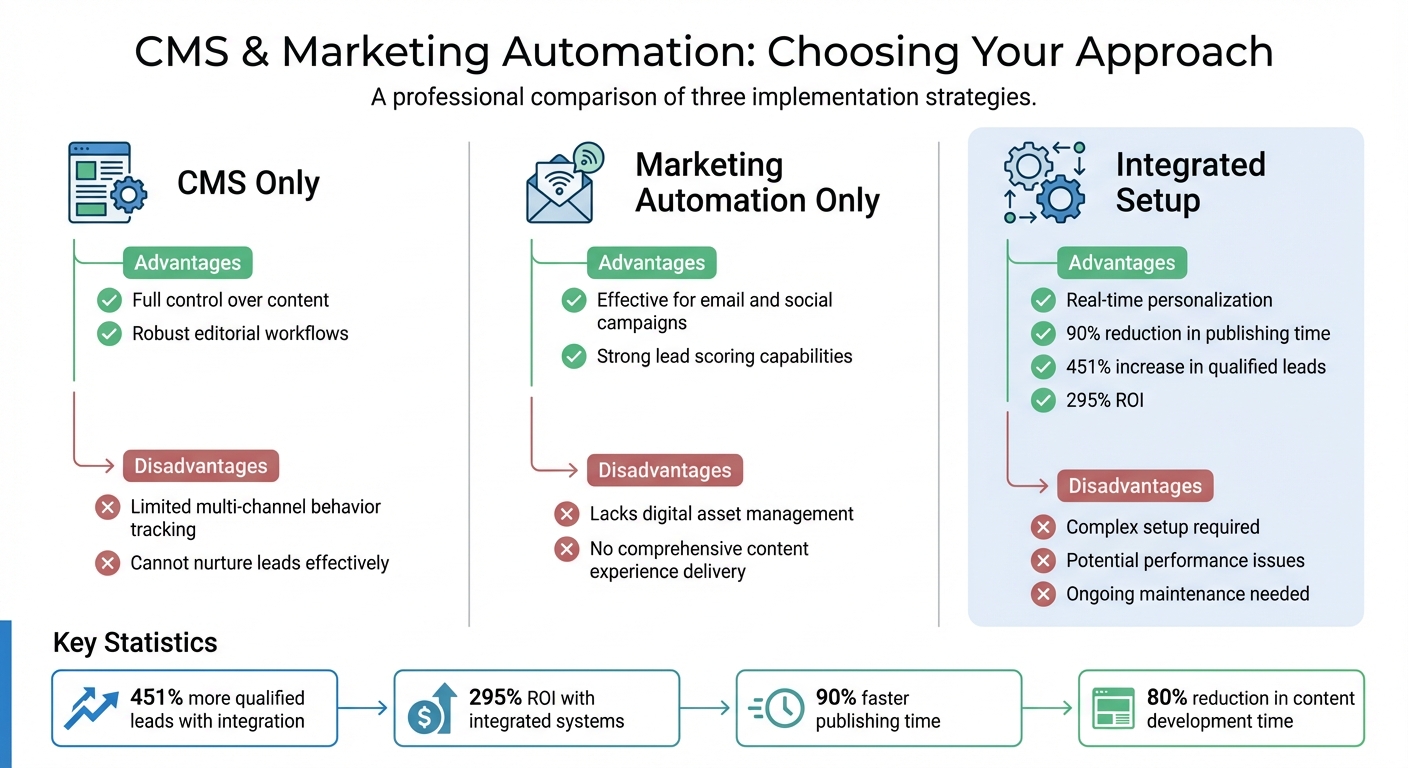
CMS vs Marketing Automation vs Integrated Approach: Advantages and Disadvantages Comparison
Choosing between a standalone CMS and an integrated setup comes with clear trade-offs. A standalone CMS is excellent for managing content creation but lacks the ability to track off-site user behavior or nurture leads effectively. On the other hand, marketing automation tools are great for driving traffic through email and social media campaigns. However, they fall short in managing digital assets or delivering a seamless content experience once users land on your site.
An integrated approach often delivers the best results. Take VMware, for example. In 2023, they transitioned from a manual partner verification process to an automated system. By connecting their CMS with marketing automation, they streamlined email communication with partners and expanded their global network – all without adding to their workforce.
That said, integration isn’t without its challenges. Embedding forms, for instance, can slow down page loading times, negatively impacting Core Web Vitals. Traditional CMS platforms often rely on plugins, which can fail during site redesigns, leading to what experts term "integration brittleness". Additionally, without centralized, role-based access controls, managing sensitive data becomes more complicated and increases the risk of exposing targeting metadata.
Despite these hurdles, the numbers speak for themselves. Companies using marketing automation for lead generation report a staggering 451% increase in qualified leads. Those with integrated systems achieve a 295% ROI. Moreover, publishing time decreases by 90%, and content development time is cut by 80% when these tools work together seamlessly. To make the most of integration, businesses should prioritize native form rendering over embedded forms, implement server-side tagging to boost performance, and use consistent identifiers across platforms.
| Approach | Advantages | Disadvantages |
|---|---|---|
| CMS Only | Full control over content with robust editorial workflows | Limited ability to track multi-channel behavior and nurture leads |
| Marketing Automation Only | Effective for email and social campaigns, with strong lead scoring capabilities | Lacks tools for managing digital assets and delivering comprehensive content experiences |
| Integrated Setup | Enables real-time personalization, reduces publishing time by 90%, and boosts qualified leads by 451% | Requires complex setup, may face performance issues, and demands ongoing maintenance |
Conclusion
Connecting your CMS with marketing automation tools isn’t just a smart move – it’s a growth driver. The numbers speak for themselves: businesses using integrated systems report an average return of $5.44 for every dollar spent, while email marketing alone can bring in $36 for each dollar invested. Plus, with 91% of decision-makers anticipating increased reliance on automation by 2025, integration isn’t just an option anymore – it’s quickly becoming a must.
When these systems work together, they create a powerful synergy. Marketing automation tools help you attract prospects through targeted campaigns, while your CMS delivers the content experience that turns visitors into customers. This partnership enables real-time lead handoffs to sales teams, personalization based on user behavior, and a centralized hub for repurposing your best-performing content with ease.
But before diving into technology, focus on strategy. Clearly define what a sales-ready lead looks like, align your teams, and audit your data to ensure it’s actionable. Assign distinct responsibilities: let your CRM manage sales and firmographic data, while your marketing automation tool handles engagement and behavioral insights.
To get the most out of your integration, use APIs to render forms directly and inclusion lists to filter for qualified leads. These steps create a strong framework for adopting new innovations down the line.
As highlighted earlier, advancements like AI-driven orchestration and privacy-first data collection are reshaping how integrations are done. By starting with clean data, clear responsibilities, and seamless information sharing, you’ll be set to embrace what’s next in the world of automation.
FAQs
How does combining a CMS with marketing automation enhance lead generation?
Combining a content management system (CMS) with marketing automation can turn your website into a lead-generation powerhouse. The CMS handles content like blog posts, landing pages, and forms, while the automation platform tracks visitor behavior and processes form submissions instantly. Together, they create a system that allows marketers to score leads, send personalized emails, and show tailored content based on what users do on your site.
Here’s how it works in practice: Let’s say a visitor downloads a whitepaper. Right away, they can receive a follow-up email, view related content during their next visit, and be added to an email sequence that helps move them through the sales funnel. This integration doesn’t just save time – it improves lead quality and boosts conversion rates. Many businesses even report noticeable revenue growth within just a few months of implementing this strategy.
For U.S. companies, this approach aligns perfectly with data-driven marketing goals. It enhances ROI, speeds up business growth, and delivers measurable results. These are the kinds of outcomes Growth-onomics focuses on achieving through its expertise in performance marketing.
What challenges can arise when integrating a CMS with marketing automation tools?
Integrating a CMS with marketing automation tools comes with its fair share of hurdles. One of the biggest challenges is the technical mismatch between systems. Since these tools often rely on different technologies, aligning APIs, data structures, and event triggers to enable smooth data flow can be both intricate and time-intensive.
Another major roadblock is the issue of data silos. Customer and content data often end up stored in separate systems, which can lead to fragmented workflows and inconsistent information. This not only disrupts efficiency but also makes achieving a unified marketing strategy much harder. On top of that, scalability can pose a problem. While some integrations might work well for small-scale campaigns, they often falter under the demands of higher traffic or more advanced personalization needs if they weren’t designed with growth in mind.
Lastly, certain marketing automation platforms come with limited personalization capabilities, which can result in inefficiencies like having to manually transfer data between tools. Growth-onomics addresses these challenges head-on by creating data-driven integration strategies that ensure seamless compatibility, break down silos, and enable scalable, personalized marketing solutions.
How can businesses protect customer data when integrating a CMS with marketing automation tools?
To protect customer data when integrating a CMS with marketing automation tools, it’s essential to choose platforms built with privacy-first principles. These systems often come with features like server-side tagging and secure APIs, which help minimize the exposure of personal data. Additionally, implementing a consent-based approach ensures that user data is only shared after receiving explicit permission.
In the U.S., adhering to regulations like the California Consumer Privacy Act (CCPA) is a must. Develop clear and transparent privacy policies that detail how data, such as form submissions or browsing behavior, will be used. Make it easy for users to withdraw consent or request data deletion. To further enhance security, encrypt data both during storage and while it’s being transmitted, and conduct regular audits to uncover and address potential vulnerabilities. By focusing on privacy and collecting only the data that’s absolutely necessary, businesses can enjoy the advantages of integrated CMS and marketing automation systems while earning and preserving customer trust.