


CLV-integrated ROI shifts the focus from short-term wins to long-term profitability by considering the total value a customer brings over time. Unlike traditional ROI, which only looks at immediate returns, CLV-based calculations help businesses understand which customers are worth higher investments and identify retention opportunities.
Key takeaways:
- CLV measures long-term value: A customer making smaller, recurring purchases often contributes more over time than a one-time high spender.
- Better resource allocation: CLV helps prioritize marketing channels that attract high-value, loyal customers – even if acquisition costs are higher upfront.
- Retention is cost-effective: Retaining customers is 5x cheaper than acquiring new ones, and loyal customers drive 80% of revenue.
- Data-driven decisions: CLV metrics reveal churn risks and guide smarter retention strategies by tracking behaviors like purchase frequency and engagement.
While CLV-based ROI requires robust data systems and predictions, it offers a broader view of marketing success. For businesses aiming for sustainable growth, focusing on CLV ensures better resource use and stronger customer relationships.
Customer Lifetime Value Explained: Grow Revenue Smarter!
Key Benefits of CLV Integration into ROI
Bringing Customer Lifetime Value (CLV) into Return on Investment (ROI) calculations shifts the way businesses evaluate marketing success. Instead of only looking at past transactions, this approach focuses on predicting future customer activity and profit potential. It’s like comparing a snapshot to a full-length movie – understanding a customer’s total value over time rather than just their first purchase. This forward-thinking method provides a clearer picture for financial decision-making.
A thorough CLV calculation factors in the Cost to Serve, which includes logistics, overhead, and support expenses that change over the course of a customer’s relationship with the company. This prevents businesses from overestimating the value of high-revenue customers whose support costs may eat into profits. Emmanuel Thomassin, Chief Financial Officer at Delivery Hero, highlights this point:
"CLV is our core steering metric. It’s a topic we’re driving intensively at all levels of the organization and we have set clear goals from which we can only deviate in exceptional cases".
By leveraging CLV insights, businesses can fine-tune resource allocation, balancing the cost of acquiring new customers against the value of retaining existing ones. Data shows that acquiring a new customer typically costs five times more than retaining a current one. Moreover, around 80% of a company’s revenue often comes from its most profitable customer segments. Identifying these high-value groups is critical for sustainable growth.
Investing in higher-cost marketing channels can also make sense when they attract customers with greater loyalty and higher purchase frequency. For example, in 2023, Samuel Huang, CEO of Telegram Ads Agency, shifted 30% of a client’s paid search budget to an affiliate partnership program. This change, focusing on performance-based partnerships rather than paid clicks, led to a 47% reduction in acquisition costs within three months, all while maintaining growth.
CLV metrics also act as early indicators of customer churn. Tracking behaviors like product usage, login frequency, and engagement scores helps businesses spot warning signs before customers leave. This is especially important given that 40% of customers stopped buying from a brand last year due to inconsistent product or service quality. On the flip side, customers who rate their experience 5/5 stars are more than twice as likely to make another purchase. By aligning CLV metrics with customer behavior, companies can build stronger, long-term growth strategies.
1. CLV-Integrated ROI Calculations
Revenue Impact
Integrating Customer Lifetime Value (CLV) into ROI calculations shifts the focus from short-term wins to long-term revenue potential. Unlike traditional Return on Advertising Spend (RoAS), which measures short-term performance, CLV-based RoAS takes into account the entire customer lifecycle. This broader perspective prevents businesses from limiting their marketing spend based on immediate returns, potentially missing out on high-value customers who might cost more upfront but bring greater profitability over time.
A common benchmark for sustainable growth is the 3:1 LTV-to-CAC ratio (Lifetime Value to Customer Acquisition Cost). Established digital businesses often report ratios ranging from 2:1 to 8:1. A great example is Mr. Spex, a European online eyewear retailer, which opened physical stores to improve its CLV-to-CAC ratio. By adopting an omnichannel approach, they balanced rising digital acquisition costs with offline touchpoints, boosting long-term customer value and reshaping their business model.
Marketing Resource Allocation
With insights from CLV, marketers can better allocate budgets toward channels that drive long-term value instead of simply focusing on the lowest cost per lead. This strategy prioritizes channels that attract customers with higher purchase frequencies and longer retention periods – even if the initial acquisition costs are higher. The idea is simple: acquisition costs are a sunk expense, so comparing them against future profit streams leads to smarter, forward-looking decisions.
| CLV Component | Impact on Resource Allocation |
|---|---|
| Average Order Value | Guides investment in upselling and promoting premium products |
| Purchase Frequency | Helps plan re-engagement campaigns at the right intervals |
| Retention Period | Supports funding for loyalty programs and enhanced customer service |
| Cost to Serve | Directs focus toward high-margin accounts for personalized support |
Customer Retention
By incorporating CLV into ROI calculations, businesses can better identify and address retention opportunities. For instance, declining purchase frequency or smaller average orders can act as early warning signs of customer churn, prompting timely and targeted outreach. Investments in retention become far more efficient when directed at the right customer segments. Additionally, tracking these metrics helps teams make informed decisions about whether to focus resources on acquiring new customers or deepening relationships with existing ones.
2. Traditional ROI Calculations
Traditional ROI methods often fall short in recognizing the full value of a customer, especially when compared to approaches that integrate Customer Lifetime Value (CLV).
Revenue Impact
Traditional ROI measures profitability as a simple ratio: (Net Return on Investment / Cost of Investment) × 100%. This method focuses on short-term sales gains, treating immediate and future returns as if they hold the same value, without accounting for the timing of those returns. Essentially, it provides a quick snapshot of how a marketing investment performed right after execution.
"Traditionally, marketers calculate the ROI of a marketing investment by measuring how much sales increased in its aftermath. This is a blunt metric: maybe the consumer had a different interaction with the brand that influenced them. Or maybe they had an intrinsic preference for the brand and would have made a purchase anyway." – Werner J. Reinartz and Rajkumar Venkatesan
For example, in 2015, a software company realized the limitations of its traditional ROI calculations. By attributing sales solely to the "last point of interaction", it credited branded search for all conversions. However, after applying statistical modeling, the company discovered that TV advertising had actually driven those branded search clicks. By reallocating resources to TV, recognizing its long-term impact, the company significantly improved its overall marketing ROI.
This example highlights how traditional ROI can misrepresent the true drivers of success, leading to misaligned resource allocation and undervaluing efforts that build long-term customer relationships.
Marketing Resource Allocation
Traditional ROI often relies on backward-looking metrics to evaluate which campaigns or customers were worth the investment. This oversimplified approach can create blind spots, treating all customers as equally valuable without considering acquisition costs or long-term profitability. For instance, resources are frequently allocated based on "last point of interaction" rules, which can lead to underinvestment in top-of-funnel activities like TV or display ads that drive brand awareness over time.
One retail company used multivariate regression to refine its resource allocation strategy. By reducing communications after the first customer touchpoint, they managed to improve their offline ROI by 10%.
These oversights in allocation can obscure opportunities for long-term engagement and make it harder to identify early warning signs of customer churn.
Customer Retention
A major flaw in traditional ROI is its inability to account for the length and quality of customer relationships. It focuses on individual transactions rather than ongoing engagement. For instance, a customer generating high revenue might seem valuable in traditional terms, but declining engagement – like fewer interactions or reduced usage – could signal an impending churn risk that goes unnoticed. Given that 42% of sales leaders cite recurring revenue as their primary income source, this transactional lens often misses critical opportunities to strengthen retention strategies.
Ultimately, traditional ROI’s narrow focus on immediate returns overlooks the broader picture, leaving businesses less equipped to sustain long-term growth.
Pros and Cons
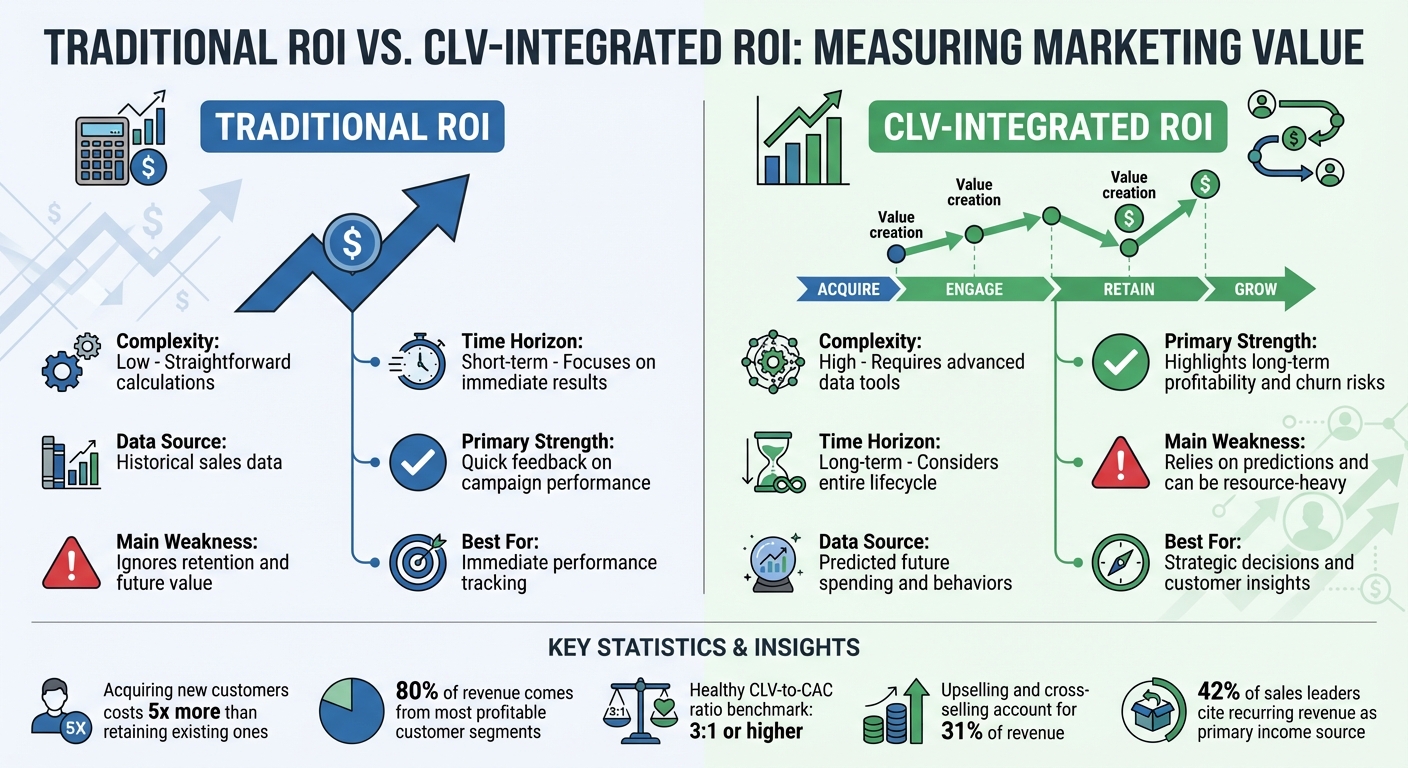
Traditional ROI vs CLV-Integrated ROI: Key Differences and Benefits
When comparing these two approaches, it’s clear both have distinct advantages and limitations that can influence strategic marketing decisions. Choosing the right method depends on your goals, resources, and ability to manage data effectively.
CLV-integrated ROI offers a broader perspective by focusing on long-term profitability. It pinpoints which customer segments are worth higher investment and identifies "high spend, low engagement" customers who may seem valuable but are at risk of churning. This method is particularly useful for strategic decisions like expanding into new markets or evaluating the effectiveness of specific marketing channels. It also emphasizes that retaining existing high-value customers is often more efficient than acquiring new ones. A CLV-to-CAC ratio of 3:1 or higher is often seen as a benchmark for a healthy business model, giving leadership a clear metric for resource allocation.
However, this approach isn’t without its hurdles. As Megan Pratt, Principal Product Marketing Manager at AdRoll, explains:
"CLV’s main drawback is that the future is difficult to predict, even with the best data at your disposal… CLV is only a best guess and shouldn’t be seen as an exact source of truth".
Implementing CLV-integrated ROI requires a robust data infrastructure, such as Customer Data Platforms and tools for identity resolution, to track customer behavior across channels. Data inconsistencies – like mixed currencies or incomplete records – can undermine accuracy. Additionally, the complexity of this approach demands strong organizational alignment and technical expertise, which can be challenging for many teams.
On the other hand, traditional ROI focuses on immediate results, making it simpler to calculate and less reliant on advanced infrastructure. It provides quick feedback on campaign performance, which is particularly helpful for smaller teams or businesses with limited analytics capabilities.
That said, traditional ROI has its own limitations. By concentrating solely on short-term transactions, it treats all customers as equally valuable and overlooks acquisition costs or future profitability. This narrow focus can lead to underinvestment in customer retention, even though upselling and cross-selling account for about 31% of revenue.
Here’s a side-by-side comparison of the two approaches:
| Feature | Traditional ROI | CLV-Integrated ROI |
|---|---|---|
| Complexity | Low; straightforward calculations | High; requires advanced data tools |
| Time Horizon | Short-term; focuses on immediate results | Long-term; considers the entire lifecycle |
| Data Source | Historical sales data | Predicted future spending and behaviors |
| Primary Strength | Quick feedback on campaign performance | Highlights long-term profitability and churn risks |
| Main Weakness | Ignores retention and future value | Relies on predictions and can be resource-heavy |
| Best For | Immediate performance tracking | Strategic decisions and customer insights |
Each method has its role, but the choice depends on whether your priority lies in short-term gains or long-term growth. By understanding these trade-offs, businesses can align their strategies with their unique goals and resources.
Conclusion
Deciding between traditional ROI and a CLV-integrated approach boils down to your business priorities: are you aiming for quick wins or building lasting customer relationships? While traditional ROI offers immediate insights into campaign performance, it often misses the bigger picture – some customers contribute to your revenue for years, while others might never come back.
On the other hand, CLV-integrated ROI views customer acquisition as a long-term investment with measurable returns. Delivery Hero’s CFO, Emmanuel Thomassin, captured this mindset perfectly when he said, "Customer lifetime value is our core steering metric. It’s a topic we’re driving intensively at all levels of the organization… We use CLV to support our strategic and operational decisions". This approach represents a shift in strategy, influencing everything from market expansion to how marketing budgets are allocated.
The numbers back it up: retaining existing customers is far more cost-effective than acquiring new ones. Plus, it’s often the most loyal and profitable customer segments that drive the majority of revenue. By prioritizing CLV, businesses can identify which marketing channels attract customers who not only convert but also stick around, spend more, and grow with the brand. This makes CLV-integrated ROI a powerful tool, even if it requires overcoming some operational hurdles.
Adopting this approach does mean upgrading your data systems and aligning your organization around new metrics, but the benefits are undeniable. It helps you avoid underfunding retention efforts, steer clear of unprofitable acquisition channels, and cultivate a customer base that generates steady, predictable revenue. As Brandon Purcell from Forrester wisely notes, "CLV is a journey, not a destination. Your first CLV model won’t be your last".
For businesses committed to long-term growth, start by segmenting customers based on their lifetime value. Then, reallocate your marketing budget to focus on channels that attract these high-value, loyal customers. Shifting from a transactional approach to a relationship-driven strategy can lead to significant improvements in both profitability and retention – so why wait?
FAQs
How does incorporating Customer Lifetime Value (CLV) into ROI calculations boost long-term profitability?
Incorporating Customer Lifetime Value (CLV) into ROI calculations allows businesses to zero in on their most valuable customers, paving the way for smarter budgeting and stronger long-term profitability. By pinpointing which customers generate the highest lifetime revenue, companies can focus on retention strategies that are proven to drive profit growth.
Here’s a compelling fact: increasing customer retention by just 5% can lead to a profit boost of 25% to 95%. Adding churn-adjusted CLV into the mix provides more accurate revenue projections and ensures marketing budgets are aligned with long-term goals. This method not only sharpens financial planning but also deepens customer connections, setting the stage for sustainable growth.
What challenges do businesses face when incorporating customer lifetime value (CLV) into ROI calculations?
Incorporating CLV into ROI calculations isn’t exactly a walk in the park – it comes with its fair share of hurdles. For starters, you need reliable, high-quality data. We’re talking about transactional histories, customer demographics, and behavioral trends. If the data is incomplete or inconsistent, it can throw off your CLV predictions and, ultimately, your ROI calculations.
Then there’s the challenge of complex calculations. Accounting for factors like churn rates, profit margins, and discount rates requires advanced analytics. Teams without access to skilled data scientists or robust analytical tools might find this process daunting.
Lastly, weaving CLV insights into your current systems often means making technical tweaks and fostering collaboration across departments. This could involve setting up tracking tools, adhering to data privacy regulations, and getting everyone on the same page about the importance of these metrics. Without clear communication and strong governance, the adoption process can drag, and the results might not live up to expectations.
Why is retaining customers more cost-effective than acquiring new ones based on CLV metrics?
Retaining customers is far more economical than acquiring new ones. On average, keeping an existing customer costs 5 to 7 times less, and in some instances, it can be as much as 25 times cheaper.
What’s more, even a modest 5% increase in customer retention can result in a 25% to 95% increase in profits. This is because loyal customers typically contribute more over their lifetime, making retention a smart and cost-effective way to boost ROI.