


Looking for an AI-driven marketing agency that delivers real financial results? Here’s the bottom line: the best agencies focus on measurable metrics like ROAS, CAC, and LTV, not vanity stats like clicks or impressions. They leverage advanced AI tools, real-time data, and precise attribution models to optimize campaigns and connect every dollar spent to revenue growth.
Key takeaways:
- ROI Metrics Matter: Prioritize agencies that track ROAS, CAC, and payback periods.
- AI Advantage: Agencies using AI improve campaign outcomes by 34% on average.
- Attribution Models: Avoid last-click bias; look for data-driven and incrementality testing approaches.
- Transparency: Demand real-time dashboards and clear explanations of AI decisions.
- Case Studies: Review industry-specific examples with concrete revenue improvements.
When evaluating agencies, focus on their ability to align with your financial goals, provide actionable insights, and demonstrate proven results. Avoid agencies that rely on vague promises or lack transparency in their strategies.
Key Metrics for Measuring ROI
Core ROI Metrics
To truly connect marketing spend to business outcomes, the best agencies focus on five key financial metrics. First, there’s ROAS (Return on Ad Spend), which calculates how much revenue is generated for every dollar spent on ads. Then, there’s CAC (Customer Acquisition Cost), determined by dividing total spend by the number of new customers. For instance, if you spend $1,200 to acquire 10 customers, your CAC would be $120. Another critical metric is LTV (Customer Lifetime Value), which measures the total revenue a customer generates over their entire relationship with your business. Ideally, your LTV:CAC ratio should hit 3:1 – anything lower means you’re overspending to gain customers.
Next up, MER (Marketing Efficiency Ratio) looks at overall marketing efficiency by dividing total revenue by ad spend. Lastly, the payback period tells you how many months it takes to recover the initial costs of acquiring a customer.
Surprisingly, 95% of AI investments don’t yield measurable returns, often because businesses fail to account for "fully loaded" costs. When evaluating an agency’s ROI claims, make sure they’re including everything – software licenses, implementation time, data infrastructure, training, and ongoing quality assurance – not just ad spend. These metrics are essential for holding agencies accountable to their promises of delivering measurable results.
How to Set Measurable Goals
Once your ROI metrics are clear, the next step is to define specific, measurable goals. Start by gathering 8–12 weeks of baseline data on CPA, CAC, and conversion rates. This historical data serves as your benchmark. Without it, you can’t tell if an agency’s AI-driven strategies are genuinely improving performance or if seasonal trends are skewing the results.
Set time-bound, specific targets based on this baseline. For example, instead of saying, "improve performance", aim for goals like reducing CAC by 25% within 90 days, achieving a payback period of under six months, or reaching a ROAS of 4.0 (generating $4.00 for every $1.00 spent). These targets should align with your monthly financial reconciliations to ensure your marketing data matches your company’s profit and loss statements.
Top agencies don’t just accept your goals – they translate them into actionable strategies. For instance, if your profit margins require a specific CAC threshold, their algorithms should optimize campaigns within those financial limits rather than chasing higher volumes at unsustainable costs.
Attribution Models Explained
Attribution models determine how credit for conversions is assigned, and the wrong approach can lead to major missteps. For example, last-click attribution gives all credit to the final touchpoint before a sale. This often leads businesses to over-invest in branded search by 41% while neglecting prospecting efforts by 28%. The truth is, the average e-commerce customer interacts with a brand 7.4 times before making a purchase.
To avoid these pitfalls, leading agencies use a combination of three attribution methods. MMM (Marketing Mix Modeling) offers a high-level view for allocating budgets across channels over the long term. Data-driven attribution uses machine learning to analyze the entire conversion path, allowing for real-time campaign adjustments – businesses leveraging AI-driven attribution report an average 34% improvement in ROAS. Lastly, incrementality testing measures the true impact of your ads by comparing a group exposed to your campaigns with a control group that wasn’t. This helps you determine which sales were genuinely driven by marketing versus those that would have happened anyway.
When vetting agencies, ask about their attribution model and how they apply it. Ensure they align their approach across platforms like Google and Meta to avoid double-counting conversions – a simple step that can boost efficiency by 22%. If an agency can’t clearly explain their attribution strategy, they’re unlikely to prove they’re driving real, incremental revenue. Understanding these models gives you the tools to evaluate whether an agency can turn strategy into measurable results.
AI and Data Capabilities to Expect
AI Tools for Campaign Optimization
Leading agencies are leveraging advanced AI tools to supercharge campaign performance. For instance, Google Ads Smart Bidding can be set up for value-based optimization, focusing on customers who bring higher profit margins rather than just increasing clicks. Similarly, Performance Max campaigns streamline targeting and creative delivery across Google’s network, while Meta Advantage offers comparable features for Facebook and Instagram.
But it doesn’t stop at bidding. Agencies are now using predictive modeling to pinpoint likely churners or identify the next wave of potential buyers. These tools directly impact key ROI metrics by fine-tuning ad spend and lowering customer acquisition costs (CAC). A great example comes from Bayer’s 2024 collaboration with an AI-driven agency. By combining Google Trends data, climate insights, and Google Cloud ML models, they predicted regional flu outbreaks, leading to real-time campaign adjustments. The result? An 85% boost in click-through rates and a 33% reduction in cost-per-click.
Agencies are also scaling creative production using automated multivariate testing, generating 50–100 creative variations per campaign – something manual processes can’t achieve. On top of that, tools like Google’s open-source Meridian offer Marketing Mix Modeling to allocate budgets effectively across channels based on historical data.
The success of these AI optimizations hinges on seamless data integration, which we’ll explore next.
Data Integration and Privacy Compliance
For AI to deliver accurate results, data from various sources must be unified. Agencies should integrate CRM systems, web analytics, and ad platforms into a centralized data warehouse or a Customer Data Platform (CDP). This creates a holistic view of the customer journey, rather than fragmented snapshots from individual tools. Marketers who rely on first-party customer data for AI report a 30% improvement in performance compared to those who don’t. Beyond performance, strong data practices ensure compliance and improve ROI measurement accuracy.
Privacy compliance is now a non-negotiable. With the decline of third-party cookies, agencies must adopt tools like Consent Mode, Enhanced Conversions, and features from the Privacy Sandbox to maintain accurate measurement while respecting user privacy [23, 25]. For example, advertisers using enhanced conversions for leads saw an 8% increase in conversions compared to those relying on standard offline conversion imports.
In the U.S., compliance with laws like the CCPA and CPRA is mandatory. Agencies should deploy Consent Management Platforms to ensure data collection aligns with user permissions. Additionally, data clean rooms allow marketers to analyze customer data alongside media platforms without sharing raw, personally identifiable information.
Transparency in AI Operations
Transparency is crucial when working with AI-driven campaigns. If an agency can’t explain the logic behind its AI decisions, it signals a lack of accountability. Systems that function as mysterious "black boxes" fail to provide the clarity needed for trust. Instead, agencies should use Explainable AI (XAI) frameworks to break down the reasoning behind every budget adjustment, audience shift, or creative suggestion [3, 26].
"The shift from manual measurement to algorithmic, real-time analysis allows near-instant adjustments to campaign parameters, fundamentally changing how we optimize for performance." – Eric Siu, Founder, Single Grain
Agencies should also provide real-time optimization dashboards that show exactly how AI is adjusting bids or pausing underperforming ads in the moment – no more waiting for monthly summaries. They should be able to explain their AI models in simple, non-technical terms. If they can’t, it might be a sign they’re hiding critical details. While AI-focused agencies are 57% more advanced in campaign measurement practices compared to traditional advertisers, this edge only matters if they can clearly communicate their approach.
How to Evaluate Case Studies and Track Records
What to Look for in Case Studies
When reviewing case studies, focus on those that showcase measurable improvements in revenue or lead generation specific to your industry. For instance, if you run an e-commerce business, prioritize examples that demonstrate revenue growth over defined timeframes. In B2B scenarios, look for evidence of qualified lead generation and a positive impact on the sales pipeline.
Take Hestan Culinary as an example. This cookware brand partnered with Single Grain in Spring 2022. The agency implemented a programmatic advertising strategy using StackAdapt‘s dynamic retargeting and a full-funnel approach. The results? Within just 45 days, their retargeting ROAS skyrocketed from 1.91 to 9.20 – a 381% increase – while overall conversions grew by 281%. Case studies like this that include specific metrics – timeframes, brand context, and ROI – are the gold standard.
It’s also important to see niche expertise. Agencies with a proven track record in a specific sector often achieve conversion rates that are 41% higher than those of generalist agencies. Avoid vague case studies that lack industry context; these are often red flags.
Additionally, scrutinize the methodology behind the results presented. Look for evidence of robust testing methods, such as geo-holdout tests, to confirm causation rather than correlation. This ensures the results are genuinely tied to the strategies deployed.
Once you’ve identified compelling case studies, turn your attention to the benchmarks that back them up.
Quantitative Benchmarks to Demand
Metrics that directly tie to profitability are non-negotiable. The most critical is Profit on Ad Spend (POAS), which is calculated as: (Revenue × Gross Margin %) ÷ Ad Spend. A POAS benchmark of 200% or more (a 2:1 profit ratio) is essential for ensuring profitability. This metric is far more meaningful than traditional ROAS, as it factors in actual margins.
"That’s like answering ‘what’s the temperature?’ with ‘it’s cloudy.’ You’re measuring the wrong thing." – Jay Kang, on using ROAS instead of profit margins
Look for evidence of reduced Customer Acquisition Costs (CAC) and increased Lifetime Value (LTV). For example, AI-powered marketing automation can cut CAC by up to 50%. If an agency can’t demonstrate significant CAC improvements, they may not be leveraging AI effectively. Proper LTV tracking is also critical – while first-month CPA might initially show a loss, long-term profitability could still be achieved.
Consider the success story of Booking.com, which used predictive audience modeling and AI-driven personalization. They achieved a 73.72% boost in conversion rates, a 65.16% rise in cart additions, and a 16.15% increase in average spend per transaction. These are the types of detailed, multi-faceted results you should expect.
For campaigns using AI tools like Performance Max, ask for Asset Strength ratings. Agencies should consistently achieve "Excellent" ratings, showing they provide the AI with enough high-quality creative material to optimize effectively. Also, inquire about creative refresh rates – top-performing agencies typically refresh 20-30% of assets each month to avoid creative fatigue.
Finally, ensure the agency employs statistical rigor in their testing. Reliable results require a confidence threshold of 90-95% to rule out seasonal or market-related fluctuations. If an agency can’t clearly explain their testing process, consider it a red flag.
Once benchmarks are clear, evaluate pricing and contract terms to ensure transparency.
Contract and Pricing Transparency
Agencies use a variety of pricing models, each with its own advantages and trade-offs. Here’s a breakdown:
| Pricing Model | Description | Best For |
|---|---|---|
| Flat-Tiered Pricing | Predictable monthly fees based on service levels | Budget clarity and scaling |
| Percentage of Ad Spend | Scaled fees (12-18%) based on ad spend | Traditional scaling |
| Pay-Per-Lead (PPL) | Fee per MQL/SQL meeting quality criteria | B2B and high-ticket services |
| CPA / Cost Per Sale | Fee per validated purchase or signup | E-commerce and PLG SaaS |
| Revenue Share | Commission on attributable incremental revenue | DTC brands with clean attribution |
For transparency, demand contractual guarantees around data ownership. Your customer data, campaign insights, and conversion tracking should remain yours if you decide to part ways. Request access to a real-time dashboard. Additionally, clarify performance guarantees – know what happens if agreed-upon benchmarks aren’t met. Some agencies offer hybrid models with a modest retainer paired with tiered bonuses for hitting specific KPI targets.
Lastly, verify the agency’s credentials. For example, Google Premier Partner status indicates the agency is in the top 3% of partners, often delivering 23% better campaign performance. Check these credentials through third-party reviews to confirm their authenticity.
Mastering Marketing ROI and AI: Insights from Noble Studios‘ 21-Year Journey
Building a Long-Term Partnership
Traditional vs AI-Driven Marketing Agency Communication Methods
Creating a strong, lasting partnership with your agency depends on three key elements: open communication, a methodical approach to testing, and a shared focus on scaling profitably.
Communication and Team Structure
To ensure smooth collaboration, you need direct access to the right people – campaign managers, data analysts, AI specialists, and creative strategists. But it’s not just about access; the involvement of senior strategists is crucial. Top-tier agencies provide seasoned experts who can interpret complex performance data and develop overarching strategies, not just junior staff focused on task execution. When evaluating an agency, check if there’s a healthy balance between senior strategists and junior team members.
Another must-have? Real-time dashboards. These tools give you immediate insights into campaign performance, spending, and return on ad spend (ROAS). But more than just numbers, the best agencies use "Explainable AI" to clarify the reasoning behind budget shifts or audience targeting decisions.
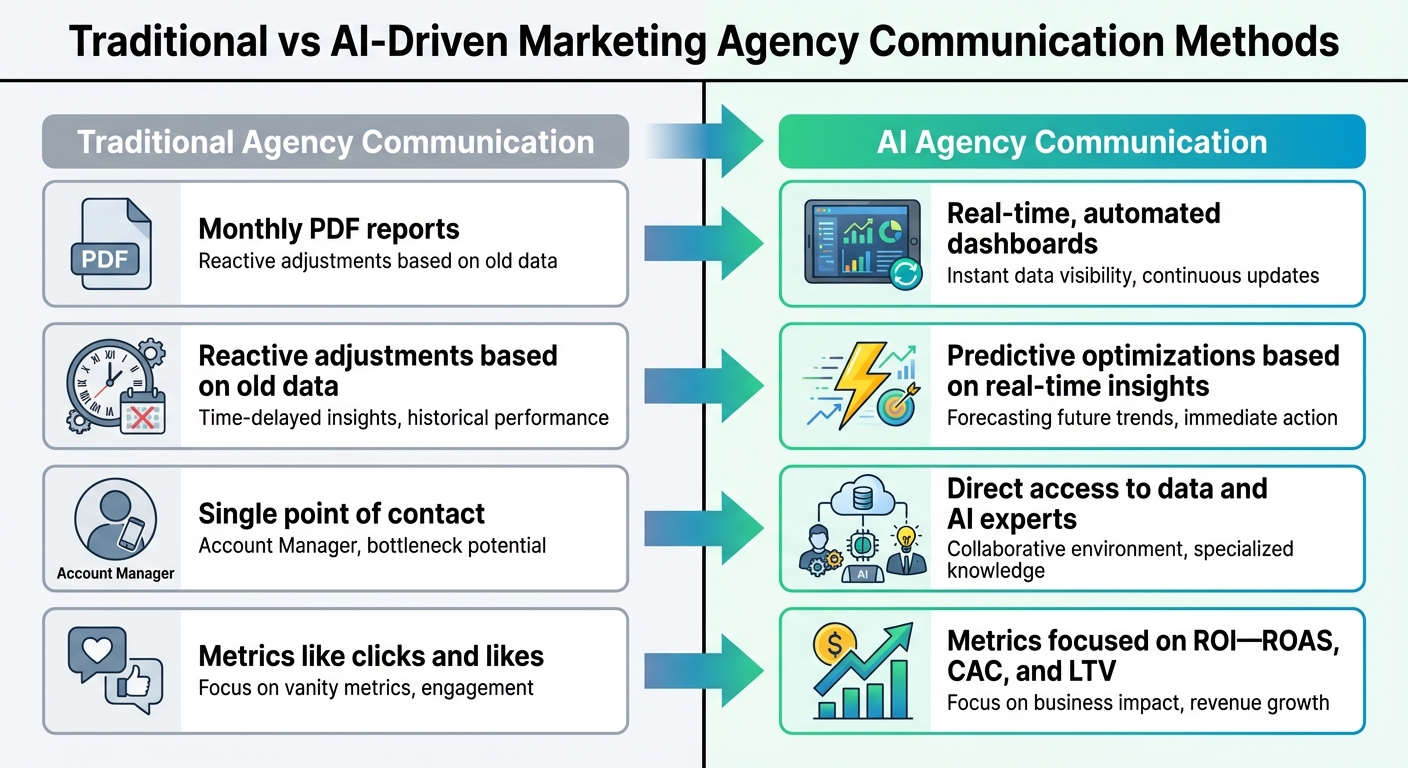
Here’s how communication differs between traditional and AI-driven agencies:
| Traditional Agency Communication | AI Agency Communication |
|---|---|
| Monthly PDF reports | Real-time, automated dashboards |
| Reactive adjustments based on old data | Predictive optimizations based on real-time insights |
| Single point of contact (Account Manager) | Direct access to data and AI experts |
| Metrics like clicks and likes | Metrics focused on ROI – ROAS, CAC, and LTV |
Proactive communication is what sets great agencies apart. Look for teams that hold regular strategy calls (every two weeks or monthly) and offer optimization suggestions without waiting for issues to arise. They should also be committed to producing AI-generated content that aligns with your brand’s identity and long-term vision.
For seamless operations, ensure the agency’s team is available during U.S. business hours and offers convenient communication channels like Slack for high-volume accounts. Solid communication practices are the foundation for effective onboarding and rapid testing.
Onboarding and Experimentation Process
A thorough onboarding process is the backbone of a successful partnership. A good agency will dive deep into your business – examining your product features, customer challenges, competitors, and audience segmentation before launching any campaigns.
One critical step is integrating your ad platforms, CRM systems, and web analytics into a unified data system. This allows AI to optimize campaigns across various channels rather than working in silos. Ask for a discovery audit that includes a review of past performance and a clear 90-day roadmap for improvement.
Testing is another vital aspect. Agencies using automated multivariate methods can triple the number of monthly test iterations compared to manual approaches.
"The shift from manual measurement to algorithmic, real-time analysis allows near-instant adjustments to campaign parameters, fundamentally changing how we optimize for performance." – Single Grain
Ask your agency for a structured optimization plan that outlines how campaigns will evolve based on data insights. This should include hypotheses for different audience segments. Additionally, inquire about their "test velocity" – how many tests they conduct monthly and their success rate – to confirm their ability to experiment at scale.
Creative testing is equally important. Leading agencies refresh creative assets monthly to avoid ad fatigue and maintain performance. Ensure they consistently achieve high ratings for Google’s Asset Strength in Performance Max campaigns. A well-defined onboarding and testing strategy is essential before scaling your marketing efforts.
Scaling Marketing Efforts
Once the groundwork is set, scaling your campaigns becomes all about precision. Scaling requires maintaining or improving efficiency as your budget grows. Look for an agency with omni-channel capabilities, able to dynamically allocate budgets across platforms like Meta, Google, Amazon, and Retail Media to avoid over-reliance on any single channel.
Advanced measurement tools are crucial for scaling. Leading agencies combine three methods: Marketing Mix Modeling (MMM) for budget planning, Multi-Touch Attribution (MTA) for daily optimizations, and incrementality testing to measure true impact. This layered approach ensures you can confidently increase spending without sacrificing ROAS.
A great example of leveraging AI for scaling comes from Klarna. In early 2024, Klarna used an OpenAI-powered assistant to manage 2.3 million customer service interactions in a single month – work equivalent to 700 full-time agents. By integrating this data into marketing dashboards, the agency significantly reduced customer acquisition costs (CAC) while enhancing the post-acquisition experience.
Predictive analytics is another game-changer. Agencies that excel in forecasting market trends and consumer behavior can adjust campaigns proactively, preventing performance drops before they occur.
As you scale, real-time dashboards become indispensable for monitoring ROAS and CAC across channels. Agencies using AI-driven measurement frameworks can respond to performance changes 60% faster than traditional methods.
Finally, evaluate pricing models that support growth. Flat-tiered pricing offers budget clarity, avoiding the "tax" on growth that comes with percentage-of-spend models. Some agencies even offer performance-based pricing, tying their fees to specific ROI or ROAS benchmarks, aligning their success with yours.
Every step – from communication to onboarding to scaling – plays a critical role in driving long-term ROI and measurable financial success.
Conclusion
Picking the right AI performance marketing agency boils down to three key principles: data-driven decisions, proven results, and a focus on long-term collaboration. The best agencies prioritize metrics like ROAS (Return on Ad Spend), CAC (Customer Acquisition Cost), and LTV (Lifetime Value). Look for partners who use multi-touch attribution models and real-time dashboards to make swift, precise performance adjustments.
When it comes to proven results, numbers don’t lie. Request case studies that include concrete figures and clear methodologies. Ask about their testing speed and how often they refresh creative assets. Agencies skilled in Performance Max frameworks often deliver 30–50% better ROAS.
Transparency is critical. Insist on real-time access to performance data rather than waiting for delayed monthly reports.
"Every dollar should have a job – and a KPI that tells you if it did the job".
For budget clarity, opt for flat-tiered pricing structures.
Building a successful, long-term partnership requires open communication, structured testing processes, and scalable strategies. The top agencies ensure access to senior strategists, data analysts, and AI experts. They hold regular strategy meetings, proactively suggest optimizations, and maintain a consistent cycle of testing and creative updates. This alignment ensures your marketing spend directly contributes to measurable business growth.
This guide has highlighted the importance of measurable results and data-driven approaches. Growth-onomics specializes in achieving real growth through AI-powered performance marketing. By combining advanced analytics, performance-focused strategies, and transparent reporting, Growth-onomics helps businesses secure sustainable ROI. Work with a team that prioritizes your business goals and delivers strategies rooted in results – not empty buzzwords.
FAQs
What ROI metrics should I focus on when evaluating an AI performance marketing agency?
When choosing an AI performance marketing agency, it’s essential to zero in on key ROI metrics that provide a clear picture of campaign success and efficiency. Here are the metrics you should pay attention to:
- Return on Ad Spend (ROAS): This tells you how much revenue is generated for every dollar spent on advertising. It’s a straightforward way to measure the profitability of your campaigns.
- Customer Acquisition Cost (CAC): By tracking how much it costs to gain a new customer, you can evaluate the efficiency of your marketing efforts.
- Conversion Rate: This metric reveals the percentage of users completing desired actions – whether it’s making a purchase, signing up, or another goal.
- Customer Lifetime Value (LTV): This estimates the total revenue a customer contributes throughout their relationship with your business, offering insights into long-term profitability.
- Incremental Revenue Lift: This measures the extra revenue your campaign drives compared to your baseline performance, giving you a sense of its true impact.
By focusing on these metrics, you’ll ensure the agency you choose is committed to delivering measurable growth that aligns with your business objectives.
How do AI tools make marketing campaigns more effective and efficient?
AI-powered tools transform marketing campaigns by processing massive datasets at lightning speed and delivering insights that can be acted upon immediately. They take over tasks like spotting audience trends, forecasting conversion rates, and fine-tuning ad bids. This automation means marketers can make quicker, more precise decisions without relying on manual analysis or guesswork.
With features like real-time performance tracking and predictive analytics, AI enables marketers to allocate budgets wisely, zero in on strategies that work, and even anticipate trends before launching a campaign. It also enhances attribution by recognizing the value of every touchpoint in a customer’s journey, ensuring that every marketing dollar works harder. The outcome? Campaigns that are not only smarter but also more efficient, driving tangible results marketers can measure.
What should I look for in case studies to ensure an agency delivers measurable results?
When diving into case studies, prioritize examples that showcase specific, measurable results – like a boost in ROAS (Return on Ad Spend) or a drop in CAC (Customer Acquisition Cost). It’s important that these outcomes are backed by before-and-after data and clearly tied to the agency’s application of AI-driven strategies.
Transparency is key. A solid case study should break down the exact metrics, detail how AI tools were implemented to drive success, and shed light on the campaign’s overall contribution to business growth. This way, you can assess genuine, data-supported achievements.