


Search behavior is changing. People are increasingly turning to AI platforms like ChatGPT not only to ask questions, but also to research products, compare options and make decisions. As user attention moves into conversational search, paid advertising is beginning to follow.
Marketers are now getting introduced to new advertising environments, with new questions that arise from those. Since ChatGPT has ads now, how can we use targeting? How much do they actually cost and what can advertisers measure as “performance”? Is this potentially a better practice and how does it compare to Google Ads?
Here we will break down how ChatGPT Ads work, what how can marketeers have control, which measurements will they get and what would this mean for organic vs paid content in AI search.
What Are ChatGPT Ads?
We have seen in digital advertising that platforms like Google, have been dominated and users search are usually shown relevant sponsored results prior to seeing organic content. And while users have been gradually guided to LLMs, is was natural to see the same shift in advertising.
ChatGPT Ads introduces paid advertising into this conversational space. Rather than appearing alongside search results, ads now appear below ChatGPT’s responses when they’re relevant to a user’s current exploration, comparison or decision-making. This differs from traditional search advertising which relies solely on keyword relevance. Instead context and intent are crucial in determining which ads are shown.
It’s important to remember that sponsored placements are distinct from ChatGPT’s organic responses. OpenAI clarifies that advertisers can’t pay to influence, rank or alter the answers users actually see.
How Do ChatGPT Ads Work?
ChatGPT Ads operate differently from traditional keyword-based advertising. Rather than focusing on precise search terms, advertisers can offer contextual clues. These include natural language phrases describing their product, potential customer demographics and scenarios where it might be beneficial.
ChatGPT uses all of these mentioned above, and alongside with relevant context and the user’s intent, it is determine when an ad is relevant. Below we will analyze how targeting works.
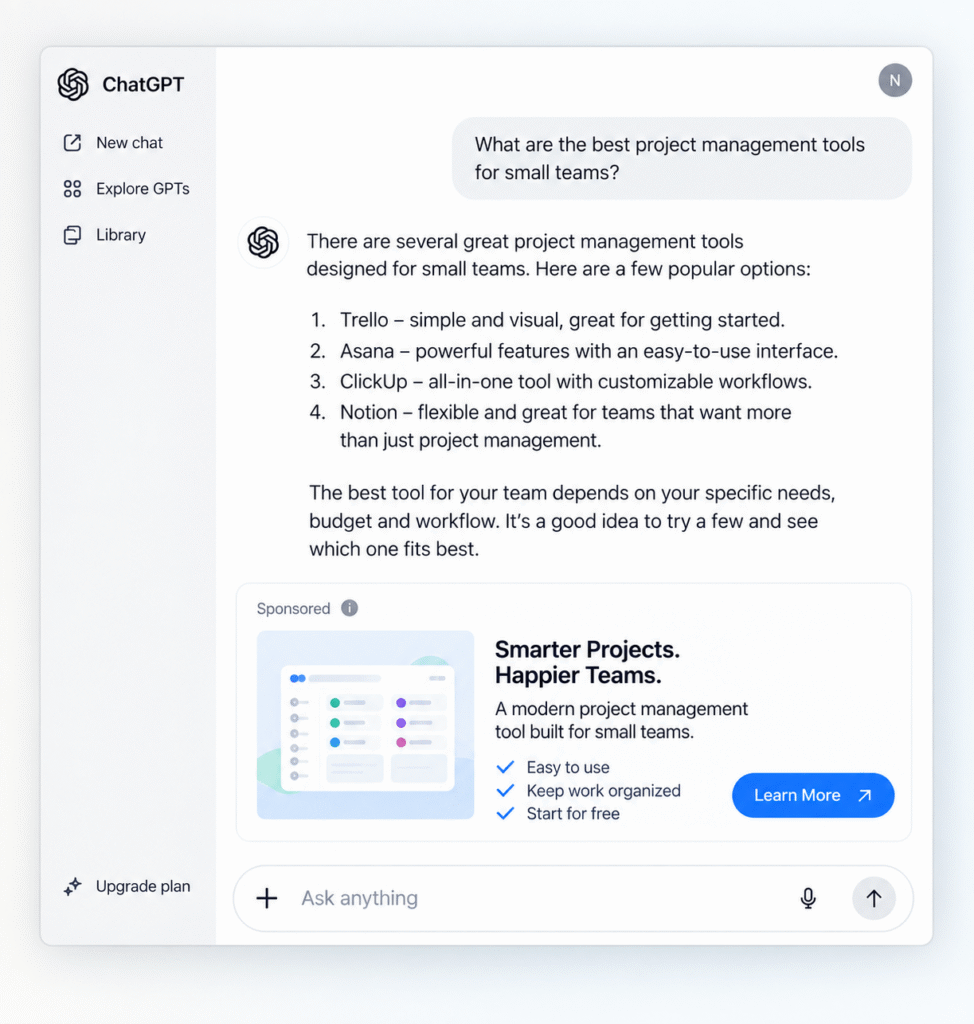
Example of how a sponsored placement could appear within ChatGPT.
Where ChatGPT Ads Appear
ChatGPT Ads are displayed beneath the organic response rather than within it. Visually distinct from ChatGPT’s original answers, these sponsored placements are clearly labelled as such. This separation allows users to easily distinguish between the generated response and the paid placement.
Who Can See ChatGPT Ads
Ads are currently shown on ChatGPT’s Free and Go plans but Plus, Pro, Business, Enterprise and Edu accounts remain ad-free. Users under 18 are also excluded.
How Does ChatGPT Ads Targeting Work?
ChatGPT Ads begin by understanding the user’s actual intent within a conversation. Rather than relying solely on a single search query, the system considers the context and intent of the current interaction to match it with relevant advertisers.
To facilitate this matching, advertisers provide context hints describing their product, its potential usefulness and applicable situations. ChatGPT evaluates these hints alongside other cues like the advertiser’s landing page, ad title and copy, and targeting settings.
For instance, a running shoe brand doesn’t necessarily need someone to type “running shoes for beginners”. A context hint could describe cushioned everyday running shoes suitable for beginners training for their first 5K. Even if the user’s conversation doesn’t explicitly mention “running shoes for beginners”, the system can still grasp the relevance when the wording differs.
When ad personalisation is enabled, ChatGPT can also utilise selected signals from the user’s broader experience such as past conversations, memory and ad interactions. These signals remain within ChatGPT and are not shared with advertisers. Alternatively, if personalisation is turned off, ads can still be chosen based solely on the current conversation.
Context Hints vs Traditional Keywords
A key difference between ChatGPT Ads and traditional search advertising lies in how advertisers convey relevance. While Google Search Ads rely on keyword targeting because users tend to search for specific words or short phrases, ChatGPT conversations differ. Users are more likely to explain their needs, describe problems or pose complete questions as part of ongoing conversations.
This shift requires the use of context hints. Instead of targeting individual keywords advertisers can use natural language phrases to describe the situations and conversations where their product or service might be relevant. Essentially the focus shifts from predicting search keywords to understanding what users might actually say during conversations when they need a solution.
How Much Do ChatGPT Ads Cost?
There’s no fixed price for advertising on ChatGPT. Advertisers control their spending by setting a daily or total campaign budget. For accounts billed in euros, the minimum daily campaign budget is €15 allowing for a relatively small test budget. This minimum varies by billing currency; for example, USD accounts have a minimum of $25 per day. Marketers should remember that the daily budget is an average rather than a strict daily spending cap. Consequently, ChatGPT Ads can spend up to twice the daily budget on a single day while total spend over the applicable seven-day period won’t exceed seven times the daily budget.
CPM, CPC & Conversion-Based Optimization
ChatGPT Ads currently offers advertisers a range of campaign objectives to suit their goals. The Views objective focuses on maximising visibility and reach by purchasing ads on a CPM basis. This means advertisers pay for every 1,000 impressions. Conversely, the Clicks objective uses CPC bidding where advertisers pay for valid clicks. This is more effective for driving users from ChatGPT to a website or product page. OpenAI currently suggests a starting maximum CPC bid of $3 to $5 per click but this is guidance rather than a fixed cost. Furthermore, a new Conversions objective allows campaigns to optimise for specific actions like purchases sign-ups or lead submissions. Depending on the setup, these campaigns can use click-based oCPC or impression-based oCPM billing and advertisers aren’t directly charged per conversion.
How the ChatGPT Ads Auction Works
OpenAI explains that ChatGPT Ads employs a relevance-weighted second-price auction. Eligible ads compete not only on their advertiser’s bid but also on their relevance. Therefore, simply offering the highest bid doesn’t guarantee ad visibility. The system considers both the advertiser’s bid and the ad’s relevance to the user’s current context. This ties directly back to context hints: while a budget can aid an advertiser’s competition, relevance still holds significant weight. For performance marketers, this setup feels familiar with its budget, objective and bid components. However, the environment for determining relevance has shifted. Advertisers now compete for relevance within a conversation rather than around a single search query.
How to Measure ChatGPT Ads Performance
Running ChatGPT Ads is only worthwhile if you can analyse the outcomes after your ad is shown or clicked. OpenAI offers performance reporting directly through ChatGPT Ads Manager while conversion tracking and URL parameters enable advertisers to link campaign activity to website actions. Ultimately, marketers should focus beyond impressions and clicks. Depending on the campaign goal, the key question is whether those interactions ultimately result in purchases registrations leads or other valuable actions.
ChatGPT Ads Manager
The ChatGPT Ads Manager offers the primary reporting environment for monitoring campaign performance. Advertisers can now track key metrics like impressions clicks spend CTR average CPC average CPM and conversions once conversion measurement is set up. Reporting is available at campaign ad group and individual ad levels. Performance data can also be viewed in charts or exported as CSV files for further analysis. This familiar starting point for performance marketers is reassuring as the metrics align with those used across other paid media platforms.
Conversion Tracking, UTMs & Attribution
Advertisers can use the OpenAI Pixel, Conversions API or both to send actions like purchases lead submissions and registrations back to ChatGPT Ads for conversion measurement. OpenAI recommends using the Pixel and Conversions API together for more reliable results. UTM parameters can also be added to landing page URLs to identify traffic from ChatGPT Ads within existing analytics platforms. Ads Manager supports dynamic URL parameters including campaign, ad group, ad and ad-account IDs. Attribution is a key area and advertisers can currently choose 7-, 14- or 30-day click-through reporting windows or a 1-day view-through window. OpenAI uses last-touch attribution rather than a multi-touch model.
ChatGPT Ads vs Google Ads: What’s Different?
| Google Search Ads | ChatGPT Ads | |
| Targeting mindset | Keywords and search queries | Context hints and conversational intent |
| User environment | Search results | Ongoing conversation |
| Placement | Search results pages | Sponsored placement below ChatGPT responses |
| Intent signals | Search query plus campaign and audience signals | Conversation context, context hints and eligible personalization signals |
| Measurement | Mature Google Ads reporting ecosystem | Ads Manager, Pixel/CAPI and UTMs; reporting still developing |
| Budgeting | Daily budget system | Average daily budget over a seven-day period |
| Organic influence | Paid search doesn’t buy organic SEO rankings | Paid ads don’t influence organic ChatGPT answers |
For Google Ads marketers familiar with the platform, many building blocks remain familiar. However, the biggest shift is in how intent is understood. It’s no longer about what someone searches for but rather what they’re trying to achieve within a conversation.
ChatGPT Advertising Best Practices
ChatGPT Ads might create a new advertising landscape but many performance marketing principles remain relevant. Relevance, clear messaging and accurate measurement are still crucial. The key difference lies in how these principles are applied within a conversational platform.
Focus on context rather than just keywords. Context hints should describe genuine situations where a product or service could be useful, not simply recreate a traditional keyword list. Marketers should consider the questions problems and conversations that might indicate a need for their advertised product or service.
Ensure the landing page is relevant. Matching the right conversation is only the beginning. The landing page should maintain the same intent and make it easy for users to find what they were looking for. Sending every ad to a generic homepage creates an unnecessary disconnect between the conversation that sparked interest and the experience after clicking.
Implement conversion tracking from the outset. Clicks alone don’t provide a complete picture. Using the OpenAI Pixel and/or Conversions API alongside UTMs can help advertisers understand whether ChatGPT Ads are effectively contributing to leads registrations purchases or other valuable actions.
Experiment with various messaging styles. Different conversations can address different needs even if they ultimately lead to the same product. Testing title, copy and creative variations helps pinpoint which messages resonate best in different contexts.
Don’t just focus on CTR. A high click-through rate indicates attention but doesn’t guarantee the right audience. Qualified leads conversions sales and ROAS offer a clearer picture of a campaign’s impact on business results.
What Are the Limitations of ChatGPT Ads?
ChatGPT Ads are rapidly evolving but remain a relatively new player in the paid media landscape. This means advertisers are working with less historical data fewer established benchmarks and a platform that’s still developing.
The limited historical benchmarks are a key challenge. While Google and Meta advertisers benefit from years of industry data to contextualise metrics like CPC CTR and conversion rate ChatGPT Ads lack this. This makes it difficult to define “good performance” across different industries.
Reporting is also still in its infancy. While Ads Manager already covers core performance metrics its reporting ecosystem is still developing compared to more established platforms.
Privacy restrictions further limit data availability. Advertisers receive aggregated performance data rather than access to individual user conversations or ChatGPT history. This limits the level of user-level insight available for campaign analysis.
Early performance results need context. While case studies and early advertiser results can be helpful they shouldn’t automatically be treated as benchmarks. Until more data becomes available across industries budgets and markets marketers should view ChatGPT Ads as a channel for testing measuring and learning rather than assuming another advertiser’s results will directly translate to their own campaigns.
Sponsored Agents: Where ChatGPT Advertising Is Heading
Sponsored Agents could elevate conversational advertising. Rather than simply seeing an ad, clicking it and continuing on a search engine or website, users could engage directly with an AI agent representing the advertiser. This interaction could allow users to ask follow-up questions explore products or services and gain more information without leaving the conversation. Sponsored Agents suggest a broader shift in online discovery, where the journey from searching for information to considering a product might increasingly occur within the same conversational environment. While ChatGPT won’t replace traditional search engines, it does indicate marketers should prepare for a world where users don’t always transition from search to results to website. Instead, this journey might involve conversation recommendations brand interaction and ultimately conversion.
ChatGPT Ads and GEO: Paid vs Organic AI Visibility
As advertising becomes integrated into the ChatGPT experience, marketers must differentiate between paid visibility and organic AI visibility. ChatGPT Ads allow brands to appear through clearly labelled sponsored placements when their offer aligns with a user’s conversation. Conversely, GEO (Generative Engine Optimisation) aims to enhance a brand’s organic visibility across AI-driven search and answer engines.
It’s crucial to understand the distinction between these two approaches. Paying for ChatGPT Ads doesn’t grant a brand an advantage in ChatGPT’s organic answers. OpenAI clarifies that advertising operates independently of the answers generated by ChatGPT, meaning advertisers can’t influence the model’s responses or brand recommendations.
This separation means ChatGPT could eventually become a platform where paid and organic visibility coexist, much like traditional search engines. While ChatGPT Ads offer paid exposure within relevant conversations, GEO focuses on cultivating authority, relevance and content signals to earn organic visibility.
Marketers don’t necessarily need to choose between ChatGPT Ads and GEO. Rather, they should view them as complementary strategies for building visibility across the evolving AI discovery journey.
Final Thoughts
ChatGPT Ads signify a shift beyond traditional paid media placements. They reflect a growing trend in how people discover research and evaluate products as search becomes increasingly conversational. While core marketing fundamentals like relevance, strong creative, useful landing pages and meaningful measurement remain crucial, marketers now have the chance to test these principles in conversational advertising. The focus should be on performance against real business outcomes rather than simply novelty.
Frequently Asked Questions
Does ChatGPT have ads?
Yes. Ads can appear below ChatGPT responses as clearly labelled sponsored placements, separate from the organic answer ChatGPT generates.
Can you advertise on ChatGPT?
Yes. Businesses in supported markets can create and manage campaigns through OpenAI’s Ads Manager Beta. Self-service availability currently varies by country, though it has already expanded across markets including the US, UK and many European countries.
How much do ChatGPT Ads cost?
There’s no single fixed cost. Advertisers set their own campaign budgets, while pricing depends on the campaign objective and auction. The current minimum daily budget for accounts billed in euros is €15, while USD accounts have a $25 minimum.
How are ChatGPT Ads targeted?
ChatGPT Ads use signals including the context and intent of the current conversation, advertiser-provided context hints, landing page, ad copy, targeting selections and, where enabled, selected personalization signals.
Are ChatGPT Ads available worldwide?
Not yet. Advertiser access and user-facing ad availability are being expanded gradually and can vary by country.
Do ChatGPT Ads affect organic ChatGPT answers?
No. OpenAI states that its advertising systems operate separately from the model generating ChatGPT’s answers. Advertisers cannot pay to influence, rank or change organic responses, and sponsored placements stay clearly separated from them.
