


Cross-channel attribution is one of the biggest headaches for marketers today. It’s all about figuring out which marketing channels and touchpoints deserve credit for driving conversions. But with fragmented data, privacy regulations, and multiple devices in play, it’s harder than ever to measure ROI accurately. Here’s a quick look at the 7 biggest challenges:
- Data Fragmentation: Marketing data lives across platforms like Google Ads, Meta, and CRMs, leading to inflated metrics and wasted ad spend.
- Data Silos: Isolated systems prevent teams from seeing the full customer journey, resulting in duplicate credit and poor budget decisions.
- Cross-Device Tracking Issues: Customers use multiple devices, but tracking often treats them as separate users, breaking the journey into fragments.
- Attribution Model Complexities: Different models (last-click, first-touch, etc.) can skew results, overvaluing some channels while ignoring others.
- Privacy Regulations: Laws like GDPR and Apple’s tracking changes reduce visibility into 42–65% of customer journeys, making accurate tracking harder.
- Multiple Channels and Touchpoints: With 6–8 interactions per customer, it’s tough to assign credit fairly across platforms.
- Lack of Standardization: Platforms like Google and Meta use conflicting rules for attribution, inflating metrics and complicating data reconciliation.
These challenges don’t just make tracking harder – they cost businesses 26% of their marketing budgets on underperforming channels. Fixing these issues requires better data integration, privacy-compliant tracking, and smarter attribution models.
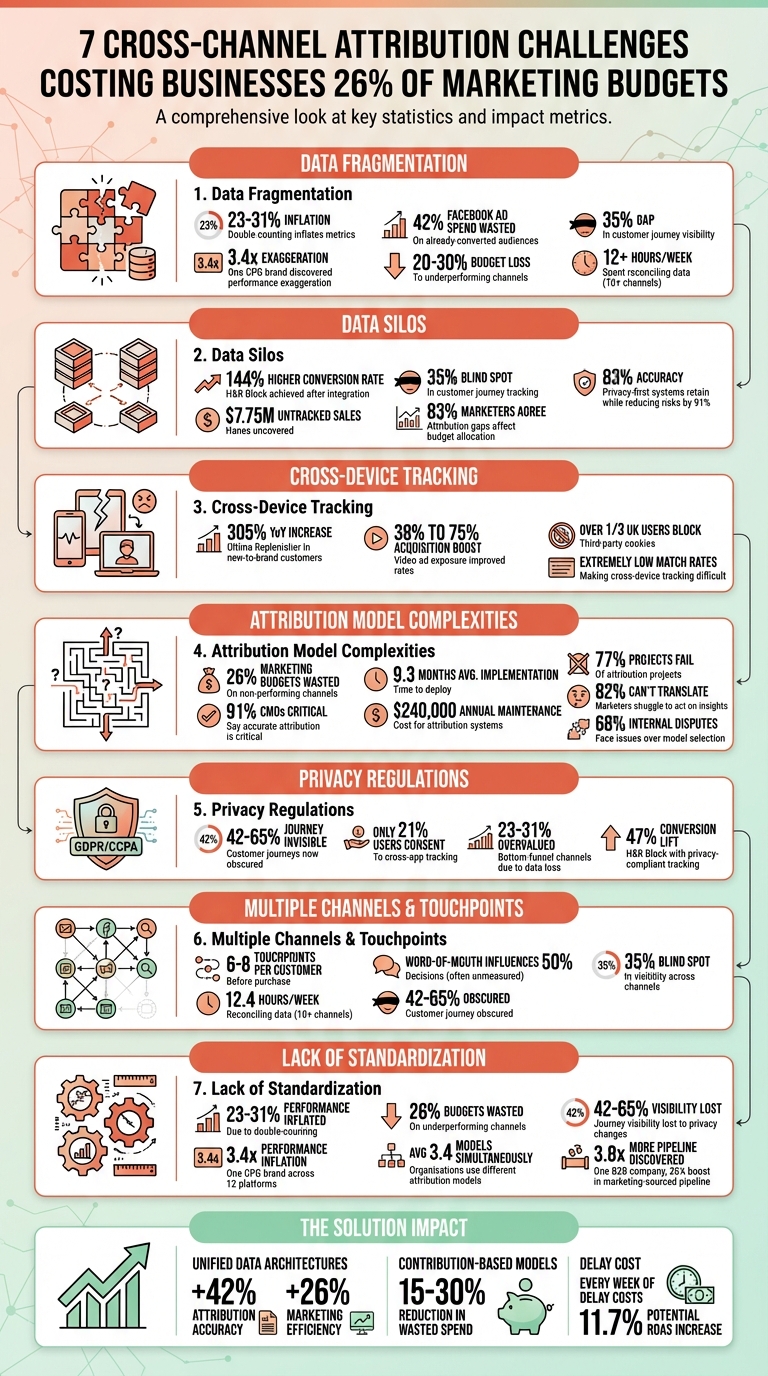
7 Cross-Channel Attribution Challenges: Key Statistics and Impact on Marketing ROI
Digital Marketing Attribution in 2025: Challenges and Solutions
1. Data Fragmentation
Data fragmentation happens when your marketing data is scattered across separate platforms like Google Ads, Meta, LinkedIn, email tools, and your CRM. Each platform uses its own data structure, which can lead to the same customer purchase being counted multiple times. This creates inaccurate performance metrics and muddles your marketing insights.
Impact on ROI Measurement
When data is fragmented, double-counting across platforms can inflate performance metrics by as much as 23–31%. For instance, a major consumer packaged goods brand discovered that fragmented reporting exaggerated their marketing results by 3.4 times. Once they unified their data from 12 platforms, they realized that 42% of their Facebook ad spend was targeting audiences already likely to convert. By reallocating $1.2 million from ineffective campaigns, they achieved a 36% boost in ROAS. On average, businesses lose 20–30% of their marketing budget to underperforming channels, while many CMOs report a 35% gap in their visibility into the customer journey. These inflated metrics highlight the need to address the challenges of fragmented data.
Complexity in Implementation
Fixing fragmented data is no small task – it’s both complicated and resource-intensive. Businesses managing 10 or more channels often spend over 12 hours per week just reconciling discrepancies. The situation is made worse by technical challenges. Platforms like Amazon and Meta often operate as closed systems, limiting third-party tracking and making it difficult to create a unified view. Each platform also uses its own data structures, APIs, and attribution models. For example, Meta may count a "view-through" as a conversion, while Google relies on "click-through" metrics, leading to conflicting performance reports. These inconsistencies make it hard to trust customer journey data.
Data Accuracy and Reliability
Effective data consolidation is essential for uncovering the real touchpoints that influence customer decisions. Fragmentation doesn’t just make reporting harder – it also hides key steps in the customer journey. For example, if a lead moves from clicking a social ad to engaging with an email campaign and finally visiting your website directly, fragmented data can prevent you from identifying which interaction drove the conversion. AI-powered attribution tools can help recover 30–40% of these lost touchpoints, according to Dr. Sinan Aral, Director of the MIT Initiative on the Digital Economy. This added visibility is critical for accurate decision-making.
Adaptability to Evolving Privacy Standards
Privacy regulations and the phasing out of cookies add another layer of complexity to tracking customer journeys. To adapt, companies are turning to first-party data collection and server-side tracking. By using server-to-server API connections and centralizing data in a Customer Data Platform (CDP) or unified data warehouse, businesses can maintain accurate attribution even in a privacy-first environment. This shift not only aligns with regulatory requirements but also improves the precision of ROI measurement.
2. Data Silos
Isolated data silos are another major roadblock to understanding the full customer journey. These silos form when marketing data is stored in separate systems that don’t communicate with one another. Unlike fragmented data – which may be scattered but still accessible – data silos create isolated pockets of information, making it impossible for teams to get a unified view. Picture this: your sales team tracks conversions in one CRM, while your email and paid media teams rely on entirely different platforms. Without data sharing, no single team has the full picture. This lack of integration not only clouds the customer journey but also skews ROI metrics.
Impact on ROI Measurement
Siloed data leads to overlapping credit across multiple channels, throwing cross-channel attribution into chaos. This duplication can make underperforming channels seem successful while masking the true ROI of others. A great example comes from H&R Block in 2024. They tackled this issue by integrating data across Prime Video, Twitch, and display ads using Amazon Marketing Cloud. The result? They uncovered that cross-channel campaigns drove a 144% higher conversion rate compared to display-only campaigns. Without breaking down silos, businesses risk misallocating budgets based on incomplete or misleading insights.
Complexity in Implementation
Eliminating data silos isn’t easy – it takes technical expertise and organizational coordination. Differences in session definitions, attribution windows, and even time zones can make it hard to align data accurately. Hanes faced this challenge when analyzing the combined effects of homepage placements, display ads, and Sponsored Brands. By integrating their siloed data, they discovered that users exposed to both display and search ads were twice as likely to convert compared to those who only saw search ads. This approach revealed $7.75 million in previously untracked sales. However, these complexities can make it difficult to ensure the reliability of performance data.
Data Accuracy and Reliability
Data silos create a 35% blind spot on average in tracking the customer journey. Critical touchpoints – like a customer clicking a social ad, reading an email, and then purchasing through direct traffic – can go missing, leading to poor budget decisions. In fact, 83% of enterprise marketers say these attribution gaps directly affect their budget allocation strategies. Implementing a Customer Data Platform (CDP) or centralized infrastructure can help solve this issue by standardizing data formats and maintaining identity resolution across channels. This ensures a seamless view of the full customer journey.
Adaptability to Evolving Privacy Standards
Data silos also make privacy compliance harder to manage. When customer consent preferences are stored across multiple systems, it’s nearly impossible to ensure that an opt-out request is applied universally. A unified data foundation enables privacy-first architectures, where sensitive data is processed locally while still maintaining measurement accuracy. For example, privacy-first attribution systems can retain 83% of measurement accuracy while reducing privacy risks by 91% compared to siloed setups. By centralizing consent management and using tools like data clean rooms, businesses can comply with regulations like GDPR and CCPA while still gaining actionable cross-channel insights.
3. Cross-Device Tracking
Tracking customer behavior across multiple devices is essential for accurate attribution. Without it, understanding the full customer journey becomes a challenge.
Imagine a customer researching a product on their phone, adding it to their cart on a tablet, and completing the purchase on a laptop. Traditional tracking systems often treat this as three separate users, breaking the conversion path into fragments. This leads to incomplete data and makes it nearly impossible to determine what truly influenced the sale.
Impact on ROI Measurement
When cross-device tracking falls short, performance metrics become skewed. Channels at the top of the funnel – like YouTube, TikTok, and connected TV – often get undervalued because they don’t generate easily trackable clicks. On the other hand, bottom-funnel channels, such as branded search and retargeting, appear to outperform. This is because they are more likely to capture conversions on the final device used for purchase, creating what experts call a "marketing performance trap".
"Cross-device tracking is difficult and match rates are extremely low." – Trevor Testwuide, Expert in Business Strategy and Marketing Measurement
A real-world example highlights the importance of cross-device tracking. In 2024, Ultima Replenisher partnered with Global Overview to assess customer acquisition costs across Fire TV and Prime Video using Amazon Marketing Cloud. Their analysis revealed that video ad exposure boosted new-to-brand acquisition rates from 38% to 75%, driving a 305% year-over-year increase in new-to-brand customers. Without cross-device tracking, this connection would have gone unnoticed, and the video budget might have been cut.
Aside from measurement biases, technical challenges make cross-device tracking even more complicated.
Complexity in Implementation
Building an effective cross-device tracking system is no small feat. It demands advanced data science expertise and constant upkeep. Match rates, even under the best circumstances, remain low. Additionally, platforms like Amazon and Meta limit third-party tracking, preventing a full view of a customer’s journey across ecosystems.
To improve tracking, businesses must implement tools like unified identifiers, server-side tagging, and consistent UTM naming. However, even with these measures, data loss and disruptions are inevitable. A more reliable approach is to combine multiple tracking methods. For example, server-side event-based tracking can enhance accuracy, while logged-in tracking ensures continuity. Layering in incrementality testing helps validate which efforts are genuinely driving conversions.
Adaptability to Evolving Privacy Standards
Privacy regulations like GDPR, CCPA, and Apple’s App Tracking Transparency have further reduced the effectiveness of cross-device tracking. Browsers like Safari and Firefox, which block third-party cookies by default, are used by over one-third of UK users. Relying on decaying identifiers makes accurate attribution nearly impossible.
To adapt, marketers are turning to privacy-friendly measurement methods. Marketing Mix Modeling (MMM) and incrementality testing rely on aggregated or experimental data, sidestepping the need for individual tracking. First-party data and server-side tracking also help maintain visibility while respecting privacy standards. Additionally, self-reported attribution methods – like asking customers, “How did you hear about us?” – can capture touchpoints that traditional cross-device tracking often misses, such as podcasts or group chat recommendations.
4. Attribution Model Complexities
Attribution models add another layer of difficulty to measuring ROI, especially after grappling with data integration and cross-device tracking challenges. Choosing the right model can feel like navigating a maze – each one tells a different story about ROI. The way these models assign credit to marketing channels can make ROI swing dramatically, depending on the method used. For instance, last-click attribution puts all the credit on the final interaction before a conversion, which often inflates the importance of channels like branded search and retargeting while ignoring earlier touchpoints. On the flip side, first-touch attribution focuses entirely on the initial interaction, overlooking the nurturing efforts that lead to the final conversion.
Impact on ROI Measurement
This complexity hits budgets hard. Companies using attribution models waste, on average, 26% of their marketing budgets on channels that don’t deliver results. A major reason for this is "attribution bias", where models overemphasize bottom-of-funnel activities – those easy to track – while undervaluing top-of-funnel efforts like YouTube, TikTok, or connected TV ads. Traditional models also fail to account for "halo effects." For example, an Instagram ad might inspire someone to later search for your brand organically, but without a direct click, that impact goes unmeasured. These gaps only add to the inconsistencies already seen in earlier challenges.
"Measurement accessibility ≠ marketing effectiveness. Just because something is easy to measure doesn’t mean it’s driving growth."
- Scott Zakrajsek, Head of Data Intelligence, fusepoint
The stakes are high. While 91% of CMOs say accurate cross-channel attribution is critical, only 13% feel confident in their current systems. On average, businesses are blind to 35% of their customer journey due to these attribution shortcomings.
Complexity in Implementation
Building a reliable attribution system is no small task. For enterprises, it takes an average of 9.3 months to implement and requires collaboration across at least four technical teams. Once up and running, maintaining these systems costs around $240,000 annually. Even with this investment, 77% of attribution projects fail because of their technical complexity. The challenges don’t stop there – 82% of marketers report that the insights they get from attribution models don’t translate into actionable optimization, and 68% of organizations face internal disputes over which model to trust.
Data Accuracy and Reliability
Privacy regulations are another hurdle. Traditional multi-touch attribution models lose between 42% and 65% of their visibility due to stricter privacy rules. Meanwhile, rules-based models like linear, time-decay, and position-based approaches assign weights to touchpoints arbitrarily, ignoring the nuances of customer behavior. Even data-driven models powered by machine learning require massive amounts of data to work effectively, and their inner workings can be so opaque that marketers struggle to interpret the results.
To tackle these challenges, many companies are layering multiple approaches. A modern strategy might combine Marketing Mix Modeling for identifying long-term trends, incrementality testing for pinpointing causal effects, and tactical tracking for short-term optimizations. This blended framework shifts the focus from trying to perfect one model to tracking broader business metrics like Marketing Efficiency Ratio and profit contribution. By doing so, brands can get a clearer picture of what’s actually driving growth, even if no single model tells the whole story.
5. Privacy Regulations and Signal Loss
Privacy regulations like GDPR, CCPA, and Apple’s App Tracking Transparency have reshaped how attribution tracking works. These changes have stripped traditional multi-touch attribution models of visibility into 42% to 65% of customer journeys. To make matters more challenging, only 21% of users globally consent to cross-app tracking under Apple’s guidelines.
Impact on ROI Measurement
This loss of tracking signals has made it harder to measure ROI accurately. Privacy restrictions hit top-of-funnel awareness channels the hardest – think display ads and social media views that don’t always result in trackable clicks. Meanwhile, bottom-funnel activities like branded search and retargeting remain easier to measure. The result? Attribution models end up overvaluing bottom-funnel channels by 23% to 31%. This misalignment leads companies to waste an average of 26% of their marketing budgets on underperforming channels. These challenges highlight the need for fresh measurement strategies to adapt to the evolving privacy landscape.
Adapting to New Privacy Standards
With traditional click-and-cookie tracking fading into irrelevance, marketers are exploring alternative measurement methods. Instead of relying on individual user tracking, they’re combining different approaches to gain insights. Take H&R Block, for example – they used Amazon Marketing Cloud with Match ID technology to track customer journeys across Prime Video, Twitch, and display ads. By leveraging pseudonymized signals, they achieved a 47% conversion lift and a 144% higher conversion rate when combining online video with display ads. Other brands adopting similar privacy-compliant strategies have seen notable improvements in acquiring new customers and driving growth.
"The most innovative attribution solutions don’t fight privacy changes, they integrate them into their measurement design. The future belongs to measurement approaches that deliver insights without requiring excessive data collection." – Professor Garrett Johnson, Privacy Researcher, Boston University Questrom School of Business
This shift requires a complete overhaul of the measurement stack. Server-side tracking offers a way around browser restrictions, while data clean rooms allow for analyzing aggregated data without revealing individual user information. Techniques like incrementality testing and Media Mix Modeling, which rely on statistical analysis rather than personal data, are proving effective in identifying which channels drive growth. Ultimately, brands that succeed in this new era are those focusing on first-party relationships through tools like loyalty programs and exclusive content.
6. Multiple Channels and Touchpoints
The rise of multiple channels in marketing has made tracking customer journeys more complicated than ever. On average, a customer interacts with 6–8 touchpoints before making a purchase. Think about it: someone might see your ad on YouTube, click a Facebook post, look up your brand on Google, and then finally make a purchase after receiving a retargeting email. Figuring out how much credit each interaction deserves is no easy task. This complexity makes it harder to measure ROI accurately, as the credit for conversions gets scattered across these varied interactions.
Impact on ROI Measurement
When multiple channels come into play, conversions often get counted more than once, throwing off ROI calculations. Attribution models tend to favor bottom-of-funnel channels like branded search and retargeting because these channels generate measurable clicks. Meanwhile, top-of-funnel channels – like YouTube or TV ads – and even word-of-mouth (which influences up to 50% of decisions) often get overlooked. This imbalance can lead to budget decisions based on incomplete or skewed data.
Complexity in Implementation
Managing attribution across so many channels is no small feat. Companies that use more than 10 marketing channels spend, on average, 12.4 hours each week just trying to reconcile data inconsistencies. The problem? Every platform has its own way of tracking. For instance, Meta might count a view-through conversion, while Google requires a direct click. This mismatch can result in either double-counting or missed touchpoints altogether. These operational headaches only add to the data accuracy issues discussed below.
Data Accuracy and Reliability
As the number of touchpoints grows, ensuring data accuracy becomes even harder. Privacy regulations and technical limitations obscure 42–65% of the customer journey, leaving many organizations with a 35% blind spot in their visibility. Major platforms like Amazon, Facebook, and Google restrict third-party tracking, creating data silos that block a full view of the customer journey. On top of that, certain interactions – like private social media shares, podcast listens, or offline influences – are nearly impossible to track, leaving significant gaps in digital dashboards. Without properly integrating these hidden touchpoints, attribution models end up being little more than educated guesses.
7. Lack of Standardization in Tools and Models
When it comes to cross-channel attribution, there’s no single playbook everyone follows. Platforms like Google Ads, Meta, and Amazon each have their own set of rules for assigning credit to conversions. This creates conflicting narratives about what’s actually driving success, adding another layer of complexity to the already challenging issues of fragmented data and intricate models.
Impact on ROI Measurement
The absence of consistent standards often leads to double-counting conversions. For instance, Meta might credit a conversion to a view-through interaction, while Google only counts direct clicks. This mismatch can inflate perceived marketing performance by anywhere from 23% to 31%. A striking example: in 2024, a Consumer Packaged Goods brand discovered that 12 different platforms were claiming credit for the same conversions, leading to a performance inflation of 3.4x. Without standardized methods to deduplicate data, marketers risk basing decisions on inflated metrics. On top of that, brands with weak attribution systems waste about 26% of their marketing budgets on channels that don’t deliver. This happens because bottom-of-funnel tactics, which are easier to measure, often get more credit, while top-of-funnel efforts like brand-building are undervalued. These inconsistencies don’t just skew ROI; they also create a need for time-consuming, resource-heavy integrations.
Complexity in Implementation
Building a reliable attribution system is no small feat. Most ad platforms, CRMs, and email tools don’t naturally work together, forcing teams to manually piece together data from different sources. On top of that, frequent updates to platform APIs and data structures mean constant upkeep is required to ensure everything runs smoothly. It’s a process that demands both technical expertise and significant resources.
Data Accuracy and Reliability
Without clear, shared definitions, data accuracy takes a hit – similar to the challenges posed by fragmented and siloed data. For example, what Meta counts as a conversion might not even register in Google’s system. Many platforms operate as "black boxes", making it tough to verify data. To deal with the lack of standardization, some organizations juggle an average of 3.4 different attribution models at the same time. Instead of clarifying things, this often just adds to the confusion.
Adaptability to Evolving Privacy Standards
Privacy regulations like GDPR and CCPA, along with features like Apple’s App Tracking Transparency, have significantly reduced visibility into customer journeys, with traditional multi-touch attribution models losing sight of 42% to 65% of those journeys. As cookies and device IDs fade out, models based on these identifiers become less reliable. Each platform approaches privacy differently, leaving marketers to create custom solutions for every channel.
"The most innovative attribution solutions don’t fight privacy changes, they embrace them as design principles."
- Professor Garrett Johnson, Privacy Researcher, Boston University
One success story comes from a B2B technology company that formed a cross-functional attribution council to unify its measurement approach. By aligning their efforts, they discovered that certain content assets were driving 3.8x more pipeline than their siloed tools had shown. This shift boosted their marketing-sourced pipeline by 26%, all without increasing their budget.
How Growth-onomics Addresses These Challenges

Growth-onomics tackles attribution challenges head-on with practical and customized solutions. By integrating data from advertising platforms, CRM systems like HubSpot, and Customer Data Platforms, the agency creates a unified system that offers marketers a complete view of their data. This centralized approach forms the backbone for crafting tailored strategies.
Consistency is key to avoiding data discrepancies. Growth-onomics enforces strict UTM naming conventions and standardized conversion labels across all platforms. This ensures data is consistent and eliminates issues like double-counting or missed touchpoints, addressing the problem of multiple platforms claiming credit for the same conversion.
To address privacy-related signal loss, the agency implements server-side tracking, reducing dependence on cookies. They also focus on building strong first-party data capabilities through continuous data collection and user engagement efforts. By relying on consented and authenticated user experiences, Growth-onomics ensures accurate attribution while staying aligned with evolving privacy regulations.
When it comes to attribution model complexities, Growth-onomics doesn’t believe in a one-size-fits-all solution. Instead, the agency develops custom attribution models tailored to factors like sales cycle length, customer lifetime value, and specific industry trends. These models account for differences in purchasing behavior, delivering more accurate and actionable insights.
Taking things a step further, Growth-onomics enhances cross-channel attribution with advanced algorithms. Using AI-driven data stitching and sophisticated matching techniques, they connect fragmented customer journeys – even without persistent identifiers. This approach helps resolve cross-device tracking issues, providing a clearer picture of how customers move across devices and channels before converting.
Conclusion
Cross-channel attribution challenges go beyond being mere technical issues – they’re draining businesses financially. On average, companies with poor attribution methods waste about 26% of their marketing budgets on channels that don’t deliver results. To make matters worse, working in channel silos often leads to overestimating marketing performance by anywhere from 23% to 31%. This means campaigns might look like they’re thriving while quietly consuming resources that could be better spent elsewhere.
The urgency to address these challenges is clear. When attribution lacks precision, businesses are left making critical budget decisions based on incomplete or misleading data – a costly strategic disadvantage.
The upside? Tackling these attribution problems can deliver immediate, measurable benefits. For example, adopting unified data architectures can boost attribution accuracy by 42% and improve marketing efficiency by 26%. Transitioning to a contribution-based measurement model can cut wasted spending by 15–30%. And for every week of delay, businesses risk losing a potential 11.7% increase in return on ad spend (ROAS).
These numbers highlight the transformative potential of getting attribution right. The solution isn’t just about fixing a technical glitch – it’s about rethinking attribution as a driver of business transformation. By centralizing data, prioritizing privacy-first systems, and layering measurement approaches, companies can unlock accurate ROI insights and make smarter budget decisions. Meanwhile, competitors who stick to outdated methods will be left guessing.
FAQs
How can businesses unify fragmented marketing data for better insights?
To bring scattered marketing data together, businesses should gather information from all their channels into one unified system. This eliminates problems like double-counting and ensures accurate reporting across various platforms. Tools like multi-touch attribution (MTA) or media mix modeling (MMM) are especially useful for understanding how each channel contributes to conversions, offering a clearer view of the customer’s journey.
Leveraging data integration tools and analytics platforms that combine touchpoints from multiple sources is essential for precise tracking. By choosing attribution models that align with your business goals, you can turn raw data into meaningful insights. This not only enhances your ability to measure ROI but also fine-tunes your marketing strategies for stronger outcomes.
What are the best ways to adapt attribution strategies to evolving privacy regulations?
Adapting to evolving privacy regulations means rethinking old-school tracking methods and embracing privacy-first strategies that respect user data. Instead of relying on third-party cookies or intrusive tracking, shift your focus to analyzing aggregated and anonymized data. With tools like AI and machine learning, you can still achieve accurate attribution while safeguarding user privacy.
Make use of contextual signals – things like the content on a webpage, ad placement, or even timing. These elements give you insights into customer behavior without crossing privacy boundaries. Pair this with privacy-safe data integrations that rely on secure, anonymized exchanges. This approach ensures compliance with laws like GDPR and CCPA while still allowing for effective campaign measurement.
You should also explore intent-driven attribution models. These models emphasize meaningful customer interactions rather than just tracking clicks, offering a smarter way to measure campaign success while staying in line with privacy standards.
How does cross-device tracking affect marketing ROI?
Tracking customers across multiple devices – like smartphones, tablets, and desktops – comes with its fair share of challenges. These hurdles often lead to gaps in understanding which marketing channels are genuinely driving conversions.
When attribution falls short, businesses risk spending their marketing budgets on channels that seem effective but don’t actually contribute to conversions. This misstep can throw off efforts to measure and improve ROI, ultimately hampering overall marketing performance.