


If you’re marketing to California residents via email, CCPA compliance is a must. The California Consumer Privacy Act (CCPA) regulates how businesses collect, use, and share personal data. For email marketers, this includes everything from email addresses to engagement metrics like open rates and click-throughs. Non-compliance can lead to fines ranging from $2,500 to $7,500 per violation, plus damages for data breaches.
Here’s what you need to know:
- Who Must Comply: Any for-profit business meeting one of these thresholds:
- Annual gross revenue over $25 million.
- Handling personal data of 100,000+ California residents.
- Earning 50%+ of revenue from selling personal data.
- Key Consumer Rights:
- Right to Know: Consumers can request access to data collected about them.
- Right to Delete: Businesses must delete personal data upon request.
- Right to Opt-Out: Clear "Do Not Sell My Information" links are required.
- Right to Correct: Consumers can request data corrections.
- Right to Non-Discrimination: No penalties for exercising privacy rights.
- Compliance Features:
- Update privacy policies to include clear data use disclosures.
- Provide opt-out mechanisms for data sales or sharing.
- Process data deletion requests within 45 days.
- Notify third-party providers to delete consumer data.
- Additional Requirements: The CPRA (effective 2023) adds stricter rules, including handling sensitive data and honoring correction requests.
Failing to comply isn’t just costly – it erodes trust. Transparent practices can help build stronger relationships with your subscribers while keeping you on the right side of the law.
What Is CCPA And Email Permissions? – TheEmailToolbox.com
What is CCPA and Why Email Marketers Need to Comply
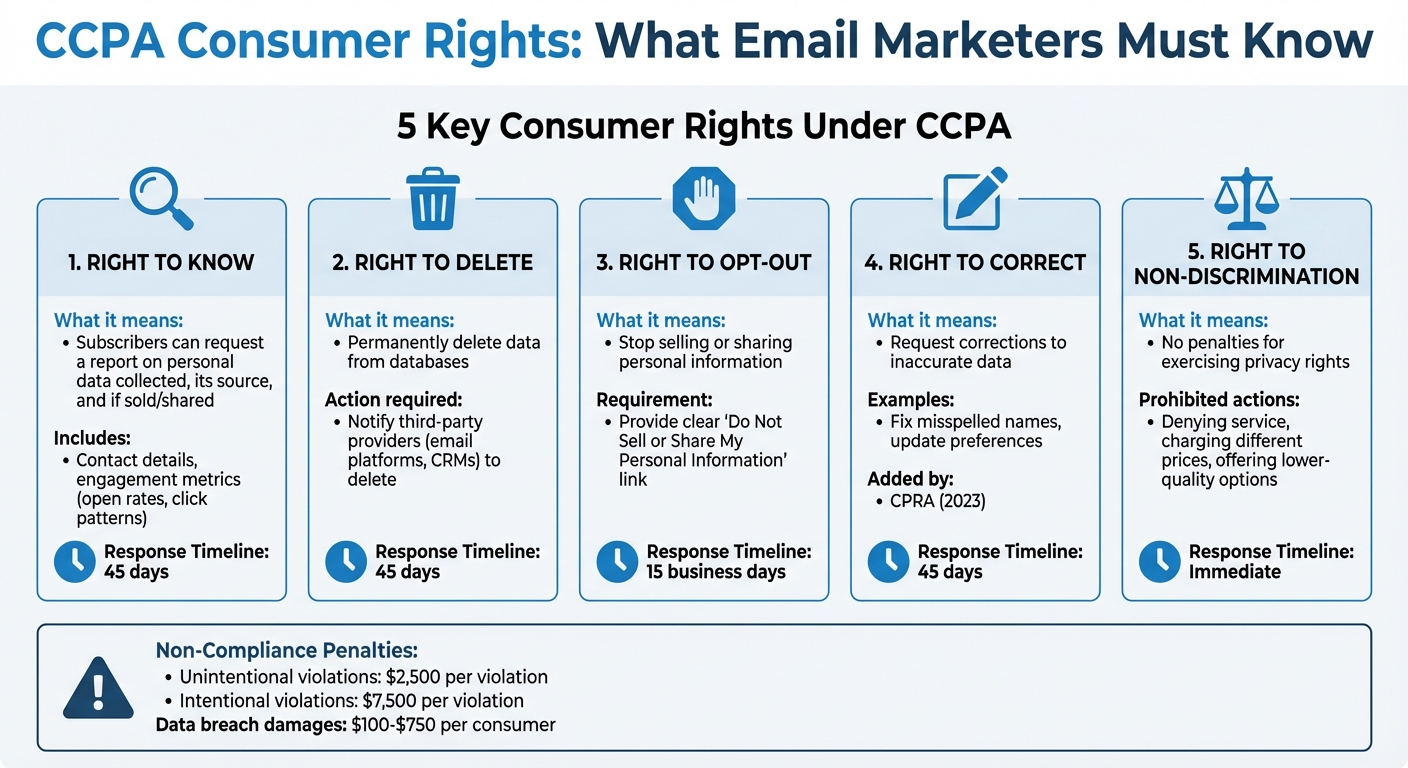
CCPA Consumer Rights and Email Marketer Obligations Guide
The California Consumer Privacy Act (CCPA) gives California residents the power to control how businesses handle their personal data. This includes details like names, email addresses, IP addresses, geolocation, and even engagement metrics like open and click-through rates. For email marketers, this is a big deal because all the tracking data you collect – whether through email analytics, CRM tools, or cookies – falls under CCPA’s broad definition of personal information.
If you mess up, the penalties are steep. Fines start at $2,500 per unintentional violation and go up to $7,500 for intentional ones, with statutory damages ranging from $100 to $750 per breach. But compliance isn’t just about avoiding fines – it’s also about building trust through transparent data practices. Plus, the CCPA outlines specific consumer rights that directly affect how you handle your email campaigns.
Consumer Rights Under CCPA
CCPA gives California residents five key rights that email marketers need to understand:
- Right to Know: Subscribers can request a report on the personal data you’ve collected about them, where it came from, and whether it’s been sold or shared. This includes not just contact details but also things like engagement metrics (e.g., open rates and click patterns).
- Right to Delete: When a consumer asks, you must permanently delete their data from your databases and notify any third-party providers (like your email platform or CRM) to do the same. You’ve got 45 calendar days to make it happen.
- Right to Opt-Out: If you sell or share subscriber data for advertising purposes, you’re required to provide a clear "Do Not Sell or Share My Personal Information" link. These opt-out requests need to be processed within 15 business days.
- Right to Correct: Introduced by the California Privacy Rights Act (CPRA) in 2023, this allows subscribers to request corrections to inaccurate data, like fixing a misspelled name or updating preferences.
- Right to Non-Discrimination: You can’t penalize someone for exercising their privacy rights. That means no denying them service, charging different prices, or offering lower-quality options.
| Consumer Right | What It Means for Email Marketers | Response Timeline |
|---|---|---|
| Right to Know | Disclose collected data, its source, and if sold/shared | 45 days |
| Right to Delete | Permanently delete data and notify third-party providers | 45 days |
| Right to Opt-Out | Stop selling or sharing personal information | 15 business days |
| Right to Correct | Fix inaccurate personal information | 45 days |
| Right to Non-Discrimination | Ensure no penalties for exercising privacy rights | Immediate |
Does CCPA Apply to Your Business?
CCPA applies to any for-profit business operating in California if it meets at least one of these criteria:
- Your annual gross revenue exceeds $25 million.
- You buy, sell, or share the personal data of 100,000 or more California residents or households (this threshold increased from 50,000 in 2023 under the CPRA).
- At least 50% of your annual revenue comes from selling California residents’ personal information.
Your physical location doesn’t matter. Even if your business is based outside California, you must comply with CCPA if you collect email addresses from California residents and meet any of these thresholds.
There’s also no exemption for small email lists. Whether you’re a $30 million company with a modest California-based list or a smaller business with a purchased list of 150,000 California contacts, compliance is mandatory if you meet the criteria.
Finally, keep in mind that the grace period for B2B communications ended on January 1, 2022. If you’re running B2B email campaigns targeting California-based businesses, you now need to comply with CCPA requirements, including honoring data breach notifications and "do not sell" requests.
Required CCPA Compliance Features for Email Marketing
The California Consumer Privacy Act (CCPA) lays out specific requirements for email marketing practices. Here’s how to ensure your setup aligns with the law.
Clear Privacy Policies for Email Data Collection
Your privacy policy needs to spell out, in plain terms, what personal information you’re collecting, why you’re collecting it, and who you’re sharing it with. Under CCPA, this includes email-related data. Be transparent about the types of information you gather – like email addresses or engagement metrics – and explain how you’re using it.
In addition to your privacy policy, you must provide a collection notice. This notice should appear right on your signup forms or landing pages, detailing the categories of data you’re collecting and how you plan to use it.
Your privacy policy should also guide consumers on how to exercise their rights under CCPA. These include the rights to access, delete, correct, and opt out of data collection. Offer at least two ways for users to submit requests – such as a toll-free phone number, email address, or web form. If you have a physical location in California, a toll-free number is mandatory.
Finally, make sure your subscribers have a clear and straightforward way to opt out of data collection or sharing.
Opt-Out Mechanisms for Email Subscribers
If you sell or share subscriber data for advertising purposes – like sharing email lists with third-party advertisers or using data for behavioral ads – you must include a "Do Not Sell or Share My Personal Information" link. This link should be easy to find, typically placed in your website footer and referenced in your privacy policy.
Process opt-out requests promptly – within 15 business days – and ensure the process is straightforward, avoiding any deceptive or confusing design elements.
Incorporate Global Privacy Control (GPC) signals to automatically respect opt-out preferences. Once a subscriber opts out, you’re prohibited from asking them to opt back in for at least 12 months.
For subscribers aged 13 to 16, you must obtain affirmative opt-in consent before selling their data. If the subscriber is under 13, consent must come from a parent or guardian.
To complete your compliance measures, ensure you handle data deletion requests efficiently.
Processing Data Deletion Requests
When a subscriber requests their data be deleted, you have 45 calendar days to act. If necessary, you can extend this period by another 45 days (for a total of 90 days), but you must notify the consumer within the original timeframe.
You’ll need to verify the requester’s identity, either by matching their email or using another identifier.
Data deletion goes beyond your own systems. Notify third-party providers – such as email platforms, CRMs, or analytics tools – to delete the consumer’s data from their records as well.
All personal data must be removed, including email addresses, purchase history, and engagement metrics. There are some exceptions, though: you can deny a deletion request if the data is required to complete a transaction, ensure security, comply with legal obligations, or if the information is publicly available.
| Requirement | CCPA Deletion Process Detail |
|---|---|
| Initial Response Time | 45 calendar days |
| Maximum Extension | Additional 45 days (90 days total) |
| Submission Channels | At least two methods (e.g., email, web form, toll-free) |
| Verification Requirement | Must confirm the consumer’s identity |
| Third-Party Notification | Notify service providers to delete the data |
| Cost to Consumer | Must be free of charge |
sbb-itb-2ec70df
How to Implement CCPA Compliance in Email Marketing
Aligning your email marketing practices with CCPA regulations isn’t something you can do once and forget about. It’s an ongoing process that requires careful planning and execution. Here’s how to make it happen.
Audit Your Email Data Practices
Start by taking a close look at how you handle email data. Map out the personal information you collect, where it’s stored, and who has access to it. Create a detailed inventory that tracks everything tied to each email address – like purchase history and engagement stats.
Don’t stop there. Review the practices of your third-party vendors, such as Email Service Providers (ESPs), CRMs, and advertising networks. Since you’re responsible for how they handle your data, their compliance with CCPA is just as critical as yours. Take the time to examine their privacy policies and data-handling processes.
Make sure your workflows can meet the CCPA’s 45-day deadline for data access or deletion requests. At the same time, ensure consumers are informed – before or at the point of data collection – about what information you’re gathering and why. Also, clear out any unnecessary data fields that serve no purpose in your email marketing. Less data means less risk.
Here’s a wake-up call: A survey of 250 privacy professionals working at companies with over 500 employees revealed that 86% hadn’t fully prepared for CCPA compliance. Don’t let that be you. Non-compliance can cost you – penalties go up to $2,500 per unintentional violation and $7,500 for intentional ones.
Use Automation Tools for Compliance Tasks
Automation can take a lot of the heavy lifting out of compliance. Tools like Consent Management Platforms (CMPs) can automatically add "Do Not Sell/Share My Personal Information" links to your emails and even target them specifically to California residents.
Email verification tools are another great resource – they can identify outdated or invalid addresses, which helps you shrink your data footprint and reduce liability. Some ESPs even offer automated "Right to be Forgotten" features, allowing you to erase all subscriber data with a single action.
Automated suppression lists are essential, too. Once someone opts out, these lists ensure they’re excluded from future campaigns and any third-party data sharing. They also keep detailed consent logs, documenting when and how users opted in, which can serve as a reliable audit trail.
For added security, consider setting up automated identity verification portals. These can confirm a consumer’s identity before processing data requests, helping you avoid fraudulent disclosures. And don’t forget about deadlines: you have 15 business days to process opt-out requests and 45 days for access or deletion requests.
While automation can handle repetitive tasks, make sure your team is trained to manage exceptions effectively.
Train Your Marketing Team on CCPA
Your team needs to fully understand CCPA’s five key consumer rights: the right to know, the right to delete, the right to opt out of data sales, the right to non-discrimination, and the right to correct inaccurate data. They should also be familiar with the legal deadlines – 15 business days for opt-out requests and 45 calendar days for data access or deletion.
Establish clear internal procedures for handling requests. This includes steps for verifying identities, retrieving data, and confirming that requests have been completed. Train your staff to include a "notice at collection" on all lead generation forms, clearly explaining what data is being collected and why.
Another important concept is "purpose limitation." For example, if you collect email addresses for a newsletter, those addresses shouldn’t be used for anything else without additional notice. Also, make sure you provide at least two ways for consumers to submit requests, such as a dedicated email address and a toll-free number or web form.
Finally, emphasize the importance of data minimization. Only collect the information you absolutely need to reduce your exposure to risk.
Conclusion
Continuous compliance plays a crucial role in ensuring both legal protection and consumer confidence. Staying aligned with CCPA requirements demands ongoing effort – regular audits, process updates, and a team well-versed in privacy rights are key. And let’s not forget, the cost of non-compliance isn’t just reputational; the financial penalties can be severe. This makes a solid, ongoing compliance strategy an absolute must.
But compliance isn’t just about avoiding fines – it’s about building trust. As marketing expert Seth Godin wisely said:
"The test is easy: If you didn’t send out your emails tomorrow, would people contact you to find out what happened?"
When subscribers trust that their data is handled responsibly, they’re more likely to engage with your content and stick around.
The privacy landscape is also shifting rapidly. New state laws and expanded CPRA provisions are raising the bar for compliance . By staying compliant now, you’re setting yourself up to handle these future changes with ease.
Simplifying your data practices and maintaining clear communication are essential to staying compliant. For instance, collecting only the data you truly need can help minimize liability. And don’t forget those deadlines – 45 days for access or deletion requests and 15 business days for opt-outs . Applying CCPA standards to all your U.S. subscribers, not just those in California, can streamline your processes and prepare your email marketing for what’s ahead.
Ultimately, respecting consumer privacy isn’t just about following the law – it’s smart business. Transparent practices build stronger, long-term relationships with your subscribers.
FAQs
How can email marketers comply with the CCPA?
To align with the California Consumer Privacy Act (CCPA), email marketers should focus on a few key practices:
- Be upfront about data collection: Provide clear, easy-to-understand notices when collecting user data.
- Simplify opt-out options: Make it straightforward for users to opt out of data sharing or unsubscribe from email communications.
- Respond to consumer requests quickly: Act promptly when users request access to, correction of, or deletion of their personal information.
- Keep your privacy policy current: Regularly update your privacy policy to reflect any data-sharing practices with third parties.
By following these steps, businesses not only comply with CCPA but also strengthen their relationship with their audience through transparency and respect for privacy.
Does the CCPA apply to email marketing for businesses outside of California?
Yes, the CCPA applies to businesses outside California if they gather personal information from California residents or operate within the state. This means your email marketing must include clear opt-out options, procedures for deleting data, and disclosures about data sales when targeting California residents. On the other hand, if your business has no dealings with California residents, the CCPA requirements won’t apply to you.
What are the consequences of not complying with the CCPA in email marketing?
Failing to meet the requirements of the California Consumer Privacy Act (CCPA) in email marketing can lead to hefty fines. The California Attorney General has the authority to impose civil penalties of up to $2,500 per unintentional violation and as much as $7,500 per intentional violation.
But it’s not just about the money. Non-compliance can seriously harm your brand’s reputation and weaken the trust customers place in you. To steer clear of these pitfalls, make sure your email marketing efforts include clear opt-out options, proper data management, and full compliance with CCPA standards.