

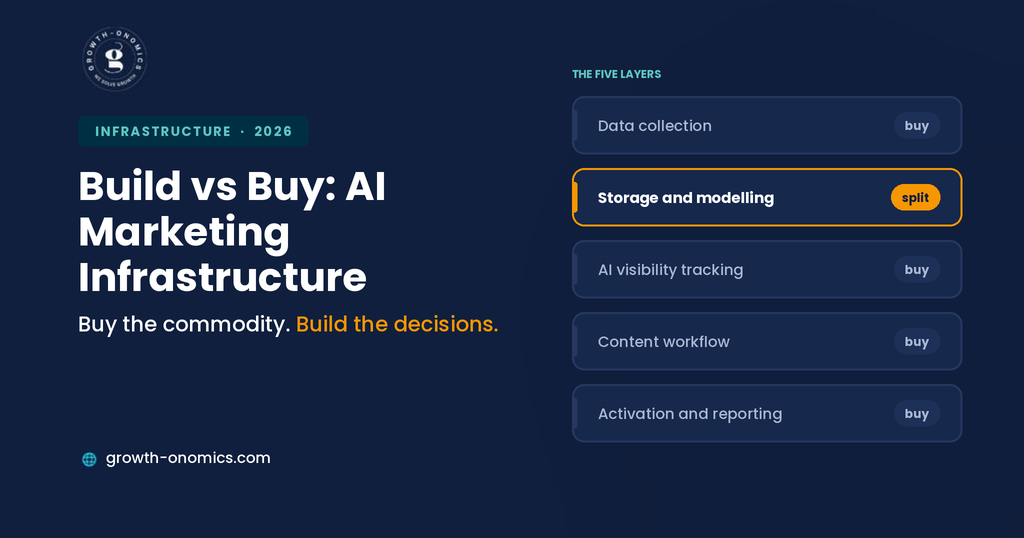
Most B2B SaaS teams should buy their AI marketing infrastructure and build only the layer that encodes something proprietary.
Buying wins on speed, maintenance, and vendor accountability. Building wins when your data model, workflow, or definitions are genuinely unlike anyone else’s, which is rarer than engineering-led companies assume.
The decision usually gets made on cost, and that’s the wrong axis. A subscription has a visible price and an invisible ceiling. A build has an invisible price and no ceiling. Comparing both on the invoice compares the one number that does not determine the outcome.
The axis that does determine it is maintenance. Something has to keep working when an API changes, a platform renames a metric, or the person who wrote it leaves. Buying assigns that to a vendor. Building assigns it to you, permanently, and that liability is what you are really buying.
This article covers what “AI marketing infrastructure” actually contains, which layers are worth building, the total cost most build cases omit, and a decision framework you can apply in an afternoon.
What Counts as AI Marketing Infrastructure?
There are 5 layers, and conflating them is why build-versus-buy conversations go in circles. The right answer differs by layer, so decide 5 times rather than once.
1. Data collection. Analytics, tag management, conversion tracking, click identifier capture. This is plumbing; it is standardised, and almost nobody should build it.
2. Data storage and modelling. A warehouse, transformation logic, and the definitions that turn raw events into metrics. Buy the warehouse; building the models that split is close to universal.
3. AI visibility and measurement. Prompt tracking across answer engines, citation records, share of voice. Emerging category, several credible vendors, and a build here means running your own prompt scheduling and result parsing.
4. Content and production workflow. Brief generation, drafting assistance, editorial checks, publishing. Heavily tooled, changing faster than any other layer here, and the place where internal builds age worst, a workflow tool written eighteen months ago encodes assumptions that no longer hold.
5. Activation and reporting. Pushing conversions back to ad platforms, assembling reports, distributing them. Mostly connectors, mostly bought.
The pattern across all 5: buy the commodity, build the part that encodes a decision only your company can make. That principle resolves most cases on its own, and the sections below are mostly about applying it when a layer looks like it might be an exception.
How Do Build and Buy Compare?
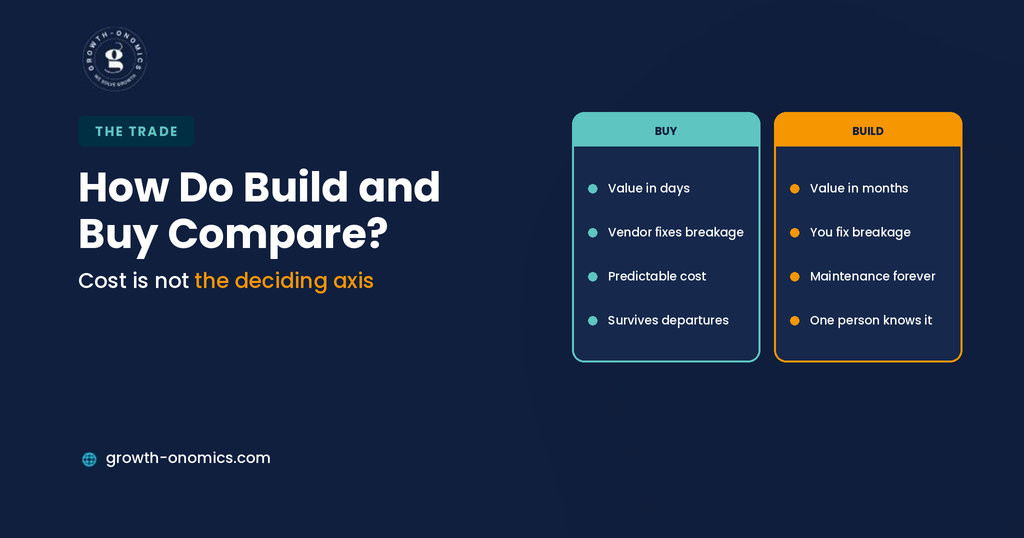
| Dimension | Buy | Build |
| Time to first value | Days to weeks | Months |
| Upfront cost | Subscription | Engineering time |
| Ongoing cost | Predictable, rises with usage | Maintenance, forever |
| Who fixes a breakage | The vendor | You, whenever you notice |
| Fits your exact workflow | Approximately | Exactly, at first |
| Survives a departure | Yes | Depends entirely on documentation |
| Ceiling | The vendor’s roadmap | Whatever you can maintain |
| Fails when | Your need is genuinely unusual | Nobody owns it after launch |
Which Layers Should You Almost Always Buy?
3, and the reasoning is the same in each case: the problem is solved, standardised, and maintained by someone whose business depends on it.
1. Data collection.
Analytics platforms, tag managers, and conversion tracking are commodity infrastructure. Building here means reimplementing consent handling, cross-domain tracking, and platform-specific conversion APIs that change without notice and without much warning. There’s no differentiation available in doing it yourself, and a considerable compliance liability in getting it wrong.
2. Connectors and activation.
Pulling data out of ad platforms and pushing conversions back is unglamorous integration work that breaks whenever a provider changes an endpoint or deprecates a version. Vendors absorb that maintenance across thousands of customers and ship a fix before most of them notice. You would absorb it alone, and notice when a report comes back empty.
3. AI visibility tracking.
Running prompts across answer engines on a schedule, parsing results, and storing comparable history is more work than it looks, and the platforms change frequently enough that a build needs continuous attention. Several vendors do this credibly. The tracking itself is a commodity; the value lies in interpreting what it shows, which is not something a build improves.
The test for this group: would a competitor gain anything from seeing how you built it? If not, you are building infrastructure that differentiates nothing.
Which Layers Are Worth Building?
2 mainly, and both are cases where the thing being built is a decision rather than a capability.
1. Your data model and metric definitions.
What counts as a qualified lead, how a cohort window is defined, which touches attach to an account, what your brand term list contains. These are business decisions encoded in logic. A vendor’s default model will be approximately right and specifically wrong, and the gap between those shows up in every report afterwards. Build this in dbt or equivalent, in a warehouse you bought.
2. Workflow glue that reflects how you actually operate.
The script that joins your CRM to your visibility data on your own account structure. The internal check that flags content published without proper topical review. The alert that fires when a key page stops rendering server-side. Small, specific, and unbuyable because no vendor knows your process or your priorities.
What both have in common: they are thin. A hundred lines of transformation logic, not a platform. Nobody needs to be assigned to them full time, and nobody has to maintain a user interface. If your build case requires a roadmap, you are building a product, and you are not in the product business.
What Does the Definitions Layer Actually Contain?
This is the layer worth building, so it is worth being concrete about what goes in it. 4 things, and all 4 are decisions rather than code.
1. Qualification thresholds.
What makes a lead qualified, what makes an opportunity viable, and which stage counts as pipeline. Every vendor ships a default and every default is a guess about a company that is not yours. It shapes every downstream number silently, which is why disagreements between marketing and sales so often trace back to a setting nobody chose.
2. Attribution windows and cohort logic.
How far back a touch counts, whether spend is compared to revenue in the same period or tracked forward as a cohort, and how multi-touch credit is handled. Agree this with finance before building it, because retrofitting a definition after a disputed board deck is how reporting credibility gets lost.
3. Account and identity resolution.
Which individuals roll up to which account, how subsidiaries and acquisitions are handled, and what happens when the same person appears twice. In B2B, this determines whether your numbers describe people or buying committees, and vendors resolve it approximately.
4. Naming and taxonomy.
Campaign conventions, brand term lists, page classifications by funnel stage. The least interesting item on the list and the one every join in every report depends on. Inconsistency here breaks reporting in ways that look like tooling problems for months.
The reason this belongs in-house is that each item is a business agreement, not a technical capability. Growth-onomics documents these before touching tooling in a reporting engagement, because a stack built on undecided definitions produces confident numbers nobody can defend.
What Does Building Actually Cost?
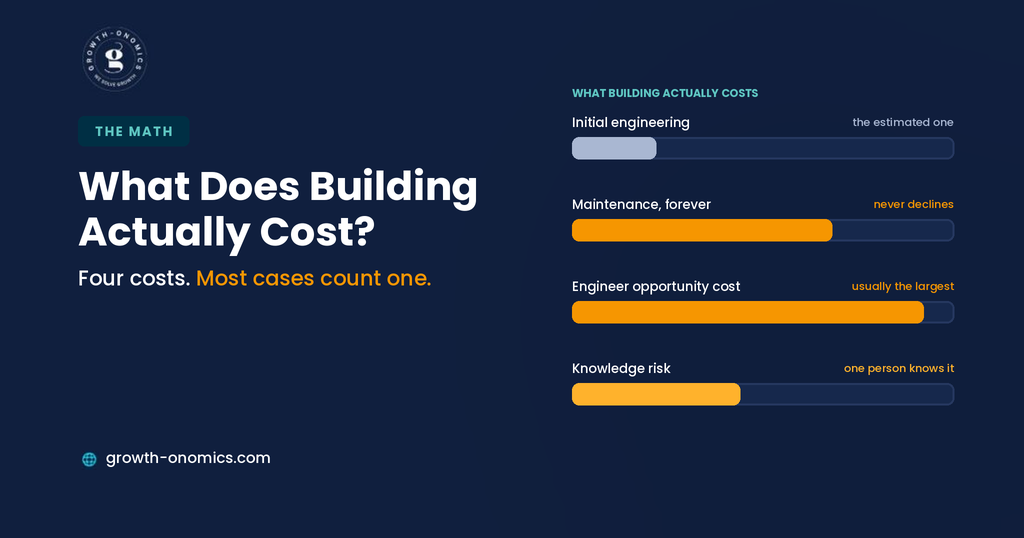
4 costs, and build cases routinely include the first and omit the rest.
1. Initial engineering. The number everyone estimates, and the smallest of the four. It is also estimated optimistically almost every time, because the estimate covers the happy path rather than the edge cases that consume the second half of the project.
2. Maintenance, forever. APIs change, platforms deprecate endpoints, authentication methods rotate, a dependency stops being supported. This does not decline over time and it competes with product work every sprint. Most internal marketing tools die here rather than at launch.
3. Opportunity cost of the engineer. The person building your reporting pipeline is not building product. In a SaaS company, that is the most expensive line in the comparison and the one least likely to appear in the business case.
4. Institutional knowledge risk. One person understands it. When they leave, you own something nobody can safely modify or confidently delete, which converts an asset into a liability without anyone making a decision.
Against that, the honest cost of buying: subscription fees that rise with usage, a roadmap you do not control, and the possibility of a vendor being acquired or shutting down. There is nothing fake about those. They are also bounded, and you can switch.
Why Do Internal Builds Fail?
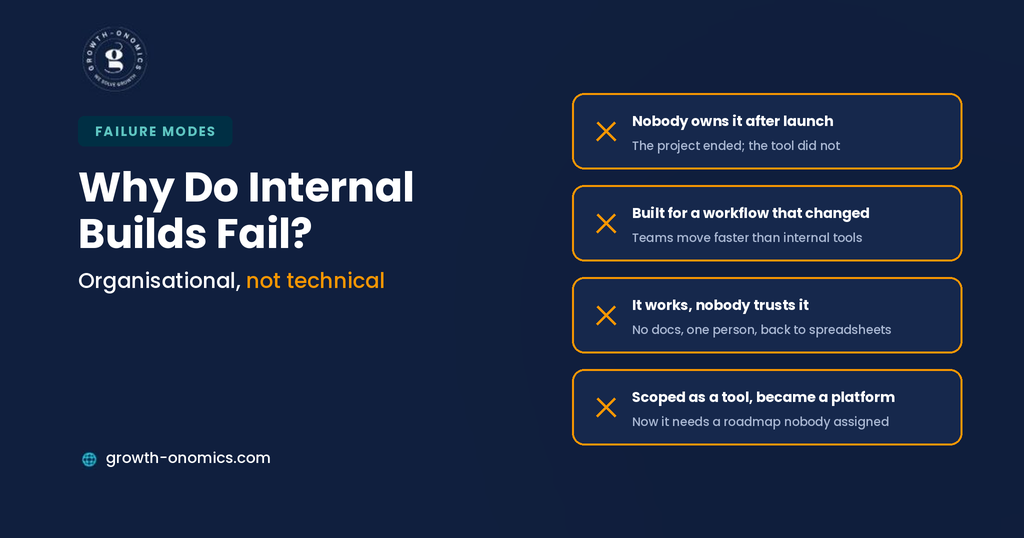
Not for technical reasons, in most cases. Four failure modes account for the majority.
Nobody owns it after launch. It was a project; the project ended, and it became nobody’s responsibility. It keeps running until it does not, and then it takes a week to work out why.
It was built for a workflow that changed. The tool encodes how the team operated 18 months ago. Teams change faster than internal tools get updated.
It works but nobody trusts it. No documentation, test coverage, or one person who understands the logic and is busy. People quietly revert to spreadsheets rather than rely on something they cannot verify, and the tool keeps running while nobody uses the output.
It was scoped as a tool and became a platform. Started as a script, grew a UI, acquired feature requests, and now requires a roadmap nobody assigned. This is the most expensive version, because it consumes engineering indefinitely while producing something a vendor sells for a monthly fee.
The pattern: builds fail organisationally rather than technically. Anyone can write the first version. Almost nobody resources the 10th year.
What Is the Middle Path?
Most working setups are neither pure build nor pure buy. Three patterns cover the majority.
Buy the platform, build the model. A warehouse and connectors purchased, transformation logic and metric definitions are written in-house and kept in version control. This is the standard answer for a reason: you own the decisions, you rent the plumbing, and a vendor change costs you a connector rather than a year of history.
Buy the tool, build the glue. Visibility tracking, analytics, and CRM bought. A thin script joins them on your account structure and pushes the result somewhere useful. The glue is a hundred lines and is genuinely yours.
Buy now, revisit at scale. Choose the vendor, use it for a year, and let real usage settle the question rather than a projection. Most teams discover they use a fraction of what they specified during procurement, which changes the build case entirely, usually against it.
The unifying principle: rent capability, own decisions. Growth-onomics scopes client reporting this way; vendor tooling for collection and tracking, documented definitions owned by the client, so the numbers survive both a vendor change and an agency change.
How Do I Decide in an Afternoon?
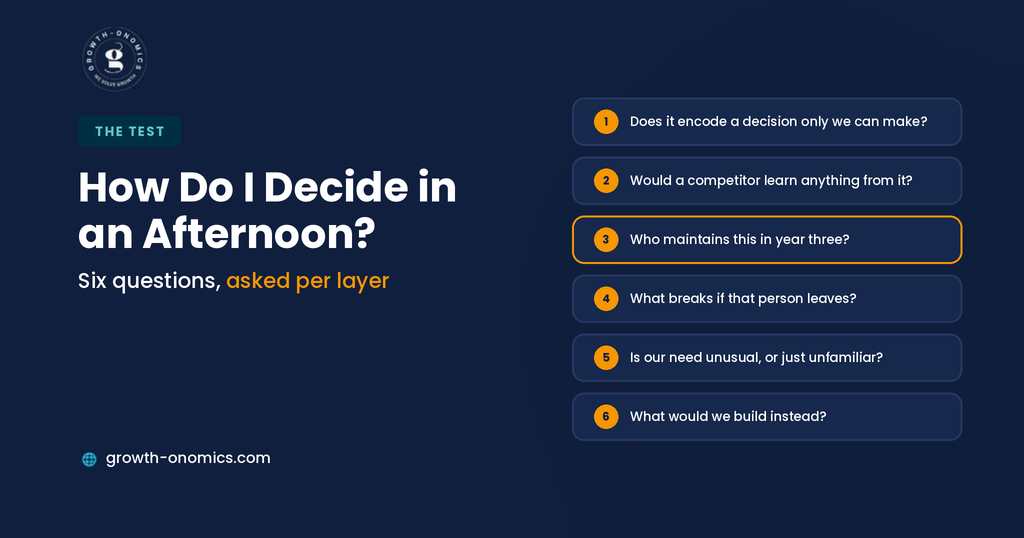
6 questions. Answer them per layer, not once for the whole stack.
Does this encode a decision only we can make? If yes, build. If it encodes a capability anyone could buy, buy it.
Would a competitor learn anything from seeing it? If no, there is no differentiation in building it.
Who maintains this in year three? Name the person. If you cannot, the build has already failed and nobody has noticed yet.
What breaks if that person leaves? If the answer is “we lose the capability,” you are building a dependency rather than an asset.
Is our requirement genuinely unusual, or just unfamiliar? Most teams believe their setup is unique, and most setups are variations on 3 or 4 common shapes. Test the belief by describing your requirement to two vendors and seeing whether either of them blinks.
What would we build instead with the same engineering time? In a SaaS company the alternative is product. Compare against that, not against the subscription price.
If most answers point to buy, buy and spend the saved engineering time on the definitions layer, which is where the differentiation actually lives.
When Should You Revisit the Decision?
4 triggers, and none of them is the passage of time.
Your usage exceeds the vendor’s economics. When per-seat or per-query pricing at your actual volume approaches the fully loaded cost of maintaining something equivalent, the calculation genuinely changes, though include maintenance and opportunity cost on the build side before concluding it has.
Your requirement diverges from the product. You are working around the tool more than working with it, and the workarounds are becoming their own system. That is a signal, though the first response should be checking whether a different vendor fits better.
The vendor’s direction moves away from yours. Acquisitions, pivots, and pricing changes all count. Portability matters here, which is why owning your data and definitions is worth the effort regardless of what you buy.
You gained the capacity to maintain it. A data team that did not exist 2 years ago changes what is realistic. This is the only trigger that makes building more attractive rather than less.
Absent one of those, an annual review is enough, and the honest outcome of most annual reviews is that the current setup is fine.
Conclusion
The build-versus-buy question feels like an engineering decision and is mostly an organisational one. The code is the easy part. The hard part is that someone has to keep it working for years, in a company where the engineering roadmap belongs to the product.
Buy the commodity layers like collection, connectors, visibility tracking because they differentiate nothing and break constantly. Build the thin layer that encodes your definitions and your workflow, because a vendor’s defaults will be approximately right and specifically wrong in ways that surface in every report.
Then apply the test that resolves most of the remaining cases: name the person maintaining it in year three. If that name does not exist, you are not choosing between build and buy. You are choosing between buying now and buying later, after a year of engineering time you cannot recover.
If you want a reporting stack where the tooling is bought, the definitions are yours, and both survive a vendor change, the Growth-onomics team can design the split before anyone signs anything.
FAQs
Should B2B SaaS companies build their own AI marketing tools?
Usually not, with one specific exception. Data collection, connectors, and AI visibility tracking are commodity infrastructure; they differentiate nothing, they break whenever a platform changes, and vendors absorb that maintenance across their whole customer base. What is worth building is the thin layer encoding your own definitions: what counts as a qualified lead, how cohort windows work, which touches attach to an account. That logic is a business decision rather than a capability, and a vendor’s default will be approximately right and specifically wrong.
How do I calculate the true cost of building?
Include four things, instead of one. Initial engineering, which is the number everyone estimates and the smallest of the four. Ongoing maintenance, which never declines and competes with product work every sprint. The opportunity cost of the engineer, who is not building product while they build your reporting pipeline usually the largest line and the one least likely to appear in the business case. And institutional knowledge risk, where one person understands it, and their departure converts an asset into a liability nobody can safely modify.
What is the biggest reason internal marketing tools fail?
Ownership, not engineering. The most common failure is that a build was scoped as a project, the project ended, and maintenance became nobody’s job. It keeps working until it does not, and then diagnosing it takes a week nobody has. Close behind: tools built for a workflow that has since changed, and tools nobody trusts because a single person understands the logic and there is no documentation. Anyone can write the first version. Almost nobody resources the tenth year.
Is it cheaper to build once you reach a certain scale?
Sometimes, and the trigger is usage rather than company size. When per-seat or per-query pricing at your actual volume approaches the cost of maintaining an equivalent internally, the calculation genuinely changes but include maintenance and opportunity cost in that comparison, not just the subscription. Two other triggers count more than scale: your requirement diverging far enough from the product that you are working around it constantly, and gaining a data team capable of owning the result. Absent those, size alone rarely justifies a build.
Does buying create vendor lock-in we will regret?
Only if you let the vendor hold things that should be yours. Lock-in is not caused by using a tool; it is caused by your data, definitions, and historical measurement living inside it. Keep raw data in a warehouse you control, transformation logic in version control, and accounts in your own name, and switching becomes an inconvenience rather than a data-loss event. Teams that get burned usually skipped that at signing, when it would have cost nothing to arrange.
What should I own regardless of what I buy?
Your data and your definitions. Raw event data in a warehouse you control, transformation logic in version control, metric definitions documented somewhere both marketing and finance have seen, and the accounts holding your analytics, search, and visibility data in your own name. That combination means a vendor change is an inconvenience rather than a data-loss event, and it is the single most effective protection against being locked into a tool whose direction stops matching yours.