

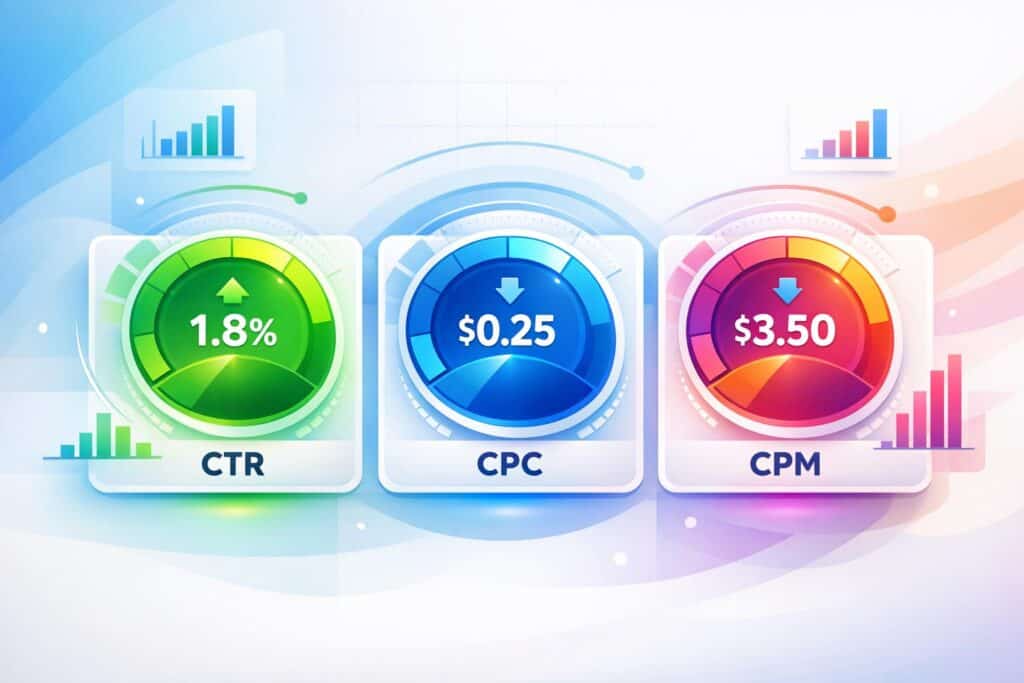
When running Meta Ads, three key metrics determine your campaign’s success: CTR (Click-Through Rate), CPC (Cost Per Click), and CPM (Cost Per Mille). These numbers tell you how well your ad engages your audience, how much you’re paying for each click, and the cost of reaching 1,000 people. Here’s what you need to know:
- CTR: Measures the percentage of people who click your ad. A higher CTR means your ad resonates with your audience. Average CTRs vary by industry, but 0.90% is a common benchmark.
- CPC: Tracks the cost of each click. Lower CPCs stretch your budget further. Industry averages range from $0.44 to $1.50.
- CPM: Reflects the cost of 1,000 ad impressions. It’s a useful metric for brand awareness campaigns. CPMs typically range from $6 to $15, depending on placement and industry.
Understanding these metrics helps you improve performance marketing results, reduce costs, and make smarter decisions. For example, increasing CTR can lower CPC, while optimizing CPM ensures better visibility for your budget. Whether you’re targeting clicks, conversions, or exposure, these metrics are essential to track and refine.
Click-Through Rate (CTR)
What is CTR?
Click-Through Rate (CTR) measures the percentage of people who click on your ad after seeing it. The formula is straightforward: (Clicks ÷ Impressions) × 100.
For instance, if your ad garners 10,000 impressions and 90 clicks, your CTR is 0.90%. This metric reveals how well your ad captures attention and drives engagement.
A higher CTR often leads to rewards from Meta, such as premium ad placements (like the Facebook News Feed) and reduced costs per click.
"CTR is your most honest feedback loop. Low CTR means your ad isn’t interesting enough to interrupt someone’s scroll."
- Karthik J, SEO Insider
To better understand your CTR, it’s helpful to compare it against industry norms and different ad formats.
How to Interpret CTR
The average CTR for Meta ads across industries hovers around 0.90%. However, this figure can shift depending on your industry, the type of ad you run, and your audience targeting.
Here’s a breakdown of industry-specific averages:
- Legal services: Around 1.61%
- Retail: Approximately 1.59%
- Finance and insurance: Typically about 0.56%
- Employment ads: Often as low as 0.47%
Retargeting campaigns, especially those using Custom Audiences, tend to perform better, with CTRs ranging from 1.5% to 2.0%. On the other hand, broad targeting often struggles, with CTRs dipping below 0.50%.
Ad format also influences CTR:
- Interactive ads (like polls or AR filters): 1.25% to 1.33%
- Single-image ads: 0.70% to 0.90%
- Video ads: 0.50% to 0.73%
Placement matters too. Ads shown in the Facebook News Feed generally achieve CTRs between 1.25% and 1.50%, while Instagram Stories usually fall between 0.80% and 1.10%.
If your CTR is below these benchmarks, it’s a signal to revisit your ad’s creative, offer, or targeting. Surpassing these averages, however, confirms that your strategy is resonating with your audience.
sbb-itb-2ec70df
Cost Per Click (CPC)
What is CPC?
Cost Per Click (CPC) is the amount you pay every time someone clicks on your Meta ad. It’s calculated using this formula: Total Spend ÷ Number of Clicks. For example, if you spend $500 and get 100 clicks, your CPC is $5.00. But if you manage to get 250 clicks for the same amount, your CPC drops to $2.00. A lower CPC means you can stretch your budget further, giving you more chances to drive conversions.
CPC works on a pay-per-engagement basis. In 2026, Meta Ads have an average CPC ranging between $0.44 and $1.50. However, this varies depending on the industry. For example, legal services typically see CPCs between $1.00 and $2.50, while e-commerce businesses experience rates closer to $0.45 to $1.25.
"Your CPC isn’t just a number on a dashboard. It’s a direct reflection of how well you’re targeting your audience, how compelling your creative is, and how fierce the competition is at that exact moment."
Now, let’s explore the main factors that shape your CPC.
What Affects CPC
Several elements influence how much you’ll pay per click:
- Audience Targeting: Narrowing your focus to high-value audiences, such as CFOs, often increases costs due to higher competition. On the other hand, broader audiences are generally cheaper because there’s more inventory available.
- Ad Relevance and Engagement: Ads with high click-through rates (CTR) are rewarded by Meta with lower costs and greater reach. For instance, improving your ad creative to boost CTR by 50% can lower your CPC by 20%–30%. Conversely, poor ad quality can significantly raise costs. A Quality Score of 1 could increase CPC by 400%, while a top score of 10 might cut it in half.
- Ad Placement: Where your ad appears matters. Ads shown in Instagram Feeds, for example, tend to cost 1.5 times more than those in Facebook Feeds.
- Bidding Strategy: Using automated bidding can sometimes reduce CPC by efficiently identifying high-value users compared to manual bidding.
- Competition and Seasonality: Certain industries, like finance and insurance, naturally face higher CPCs due to intense competition. Seasonal spikes, such as during Q4 or Black Friday, can also drive up CPC by 1.5 to 2 times as advertiser demand soars. For example, Meta’s advertising costs rose 24% year-over-year in early 2025, reflecting the growing competition on the platform.
Cost Per Mille (CPM)
What is CPM?
CPM, short for "Cost Per Mille", uses the Latin term "mille", meaning 1,000. It represents the cost of 1,000 ad impressions on Meta’s platforms. The formula is straightforward: (Total Ad Spend ÷ Total Impressions) × 1,000. For instance, if you spend $2,500 and your ad receives 400,000 impressions, your CPM would be $6.25.
This metric helps measure the cost of reaching a specific audience size and is often used to gauge how efficiently your ad dollars are being spent on visibility. Unlike CPC (Cost Per Click), CPM focuses on impressions rather than clicks. For example, industry trends show that Meta’s CPM rates rose from $6.11 in May 2024 and are expected to climb to around $9.31 by August 2025. Instagram Stories tend to cost between $6.00 and $8.00 per CPM, while Facebook Feed ads typically range from $7.00 to $15.00.
"CPM tells you how efficiently you’re buying exposure. Lower CPM means more eyeballs per dollar spent."
A notable evolution in advertising is the rise of viewable CPM (vCPM). With vCPM, you only pay for ads that meet specific conditions: at least 50% of the ad must appear on a user’s screen for at least one second, ensuring that your investment goes toward ads that are actually seen.
When to Use CPM
CPM is most effective when your main objective is to boost brand awareness rather than drive immediate conversions. It’s ideal for campaigns focused on introducing new products, increasing brand visibility, or maximizing exposure. Additionally, CPM works well for retargeting campaigns, helping you re-engage audiences who have already interacted with your brand.
2025 Meta Ads Benchmarks by Industry (CTR, CPC, CPM, CPL & ROAS)
Benchmarks for CTR, CPC, and CPM
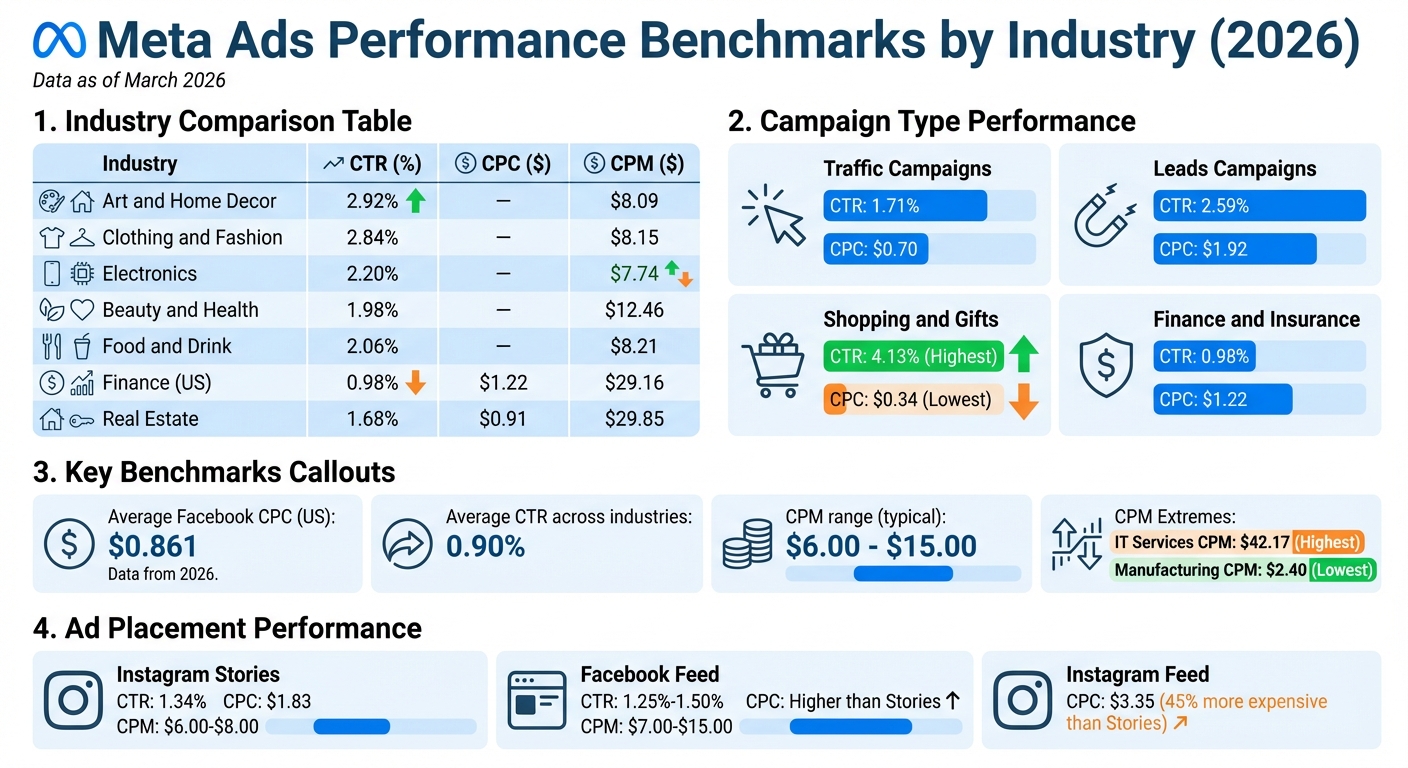
Meta Ads Metrics Comparison: CTR, CPC, and CPM Benchmarks by Industry
Benchmarks by Industry
Knowing how your Meta Ads stack up against averages in your industry can help pinpoint both opportunities and challenges. As of March 2026, the average Facebook CPC for U.S. campaigns is $0.861. For Traffic campaigns, the average CTR is 1.71%, with a CPC of $0.70. In contrast, Leads campaigns show a higher CTR at 2.59% but come with a CPC of $1.92, showcasing Meta’s focus on aligning costs with campaign objectives .
Shopping and Gifts campaigns lead the pack with the highest CTR of 4.13% and the lowest CPC at $0.34. On the other hand, Finance and Insurance campaigns face tougher competition, with a CTR of 0.98% and a CPC of $1.22. When it comes to CPM, IT Services & Outsourcing sees the highest rates at $42.17, while Manufacturing enjoys CPMs as low as $2.40. U.S. finance campaigns, specifically, report a median CPM of $29.16, which is 47% above the global benchmark.
| Industry | CTR | CPC | CPM |
|---|---|---|---|
| Art and Home Decor | 2.92% | – | $8.09 |
| Clothing and Fashion | 2.84% | – | $8.15 |
| Electronics | 2.20% | – | $7.74 |
| Beauty and Health | 1.98% | – | $12.46 |
| Food and Drink | 2.06% | – | $8.21 |
| Finance (US) | 0.98% | $1.22 | $29.16 |
| Real Estate | 1.68% | $0.91 | $29.85 |
"CTR improving in spite of higher costs means that consumers are continuing to engage with advertising, which is a good sign for businesses having to front more marketing dollars." – Tyler Mask, Director of Optimization Strategy at LocaliQ
These numbers can shift based on several variables, as explained below.
What Affects Benchmarks
Several factors contribute to the variations in benchmarks:
Campaign Objectives: Lead Generation campaigns often see higher CTRs (2.59%) because they target users with higher intent. Meanwhile, Awareness campaigns, designed to reach broader audiences, typically report lower CTRs (0.94%).
Ad Placement: Instagram Stories, with their immersive full-screen format, achieve a CTR of 1.34% at a CPC of $1.83 – about 45% cheaper than Instagram Feed ads, which average $3.35 CPC.
Audience Targeting: Narrow, highly specific audiences can drive up CPM and CPC due to increased competition in auctions. Broader targeting can reduce these costs but may also lower the quality of leads .
Creative Quality: Ads with strong creative performance – conversion rates of 10–15% or higher – can keep CPMs around $25. In contrast, weaker creatives often see CPMs soar above $50.
Ad Frequency and Seasonality: High ad frequency (above 3.0) can increase acquisition costs by 10–25%. Seasonality also plays a big role – Q4 holiday campaigns can see CPMs spike 2–3 times above average, peaking in November before dropping in January .
The U.S. remains one of the most expensive markets for advertising globally. For instance, e-commerce CPMs in the U.S. average $20.48, compared to $10.85 in the UK and just $2.70 in India.
How to Improve CTR, CPC, and CPM
Fine-tuning these metrics can elevate your campaign’s efficiency and return on ad spend (ROAS). Even small adjustments can lead to reduced costs and better performance. Here’s how to make measurable progress in each area.
How to Improve CTR
Visuals play a massive role in ad performance – over half of it, in fact. Eye-catching colors and "pattern interrupts" can grab attention within the first three seconds. Ads featuring human faces with direct eye contact have been shown to increase engagement by up to 300%. Even upgrading to high-quality images can boost click-through rates (CTR) by more than 50%.
Keep your ad copy concise – stick to under 125 characters. Use curiosity-driven phrases like “Why 47% of marketers switched to…” to spark interest. Numbers in headlines can also be powerful, boosting engagement by up to 36%. Instead of generic calls-to-action (CTAs) like “Click Here,” try specific, action-oriented phrases like “Shop the Sale” or “Get Your Free Guide”.
Track the right CTR metric. For conversion-focused campaigns, prioritize "Link Click-Through Rate" rather than "CTR (All)", which includes less meaningful interactions like likes or profile clicks. A CTR of 1% is decent, while 2.5–3% is considered excellent. For context, the average CTR across industries is about 0.90%.
Combatting ad fatigue is key. Refresh your creative every 10–14 days, as performance tends to dip when frequency exceeds 3–4 views per user. When testing new strategies, tweak one variable at a time (e.g., headline A vs. headline B) for 3–7 days to find what works. Interestingly, ads styled as user-generated content (UGC) often outperform polished professional videos, sometimes resulting in 72% lower CPM.
How to Lower CPC
Once your CTR improves, the next step is to reduce your cost per click (CPC).
Engagement is your ally. Platforms like Meta and Google reward engaging ads with lower CPCs because they provide value to users. A higher Quality Score can drive CPC down, while a lower score does the opposite. Boosting your CTR is one of the fastest ways to cut costs.
Targeting "warm" audiences, such as previous website visitors, can also help. These users are more likely to click, often achieving CTRs of 1.5–2.0%, compared to less than 0.50% for cold audiences. Implementing negative keywords is another smart move to filter out irrelevant searches that waste your budget.
Broaden your audience targeting. Narrow targeting often drives up costs due to increased competition. Expanding your reach to at least 500,000 people gives Meta’s algorithm more room to find cheaper ad placements. On Google, using long-tail keywords can reduce competition while attracting more qualified traffic.
Technical optimizations matter too. Ensure your landing page loads in under three seconds – slower pages increase bounce rates and hurt your relevance score, which can raise CPC. Since over 80% of Meta traffic comes from mobile users, design your ads in vertical or square formats (1:1 or 4:5) for better performance.
If you’re comfortable with more hands-on management, consider manual bidding with cost caps. This can help control spending but requires close monitoring to avoid throttling your reach.
How to Improve CPM Efficiency
Optimizing CPM involves a mix of broader targeting and strategic scheduling.
Expand your audience. Narrow targeting drives up competition and costs, while a broader audience can cut CPM by as much as 68%. Expanding your reach to over 500,000 people allows Meta’s algorithm to find cheaper placements.
Take advantage of Advantage+ Placements. This feature lets the algorithm distribute ads across lower-cost inventory like Stories, Reels, and the Audience Network, rather than sticking to pricier feed placements. This approach typically reduces CPM by 15–25%. Video ads can also help, as they unlock more placements and tend to drive 20–30% lower CPMs compared to static images.
Stay ahead of creative fatigue. When your campaign frequency hits 3.0 or higher for prospecting, it’s time to refresh your creative or expand your audience to avoid rising costs. User-generated videos, in particular, can slash CPM by up to 72% compared to stock images.
Timing matters too. Avoid peak advertising periods like Q4, when CPMs can jump 30–50%, with Black Friday week seeing spikes of 50–150%. Running ads during off-peak hours, such as late nights or early mornings, can help lower costs. Additionally, using the Conversions API (CAPI) can improve data match rates, reducing algorithm uncertainty and, ultimately, CPM.
"CPM isn’t a price tag – it’s an algorithm thermometer." – Adfynx Team
How Growth-onomics Can Help Optimize Your Meta Ads
To get the most out of Meta Ads, you need to dig into the details of key metrics like CPM, CPC, and CTR. Growth-onomics takes a full-funnel approach, analyzing how these metrics interact. For example, CPM affects CPC, and together with CTR, they determine traffic volume and ultimately ROAS. This approach identifies where performance might be falling short – like low CTR hinting at creative issues or high CTR with low conversions pointing to landing page problems. Here’s how Growth-onomics fine-tunes each metric to drive stronger results.
Creative testing is a cornerstone of Growth-onomics. By testing 10–50 creative variations per campaign, the method identifies the most effective visuals, headlines, and formats. This process can lead to a 15–30% drop in CPM within just a few days. For video ads, the focus sharpens even further. Metrics like Hook Rate (3-second views divided by impressions) and Hold Rate (ThruPlays divided by 3-second views) are tracked to tweak content for better viewer retention.
Accurate tracking is another critical pillar, especially in the wake of iOS 14.5+ privacy updates. Growth-onomics addresses this by setting up dual tracking systems using the Meta Pixel and Conversions API (CAPI). This layered approach ensures more reliable attribution, reduces data gaps, and helps Meta’s algorithm better optimize campaigns.
Automation also plays a big role in boosting performance. Growth-onomics uses real-time optimization rules to pause underperforming ads or adjust budgets based on metrics like CPA, ROAS, and frequency. This prevents wasted ad spend while scaling successful ads quickly. Custom dashboards keep key metrics like ROAS and CPA front and center, helping businesses make faster decisions. Companies that actively monitor these metrics tend to see a 34% improvement in ROAS compared to those who check in less frequently.
Finally, audience targeting strategies help refine performance even further. Growth-onomics employs techniques like interest stacking, 3–5% lookalike audiences, and customer exclusions to improve targeting precision and lower CPM. Since performance benchmarks vary by industry – a $30 CPM might work for B2B SaaS on LinkedIn but not for DTC apparel on Instagram – Growth-onomics tailors its strategies to fit specific business needs. This data-driven approach ensures challenges are addressed at their root.
Conclusion
Grasping CTR, CPC, and CPM goes beyond just knowing their definitions – it’s about understanding how they reveal the true health of your campaigns. These three metrics are the backbone of Meta Ads performance. For instance, high engagement not only signals quality to Meta’s algorithm but also helps win auctions more efficiently, which can drive down both CPM and CPC costs. On the flip side, a CTR drop paired with a frequency above 3–4 often indicates ad fatigue, while a strong CTR but low conversions might point to issues with your landing page.
Making informed decisions is key. As one expert aptly puts it:
"The businesses that win in paid advertising don’t chase cheap clicks – they engineer profitable systems".
With Meta CPMs expected to rise to $9.31 by August 2025 and competition heating up across industries, optimizing your strategy isn’t just an advantage – it’s a necessity. These challenges demand a smarter, data-driven approach.
This is where Growth-onomics comes into play. By combining rigorous creative testing, dual tracking, real-time automation, and audience-specific strategies, it connects the dots between CPM, CPC, and CTR across the entire funnel. This approach helps businesses identify exactly where performance falters and fix issues at their core. Companies that consistently monitor and refine these metrics see an average of 34% better ROAS compared to those who only check them sporadically.
FAQs
Which metric should I prioritize for my Meta Ads goal?
When deciding which metric to focus on, it all comes down to your campaign’s goal. If your aim is to boost traffic or engagement, CTR (Click-Through Rate) is key – it shows how effectively your ad grabs attention. On the other hand, if conversions or sales are your priority, keep an eye on CPC (Cost Per Click) and ROI. These metrics help you evaluate how efficiently you’re spending your budget. The trick is to align your metrics with your objectives and use a mix of them to get a well-rounded view of your campaign’s performance.
Why is my CTR high but conversions low?
A high CTR (Click-Through Rate) paired with low conversions suggests your ads are grabbing attention but falling short in turning that interest into action. This disconnect often stems from issues like an unpersuasive landing page, an offer that doesn’t resonate, or a frustrating user experience. Another common culprit? Misaligned audience targeting.
To address this, take a close look at your entire funnel. Evaluate the landing page quality – is it engaging and aligned with your ad? Check the offer relevance – does it meet the needs of your audience? Lastly, review your audience targeting – are you reaching the right people? Identifying and fixing these weak spots can help bridge the gap between clicks and conversions.
How can I lower CPM without hurting results?
To bring down CPM while keeping performance steady, concentrate on making your ads more relevant and appealing. Fine-tune your audience targeting, update your ad creatives frequently, and consider broadening your audience pool. A high CPM often signals that the algorithm isn’t fully confident in your ad quality. By crafting engaging, well-targeted ads, you can cut costs without sacrificing results.
