

Dirty data is expensive. Companies lose $12.9 million annually on average due to poor data quality, and the U.S. economy takes a $3.1 trillion hit each year. In marketing, this issue is even more critical – 70% of marketers cite bad data as their biggest challenge in automation. Problems like duplicate contacts, outdated emails, and broken links waste budgets and lead to bad decisions.
Here’s the solution: Combine Automated Cleaning and Manual Governance. Automation handles repetitive tasks like deduplication and formatting, while manual oversight ensures accuracy for complex decisions. Together, these approaches save time, reduce errors, and improve campaign performance. For example, ASUS saved 90 hours per week by automating data standardization.
Key Takeaways:
- Automated Cleaning: Fixes errors at scale, saves time, and improves data consistency.
- Manual Governance: Adds human oversight for complex issues and compliance needs.
- Hybrid Approach: Use automation for routine tasks and manual reviews for critical decisions.
A clean database drives better decisions and higher revenue – up to 23% more growth compared to poor data practices. Let’s break down how to make this work.
10 Essential Data Hygiene Practices for Marketing Success
1. Automated Cleaning
Automated cleaning leverages software and AI to standardize and validate marketing data automatically. Instead of manually fixing typos in spreadsheets or hunting down duplicate entries, these systems apply validation rules right when the data is ingested. This means issues like malformed UTM parameters, inconsistent naming conventions, or impossible values are caught before they can mess up your reports. By tackling these problems early, automated cleaning ensures your data is accurate and reliable, creating a solid foundation for smoother operations.
Take ASUS, for example. In 2024, they adopted Improvado to automate data standardization across their global marketing efforts. According to Jeff Lee, Head of Community and Digital Strategy, this move saved them around 90 hours per week – time that used to be spent manually aggregating and formatting reports. Now, instead of wasting days on tedious tasks, the team can generate reports in just minutes.
"Improvado saves about 90 hours per week and allows us to focus on data analysis rather than routine data aggregation, normalization, and formatting." – Jeff Lee, Head of Community and Digital Strategy, ASUS
The benefits go beyond time savings. On average, analytics teams spend 45% of their time cleaning data rather than analyzing it. Automated cleaning eliminates this grunt work, freeing up teams to focus on insights. Plus, the impact is measurable: machine learning models trained on clean data can see 15% to 30% better prediction accuracy, and automated deduplication can slash database storage costs by 20% to 40%.
Effectiveness
Automated cleaning doesn’t just save time – it solves problems manual methods can’t handle at scale. AI-driven anomaly detection can pinpoint outliers, like misplaced decimals in ad spend data, that human reviewers might overlook. These systems also enforce consistent standards across hundreds of platforms, ensuring metrics like "Link Clicks" from Facebook and "Clicks" from Google Ads are harmonized into a single, unified measure.
This level of consistency is crucial because marketing data degrades quickly. Roughly 30% of company data becomes outdated each year due to factors like job changes and updated contact information. Automated systems work continuously, acting as ongoing maintenance rather than a one-off cleanup. This ensures your data stays accurate and actionable between updates.
Scalability
When datasets hit millions of rows, manual cleaning tools like Excel simply can’t keep up. Automated platforms, on the other hand, can handle billions of rows across 500+ data sources with ease. For marketers managing data from platforms like Google Ads, Facebook, and CRMs, this means consolidating and cleaning massive datasets without any hiccups.
The need for scalability is only growing. By 2030, global data volumes are expected to hit 572 zettabytes – about 10 times what we have today. Automation is essential for keeping pace. For instance, a U.S.-based data aggregator managing a 50-million-record database achieved 100% accuracy by implementing automated validation and rule-based macros, ensuring their dataset remained reliable and marketable.
Cost Efficiency
The return on investment for automated cleaning is hard to ignore, with ROI typically ranging from 5:1 to 15:1. Companies with high-quality data enjoy 23% higher revenue growth compared to those struggling with poor data practices. The savings add up across multiple areas: reduced labor costs, lower storage expenses, better campaign performance, and more accurate predictive models. By cutting down on manual effort and minimizing wasted ad spend, automation ensures every dollar in your marketing budget is put to better use.
Suitability for Marketing
Marketing-specific challenges – like managing UTM structures, cross-channel attribution models, and platform-specific taxonomies – demand the speed and precision of automation. These systems are built to handle the complexity of modern campaigns while delivering the agility needed for real-time decision-making.
"One of the biggest bottlenecks in our workflow is bridging the gap between raw data and actionable insights fast enough to influence real-time decisions." – Jonathan Aufray, Growth Hackers
Automated cleaning integrates seamlessly into your ETL (Extract, Transform, Load) process, ensuring analysts always work with clean, analysis-ready data. By introducing validation during the "Transform" stage, you can prevent messy data from ever reaching your dashboards. For marketing teams, this approach is a game-changer – standardizing global reports that once took days now happens in just minutes.
2. Manual Governance
Manual governance sets up a system of rules and oversight to stop flawed data from entering your systems in the first place. Instead of just fixing errors after they happen, this approach creates a structured framework. Here, data stewards define what "accurate" data means, implement workflows for approving critical changes, and enforce company-wide standards for data entry. Essentially, it’s like installing guardrails to keep your marketing data clean from the outset, rather than constantly cleaning up issues later.
This involves defining standards – like using "VP" instead of "Vice President" for job titles – and assigning individuals to oversee data quality within specific areas. Data stewards also conduct regular audits to catch inconsistencies, organize training for anyone handling data, and ensure compliance with regulations like GDPR and CCPA. For marketing teams, this layer of governance is crucial to avoid mishaps like sending duplicate emails or distributing inaccurate information, which can harm your brand.
"Data cleansing extends beyond mere cleaning, encompassing a broader scope that includes enriching data, ensuring compliance with data governance, and aligning data with business objectives." – P3 Adaptive
Effectiveness
Manual governance shines when tackling complex decisions that automation might overlook. For instance, determining whether a lead fits your ideal customer profile or deciding if two similar company names represent the same organization often requires human expertise and judgment. This approach builds long-term trust in your data by aligning it with strategic marketing goals and ensuring compliance with regulations.
That said, there’s a trade-off. Manual processes can be time-consuming and mentally draining, making them harder to scale. While automation can process millions of records in minutes, manual reviews might take days to ensure consistency across regions or platforms. The sweet spot lies in reserving human oversight for critical tasks – like auditing historical trends or validating intricate attribution models – while letting automation handle repetitive, routine work.
Scalability
While manual governance is great for nuanced decision-making, it struggles to scale efficiently. A process that works for a database of 10,000 records becomes unwieldy when managing millions of customer interactions. Adding to the challenge, about 30% of company data becomes outdated annually due to job changes and updated contact information. The solution isn’t to pick one approach over the other but to combine them thoughtfully. Manual governance sets the rules and policies, which automation then executes at scale. For instance, data stewards might define acceptable UTM parameter formats or lead scoring criteria, and automation ensures these are applied consistently across campaigns.
Cost Efficiency
Flawed data costs companies millions each year and hinders growth. Investing in a well-structured governance framework – with clear standards, dedicated stewards, and routine audits – can prevent costly errors like wasting ad budgets on outdated audiences or facing regulatory fines for non-compliance. However, manual oversight comes with high labor costs. When analysts spend nearly half their time cleaning data instead of delivering insights, it drags down overall productivity. A cost-effective approach balances upfront investments in governance with automation to reduce ongoing manual effort, freeing up teams to focus on strategic decisions.
Suitability for Marketing
Marketing teams face unique challenges where manual governance proves particularly useful. Regulations like GDPR and CCPA require human oversight to ensure proper handling of customer data and accurate maintenance of consent records. When combined with automation, manual governance provides a strategic framework to keep data accurate across channels. This is essential for tasks like attribution modeling, mapping customer journeys, and analyzing cross-channel campaigns. However, modern marketing often demands real-time decisions – such as real-time bidding or hourly budget adjustments – where purely manual processes can slow things down. The best approach is to use manual governance to set the overarching standards and framework while relying on automation to handle routine tasks across marketing platforms. Up next, we’ll dive into the pros and cons of these approaches.
sbb-itb-2ec70df
Advantages and Disadvantages
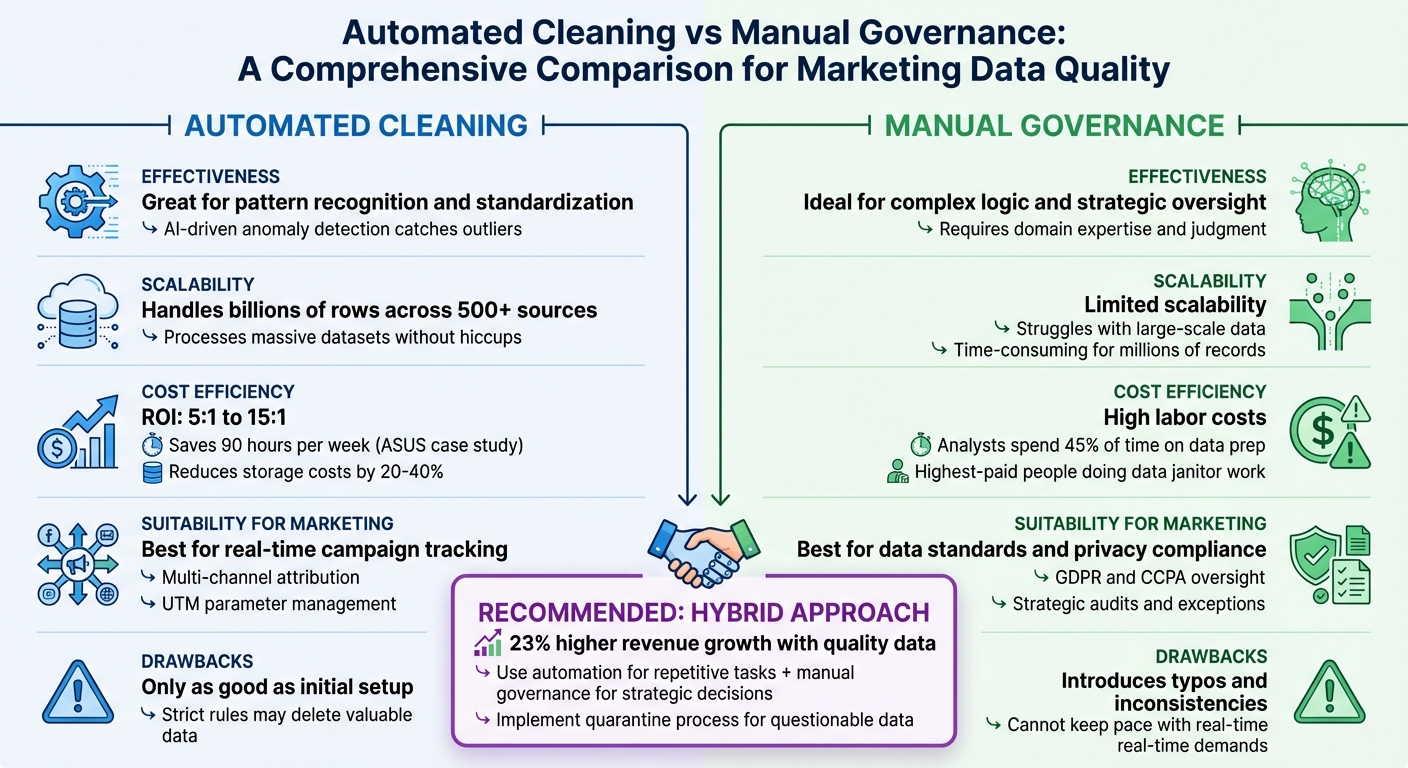
Automated Cleaning vs Manual Governance: Marketing Data Quality Comparison
Building on the methods discussed earlier, this section dives into the pros and cons of automated cleaning and manual governance. Each approach has its strengths and weaknesses, and understanding these trade-offs is key to deciding how to allocate resources and blend both strategies effectively.
Automated cleaning shines when it comes to speed and consistency. It can handle massive datasets – billions of rows from over 500 marketing platforms – while ensuring uniform naming conventions and formatting rules every time. This means organizations can save a lot of time by automating repetitive tasks like standardization. However, automation is only as good as its setup. If the initial rules are flawed, the system will consistently produce incorrect results. Another drawback is that overly strict rules can delete records that might actually hold valuable information, potentially leading to data loss.
Manual governance, on the other hand, is more effective for tasks requiring human judgment, such as addressing complex business logic or resolving inconsistencies that need domain expertise. It’s particularly useful for scenarios where external verification or nuanced decisions are needed. But this approach comes with a hefty price tag. High cleaning costs can strain budgets, and analytics teams often spend nearly half their time on data prep instead of diving into meaningful analysis.
"Your highest-paid people are doing data janitor work instead of finding insights that actually help the business"
Manual processes also introduce structural issues like typos and inconsistent abbreviations, which can lead to further inaccuracies.
Here’s a quick comparison of the two approaches:
| Feature | Automated Cleaning | Manual Governance |
|---|---|---|
| Effectiveness | Great for recognizing patterns and standardization | Ideal for complex logic and strategic oversight |
| Scalability | Handles billions of rows across 500+ sources | Limited; struggles with large-scale data |
| Cost Efficiency | Cost-effective; saves labor hours with a 5:1 to 15:1 ROI | Costly; relies on high-paid analysts for routine tasks |
| Suitability for Marketing | Best for real-time campaign tracking and multi-channel attribution | Best for setting data standards and ensuring privacy compliance |
Instead of picking one approach over the other, the best strategy is to combine both. Use automation for repetitive, high-volume tasks like deduplication and date formatting, and rely on manual governance for strategic audits or exceptions involving complex rules. This balanced approach can significantly improve data quality, which, in turn, can lead to a 23% higher revenue growth for organizations compared to those with poor data practices.
One practical way to implement this hybrid strategy is by setting up a "quarantine" process. Instead of automatically deleting questionable data, route it to a separate table for manual review. This prevents valuable information from being lost while keeping your database clean. Another useful tactic is to establish data contracts that clearly define expectations for critical datasets – such as required fields and valid values – and automate their validation during data ingestion. These steps help create a well-rounded strategy for maintaining top-notch data quality.
Conclusion
Striking the right balance between automation and manual oversight is key to managing your data effectively. Think of automation as the engine that powers through routine tasks, like standardization, deduplication, and formatting across platforms. This frees up your team to focus on higher-value activities that require strategic thinking and decision-making.
While automation handles the repetitive groundwork, manual governance ensures that your data strategy stays on track. It provides the critical oversight needed to set the rules for automation, manage complex exceptions that demand business context, and ensure compliance with regulations like GDPR and CCPA. Without this human touch, automation risks making errors that could lead to the loss of important data.
The impact of quality data can’t be overstated – it fuels revenue growth, while poor data can cost companies millions each year. A great example of this hybrid approach in action is ASUS, where Jeff Lee led an initiative to automate standardization processes. This move saved the company an impressive 90 hours per week, all while maintaining the strategic oversight necessary to keep their data accurate and actionable.
Getting started with this approach is straightforward. Begin by automating repetitive tasks such as deduplication, field standardization, and formatting during your ETL process. Then, appoint data stewards to perform regular audits and define the standards your automation should enforce. To safeguard valuable records, consider implementing a "quarantine" system where automation flags questionable data for manual review instead of outright deletion. This ensures your database remains clean without risking the loss of potentially important information.
Keep in mind that marketing data is constantly changing – about 30% becomes outdated every year due to job changes and business dynamics. Your hybrid strategy should be a continuous effort, with automation managing high-volume tasks and manual oversight guiding the big-picture decisions. Together, this combination creates a solid foundation for smarter, more confident marketing strategies.
FAQs
What are the best ways to ensure automated data cleansing is effective?
To make automated data cleansing work efficiently, start by crafting a clear plan that prioritizes the key pillars of data quality: accuracy, completeness, consistency, uniformity, and validity. This plan should then be translated into machine-readable rules that can validate data fields, enforce a standardized schema, and identify anomalies as they occur.
For dependable results, businesses can take the following steps:
- Apply identity resolution and deduplication to match records and remove duplicates effectively.
- Embed cleansing steps directly into data pipelines, ensuring all transformations are version-controlled and rigorously tested.
- Configure automated alerts to catch quality issues, such as missing data or sudden spikes in errors, and schedule periodic re-validation to maintain standards.
Growth-onomics supports businesses in integrating these practices into smooth, efficient workflows, helping their data cleansing efforts stay precise, scalable, and aligned with their marketing objectives.
Why is manual oversight important for ensuring data compliance during marketing data cleansing?
Manual oversight is essential for ensuring compliance with regulations like CCPA and GDPR during marketing data cleansing. It provides a human layer of accountability by assigning specific responsibilities, enforcing critical policies (like "Do-Not-Call" lists), and reviewing or approving any changes or exceptions before they are put into action.
When paired with automated tools, manual reviews add an extra layer of assurance. They help confirm that processes such as data validation and deduplication are carried out correctly, minimizing errors or risks that could lead to non-compliance. This balance between automation and human input ensures data remains accurate, consent-driven, and fully auditable – cornerstones of a robust compliance strategy.
How do automated tools and manual oversight work together to improve marketing data quality?
Automated tools take care of the grunt work, swiftly tackling common problems like missing values, duplicate entries, or incorrect timestamps. These tools work quickly and at scale, ensuring your marketing data is accurate and dependable before it’s used for analysis or campaign strategies.
However, manual oversight plays a crucial role that automation can’t fully replace. Humans step in to handle tricky edge cases, tweak rules as business priorities shift, and make sure the data meets broader quality benchmarks, such as accuracy and consistency. By combining the speed and efficiency of automation with the adaptability and precision of human review, you get a robust system that keeps your marketing data clean and ready for action.