

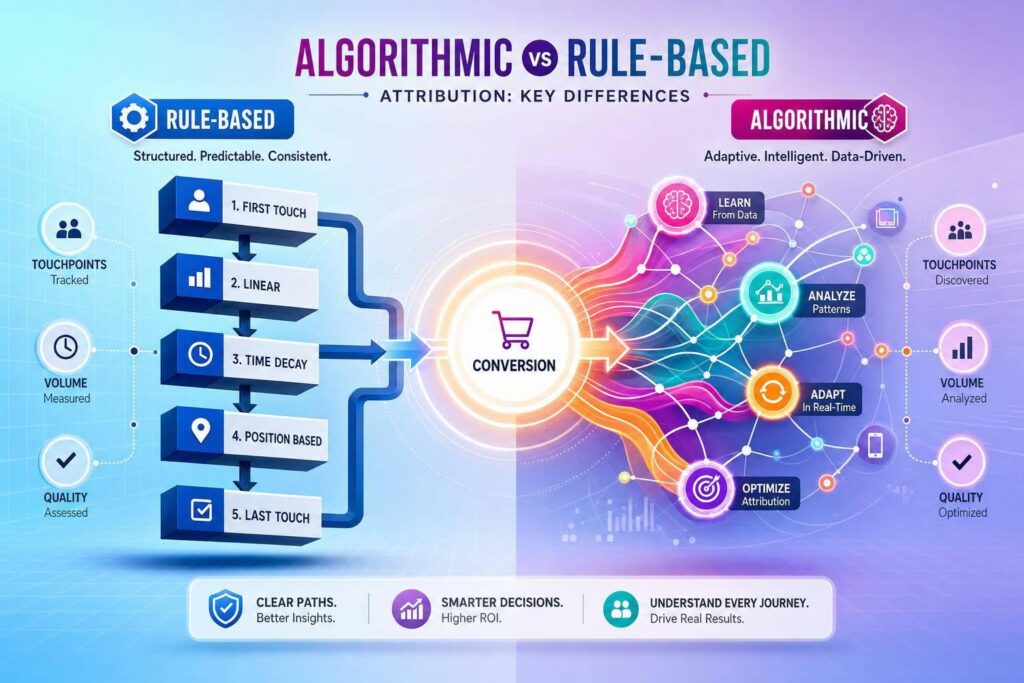
If I had to boil it down to one line, it’s this: rule-based attribution uses fixed credit rules, while algorithmic attribution uses conversion data to estimate which channels helped drive the sale.
That choice affects how I read performance, where I move budget, and whether I end up over-crediting the last click. For many smaller teams, rule-based models are the better starting point because they’re simple and easy to audit. For higher-volume programs with messy buyer journeys, algorithmic models can give a closer view of channel impact – but only if tracking is clean and conversion volume is high enough.
Here’s the short version:
- Rule-based attribution
- Uses set formulas like first-click, last-click, linear, time-decay, and position-based
- Works best when volume is low or the journey is simple
- Is easy to explain, but can miss how channels work together
- Algorithmic attribution
- Uses observed conversion paths to assign credit
- Fits multi-channel, multi-touch programs with enough data
- Can improve budget decisions, but is harder to explain and more sensitive to tracking issues
- What changes the decision
- Conversion volume
- Sales cycle length
- Channel mix
- Tracking quality
- Reporting needs
A few numbers make the tradeoff clear:
- B2B buyers average 27 interactions before converting
- 41% of marketers still use last-touch
- Only 21.5% trust last-click for long-term platform impact
- Algorithmic models often need at least 300 to 400 conversions per month for stable weighting
- GA4 data-driven attribution has much higher thresholds, including 400 conversions per action and 20,000 total conversions in the lookback window
- Some teams report 20% to 30% better media efficiency after moving to algorithmic attribution
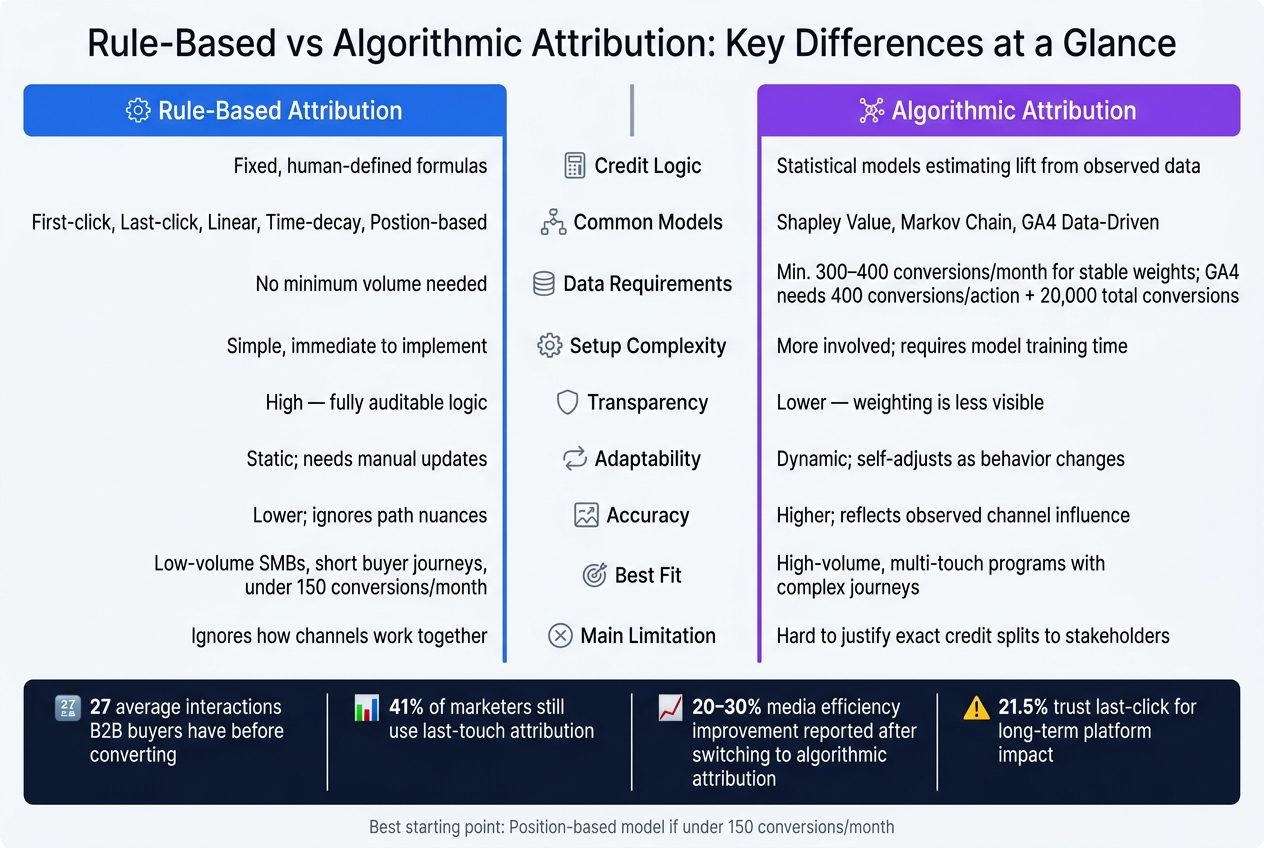
Rule-Based vs Algorithmic Attribution: Key Differences at a Glance
Attribution IQ vs Legacy Attribution in Adobe Analytics
sbb-itb-2ec70df
Quick Comparison
| Criteria | Rule-Based Attribution | Algorithmic Attribution |
|---|---|---|
| How credit is assigned | Fixed rules | Model-based weighting from past data |
| Common models | First-click, last-click, linear, time-decay, position-based | Shapley value, Markov chain, GA4 data-driven |
| Data needs | Low | High |
| Setup | Simple | More involved |
| Best for | Low-volume SMBs, short journeys | Higher-volume, multi-touch programs |
| Main upside | Easy to audit and explain | Better at reading channel contribution |
| Main downside | Can distort channel value | Harder to justify exact credit splits |
| Good starting point | Under 150 conversions/month: often position-based | Usually after tracking is solid and volume is high enough |
My takeaway: if your data is thin, fixed models are often the safer pick. If your conversion volume is strong and your journey spans many touchpoints, algorithmic attribution may give you a better basis for budget decisions.
That’s the core difference the rest of the article breaks down.
Rule-Based Attribution: Fixed Rules for Assigning Credit
Rule-based attribution is the simplest place to start because it follows fixed credit rules. In plain English, it uses set formulas to decide which touchpoints get credit. Those formulas don’t change, even if customer behavior does.
That makes these models easy to launch and easy to explain. But there’s a catch: they can flatten a messy, multi-touch journey into something a little too neat.
Common Rule-Based Models Explained
Five common models split credit in different ways, and that can change how each channel looks on paper.
| Model | Credit Logic | Best Use Case | Main Limitation |
|---|---|---|---|
| First-Click | 100% to the first touch | Brand awareness and discovery | Ignores every nurturing and closing interaction |
| Last-Click | 100% to the final touch | Short sales cycles and bottom-funnel channels | Overvalues bottom-funnel channels like branded search |
| Linear | Equal split across all touches | Balanced reporting baseline | Treats a casual impression the same as a high-intent demo |
| Time-Decay | More credit to recent touches | Short sales cycles | Undervalues early awareness that started the relationship |
| Position-Based | 40% first, 40% last, 20% middle | B2B; valuing both acquisition and closing | The 40/40/20 split is arbitrary |
A simple example shows why model choice matters so much. On a four-touch path to a $100 conversion, first-click gives $100 to the first touch. Last-click gives $100 to the last touch. Linear splits it evenly, so each touch gets $25.
Same path. Same conversion. Very different story.
Because of that, the model you choose can shift how much credit a channel gets by 40% or more for the same conversion path.
Where Rule-Based Models Work Best
Rule-based models make sense for teams that don’t yet have enough conversion volume for stable algorithmic weighting. If your site gets fewer than 300–400 conversions per month, algorithmic models usually don’t have enough data to produce stable, reliable weights.
They’re also a good fit when:
- the sales cycle is short
- the channel mix is simple
- the team needs a model people can understand right away
Another plus: the logic is fully auditable. You can trace exactly why a channel got the credit it did, which helps when you’re explaining results to leadership or cross-functional teams.
Main Limits of Rule-Based Attribution
The main issue is simple: people choose the weights, not the data.
That can become a big problem in long B2B sales cycles. When buyers average 27 interactions before converting, a last-click model can miss most of the story. It gives all the credit to the final interaction and leaves out the upper-funnel touches that built interest and intent over time.
First-click has the opposite problem. It rewards discovery, then ignores the touches that helped seal the deal.
There’s another gap too. Rule-based models can’t spot how channels work together. A fixed formula won’t show that one touchpoint made another one work better. It just assigns credit based on position or timing, full stop.
That’s exactly the problem algorithmic attribution tries to fix.
Algorithmic Attribution: Credit Based on Observed Data
Algorithmic attribution uses past conversion data to assign credit. Instead of leaning on fixed rules, it learns from what people actually did. That gives marketers a better read on which channels are helping drive revenue.
How Algorithmic Models Assign Credit
At a basic level, the model looks at paths that led to a conversion and compares them with paths that did not. From there, it estimates the lift each channel added. Two common math frameworks sit behind these models:
- Shapley Value: estimates each channel’s average marginal contribution if it were removed.
- Markov Chains: measures the drop in conversion probability when a channel is removed from the path.
For marketers, the goal is simple: separate true contribution from plain touchpoint frequency.
These weights change as new data comes in. They can also shift with seasonality or changes in channel mix. So a channel that shows up all the time but does little to improve conversion odds may get less credit than its raw volume suggests. On the flip side, a less common touchpoint that keeps lifting conversions can earn more credit.
Data and Technical Requirements
This level of accuracy depends on having enough clean conversion data.
Algorithmic models are only as good as the data behind them. If volume is too low, the model can overfit to outliers or produce shaky credit allocations.
GA4’s data-driven model requires a minimum of 400 conversions per action and 20,000 total conversions across all actions within the lookback window. Fall below that line, and credit allocations can swing from month to month.
Data quality matters just as much as volume. Messy UTM tagging and browser privacy limits can skew credit. One common fix is server-side tracking, which helps cut browser-level data loss. For example, tools like Meta’s Conversions API (CAPI) and Google Enhanced Conversions can send event data straight from the server.
How Algorithmic Attribution Supports Better Budget Decisions
Algorithmic attribution works well for messy, multi-channel customer journeys. It can spot channels that assist conversions even when they do not get the final click. That helps teams make better budget calls, not just better models.
Companies using algorithmic attribution have reported a 20% to 30% improvement in media efficiency from smarter budget allocation.
For long B2B sales cycles, use a 90-day lookback window so early awareness touchpoints still get counted.
These tradeoffs stand out fast when you line up credit logic, accuracy, and fit for the business.
Algorithmic vs Rule-Based Attribution: Key Differences
The main difference comes down to how each model assigns credit: fixed rules or data-driven weighting. That one choice affects reporting accuracy and, just as important, every budget move that comes after it.
Credit Logic, Accuracy, and Flexibility
Rule-based models stay fixed. The formula doesn’t change unless someone updates it by hand, even if buyer behavior starts moving in a new direction.
Algorithmic models work differently. As new conversion data comes in, the model recalibrates, and credit weights shift with customer behavior. That gives you a model that can track what’s happening now, not just what was set up months ago.
The tradeoff is pretty straightforward. Rule-based models give you a clear formula that’s easy to defend. Algorithmic models tend to be more accurate, but they’re harder to explain at the channel level. You may know what credit a channel received without being able to walk a stakeholder through every part of why it got that exact share.
Complexity, Transparency, and Business Fit
Here’s a side-by-side look at the factors that usually matter most:
| Factor | Rule-Based Attribution | Algorithmic Attribution |
|---|---|---|
| Credit Logic | Fixed, human-defined formulas | Statistical models that estimate lift |
| Data Requirements | No minimum volume | Needs sufficient conversion volume |
| Setup Complexity | Immediate; simple to implement | Requires time for model training |
| Transparency | High; fully auditable logic | Less transparent weighting |
| Adaptability | Static; needs manual updates | Dynamic; self-adjusts to behavior shifts |
| Accuracy | Lower; ignores path nuances | Higher; reflects observed influence |
| Best Fit | Low-volume SMBs | High-volume, multi-touch programs |
| Main Limitation | Ignores nuances in buyer behavior | Hard to justify specific credit splits |
Transparency is where rule-based models have a clear advantage. If you need to explain a budget shift to stakeholders, a position-based model with a fixed split is much easier to defend than a model that uses less visible weighting behind the scenes.
Algorithmic attribution starts to make sense when the business has enough data to trust the output and enough conversion volume to keep the model steady. Without that volume, the math can get shaky fast.
That’s why model choice isn’t just a technical call. It’s a business call too. The gap between these two approaches shapes when it makes sense to keep things simple and when it’s time to move to data-driven attribution.
How to Choose the Right Attribution Model
Pick your model based on four things: conversion volume, channel mix, reporting needs, and the strength of your analytics setup. Once you know how each model works, the next step is figuring out which one fits your business.
When to Start with Rule-Based Attribution
If you have fewer than 150 conversions per month, start with position-based (U-shaped) attribution. If you’re in the 150 to 300 range, time-decay can work too – but only if its half-life lines up with your sales cycle.
That matters more than it sounds. If the timing in the model doesn’t match how people actually buy, the output can get messy fast.
Rule-based models are also easier to explain to finance and leadership. The logic stays fixed, so people can see how credit is assigned and why.
For short buyer journeys, first-touch or last-click attribution is often enough to guide budget choices. It’s not fancy, but for simple paths, it does the job.
When to Move to Algorithmic Attribution
As volume grows and customer journeys get more layered, fixed rules start to show their limits. That’s usually the point where algorithmic attribution makes more sense. But don’t switch just because it sounds more advanced. Move when conversion volume is high enough to support stable weighting.
There’s one big catch: audit tracking before you switch. Algorithmic models can’t fix missing or broken identity data. If the data is incomplete, the model will still produce answers – it just won’t produce answers you should trust. Better attribution starts with clean, complete data, not a fancier method.
It also helps to run both models side by side for a while. This gives you a clearer view of where fixed rules may be giving too much credit – or not enough – to certain channels.
Conclusion: The Core Difference to Remember
Rule-based attribution follows preset formulas. Algorithmic attribution estimates contribution from observed data and shifts as behavior changes. The right choice comes down to your data volume, journey complexity, and what kind of reporting your team needs.
FAQs
How do I know when to switch to algorithmic attribution?
Switch when you consistently hit 300 to 400 conversions per month.
Below that range, algorithmic models often don’t have enough data to spot steady patterns. And when that happens, they can do worse than rule-based models.
Your tracking also needs to be in good shape. That means:
- Clean server-side tracking
- Resolved cross-device identity
- Consistent event schemas
If you’re not sure your setup is ready, Growth-onomics can help assess your data maturity before you test an algorithmic model alongside your current one.
What happens if my tracking data is incomplete or inaccurate?
It depends on the model.
Rule-based attribution can still work when data is sparse or a bit messy because it follows fixed rules. It doesn’t need to “learn” from large volumes of clean data.
Algorithmic attribution is different. It needs high-quality, complete data to work well. If your data is weak, or you don’t have enough conversions, the model can point you in the wrong direction.
In that situation, rule-based models are the safer pick until your tracking setup is in better shape.
Which rule-based model is best for a small marketing team?
For a small marketing team, Position-Based Attribution is often the best rule-based model, especially when you’re working with fewer than 150 to 400 monthly conversions.
Here’s why it works so well: it gives you a steady, balanced read on the customer journey. 40% of the credit goes to the first interaction, 40% goes to the last interaction, and the remaining 20% is divided among the middle touchpoints.
That setup makes sense for a lot of teams. The first touch gets credit for bringing someone in. The last touch gets credit for closing the deal. And the middle steps still get their share, without taking over the whole story.
It also helps that this model is transparent and easy to explain to stakeholders. No black box. No head-scratching. Just a simple way to show how each stage of the path contributes.