

When it comes to reducing your Cost Per Acquisition (CPA), AI and manual optimization take very different approaches. AI uses machine learning to analyze real-time data and make instant adjustments, while manual optimization relies on human analysis and periodic updates. Here’s the main takeaway: AI reduces CPA faster and more consistently, but manual methods offer more control and transparency.
Key Points:
- AI Pros: Cuts acquisition costs by up to 68%, processes data in milliseconds, and scales easily across large campaigns.
- Manual Pros: Provides granular control, works better for budgets under $10,000/month, and is ideal for industries with strict regulations.
- AI Cons: Requires at least 30 conversions/month to work effectively, lacks transparency, and may over-optimize for platform metrics.
- Manual Cons: Requires 15–20 hours/week per campaign, slower response times, and misses up to 40% of potential search volume.
Quick Comparison:
| Feature | Manual CPA Optimization | AI-Driven CPA Optimization |
|---|---|---|
| Speed | Days to weeks for changes | Milliseconds for adjustments |
| Cost Efficiency | 8–12% improvement | 15–31% improvement |
| Management Time | 15–20 hours/week | 2–4 hours/week |
| Scalability | Limited by human capacity | Unlimited campaigns |
| Transparency | High | Low ("black box") |
For most businesses, a hybrid approach – combining AI for large-scale automation and manual methods for compliance or niche campaigns – delivers the best results. Start by auditing your conversion tracking and ensure your budget aligns with the method you choose.
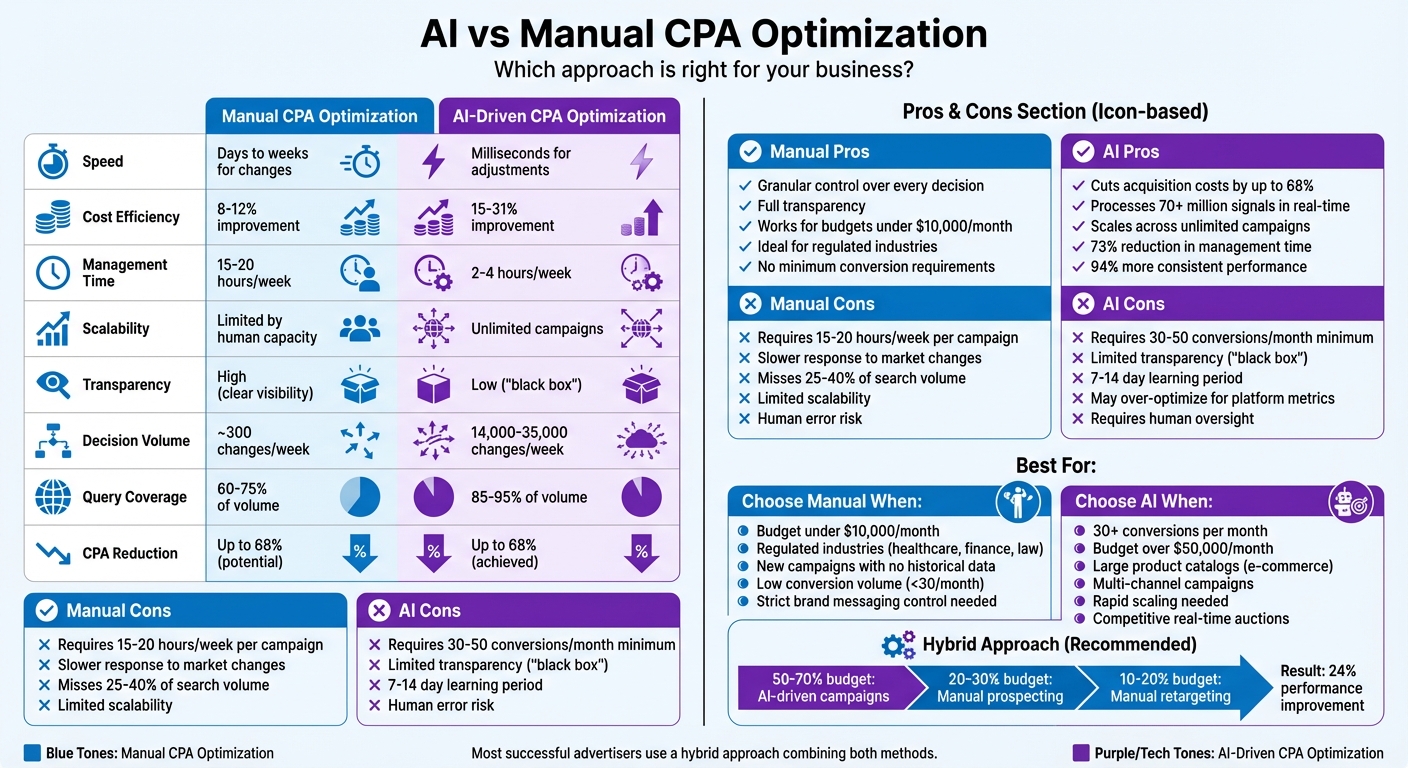
AI vs Manual CPA Optimization: Side-by-Side Comparison
Manual CPA Optimization: How It Works and What to Expect
How Manual CPA Optimization Works
Manual CPA optimization puts you in the driver’s seat of your advertising spend. You set specific maximum bid amounts for keywords, ad groups, or campaigns, ensuring platforms like Google Ads stay within your limits. This method relies heavily on analyzing historical performance data – typically from the past week or month – rather than reacting to real-time auction dynamics.
It’s a hands-on process that demands time and effort. Tasks include fine-tuning ad schedules, adjusting demographic and geographic targeting, and making bulk changes using tools like Google Ads Editor. Since this approach is rooted in historical data, updates happen on a 7–14-day cycle, which can leave you lagging behind sudden market changes.
Expect to dedicate 15–20 hours per week to manage this process thoroughly. A significant chunk of that time involves combing through search term reports to weed out irrelevant terms – often 20–30% of search terms – to prevent wasted spending. However, this approach typically captures just 60–75% of available search volume, as it lacks the semantic breadth AI-driven methods provide.
While manual CPA optimization offers some clear advantages, it also comes with notable limitations, which are explored below.
Advantages of Manual CPA Optimization
Manual optimization’s biggest strength lies in granular control. You decide where every dollar goes, which bids to tweak, and which audiences to target. This level of control also means full transparency – you know exactly why each decision is made, unlike the more opaque nature of AI systems.
This method shines for new campaigns without historical data. AI strategies often need at least 30 conversions within 30 days to start working effectively. With manual bidding, you can establish a baseline performance right from the start. It’s also ideal for regulated industries where every decision must be carefully reviewed and documented.
Another plus is predictability. With manual optimization, you can maintain steady budget allocation and spending patterns – critical when working with tight financial constraints. You can also act quickly when needed, such as adjusting bids in response to a competitor suddenly increasing CPCs. Skilled manual management can deliver 8–12% performance improvements, though this is only about 31% of the potential CPA reduction that advanced AI systems can achieve.
Drawbacks of Manual CPA Optimization
Despite its benefits, manual optimization has clear drawbacks, especially when it comes to scalability. Human managers simply can’t match the speed or depth of AI, which processes millions of real-time signals – like device type, user intent, and location – in milliseconds. Manual methods rely on periodic updates based on historical data, which can’t keep up with real-time auction dynamics.
Response time is another major hurdle. When market conditions shift, you need to identify the change, analyze its impact, and adjust your strategy – a process that often lags behind what’s happening in real-time. In programmatic advertising, for example, bid requests need to be answered within 6 to 16 milliseconds, a speed manual methods can’t achieve.
There’s also the risk of human error. Mistakes like setting bids too low during the learning phase or applying overly restrictive targeting can hinder campaign performance. As Lakshya Suneja from Mediasmart puts it:
Manual means ‘made by the man’ and as such, it is expected to be fallible.
Finally, the time commitment can be overwhelming. Even with 15–20 hours per week, manual optimization often misses 25–40% of available search volume that AI systems could capture. This limitation makes it challenging to manage multiple campaigns efficiently.
AI-Driven CPA Optimization: How It Works and What to Expect
How AI-Driven CPA Optimization Works
AI-driven CPA optimization brings a new level of precision to campaign management. By leveraging machine learning, these systems process over 70 million signals – like device type, location, time of day, browser, and operating system – in real time. Decisions are made in about 100 milliseconds, allowing the system to adapt to auction dynamics as they happen.
These algorithms go deep, analyzing 247 factors, including bidding patterns, audience behavior, keyword relationships, and competitive trends. They even predict CPA trends 14–21 days in advance with an impressive 87% accuracy. On top of that, they assess conversion probabilities by examining thousands of user characteristics and intent signals.
Take Google’s AI Max, for example. It uses natural language processing to match related queries and tests thousands of creative combinations in real time. This can expand campaign reach by up to 340%. Imagine a query for "red midi dress" being connected to "colorful spring dresses" based on context, going far beyond the boundaries of manual keyword lists.
"The era of spreadsheet-based bid management is over, replaced by algorithms that process millions of data points in milliseconds to make decisions that would take human analysts hours or days."
– Alvar Santos, January 2026
The results speak for themselves. In 2025, L’Oréal used AI Max for its global campaigns, cutting cost-per-conversion by 31% while expanding relevant query coverage by 340%. Similarly, a regional dental practice that adopted AI Max saw a 186% boost in qualified appointment bookings, a 42% drop in cost-per-lead, and a 67% reduction in management time.
These capabilities provide immediate benefits, streamlining operations while delivering better outcomes.
Advantages of AI-Driven CPA Optimization
AI-driven optimization offers a level of speed and efficiency that manual methods simply can’t match. For example, AI systems can deliver meaningful cost reductions within 48–72 hours, whereas manual adjustments often take 2–3 weeks to achieve statistical significance.
Scalability is another standout feature. While manual management struggles as campaigns grow more complex – dropping to 34% effectiveness across large portfolios – AI systems maintain a 91% effectiveness rate for portfolios with 100+ campaigns. Plus, AI can cut management time by 73%, allowing marketers to focus more on strategy and creative work.
The cost savings are equally compelling. AI-driven CPA reduction can lower acquisition costs by 68% and deliver 94% more consistent performance. Within 60 days of switching to AI-powered Smart Bidding, performance typically improves by 15–30%, and conversion rates can climb by 12–25% as high-intent users are better targeted.
Predictive capabilities are another game-changer. For instance, a woodworking retailer in Connecticut transitioned high-volume campaigns (120+ conversions per month) from manual CPC to Target ROAS. By identifying late-night and geographic micro-targeting opportunities, their return on ad spend (ROAS) jumped from 380% to 467% in just 60 days.
"AI-powered Smart Bidding has fundamentally transformed Google Ads, delivering 15-30% better performance than manual strategies through predictive marketing capabilities."
– Alvar Santos, Growth Rocket
Unlike manual methods, which often focus on single variables like bid adjustments, AI systems analyze and optimize hundreds of factors simultaneously. This multi-dimensional approach uncovers opportunities that would be nearly impossible to spot manually.
Drawbacks of AI-Driven CPA Optimization
Despite its strengths, AI-driven optimization isn’t without its challenges. One major issue is the "black box effect", where the system’s decision-making process lacks transparency. Tools like Performance Max, for example, often provide limited visibility into search terms and placements, which can lead to wasted spend on irrelevant traffic.
Data requirements can also be a hurdle. AI systems typically need 30–50 conversions within a 30-day period to function effectively. For new campaigns or niche markets, generating enough data can be difficult. Ad blockers can further complicate this, with up to 30% of conversions potentially going untracked, leaving the system to optimize based on incomplete information.
Another drawback is the calibration period. AI systems usually take 7–14 days to adjust, during which performance can fluctuate as the algorithm experiments with different strategies. This can be problematic for campaigns with tight budgets or immediate performance goals.
There’s also the risk of over-optimizing for platform metrics at the expense of broader business objectives. For example, a Connecticut law firm used a custom workflow to align Google Ads bids with CRM capacity and attorney schedules. This strategy reduced the cost per qualified case from $843 to $556 and saved $6,120 per month by pausing ads when capacity was full.
Finally, even the most advanced AI systems require human oversight. Without proper constraints, algorithms might chase unprofitable traffic or make automated adjustments – like adding broad match keywords or altering budgets – that could lead to costly mistakes. Strategic intervention is essential to avoid these pitfalls and ensure the system aligns with overall business goals.
Key Differences Between AI and Manual CPA Optimization
Speed, Efficiency, and Scalability Compared
When comparing AI and manual CPA optimization, the differences in speed, efficiency, and scalability are striking. AI systems excel in processing data and making adjustments in milliseconds, whereas manual efforts rely on feedback loops that take 7–14 days to achieve statistical significance. Consider this: a two-person team can handle around 150–300 changes per week, but AI systems process 2,000–5,000 decisions daily, reaching up to 35,000 weekly.
AI campaigns typically stabilize within 4–6 weeks, achieving full optimization significantly faster than the 8–12 weeks required for manual methods. Efficiency is another area where AI stands out – AI reduces acquisition costs by 68% while ensuring a 94% improvement in performance consistency compared to manual processes. On the other hand, manual adjustments only capture 31% of potential CPA reductions and can inadvertently increase costs by 15–23% due to issues like keyword cannibalization.
Scalability further highlights AI’s advantage. While human managers can effectively handle 3–5 complex accounts, AI can manage unlimited portfolios without a drop in performance. AI maintains 91% effectiveness across 100+ campaign portfolios, whereas manual efforts see a steep decline in effectiveness, dropping to just 34% at similar scales.
These metrics set the stage for understanding how control, transparency, and resource demands differ between the two approaches.
Control, Transparency, and Resource Needs Compared
Manual optimization offers unparalleled control over bids, keywords, and ad copy, with full transparency into decisions and spending. In contrast, AI systems often operate as a "black box", providing limited insight into individual placements or the logic behind algorithmic choices.
Resource demands also vary significantly. Manual optimization is labor-intensive, requiring 15–20 hours of management per week per account. AI-driven systems, however, reduce this to just 2–4 hours of strategic oversight per week, cutting management time by 73%. Financially, the difference is equally stark: managing a $50,000 monthly ad spend with an in-house team incurs a 52% management premium. In comparison, AI tools cost only 1–3% of the ad budget. For example, a three-person in-house PPC team costs around $310,000 annually (including salaries, benefits, and tools), while AI platforms for smaller accounts start at $99–$299 per month.
"The future belongs to advertisers who can strategically direct AI rather than replace it. AI Max gives us the tools to do both effectively."
– Frederick Vallaeys, Co-founder, Optmyzr
Comparison Table
| Feature | Manual CPA Optimization | AI-Driven CPA Optimization |
|---|---|---|
| Adjustment Speed | Days to weeks (reactive) | Milliseconds (real-time) |
| Decision Volume | ~300 changes per week | 14,000–35,000 changes per week |
| CPA Efficiency | 8–12% performance gains | 15–31% cost-per-conversion improvement |
| Management Time | 15–20 hours weekly per campaign | 2–4 hours of oversight weekly |
| Scalability | Limited by human capacity | Unlimited campaigns |
| Query Coverage | 60–75% of available volume | 85–95% of available volume |
| Control | Full (granular control) | Limited (strategic guardrails) |
| Transparency | High (clear visibility) | Low ("Black Box" decisions) |
sbb-itb-2ec70df
When to Use AI vs Manual CPA Optimization
Best Use Cases for AI-Driven CPA Optimization
AI-driven CPA optimization shines when you have enough data – typically at least 30–50 conversions per month – to give the algorithm a solid foundation to work with. For e-commerce businesses with extensive product catalogs, AI is invaluable. It can handle thousands of SKUs at once, optimizing for product-level CPA while delivering results that would be nearly impossible to achieve manually.
If you’re running multi-channel campaigns across platforms like Search, Display, YouTube, and Discover, AI can seamlessly coordinate efforts, ensuring your strategy stays cohesive. Many large brands have seen measurable improvements, such as lower cost-per-conversion and broader query coverage, by integrating AI into their campaigns. AI also thrives in rapid scaling scenarios, uncovering long-tail keyword opportunities that manual teams might overlook.
In competitive, real-time auction environments, AI’s ability to adjust bids in milliseconds is a game-changer. Markets where user signals – like location, device, and intent – evolve rapidly benefit from AI’s capacity to analyze up to 247 variables simultaneously, providing a significant competitive advantage. However, industries that require strict regulatory compliance or demand precise creative control may still lean toward manual methods.
Best Use Cases for Manual CPA Optimization
Despite AI’s strengths, manual CPA optimization is essential in situations where control and compliance take priority. Industries such as healthcare, finance, law, and addiction treatment often require human oversight to ensure campaigns meet strict regulatory standards and messaging guidelines. Similarly, when launching new products with no historical data, manual optimization is necessary because AI lacks the baseline information it needs to perform effectively.
For campaigns with small budgets – under $100 per day – manual management often yields better results. AI learning phases can lead to wasted spending in these cases, making human intervention more cost-efficient. Niche campaigns with low conversion volumes (fewer than 30 conversions per month) are another area where manual methods outperform AI, as the lack of data limits the algorithm’s effectiveness. Additionally, scenarios that demand precise control over messaging and ad copy to maintain brand identity – such as brand protection campaigns – are better suited for manual optimization.
Using Hybrid Approaches
Blending both AI and manual strategies often delivers the best results. Many top-performing advertisers in 2026 adopt a portfolio approach, leveraging AI’s automation capabilities alongside strategic human oversight. A typical budget allocation might look like this:
- 50–70% for AI-driven campaigns (e.g., Performance Max or Advantage+) to scale proven products
- 20–30% for manual prospecting to test new audiences and high-intent keywords
- 10–20% for manual retargeting to maintain control over messaging
This hybrid model delegates tasks like real-time bidding adjustments, keyword expansion, and optimization to AI while leaving strategic decisions – such as negative keywords, seasonality adjustments, and brand safety measures – to human managers. For example, B2B services using this mix have reported a 24% improvement in performance compared to relying solely on AI or manual methods.
How to Switch to Target CPA in Google Ads (Using Gemini AI)
Conclusion
Choose the optimization method that aligns with your specific goals and operational needs. AI has the potential to cut acquisition costs by up to 68%, provided there’s sufficient conversion volume to work with. On the other hand, manual approaches shine in regulated industries and low-volume campaigns where every dollar demands careful scrutiny.
The first step? Audit your conversion tracking. Any errors here can derail even the most advanced AI optimization efforts. Then, consider your ad budget: manual methods are often better for campaigns spending under $10,000 monthly, while AI thrives with budgets exceeding $50,000.
Many advertisers find success with a hybrid approach. For enterprise-level accounts, a common strategy is to allocate around 70% of the budget to AI-driven campaigns for scaling proven products. The remaining 30% can be reserved for manual efforts, ensuring oversight and flexibility. This division allows AI to handle tasks like real-time bidding and keyword expansion, while human expertise focuses on compliance, creative direction, and strategic adjustments.
"The future belongs to advertisers who can strategically direct AI rather than replace it." – Frederick Vallaeys, Co-founder, Optmyzr
Ultimately, your strategy should reflect your goals, industry limitations, and available resources. For industries like healthcare or finance, manual control remains essential to navigate strict regulations. On the flip side, if you’re managing a large-scale e-commerce operation, AI’s ability to process and analyze up to 247 variables simultaneously can give you a competitive edge. The real trick lies in knowing when to let AI take the reins and when to rely on human judgment.
FAQs
How do I know if I have enough conversions for AI bidding?
AI bidding thrives when campaigns generate sufficient conversion data, allowing algorithms to learn and improve performance. While the exact amount can vary, having a steady stream of conversions – often several dozen per week or month – provides a solid foundation. Keep an eye on your campaign’s progress over time; if conversions show consistent growth, it indicates that AI bidding has the potential to drive stronger outcomes.
What guardrails should I set so AI doesn’t waste budget?
To keep AI-driven campaigns from overspending, it’s essential to establish clear boundaries through automation rules and performance thresholds. For example, you can set parameters to pause or scale back spending on ads that aren’t meeting targets like ROAS (Return on Ad Spend) or CPA (Cost Per Acquisition). Implement budget caps and performance-based guidelines to ensure funds are allocated effectively. Stay proactive by regularly reviewing AI’s actions, tweaking rules when necessary, and maintaining human oversight to ensure decisions align with your broader strategy.
What’s the best hybrid split between AI and manual campaigns?
Balancing AI’s efficiency with human creativity is key to an effective hybrid approach. Many marketers aim for a 70–80% automation level for tasks like bid adjustments and keyword optimization. This leaves 20–30% of the workload for human input, focusing on creative strategy and audience engagement. This mix allows campaigns to benefit from AI’s speed and accuracy while retaining the human element essential for storytelling and making nuanced decisions. Of course, the exact balance can be adjusted based on your specific goals and available resources.