


In a world where privacy regulations like GDPR and CCPA are reshaping data collection, and browser updates are phasing out third-party cookies, marketers face new challenges in tracking customer journeys. AI tools are stepping in to bridge the gaps, leveraging machine learning to model missing data and maintain accuracy without compromising user privacy.
Here’s a quick look at five AI-powered tools designed to track data in cookieless environments:
- Google Analytics 4 (GA4): Uses machine learning to estimate user actions and offers features like Consent Mode and Enhanced Conversions for privacy-compliant tracking.
- MetricsFlow: Focuses on behavior-based tracking without cookies or personal identifiers, ensuring complete anonymity.
- Ruler Analytics: Employs Bayesian models and first-party data to connect ad impressions to conversions, with strong integration capabilities.
- Piwik PRO: Offers consent-aware AI and anonymous tracking options, ideal for privacy-focused businesses.
- SealMetrics: Tracks interactions using privacy-friendly algorithms, avoiding cookies and user profiling entirely.
These tools help businesses comply with privacy laws while maintaining insights into customer behavior. They rely on first-party data, server-side tracking, and AI models to overcome gaps left by declining cookie use.
Quick Comparison
| Tool | Key Features | Privacy Compliance | Best For | Starting Price |
|---|---|---|---|---|
| Google Analytics 4 | AI-driven conversion modeling, Consent Mode | GDPR, CCPA | General-purpose analytics | Free |
| MetricsFlow | Behavior-based tracking, no cookies | GDPR, CCPA | Anonymized user journey analysis | Contact for pricing |
| Ruler Analytics | Bayesian models, first-party data focus | GDPR, CCPA | Revenue attribution, CRM integration | $199/month |
| Piwik PRO | Consent-aware AI, anonymous tracking | GDPR, CCPA, EU data residency | Privacy-first organizations | Free (Core plan) |
| SealMetrics | Privacy-safe algorithms, no consent needed | GDPR, CCPA, PECR, CNIL | High-compliance industries | Contact for pricing |
These tools highlight the shift from cookie-based tracking to privacy-first solutions, ensuring businesses stay compliant while retaining critical insights.
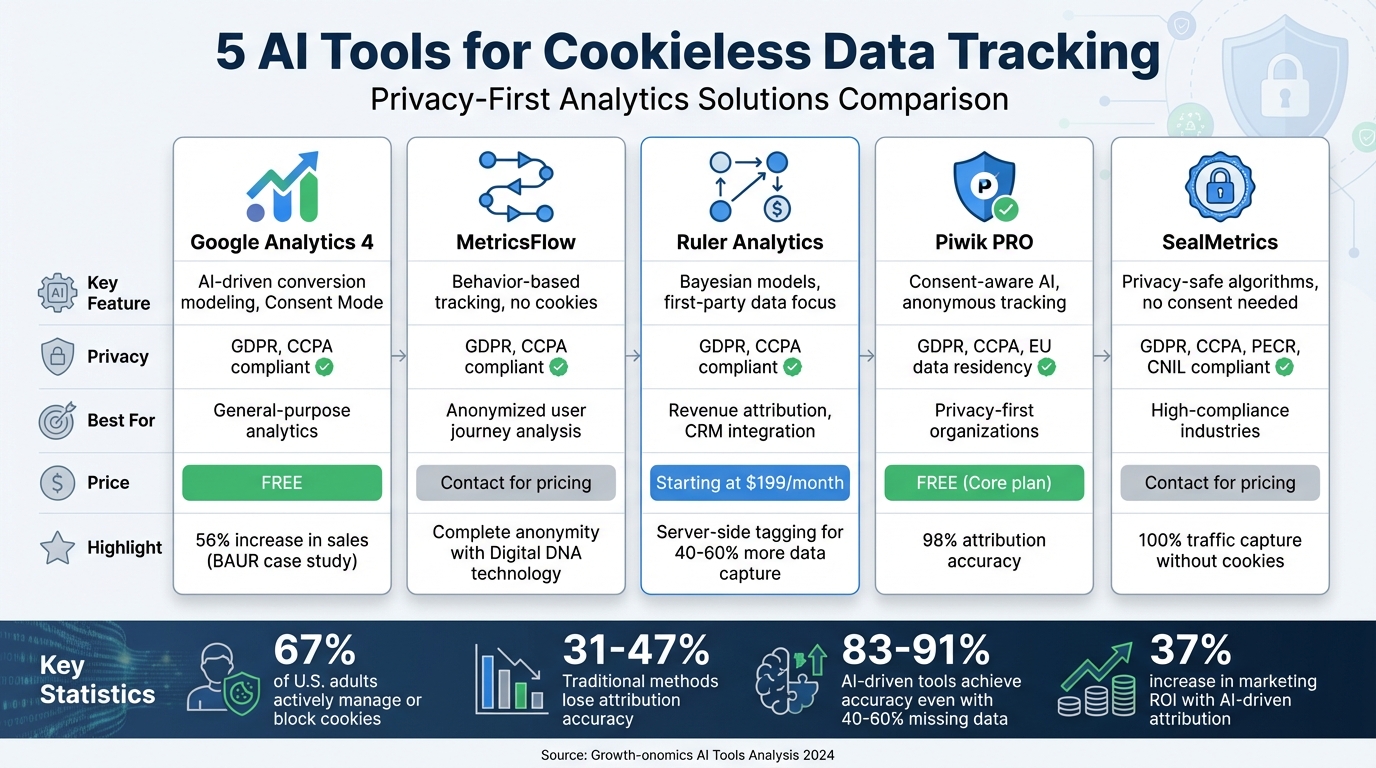
AI Tools for Cookieless Data Tracking: Feature Comparison Chart
1. Google Analytics 4
AI-Driven Tracking Capabilities
Google Analytics 4 (GA4) leverages machine learning to fill in the gaps when users decline cookies. To do this, it requires data from 1,000 daily non-consenting users over seven consecutive days and 1,000 daily consenting users over seven of the past 28 days. This approach helps estimate user actions while respecting privacy preferences.
Its conversion modeling goes a step further, attributing conversions to both observed and unobserved events. For example, BAUR reported a 56% increase in sales and reached 70% of predictive audiences using these AI-powered insights. All of this happens under strict privacy controls, ensuring user trust.
Privacy Compliance (GDPR/CCPA)
GA4 is designed with privacy regulations like GDPR and CCPA in mind. It uses Consent Mode, which dynamically adjusts tracking behavior. When users decline cookies, GA4 sends anonymous, cookieless signals – such as timestamps and user-agent data. This ensures compliance without sacrificing insights. For instance, Gymshark saw a 9% reduction in drop-offs after implementing these features.
The platform also supports GDPR’s "right-to-be-forgotten" through its User Deletion API and provides country-specific controls to tailor compliance efforts for different regions.
Features for Cookieless Environments
GA4’s Blended reporting identity combines observed data with modeled insights, offering a complete view of user and session metrics – even when traditional identifiers are unavailable. You can enable this feature in the Admin settings.
Another key tool is Enhanced Conversions, which uses hashed first-party data (like email addresses) to maintain accurate measurement as third-party cookies are phased out.
Kamal Janardhan, Google’s Senior Director of Product Management, highlights the importance of data quality in this process:
"While the AI model is the engine, the quality data fed into it is the high-octane fuel".
This is why GA4 places a strong emphasis on integrating CRM, web, and app data sources. By connecting these rich first-party data streams, GA4 ensures its AI models perform at their best.
2. MetricsFlow

AI-Driven Tracking Capabilities
MetricsFlow uses its AI-powered "Digital DNA" technology to map out visitor journeys on your website – without relying on cookies, IP addresses, or digital fingerprints. Instead of traditional tracking methods, it focuses on behavioral patterns to maintain complete anonymity. The platform also simplifies performance analysis by offering AI-generated queries through a centralized command center, allowing you to use plain language for insights. This approach not only respects user privacy but also delivers powerful tracking capabilities.
Privacy Compliance (GDPR/CCPA)
MetricsFlow is built with privacy in mind, eliminating the need for cookie banners by avoiding data storage on user devices and steering clear of collecting personally identifiable information (PII). This design ensures compliance with privacy regulations like GDPR and CCPA, giving visitors a seamless browsing experience while still providing you with essential analytics.
Features for Cookieless Environments
Designed for environments where privacy is a priority, MetricsFlow offers tools like privacy-first dashboards and funnel analyses to track user journeys from their first visit to conversion – all while maintaining strict data governance. For developers, it includes a dedicated analytics API that supports programmatic insights, one-click data exports, and automation to make integration effortless.
3. Ruler Analytics
AI-Driven Tracking Capabilities
Ruler Analytics leverages machine learning to deliver cookieless tracking solutions. Using a Bayesian model, it connects ad impressions to conversions when direct data isn’t available. This approach has become especially important after privacy updates like iOS 14.5, where more than 80% of users opted out of cross-app tracking.
To allocate conversion credit across channels, Ruler employs Shapley Regression, a game theory-based framework. For platforms with large impression volumes, its DDA + Impression Model combines click-based data with probabilistic inputs, ensuring that top-of-funnel interactions influencing conversions are recognized. Additionally, its Marketing Mix Modeling (MMM) feature measures the impact of both online and offline channels, including TV and radio.
Privacy Compliance (GDPR/CCPA)
Ruler Analytics places a strong emphasis on privacy compliance by focusing on first-party data collection. It captures UTM parameters, click IDs, and form submissions directly from users, ensuring its tracking aligns with GDPR and CCPA standards. This permission-based approach has become increasingly important, as a February 2023 UK survey revealed that about 23% of respondents aged 45 to 54 reject website cookies daily.
"A first-party data strategy is no longer a ‘nice-to-have’. It’s a business-critical requirement in today’s privacy-first digital environment." – Ruler Analytics
By using first-party data, marketers retain control over their information, reducing reliance on external platforms while meeting strict privacy regulations that demand explicit user consent.
Data Integration and Compatibility
Ruler integrates effortlessly with platforms like Salesforce, HubSpot, Google Ads, Meta, and Microsoft Ads, creating a unified view of marketing and sales data. By capturing identifiers such as gclid and fbclid, it links CRM pipelines to marketing efforts, enabling closed-loop revenue attribution. This means leads can be tracked throughout the sales funnel, and offline sales can be tied back to their original marketing source. Additionally, Ruler sends these identifiers back to ad platforms, helping optimize bidding strategies based on real revenue data. This integration ensures reliable revenue attribution, even in a cookieless world.
Features for Cookieless Environments
Ruler’s server-side tagging processes data on the backend, bypassing browser-based tracking limitations and offering greater control over data collection. This method is critical for maintaining attribution accuracy when browser-based tracking falls short. Pricing starts at $199/month, with discounts for annual plans and special rates for agencies. Traditional tracking methods, often restricted by browser limitations, capture only 40–60% of actual user activity. Studies also show that removing third-party cookies can reduce attribution accuracy by 31% to 47% when relying on older methods.
4. Piwik PRO
AI-Driven Tracking Capabilities
Piwik PRO offers advanced data processing pipelines designed to analyze event-level data, predict user behavior, and tailor interactions – all without relying on cookies. By using consent-aware AI training, the platform ensures it only processes data from users who have given explicit permission. This approach enables it to capture complete customer journeys, delivering up to four times more data and achieving an impressive 98% attribution accuracy. With these tools, Piwik PRO creates behavioral segments to identify high-intent visitors in real time and engages them through automated triggers. All of this is seamlessly aligned with the platform’s strong focus on data privacy.
In 2024, Wojciech Telecki, Head of Digital Marketing at Rawlplug, shared that after adopting Piwik PRO, they achieved 98–99% accuracy in matching online transaction data with accounting records. This was a dramatic improvement compared to the 30% accuracy they had previously experienced with Google Analytics.
Privacy Compliance (GDPR/CCPA)
Piwik PRO is built with privacy in mind, ensuring compliance with regulations like GDPR and CCPA. Its integrated Consent Manager automatically tracks the legal basis for data collection and manages consent, ensuring tracking tags are activated only after users provide explicit agreement. For CCPA compliance, the platform offers features like a "Do Not Sell" option, automated data disclosure reports, and integrated preference management.
The platform also provides EU-based data residency in over 60 Azure regions, keeping data within European jurisdictions. Additionally, its zero-cookie-load mode ensures no tracking tags or cookies are activated before user consent is obtained.
"Piwik PRO helped us ensure GDPR compliance of our marketing setup. Their guidance in removing insecure third-party integrations was crucial. We confidently navigated the complexities, ensuring every aspect met privacy standards." – Emke de Vries, Former Online Marketer, ICTRecht
Features for Cookieless Environments
To address the challenges of cookieless tracking, Piwik PRO offers three anonymous methods: using cookies with session data, session hashes without cookies, or no cookies at all. These methods rely on session hashes that automatically expire 30 minutes after the last user action.
Digital analytics consultant Mikko Piippo noted that implementing Piwik PRO’s anonymous tracking for a B2B client led to nearly three times more sessions compared to GA4, which had been limited by consent-related obstacles. The platform ensures data remains up-to-date, refreshing every 30 minutes, while its real-time dashboards update every 10 seconds. Piwik PRO offers a free Core plan, with Business and Enterprise tiers available for users seeking additional features and support.
sbb-itb-2ec70df
5. SealMetrics
AI-Driven Tracking Capabilities
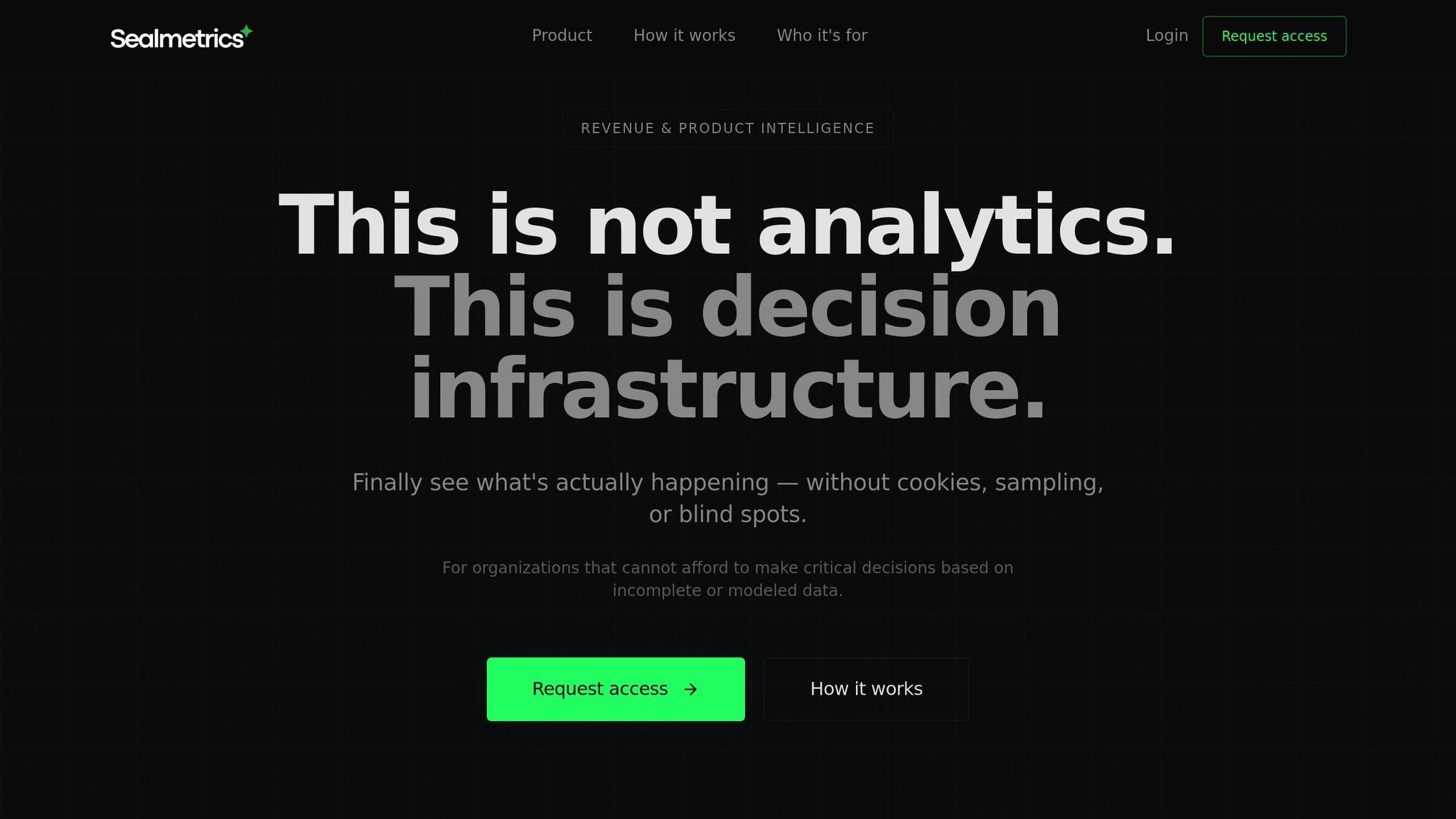
SealMetrics takes a fresh approach to cookieless tracking, presenting itself as "decision infrastructure" rather than a typical analytics tool. By using privacy-preserving algorithms, it analyzes events and aggregates statistical patterns without linking hits or profiling users. This means it can capture all interactions without relying on methods like sampling or browser identifiers.
The platform offers two tracking modes tailored to different needs. GlobalTracker uses a temporary, session-specific ID that expires as soon as the session ends, making it a great fit for e-commerce and marketing teams. On the other hand, SuperPrivacy Mode treats every interaction as a standalone event, which is ideal for industries like healthcare, government, or finance that demand high compliance standards. Both modes operate using just four anonymous variables: the timestamp, user agent (captured but not stored), the current URL, and the referral URL.
"This is not analytics. This is decision infrastructure. Sealmetrics doesn’t just show data. It actively helps teams decide what to do next." – SealMetrics
This design positions SealMetrics as a strong contender in the privacy-focused tracking space.
Privacy Compliance (GDPR/CCPA)
SealMetrics takes privacy seriously by operating without cookies, which means it avoids accessing "terminal equipment" as defined by the ePrivacy Directive. Since it doesn’t collect personal data or track individual users, the platform complies with GDPR, CCPA, PECR, and CNIL guidelines – no consent banners required[39,40]. All data is processed and stored within the European Union, specifically in Dublin, Ireland[39,40].
Its "Ping" method functions like a search engine crawler, sending anonymous requests that are processed through privacy-friendly algorithms. This allows it to generate insights without building user profiles. By simplifying consent requirements, SealMetrics reduces user fatigue from constant banner notifications while maintaining accurate data collection[39,40].
"This is privacy-by-design, not privacy-by-policy." – SealMetrics
Features for Cookieless Environments
Unlike traditional analytics tools that often lose data due to consent requirements, SealMetrics captures 100% of traffic hits without needing cookies or user approval[29,39]. The platform uses privacy-safe attribution methods, focusing on last-click attribution and anonymous channel tracking through UTM parameters. This way, it links conversions to marketing channels rather than individuals.
Getting started is simple – teams only need to add a single JavaScript snippet to begin capturing data, eliminating the need for complex setups or consent banners. Many organizations use SealMetrics alongside tools like GA4, not as a replacement for dashboards, but as a reliable, independent source for revenue and product insights.
How Does Cookie-Less Tracking Work In Google Analytics 4
Conclusion
The five AI tools discussed – Google Analytics 4, MetricsFlow, Ruler Analytics, Piwik PRO, and SealMetrics – mark a shift in how businesses handle data tracking. These tools step away from traditional cookie-based methods and lean into privacy-focused frameworks that emphasize first-party data, server-side processing, and machine learning. This approach isn’t just about meeting GDPR or CCPA regulations – it’s about adapting to browser updates and ensuring businesses maintain full control over their data.
Here’s a telling statistic: 67% of U.S. adults actively manage or block cookies. Older tracking methods are struggling, with attribution accuracy dropping by 31% to 47% when relying on outdated techniques. On the other hand, companies using AI-driven attribution tools report a 37% increase in marketing ROI. Even when 40–60% of touchpoint data is missing, AI models still achieve 83–91% accuracy. These numbers highlight why the industry is moving toward smarter, privacy-conscious solutions.
"The future of attribution isn’t about finding ways to track more, it’s about getting smarter about modeling with the data we can ethically collect." – Dr. Sinan Aral, Director of the MIT Initiative on the Digital Economy
That said, adopting these tools comes with hurdles. Setting up server-side tracking and integrating legacy systems requires specialized expertise. Many businesses face issues with fragmented tools – where event trackers, data warehouses, and identity solutions don’t sync properly. Additionally, implementing consent modes can initially cause data losses of up to 50%, though performance typically stabilizes within one to four weeks. These challenges underscore the importance of expert support.
This is where Growth-onomics comes in. They simplify the complexities of technical setup, compliance, and data integration, helping businesses turn tools into actionable insights. Their expertise ensures companies don’t just install these systems but also use first-party data effectively within AI frameworks. With only 9% of companies currently excelling in AI-driven measurement, having the right guidance can be a game-changer.
FAQs
How do AI tools protect user privacy while enabling cookieless tracking?
AI tools are stepping up to protect user privacy in a world without traditional cookies by using techniques that steer clear of collecting personally identifiable information. Instead of relying on browser cookies, these tools use privacy-focused methods like first-party data collection, server-side tracking, and probabilistic matching. These strategies enable businesses to gather insights while staying aligned with regulations such as GDPR and CCPA.
To further ensure compliance, many AI tools employ practices like data anonymization and explicit user consent management. By prioritizing privacy-friendly designs, these tools respect user preferences and maintain transparency, all while providing reliable data for marketing and analytics.
What are the benefits of using AI tools for cookieless data tracking?
AI tools designed for cookieless data tracking offer some game-changing benefits for marketers navigating the growing emphasis on user privacy. They improve measurement accuracy by leveraging advanced algorithms to bridge the gaps left by the decline of third-party cookies. This means marketers can still gain reliable insights, even when access to data is limited.
These tools also enable privacy-compliant data collection by using techniques like machine learning and probabilistic modeling. Not only do these methods respect user privacy, but they also ensure marketers can continue to access the analytics they need without crossing ethical or legal boundaries.
On top of that, AI-powered tools simplify campaign optimization by automating the process of uncovering valuable insights. They help marketers pinpoint what’s working, eliminate inefficiencies, and refine their strategies. The result? Smarter decisions, better ROI, and marketing approaches that keep pace with shifting privacy regulations and consumer expectations.
How do AI tools ensure accurate data tracking without using cookies?
AI tools can track data accurately without relying on cookies by leveraging first-party data, server-side tracking, and identity resolution techniques. These approaches enable them to study user behavior across different platforms while adhering to privacy guidelines.
To stay compliant with regulations like GDPR and CCPA, these tools also incorporate privacy-centered frameworks. By focusing on secure and transparent data collection, they strike a balance between maintaining accuracy and safeguarding user trust.