


AI is reshaping SEO – and fast. Here’s what you need to know:
- Search is evolving: Half of consumers now use AI-powered search, and 50% of Google searches include AI-generated summaries. By 2028, this could hit 75%.
- SEO priorities are shifting: It’s no longer about ranking in the top 10 links. Brands now aim to be cited in AI-generated answers by creating content that’s clear, concise, and easy for AI to extract.
- Key metrics are changing: Traditional metrics like click-through rates are being replaced by "AI Share of Voice" and citation frequency in AI summaries.
- AI-driven competition: Companies using AI tools for faster insights and optimized content are gaining a competitive edge, while others risk losing up to 50% of their search traffic.
In this new landscape, brands must rethink their strategies – focusing on creating content AI can easily process, staying visible in AI-driven platforms, and tracking performance in real-time. If you’re not already preparing for this shift, you’re falling behind.
The ultimate guide to AEO: How to get ChatGPT to recommend your product | Ethan Smith (Graphite)
How AI Changes Search
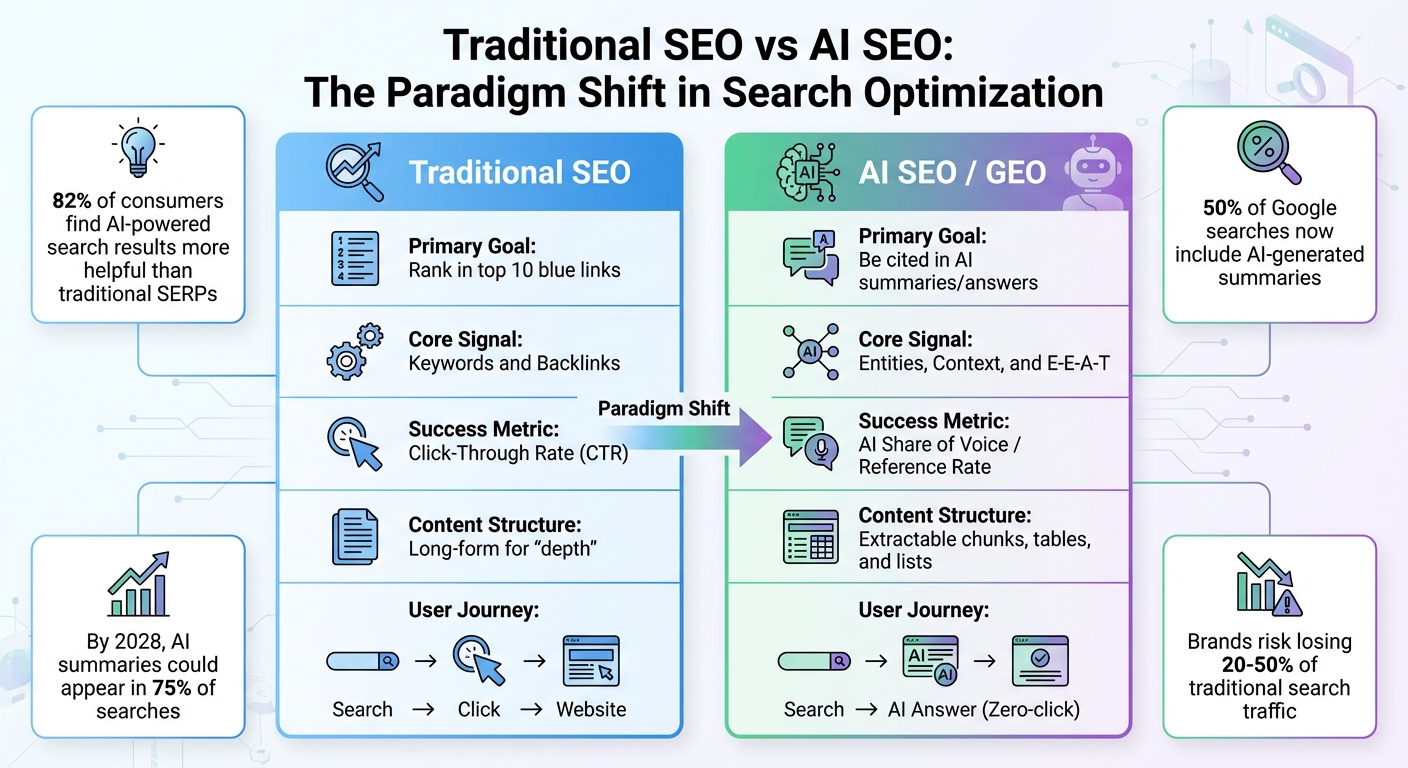
Traditional SEO vs AI SEO: Key Differences in Search Optimization
Google still dominates the global search market, handling over 90% of searches worldwide and processing an astounding 5 trillion searches each year. But the way we search is undergoing a major transformation. Thanks to AI, search engines are evolving to understand entities – specific concepts like people, places, and products – and how these entities are connected.
AI-Enhanced Search Engines
Search engines have come a long way from simply matching keywords to web pages. Today, AI models focus on understanding the context and intent behind your query. For example, when you type something like "best family car", the AI breaks it down into smaller, targeted sub-queries to gather a more comprehensive answer.
This shift has made search results more tailored to individual users. In fact, 82% of consumers find AI-powered search results more helpful than traditional search engine results pages (SERPs). Why? Because AI personalizes the answers based on your search history and inferred intent. For instance, a financial analyst searching "Apple performance" gets results focused on stock trends, while a casual consumer might see product reviews. As Nick LeRoy, Owner of Nick LeRoy Consulting, explains:
"The universal ranking is dead. The assumption that there’s one top answer to optimize for is flawed because personalization destroys the concept of a ‘top’ answer".
This personalization has given rise to what experts call "zero-click dominance." AI summaries and chatbots now provide direct answers on the search page, eliminating the need for users to click through to websites. For brands, this means the goal has shifted – from driving clicks to earning mentions in these AI-generated summaries.
This evolution in how queries are processed has also led to a rethinking of what makes content rank-worthy.
Changes in Ranking Signals and Search Priorities
The factors that influence search rankings are shifting. Traditional metrics like keyword density and backlinks are taking a backseat to how well AI can extract and cite your content. Search engines now prioritize extractability – content that’s structured with clear definitions, bullet points, and data tables that AI can easily process and reference.
Another major focus is E-E-A-T (Experience, Expertise, Authoritativeness, Trustworthiness). AI algorithms actively seek content that’s backed by expert bylines, original research, and citations from credible platforms like Reddit, G2, and news outlets. This ensures AI provides accurate information, which means creating original data or conducting proprietary research can give your content a competitive edge.
Here’s how the landscape has changed:
| Feature | Traditional SEO | AI SEO / GEO |
|---|---|---|
| Primary Goal | Rank in top 10 blue links | Be cited in AI summaries/answers |
| Core Signal | Keywords and Backlinks | Entities, Context, and E-E-A-T |
| Success Metric | Click-Through Rate (CTR) | AI Share of Voice / Reference Rate |
| Content Structure | Long-form for "depth" | Extractable chunks, tables, and lists |
| User Journey | Search → Click → Website | Search → AI Answer (Zero-click) |
These changes are redefining how brands approach content creation to ensure their material is optimized for AI-driven search.
New Competition Dynamics in Organic Search
AI is reshaping the competitive landscape in search, where speed and access to data are more critical than ever. While Google remains the leader, ChatGPT has surged to become the 5th most visited site globally, with nearly 5 billion visits per month. However, AI chatbots currently account for just 2.96% of total search traffic, leaving plenty of room for growth. Two-thirds of consumers believe AI will completely replace traditional search within the next five years.
Forward-thinking brands are already adapting. They’re leveraging AI tools to uncover emerging search trends months before they’re reflected in traditional keyword research – a strategy known as "trend archaeology". Instead of focusing on individual keywords, they’re building interconnected topic clusters to signal authority to AI models. They’re also paying close attention to how AI platforms describe their brand, as these descriptions – whether "affordable" or "premium" – directly shape AI-driven recommendations. By embedding their brand identity into the AI ecosystem, companies are positioning themselves for success.
As Zach Cohen and Seema Amble, Partners at Andreessen Horowitz, put it:
"How you’re encoded into the AI layer is the new competitive advantage".
Brands that fail to adapt risk losing 20-50% of their traditional search traffic. Surprisingly, only 22% of marketers currently track their brand’s visibility within Large Language Models. This gap presents a huge opportunity for those willing to embrace AI-focused strategies and stay ahead of the curve.
AI Across the SEO Lifecycle
AI is reshaping every aspect of SEO, from keyword research to tracking content performance. It’s not just about speeding up processes – it’s about transforming how we approach search optimization altogether. Brands that fully integrate AI into their SEO workflows are the ones gaining a competitive edge. Instead of treating AI as a one-off tool, they’re using it to refine strategies across research, content creation, and technical SEO.
AI-Driven Keyword and Topic Research
Gone are the days of manually sorting through endless keyword lists. AI now uses semantic clustering to group keywords by meaning rather than exact text matches. This shift helps you build topical authority by focusing on concepts rather than individual phrases. It’s no surprise that 60% of marketers now rely on tools like ChatGPT for keyword research.
AI also excels at search intent classification, automatically categorizing keywords into Informational, Navigational, Commercial, and Transactional groups. This ensures your content aligns perfectly with user intent at every stage of their journey. Another game-changer? Automated gap analysis, which compares your keyword profile against competitors to uncover areas where they rank and you don’t, as well as untapped opportunities.
A newer approach, persona-based prompting, allows AI to simulate target audiences. By doing so, it reveals niche pain points and fresh content angles that traditional tools might miss. Jonathan Berthold, VP of Revenue at Moz, describes this as "Relevance Engineering", where AI intersects with content strategy to improve visibility across search platforms.
The SEO landscape is evolving quickly. With generative engines like ChatGPT expected to reduce traditional search volume by 25% by 2026, understanding how AI breaks queries into semantically diverse sub-queries is becoming essential for comprehensive topic coverage.
| Tool | Best For | Key Research Feature |
|---|---|---|
| Moz AI | Intent Analysis | Uses machine learning for dual-layer intent classification |
| Semrush | Gap Analysis | Identifies competitor keywords you’re missing |
| SurferSEO | Clustering | Groups keywords by shared ranking URLs |
| ChatGPT (GPT-4) | Ideation | Generates creative angles and persona-driven insights |
| Rankscale.ai | GEO Tracking | Tracks visibility across platforms like ChatGPT and Perplexity |
AI-Assisted Content Creation and Strategy
Creating content that thrives in AI-driven search requires a shift in strategy. AI tools can help you optimize for passage-level ranking, where individual sections of a page are surfaced in search results. To take advantage of this, place clear and concise answers directly after headers (H2s). This increases your chances of appearing in AI Overviews and featured snippets.
A hybrid approach works best. While AI is great for generating ideas and outlines, only about 20% of marketers use it to draft complete articles. Most rely on AI for brainstorming and research, leaving the actual writing to humans who bring brand voice, fact-checking, and unique insights to the table. This balance ensures content remains authoritative and aligned with your audience.
Take the example of Princess Cruises, which partnered with 97th Floor in 2024 to dominate searches for Alaskan cruises. By creating 70 new pieces of content and optimizing 23 port landing pages with dense internal linking, they achieved a 261% increase in AI Overview mentions and captured 88.4% of impressions in AI-driven search within just three months.
To stand out, focus on E-E-A-T (Experience, Expertise, Authoritativeness, Trustworthiness). This includes adding expert bylines, original data, and statements like "We tested…" to differentiate your content from generic AI-generated material. As Aleyda Solis, International SEO Consultant at Orainti, puts it:
"I like to think of LLMs as partners – they handle the heavy lifting, and I guide the final result".
Technical SEO and User Experience Improvements
AI is revolutionizing technical SEO by making it faster and more precise. Automated auditing tools can now identify issues like redirects, crawl errors, and missing metadata, prioritizing fixes based on their potential ranking impact. Some advanced AI systems even go a step further, autonomously monitoring your site’s health, diagnosing ranking drops, and implementing fixes without human intervention.
Beyond fixing problems, AI enhances user experience. It analyzes content structure and engagement data to suggest improvements in readability and layout. AI tools can also generate dynamic metadata, such as title tags and meta descriptions, that adapt in real-time to user behavior and search trends, boosting click-through rates.
Another critical area is multimodal optimization, where AI suggests alt text, captions, and transcripts to improve accessibility and searchability for images, videos, and audio. Proper schema markup plays a key role here, helping AI models parse and cite your content effectively.
Technical performance is non-negotiable. AI search systems prioritize pages that are fast, mobile-friendly, and secure. Meeting Core Web Vitals, mobile UX, and HTTPS standards is essential. As Brendan Hufford, Founder of Growth Sprints, explains:
"AI search has no universal rankings. The results are hyper-personalized from search to search, making ‘rankings’ fundamentally meaningless".
To measure your influence in this new landscape, tracking metrics like AI Share of Voice and citation frequency within large language models (LLMs) is becoming crucial.
sbb-itb-2ec70df
Changing Competitive Strategy with AI SEO
As AI continues to reshape SEO, competitive strategies must evolve to keep up. The game has shifted from simply putting in more effort to working smarter. This means embracing continuous optimization, speeding up execution, and making decisions based on data. Traditional methods like quarterly audits or manual keyword tracking are no longer sufficient. Instead, brands need to adopt a real-time, agile approach that prioritizes constant fine-tuning over occasional check-ins.
From One-Time Audits to Continuous Optimization
Periodic SEO audits are becoming a thing of the past. Thanks to AI, brands can now implement ongoing optimization loops that monitor site health, evaluate performance, and adjust strategies in real time. This approach revolves around the 3-Pillar Monitoring Framework, which focuses on:
- Intent/Answer Performance: Ensuring content aligns with user search intent.
- Real-Time Technical Health: Constantly checking for technical issues.
- Cross-Platform Citations: Tracking mentions across various platforms.
AI-driven workflows are changing how SEO tasks are handled. Instead of manually guiding AI tools step by step, companies are deploying autonomous AI agents. These agents independently research competitors, identify content gaps, and execute multi-step SEO strategies. The result? Businesses can speed up processes by 30–50% while reducing time spent on low-value tasks by 25–40%. This shift is part of a broader trend, with the global AI agents market expected to grow from $5.40 billion in 2024 to $50.31 billion by 2030.
Take Smart Rent as an example. After identifying technical SEO issues in late 2024, the company implemented an AI-driven framework that continuously monitored and optimized its content. Within just one month, they achieved a 100% increase in visibility on platforms like ChatGPT, Perplexity, and Gemini, along with a 50% boost in AI Overviews mentions.
Competing Through Data and Speed
In the world of AI-driven search, success hinges on two key factors: high-quality data and rapid execution. Brands that can quickly spot opportunities, implement changes, and measure results will have the upper hand.
One standout AI capability is "trend archaeology." This involves analyzing search patterns to uncover emerging topics and vocabulary months before they become competitive keywords. As a result, traditional metrics like click-through rates (CTR) and keyword rankings are taking a backseat to newer measures such as AI Share of Voice and citation frequency. Consider this: when a generative AI summary appears on a search results page, users click on traditional links only about 8% of the time. This means that earning citations in AI-generated answers is becoming more important than ranking in the top 10 results.
| Metric Type | Traditional SEO Focus | AI SEO Continuous Focus |
|---|---|---|
| Primary Goal | Rank in top 10 blue links | Earn citations in AI summaries |
| Measurement | CTR and Organic Sessions | AI Share of Voice and Citations |
| Optimization Unit | Keyword-optimized pages | Intent-focused passages/entities |
| Execution Cycle | Quarterly/Monthly Audits | Real-time autonomous workflows |
LS Building Products offers a great example of this data-driven approach. By optimizing existing content for AI platforms and continuously monitoring performance, the company saw a 540% increase in AI Overviews mentions and doubled its visibility on platforms like ChatGPT, Gemini, and Perplexity.
Winning in AI-Driven Search
To build a competitive edge in AI-driven search, brands need to rethink how they create and structure content. The focus is shifting from keyword-heavy pages to establishing topical authority through well-organized content ecosystems.
Start by adopting an answer-first structure. Place a clear, concise answer (2–3 lines) immediately after headers to improve your chances of being quoted in AI Overviews. As Casey Nifong, founder and contributor to Search Engine Land, explains:
"If your content can’t answer a question clearly in 30 seconds, it’s unlikely to be selected for AI-generated answers".
Next, prioritize extractability. Use simple structures like one-sentence definitions followed by bulleted lists or tables. This makes your content easier for AI to parse and include in summaries. Stick to semantic HTML – like native tables and lists – so AI crawlers can access your data without issues caused by JavaScript or custom code.
Finally, implement the hub-spoke-wheel model to establish authority. Create a central "Entity Home" (the hub) as your main source of information. Link to supporting content (spokes) and ensure your brand’s information is consistent across the web (the wheel). This approach helps educate AI knowledge graphs and boosts your visibility.
With 88% of businesses worried about losing organic visibility due to AI-driven search, the brands that succeed will be those that embrace continuous optimization, act quickly on data insights, and structure their content to meet the needs of AI systems.
Building an AI-Ready SEO Framework
To make the most of AI in SEO, you need a solid foundation that supports intelligent automation. This means preparing your data infrastructure, setting clear governance rules, and creating workflows that balance AI-driven efficiency with human oversight. Without these essentials, even the most advanced AI tools may struggle to deliver impactful results. This framework ties directly into the earlier AI SEO strategies, ensuring a smooth transition from planning to execution.
Data Foundations for AI SEO
AI systems don’t work like traditional search engines. Instead of matching exact keywords, they organize information around entities and concepts. To align with this, brands need to map their core topics to specific questions, comparisons, and user intent signals. This helps AI models recognize authority and relevance. These practices are essential for producing content that is both credible and easy for AI systems to process.
One critical step is strengthening your structured data implementation. Using JSON-LD schema markup – such as Article, Organization, Person, FAQ, and Product schema – acts like a cheat sheet for large language models. This helps them understand your content, verify authorship, and assess your brand’s credibility.
Your historical performance metrics also play a big role. Clean analytics data, including click-through rates, search volume, and user behavior, helps train AI models to predict traffic trends and pinpoint optimization opportunities. But AI doesn’t stop at your website. It pulls signals from the broader web – platforms like G2, Capterra, Reddit, Quora, and even knowledge bases like Wikipedia and Wikidata. Ensuring your brand’s information is accurate across these platforms is crucial for AI systems to use reliable data.
Additionally, structure your content into extractable passages. AI systems often retrieve specific sections rather than entire pages. This means every paragraph should stand alone, making sense without relying on other parts of the page. Avoid phrases like "as mentioned above", which can confuse AI when content is extracted out of context.
A great example of this approach is Princess Cruises, which significantly improved its AI search visibility by adopting a structured, entity-based strategy.
Governance and Risk Management for AI SEO
Automation can be risky without proper oversight. Establishing governance ensures quality and protects your brand’s reputation. This aligns with the continuous optimization approach discussed earlier.
The cornerstone of governance is human-in-the-loop validation. Every piece of AI-generated content should be reviewed by a subject-matter expert to meet Google’s E-E-A-T standards (Experience, Expertise, Authoritativeness, and Trustworthiness). As Aleyda Solis, International SEO Consultant at Orainti, points out:
"Without proper validation, generative AI outputs risk undermining SEO reputation and trust, causing more harm than good".
Create a validation framework to check AI outputs for brand alignment, factual accuracy, and inclusivity before publishing. This includes verifying statistics and claims against primary sources to avoid errors from AI, often referred to as "hallucinations." Use the 5Ws and H framework (Who, What, When, Where, Why, and How) when crafting prompts to reduce generic or biased outputs.
Data security is another critical factor. Never input sensitive or proprietary information into public AI tools unless it’s anonymized. Be transparent about your use of AI in content creation by adopting clear policies to maintain user trust.
Regular sentiment monitoring is also essential. AI systems don’t just list brands – they shape perceptions. For instance, an AI might describe your product as "expensive but comprehensive" or "beginner-friendly but limited", influencing how potential customers see you. Use tools to track how AI characterizes your brand across platforms, whether positively, neutrally, or negatively.
Your website should act as an Entity Home – a central source of truth for AI systems to validate information. As Dave Davies, Head of SEO at Weights & Biases, explains:
"Google needs an anchor to determine whether a piece of content is trustworthy and valuable. The entity that is you is that anchor".
With governance in place, the next step is to apply these principles through a structured implementation plan.
Implementing AI SEO with Growth-onomics
Rolling out AI SEO capabilities requires a phased approach that aligns with your business goals and current capabilities. Growth-onomics offers a roadmap through three key phases.
Phase 1: Foundation and Assessment. Begin by evaluating your current SEO program and assessing how AI Overviews are influencing your high-value URLs. Track your brand’s presence in tools like ChatGPT, Perplexity, and Google AI Overviews. This initial analysis provides a baseline for measuring progress.
Phase 2: Strategic Roadmap Development. Transition from a keyword-focused strategy to AI Search Topics that prioritize entities, user questions, and intent. Build prompt libraries using frameworks like the 5Ws and H to ensure consistent, high-quality AI outputs for metadata and content outlines. Adopt answer-first content structures with concise summaries under headers that AI can easily extract and cite.
Phase 3: Technical Implementation and Scale. Add JSON-LD schema markup (FAQPage, Organization, Product) to provide machine-readable signals that help AI systems interpret your content. Use cross-functional dashboards to track AI Share of Voice and citation frequency alongside traditional metrics. Develop original data to strengthen your authority.
Tally, an online form builder, is a great example of this approach in action. By focusing on authentic engagement on platforms like Reddit and niche forums in 2024, Tally became a frequently cited source in AI search. By January 2026, AI-powered search had become their largest acquisition channel, with ChatGPT as the top referrer for weekly signups. Marie Martens, Co-founder of Tally, shared:
"Inclusion of web browsing is turned on by default, which made forums, Reddit posts, blog mentions, and authentic UGC part of the AI’s source material".
Growth-onomics ensures that AI SEO efforts integrate with broader growth marketing strategies, connecting search optimization with customer journey mapping, performance marketing, and conversion efforts for a unified growth framework.
Conclusion: The Future of Competitive SEO with AI
The landscape of search competition is undergoing a seismic shift. By 2028, AI-powered search is projected to generate $750 billion in U.S. revenue, even as traditional search traffic faces a potential decline of 20–50%. With 82% of consumers already favoring AI-driven results, the rules of the game are changing fast.
In this evolving environment, rankings alone won’t define success. The real battleground is in earning citations – how often AI systems recognize your brand as a reliable source. As Kelsey Libert, Co-founder of Fractl, aptly states:
"Search isn’t a platform, it’s a behavior. Whether people are typing into Google or prompting ChatGPT, consumers are still asking questions that require content, expertise, and trust".
This highlights the importance of optimizing for passage extractability, building entity authority through structured data, and ensuring a strong presence on third-party platforms, which account for 85% of brand mentions. These strategies are essential in adapting to the new competitive dynamics of AI search.
Autonomous AI agents are already reshaping SEO practices, handling tasks like competitor analysis and technical audits with efficiency gains of 30–50%. The market for these agents is expected to grow from $5.40 billion in 2024 to a staggering $50.31 billion by 2030. Despite these advancements, human strategists remain crucial for steering AI tools toward meaningful outcomes, reinforcing the need for a balanced approach that combines technology with human insight.
As brands navigate this shift, they must rethink how they position themselves in AI-driven search. Elizabeth Silliman, Partner at McKinsey, cautions:
"Traditional brand strength is no indicator a brand is ready to compete in the new world of AI-powered search. Visibility is not guaranteed".
To thrive, brands must prioritize creating citation-worthy content, implementing advanced schema markup, and fostering cross-department collaboration – from PR to customer success – to build a cohesive digital presence that AI systems recognize and trust.
The future belongs to those who excel at Relevance Engineering – structuring content to be easily processed by AI while leveraging human expertise to maintain authenticity and trust. With 96% of SEO job postings in 2025 expected to focus on AI, mastering AI-driven strategies is no longer optional – it’s the key to staying ahead.
FAQs
How can brands make sure their content appears in AI-generated search results?
To improve the likelihood of your content appearing in AI-generated search summaries, focus on producing well-researched, authoritative content that aligns with Google’s E-E-A-T guidelines – Experience, Expertise, Authoritativeness, and Trustworthiness. Using structured data markup can also make it easier for search engines to interpret and display your content, boosting its visibility.
Equally important is maintaining strong technical SEO practices. Aim to secure top spots in organic search rankings since AI summaries often pull data from these high-ranking pages. Regular updates and optimizations to your content can help keep it relevant and competitive in search results.
How is AI SEO different from traditional SEO?
Traditional SEO is all about boosting a website’s visibility on search engine results pages (SERPs). This involves optimizing for keywords, building backlinks, and fine-tuning on-page elements. Success is typically measured using metrics like organic rankings, click-through rates (CTR), and traffic volume.
AI SEO, however, takes a different approach. It focuses on making content ready for AI-driven tools like ChatGPT, Google’s AI Overviews, and other conversational platforms. The aim isn’t just to rank links but to create content that’s "answer-ready." This means using entity-rich language, structured data, and prioritizing E-E-A-T (Experience, Expertise, Authoritativeness, Trustworthiness) signals, ensuring AI systems can reference the content effectively.
Here’s how the two approaches differ:
- Keywords vs. Topics: Traditional SEO revolves around specific keywords, while AI SEO leans into broader topics and semantic relevance.
- Backlinks vs. Structured Citations: Backlinks play a key role in traditional SEO, but AI SEO relies more on structured citations that AI tools can easily interpret.
- Performance Metrics: Traditional SEO tracks SERP rankings, while AI SEO focuses on metrics like AI-driven impressions and referrals from conversational platforms.
To stay ahead, businesses need to strike a balance between these strategies – maintaining strong SERP visibility while also preparing content for the growing influence of AI-driven search tools.
How is AI changing the way brands track their search performance?
AI is reshaping how brands evaluate search performance by introducing metrics that extend beyond the usual keyword rankings and click-through rates. Marketers are now paying close attention to AI-driven traffic sources, such as visits stemming from large-language-model (LLM) answers, while also monitoring shifts in branded search volume and direct traffic growth. These insights give brands a better grasp of how AI-generated results are steering users toward their websites.
As AI-generated snippets become more prevalent, traditional clicks have taken a hit – users often find the answers they need directly within AI summaries. To stay ahead, brands are embracing new performance indicators like AI share of voice – a measure of how often their content is referenced in AI-generated answers – and tracking how frequently their material is cited in AI-powered search results. These metrics offer a more accurate view of visibility in this changing search environment, helping brands fine-tune their content and strategies for both traditional search engines and AI-driven answer platforms.