

AI is changing performance marketing and pay-per-click (PPC) advertising by predicting which users are most likely to interact with ads. Here’s what you need to know:
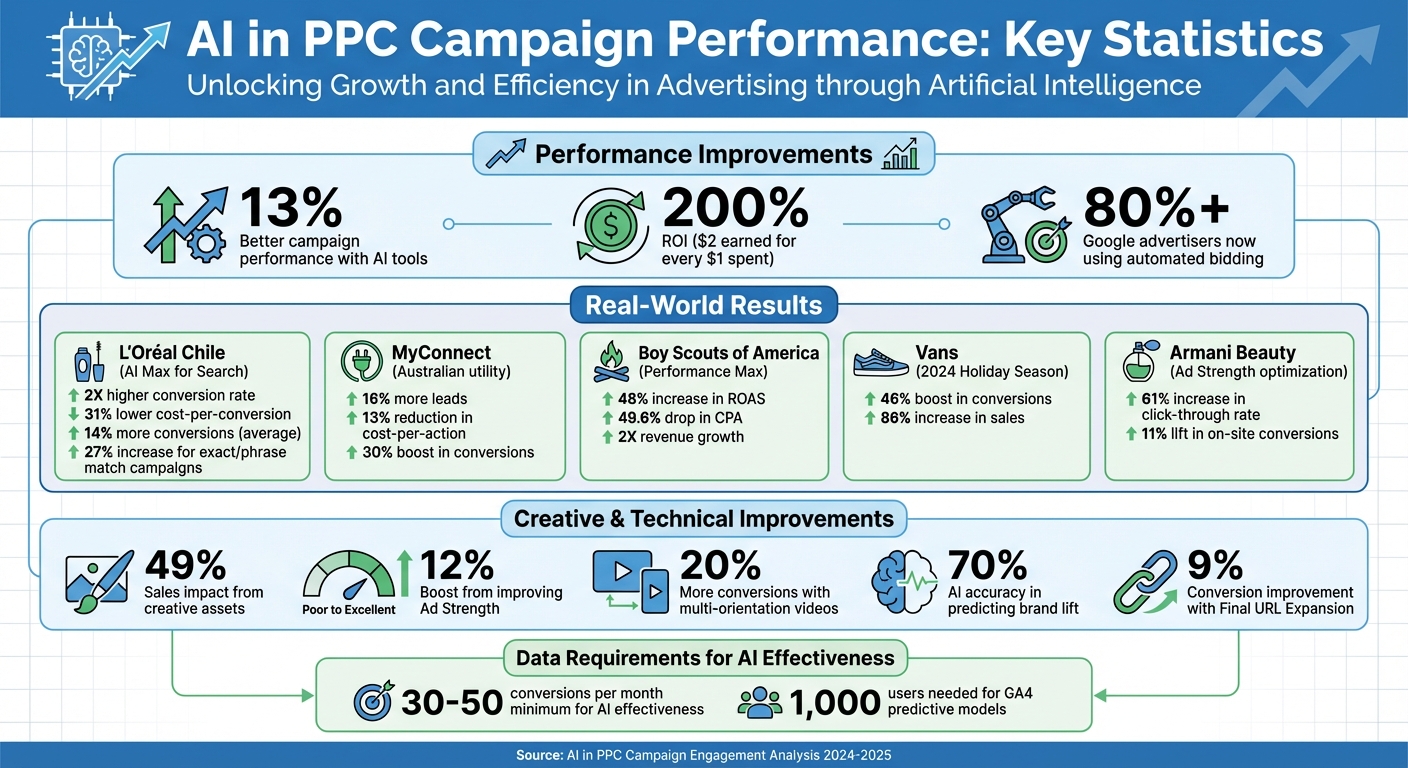
- AI tools improve results: Campaigns using AI see up to 13% better performance and 200% ROI ($2 earned for every $1 spent).
- Real-time adjustments: AI adjusts bids within milliseconds, using data like device type, location, and user behavior.
- New metrics: Tools like Engagement Value Scores (EVS) and Customer Lifetime Value (CLV) go beyond clicks to measure meaningful interactions.
- Better audience targeting: AI uses first-party data to focus ad spend on high-value users, avoiding waste.
- Smarter ad creative: AI combines headlines, images, and calls-to-action dynamically, boosting engagement.
AI has made PPC campaigns faster, smarter, and more efficient. Whether it’s predicting engagement or optimizing bids, it’s clear that AI is shaping the future of digital advertising.
AI in PPC: Key Performance Metrics and ROI Statistics
Can AI Really Boost PPC by 40%? | Ft. Andrea Atzori
sbb-itb-2ec70df
Core Concepts in AI-Driven Engagement Prediction
Building on the earlier discussion, let’s delve into the core metrics and techniques that highlight AI’s evolving role in predicting PPC engagement.
Key Metrics for Engagement Prediction
AI goes beyond simple click tracking to capture more nuanced engagement metrics. Take the Engagement Value Score (EVS), for instance. It evaluates user interactions by factoring in elements like time spent on a site, scroll depth, and multi-touch activities. These insights paint a clearer picture of genuine user intent. Another metric, Predicted CTR (pCTR), relies on machine learning to forecast the likelihood of a user clicking, drawing from patterns in historical behavior. And then there’s Quality Score 2.0, which fine-tunes ad relevance by interpreting user intent alongside contextual details.
AI also predicts Customer Lifetime Value (CLV) by analyzing past purchase behaviors and assessing churn risks. Meanwhile, Intent Alignment measures how closely an ad variant aligns with a user’s likelihood to purchase or address specific queries. These predictive tools shift PPC strategies from reactive analysis to proactive planning, enabling marketers to allocate resources toward high-value opportunities before campaigns even begin.
AI Techniques Used in Engagement Prediction
AI relies on a variety of machine learning techniques to predict engagement. Logistic regression serves as a foundational tool, modeling conversion probabilities and forecasting Return on Ad Spend (ROAS). More advanced methods, like neural networks, take things further. The Deep Interest Evolution Network (DIEN), for example, tracks shifting user interests. Taobao’s use of DIEN in its display ad system achieved a 20.7% boost in CTR. Similarly, Gated Recurrent Units (GRU) analyze sequential user behaviors to predict the next likely action.
Attention mechanisms refine predictions by emphasizing relevant historical interests while filtering out random clicks that don’t reflect genuine intent. This complements dynamic ad adjustments discussed earlier. Additionally, NLP and BERT models extract semantic embeddings to evaluate how well ad copy aligns with user intent. Another approach, the Session Interest Model via Self-Attention (SISA), breaks user behavior into sessions, recognizing that browsing intent often shifts across different timeframes.
Data Signals That Drive Predictions
AI models rely on a diverse range of data signals to make accurate predictions. Behavioral signals – like search history, website visits, app interactions, scroll depth, and time spent on a page – are key drivers of engagement forecasts. First-party data from CRM systems, including email addresses and purchase histories, helps AI identify similar high-value users using tools like Customer Match. For instance, Google Analytics 4 requires at least 1,000 users who completed a relevant event and 1,000 who didn’t within a seven-day period to activate its predictive models.
Contextual signals – such as device type, location, and time of day – allow AI to adjust bids dynamically based on real-time conditions. Semantic signals analyze search themes and embedding vectors to infer intent beyond exact keyword matches. AI even evaluates product images and modular ad assets – like headlines, descriptions, and calls-to-action – to determine which combinations resonate most with specific user groups. On the technical side, factors like landing page speed and trust indicators (e.g., HTTPS, privacy policies) influence Quality Score and ad rankings.
"The better the data you provide, the more likely you are to be successful and bring in profitable revenue for your business."
– Duane Brown, CEO, Take Some Risk Inc.
AI Trends Changing PPC Campaign Engagement
AI is transforming PPC campaigns from rigid strategies into dynamic systems that anticipate and respond to user intent in real time. Three key trends are driving this evolution: automated bidding tailored to each auction, signal-based targeting to identify high-intent users, and creative optimization that adapts ads on the fly. These innovations build on the metrics and techniques already in use, highlighting AI’s growing influence in PPC.
AI-Powered Automation and Smart Bidding
AI-driven bidding strategies are reshaping how advertisers approach auctions. Instead of applying a one-size-fits-all bid, AI evaluates millions of signals – like device type, location, browser, and time of day – to adjust bids for each auction. This auction-time optimization ensures more precise targeting. For example, two users searching the same keyword might trigger different bids based on their likelihood to convert. Over 80% of Google advertisers now rely on automated bidding to achieve better results.
A standout example is AI Max for Search, a beta program launched in May 2025. It uses keywordless technology to capture untapped search queries. L’Oréal Chile implemented AI Max to uncover searches like "what is the best cream for facial dark spots?" The campaign delivered a 2X higher conversion rate and a 31% lower cost-per-conversion.
"AI Max not only allowed us to pioneer the use of AI in Search – it also propelled us into new markets, reaching untapped audiences with lower costs, higher conversions and more relevant ad experiences that significantly boosted engagement." – Nicolás Moya, CMO of L’Oréal Chile
Advertisers using AI Max often see 14% more conversions at comparable CPA or ROAS. For campaigns previously dependent on exact and phrase match keywords, this figure jumps to 27%. MyConnect, an Australian utility provider, experienced 16% more leads, a 13% reduction in cost-per-action, and a 30% boost in conversions from previously overlooked queries.
Signal-Based Audience Targeting
AI is also refining audience targeting by leveraging enhanced data signals. Traditional PPC relied on static audience lists and strict keyword matching, but AI uses audience signals – insights from CRM data, website visits, and in-market behavior – to identify high-intent users without restricting reach.
"Signals are directional, not deterministic. They guide the algorithm to efficiently explore the target market without limiting reach." – Emily Dominguez, PPC Manager at Orange 142
By analyzing user behavior across platforms like Search, YouTube, and Discover, AI can infer intent beyond typed queries. This intent recognition enables systems to predict engagement based on actions rather than words. Advertisers can guide these systems using search themes, which act as modern-day keywords to align campaigns with broader topics. Up to 25 themes can be added to Performance Max campaigns to drive results.
As third-party cookies phase out, first-party data has become essential for maintaining accurate predictions. Feeding AI systems with CRM insights and website behavior has proven effective. Early tests of AI-driven audience prototypes showed a 72% increase in incremental outcomes and a 43% reduction in costs.
AI in Creative Optimization
Creative assets play a huge role in ad performance, accounting for 49% of total sales impact. AI is now revolutionizing how these assets are selected and assembled. By analyzing user context in real time, AI systems dynamically combine headlines, images, and calls-to-action to craft ads that resonate with individual users.
Responsive Search Ads are a prime example of this evolution. These ads automatically mix and match headlines and descriptions based on real-time signals. Advertisers who improve their Ad Strength rating from "Poor" to "Excellent" typically see a 12% boost in clicks and conversions. Armani Beauty demonstrated the power of this approach in 2023 by optimizing its unbranded search campaigns. By enhancing Ad Strength and adding image assets, the brand achieved a 61% increase in click-through rate and an 11% lift in on-site conversions.
AI tools are also generating creative assets directly within ad platforms. Features like automatically created assets (ACA) and generative AI analyze website content and user context to produce tailored headlines, images, and descriptions. For video campaigns, AI can reformat horizontal videos for platforms like YouTube Shorts, with multi-orientation videos delivering 20% more conversions on YouTube compared to horizontal-only formats.
Google’s internal testing revealed that AI models can predict with 70% accuracy whether a creative asset will drive brand lift before it even launches. This predictive capability helps advertisers make smarter creative decisions upfront, shifting from reactive adjustments to proactive planning.
How to Use AI in PPC Engagement Prediction
Using AI in PPC campaigns involves three main steps: planning with predictive insights, optimizing performance in real-time, and evaluating outcomes to catch and correct potential issues. These steps combine AI-driven insights with Growth-onomics‘ dedication to a data-focused PPC strategy.
Campaign Planning and Budget Allocation
AI transforms static budgets into flexible investments. By analyzing historical data, seasonal trends, and competitive insights, predictive models can simulate various budget scenarios before a campaign even begins. This approach helps identify which channels, keywords, and audience segments are likely to perform well – and which could waste resources.
For example, in 2024, the Boy Scouts of America shifted their Scoutshop.org store to Google Performance Max using Target ROAS bidding. By letting AI allocate budgets based on profit margins rather than revenue alone, they saw a 48% increase in ROAS, a 49.6% drop in CPA, and doubled their revenue within a year.
A good starting point is a 60/40 budget split: allocate 60% to high-conversion, intent-based keywords and 40% to geo-targeted or demographic variations. This balance ensures efficiency while giving AI the flexibility to explore new opportunities. Once campaigns go live, AI can adjust spending dynamically based on real-time performance.
Make sure your campaigns generate at least 30–50 conversions per month to provide enough data for AI to work effectively.
After setting budgets and planning, the next step is leveraging AI to optimize campaigns in real time.
Real-Time Campaign Optimization
When campaigns are live, AI continuously monitors hundreds of signals – like device type, location, time of day, browser, and user search history – to adjust bids for individual auctions. This auction-time optimization allows for tailored bids, even when two users search the same keyword, based on their likelihood to engage.
During the 2024 holiday season, Vans used Performance Max to deliver customized messages to different audience segments, from skateboarders to parents. This AI-driven approach boosted conversions by 46% and increased sales by 86% compared to previous strategies.
AI also personalizes ad creatives by combining elements like headlines, images, and calls-to-action based on a user’s intent in real time. For instance, Google’s Final URL Expansion feature identifies high-performing search queries and updates landing pages automatically, often leading to a 9% improvement in conversions or conversion value.
To make the most of real-time adjustments, use seasonality adjustments for short-term events, like flash sales, where conversion rates are expected to spike by over 30%. This ensures Smart Bidding adapts quickly without waiting for the usual 7- to 14-day learning period. If a campaign remains in "Learning" status for more than two weeks, consider increasing the budget, loosening targets, or switching to a less aggressive bid strategy.
HyperVerge, a B2B tech company, partnered with RevvGrowth to dynamically shift budget across high-performing ad sets. With a fixed $4,000 Google Ads budget over three months, they increased MQLs by 327% – from 11 to 47 – without spending more.
While real-time adjustments are powerful, ongoing evaluation is critical to ensure campaigns stay on track.
Evaluating AI Predictions and Avoiding Common Mistakes
AI isn’t perfect. A frequent misstep is relying too heavily on black-box models without understanding the data behind them. To measure AI’s impact accurately, document 30 days of CPA, ROAS, and CTR data.
"Without accurate data, even the smartest AI makes terrible decisions. I’ve seen Performance Max campaigns with ‘2% conversion rates’ that were actually converting at 5% – they just weren’t tracking phone calls and form submissions." – MonsterInsights
Accurate conversion tracking is essential. Missing data – like phone calls, form submissions, or in-app events – can lead AI to optimize for the wrong goals. Make sure sitewide tagging and enhanced conversion tracking are set up correctly.
Another common issue is letting AI prioritize volume over efficiency. To avoid this, segment campaigns by factors like product margin, geography, or intent level to give the algorithm clear objectives. For example, separating high-margin from low-margin products ensures AI focuses on conversions that drive profitability.
Different AI tools offer varying levels of control and cost. Google Smart Bidding is free and easy to use but provides limited transparency. Third-party tools like Optmyzr, which cost between $209 and $629 per month, offer more control and cross-platform integration. Custom-built AI models provide the most control but require technical expertise and higher upfront costs.
Finally, human oversight is indispensable. AI should complement your team, not replace it. As Rambod Yadegar, Co-founder and President of HawkSEM, explains:
"Like all marketing and PPC tools, we feel that even the latest AI tools should be an assist to the human team as opposed to leading the way".
Keep an eye on traffic quality metrics like bounce rates or declining engagement, and step in if the system veers off course. Combining AI’s precision with human judgment is key to driving PPC success.
At Growth-onomics, we pair cutting-edge AI insights with strategic human oversight to ensure our PPC campaigns deliver both engagement and profitability.
The Future of AI in PPC Engagement Prediction
Trends Driving the Future of Engagement Prediction
The next wave of AI in PPC advertising is all about autonomous agents – digital assistants that don’t just wait for commands but independently plan, execute, and refine multi-step strategies across platforms. This evolution has captured significant attention, with $1.1 billion in equity investment in 2024 and a 985% increase in job postings for autonomous AI roles between 2023 and 2024.
These agents won’t operate in isolation. Thanks to the Agent2Agent (A2A) Protocol, different AI systems – like Google’s ADK, CrewAI, and AutoGen – will be able to communicate and collaborate. This setup allows them to tackle complex marketing challenges together. For example, autonomous AI can manage sub-agents that specialize in tasks like keyword research, creative testing, and bid adjustments, all in real time.
Another exciting advancement is predictive creative scoring, where AI evaluates over 50 features in ad creatives – spanning text, audio, and visuals – to estimate brand lift before a campaign even starts. Early testing has shown promising results, with models achieving 70% accuracy and delivering 72% better outcomes while cutting costs by 43%.
As third-party cookies phase out, first-party data is becoming the cornerstone of engagement prediction. Marketers who leverage consented customer data for AI-based strategies have reported a 30% boost in performance compared to those who don’t. Looking ahead, technologies like quantum computing could revolutionize behavior modeling, while satellite data might enable hyper-local targeting through real-time geographic signals.
These trends are shaping a future where AI-driven PPC campaigns are smarter, faster, and more effective than ever.
Preparing for AI-Driven PPC Success
To stay ahead in this AI-driven landscape, it’s crucial to prepare your campaigns now. Start by documenting your decision-making processes – such as budget changes or keyword adjustments – so future AI agents can learn from your strategies. Pair this with creating clean, detailed performance databases to provide AI systems with the high-quality data they need for accurate predictions.
Consider following an 8-week roadmap to ease into this transition. In weeks 1-2, focus on implementing GA4 and switching to Target CPA bidding. During weeks 3-4, allocate 20% of your budget to Performance Max campaigns. From month 2 onward, integrate AI-powered tools for landing page testing and predictive budget planning.
Strong conversion tracking should also be a top priority. Complete and accurate data is essential for training AI systems effectively. As Benjamin Wenner, a Growth Hacker, puts it:
"By 2030, the best performance marketers will not just run campaigns. They will train agents to run campaigns, collaborate with other agents, and generate income through expertise sharing."
At Growth-onomics, we specialize in helping businesses transition from current automation systems to the autonomous agent-driven future. By combining AI efficiency with strategic human oversight, we ensure your PPC campaigns are equipped to thrive in this new era, delivering both engagement and profitability.
FAQs
How does AI help boost ROI in PPC campaigns?
AI brings a powerful edge to pay-per-click (PPC) campaigns by leveraging machine learning to analyze vast amounts of data and fine-tune performance. It can predict which clicks are most likely to lead to conversions, adjust bids dynamically, and even pause poorly performing keywords to cut down on wasted ad spend. On top of that, AI can craft ad variations designed to resonate with specific audiences, boosting both engagement and conversion rates.
By automating these tasks, businesses can see a stronger return on ad spend (ROAS) while dedicating more time to big-picture strategies. Growth-onomics taps into these AI-driven capabilities to deliver campaigns rooted in data and focused on measurable results, helping businesses thrive in today’s highly competitive market.
What are Engagement Value Scores, and how are they different from traditional PPC metrics?
Engagement Value Scores are predictive metrics powered by AI that estimate how a pay-per-click (PPC) ad might perform even before it’s launched. By examining historical data, audience behavior, creative elements, and contextual factors, these scores forecast outcomes like click-through rates, conversions, or the amount of time users spend on a site.
What sets Engagement Value Scores apart from traditional metrics like click-through rate (CTR) or cost-per-acquisition (CPA) is timing. While CTR and CPA are calculated after an ad has already run, Engagement Value Scores take a proactive approach. They allow marketers to predict which campaigns, creative assets, or audience segments are likely to deliver the best results. This forward-thinking method helps refine strategies and allocate budgets more effectively – before any money is spent – shifting the focus from analyzing past performance to planning for future success.
How does AI enhance ad creative to improve engagement rates?
AI takes ad creation to the next level by analyzing past engagement data through machine learning models. This allows it to automatically create and test multiple versions of ad copy, images, and layouts. Each variation is scored based on performance metrics, helping identify the top-performing assets. These winning combinations are then delivered in real time to boost click-through rates and audience engagement.
What’s more, AI doesn’t just stop there – it keeps learning and refining. This means your ads stay relevant and captivating, delivering stronger results while saving you both time and effort.