


When it comes to revenue, AI performance marketing agencies outshine their traditional counterparts. AI agencies leverage automation, real-time optimization, and advanced analytics to deliver faster campaign launches, higher ROI, and precise revenue tracking. In contrast, traditional agencies excel in long-term brand-building and emotional storytelling but often struggle with slower processes and indirect metrics.
Key takeaways:
- AI agencies: Deliver campaigns 75% faster, cut costs by 15%-20%, and improve ROI by 30%-50%.
- Traditional agencies: Strong in brand-building but face inefficiencies in speed and revenue attribution.
- Businesses focused on rapid growth and measurable results benefit more from AI-driven models, while those prioritizing brand equity may find value in traditional methods.
Quick Comparison:
| Feature | AI Performance Agency | Traditional Agency |
|---|---|---|
| Campaign Speed | 75% faster | Weeks to months |
| ROI Improvement | 30%-50% | Indirect, harder to measure |
| Cost Efficiency | 15%-20% savings | Higher manual costs |
| Revenue Tracking | Precise, real-time | Indirect, delayed |
| Best For | Rapid growth, data-driven results | Long-term brand equity |
For most revenue-focused businesses, AI agencies are the clear choice. However, a hybrid approach combining AI’s speed and precision with traditional agencies’ storytelling can offer the best of both worlds.
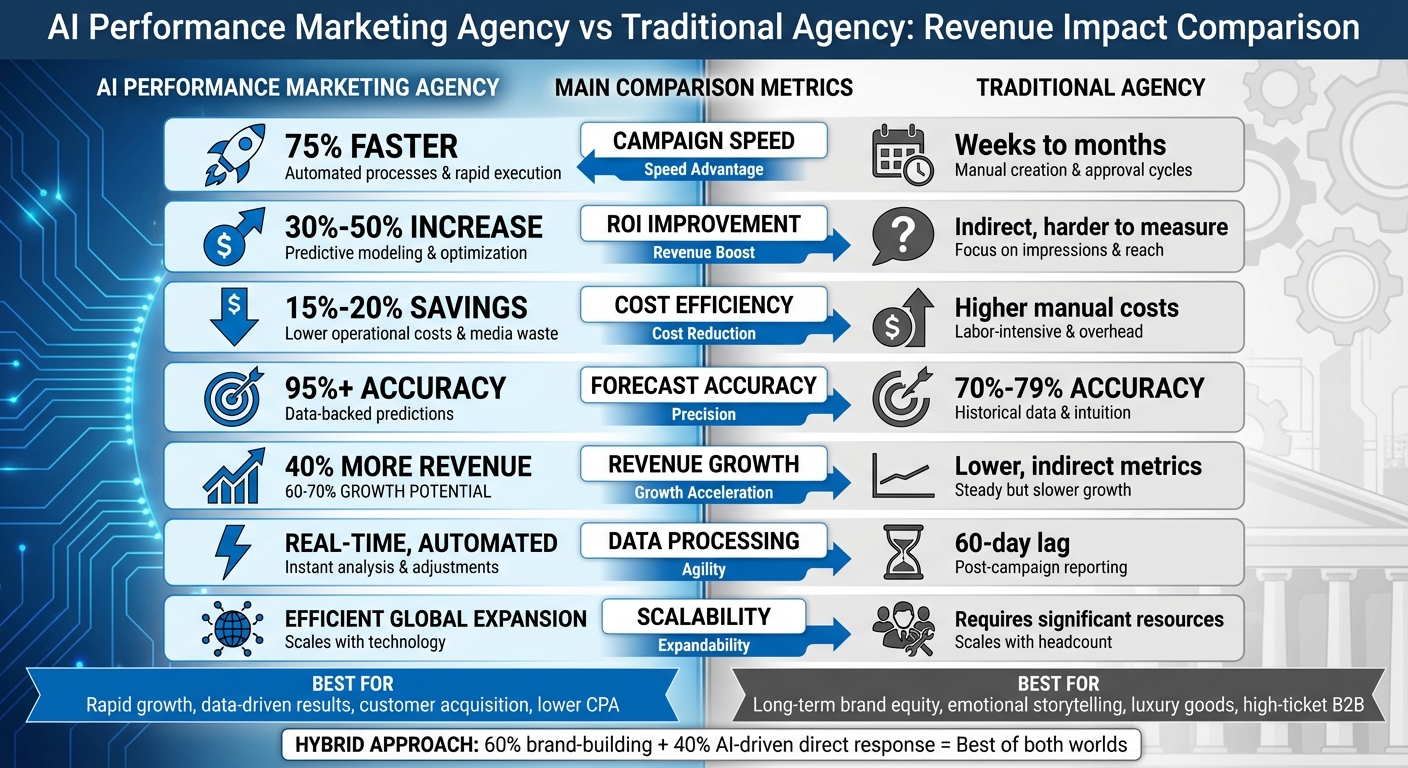
AI vs Traditional Marketing Agency Performance Comparison
How AI Performance Marketing Agencies Generate Revenue
AI Automation and Real-Time Optimization
AI-powered marketing agencies make money by automating tasks that traditional agencies typically handle manually. For instance, instead of waiting days to adjust ad bids, AI systems can tweak them in real-time – sometimes within minutes. This allows campaigns to adapt instantly to market changes rather than reacting after the fact. These systems continuously adjust bids, targeting, and creative elements while testing multiple variations simultaneously.
The financial results speak for themselves. Early adopters have seen their ROI triple while cutting marketing costs by 15%–20%. A standout example: In 2024, Omnicom Media Group used its "Omni Bid Agent" to optimize offline sales for a major client. By integrating proprietary data and sales information into its AI bidding strategies, the agency delivered a 107% jump in display ROAS, a 567% increase in video ROAS, and a 153% boost in YouTube ROAS.
Another key revenue driver is dynamic budget allocation. AI doesn’t just optimize campaigns within one channel; it reallocates budgets across platforms in real-time based on performance. For example, if Facebook ads are converting better than Google Ads at a specific time, the system automatically shifts resources to maximize returns. Traditional agencies simply can’t match the speed or scale of these cross-channel adjustments. This flexibility lays the groundwork for even more tailored strategies, which further enhance revenue.
Personalization and Improved Customer Journeys
AI agencies leverage data to craft highly personalized experiences that directly improve conversion rates and customer lifetime value. By analyzing transaction history, browsing patterns, and real-time cues – including immediate purchase signals – AI can predict what customers want before they even start searching. It delivers the right message at the perfect moment.
This level of personalization has a big impact on revenue. Businesses using AI to optimize customer journeys report an average 25% boost in revenue, a 30% rise in customer satisfaction, and a 25% increase in customer retention. For instance, between 2021 and 2024, Bombay Shaving Company used AI to refine their targeting and budget strategies, resulting in a 41% revenue increase and a 47% improvement in overall performance. Similarly, Hotstar applied AI-driven recommendations for creative and targeting optimization, achieving a 90% surge in daily subscriptions.
AI also minimizes wasted spending. A European insurance company revamped its sales approach by using AI to personalize campaigns across hundreds of microsegments. The AI even adapted sales scripts based on buyer behavior, leading to conversion rates 2 to 3 times higher and a 25% cut in customer service call times. This precision ensures marketing budgets are focused on high-value prospects rather than broad, less-effective audiences.
Key Metrics and Data Sources in AI Agencies
To maximize revenue, AI agencies rely on metrics that directly tie to business outcomes, avoiding vanity stats. Key performance indicators include ROAS (Return on Ad Spend), CAC (Customer Acquisition Cost), LTV:CAC Ratio (Lifetime Value to Customer Acquisition Cost), and MER (Marketing Efficiency Ratio), which measures total revenue against total ad spend. Real-time dashboards allow agencies to respond to performance shifts 60% faster, enabling quick adjustments to budgets and creative.
The data fueling these metrics comes from a variety of sources. AI agencies consolidate information from advertising platforms, CRM systems, marketing automation tools, and web analytics into centralized data warehouses. They also incorporate unstructured data – like social media sentiment, customer support transcripts, and sales call recordings – to create a comprehensive view of the customer. This unified data approach supports predictive modeling, which forecasts trends like seasonal demand or market shifts. As a result, agencies can adjust media strategies and budgets proactively.
AI agencies are far ahead in measurement practices. They are 57% more advanced in campaign tracking than traditional advertisers and conduct 3x more test iterations per month than manual methods allow. By using algorithmic, multi-touch attribution instead of outdated last-click models, these agencies achieve 35% more accurate ROI tracking. Such precision ensures every dollar is accounted for, and underperforming campaigns are quickly eliminated.
Traditional Agencies: Strengths and Revenue Limits
The Traditional Agency Model: Pros and Cons
Traditional agencies are known for their strengths in creative development and brand storytelling. They excel at crafting high-quality campaigns that forge emotional connections – a space where human creativity continues to shine. These agencies also thrive in "upstream" strategic work, like complex business planning, partnership negotiations, and overarching marketing strategies that require nuanced human judgment. When it comes to large-scale media buys, traditional agencies hold strong negotiation power, often securing better pricing for national TV spots and other mass media placements.
But the traditional model has its challenges. Many of these agencies rely on manual processes that slow down campaign adjustments, sometimes taking weeks or even months to implement changes. For instance, roughly 66% of companies still use spreadsheets for forecasting – a method riddled with inefficiencies and prone to human error. Sales reps lose about 20% of their time to manual data entry tasks, and up to 79% of deal data is missing from CRMs. These inefficiencies highlight the operational limitations that impact their overall revenue performance, especially when compared to AI-driven approaches.
Revenue Impact of Traditional Methods
One of the biggest hurdles for traditional agencies is the measurement gap, which makes it harder to track revenue directly. TV, print, and radio ads often rely on indirect metrics like surveys and ratings, making it difficult to tie campaigns directly to sales outcomes. Despite accounting for about 56% of total ad spend, traditional media struggles to demonstrate clear ROI.
The numbers paint a concerning picture. Around 60% of traditional trade promotions fail to break even. Forecasting errors often range between 10% and 30%, and nearly 30% of trade promotion spending ends up wasted on targeting the wrong customers. Traditional lead generation methods also fall short, with conversion rates 50% lower than those achieved through AI-powered strategies. Much of this inefficiency stems from broad targeting approaches that fail to drive incremental revenue, as they often reach consumers who would have made purchases regardless. These challenges underscore why traditional agencies may struggle to deliver consistent revenue growth outside specific scenarios.
When Traditional Agencies Work Best
While traditional agencies may lag in speed and efficiency, they shine in areas where long-term brand building takes precedence over immediate conversions. For example, companies that prioritize brand strength and creative quality have seen an annualized total shareholder return of 23.3% over five years – outperforming the S&P 500 by 8.8 percentage points. Marketers who excel across the entire "marketing value creation flywheel" (execution, brand building, and profit generation) deliver 79% higher total shareholder value compared to their peers.
"External agencies are well positioned to address… Creative development and production for building brand equity." – Bain & Company
Traditional methods are particularly effective for mass-market consumer goods aimed at broad, diverse audiences, where precise digital targeting is less critical. They also excel in fostering trust and emotional connections – areas where human creativity remains unmatched. However, while traditional agencies bring deep strategic insight and expertise to the table – factors that contribute to 70% of successful marketing measurement – their slower processes and lack of precise revenue tracking can be a drawback when compared to the speed and efficiency of AI-driven models. These trade-offs make traditional agencies a better fit for specific, brand-focused scenarios rather than fast-paced, data-driven campaigns.
Gen AI’s Impact on ROI for Businesses and Agencies With Udayan Bose
AI vs Traditional: Revenue Comparison
When it comes to driving revenue growth, the operational differences between AI-driven and traditional agencies are hard to ignore.
Cost Efficiency and Profit Margins
AI-driven agencies achieve significant cost savings, cutting expenses by 15%–20% through automation of tasks like content creation and audience targeting. In contrast, traditional agencies often waste about 30% of their trade promotion budgets on ineffective targeting.
AI’s ability to personalize at scale reduces the cost to serve by as much as 30% while delivering a 22% higher return on investment (ROI). In some cases, campaigns have seen ROI improvements of 30%–50%. For instance, AI-powered email campaigns boast an average ROI of 42:1, far surpassing the 29:1 median ROI for traditional direct mail efforts. Additionally, AI solutions can scale globally without the need for proportional increases in staffing and resources – a challenge that traditional agencies face when expanding operations. These efficiencies not only lower costs but also enable faster execution and scalable growth.
Speed and Scalability
AI-driven campaigns are known for their speed, launching up to 75% faster than traditional methods. Some even achieve execution speeds 15 times faster thanks to advanced AI systems. Traditional agencies, on the other hand, often require weeks or even months to plan and roll out campaigns.
Real-world examples highlight this stark difference. In 2025, a global retailer used AI to overhaul its content supply chain, slashing campaign cycle times from 25 weeks to less than 8 weeks. Similarly, a U.S. homebuilder trained AI on over 500,000 sales transcripts to mimic top-performing sellers. The result? Conversion-to-appointment rates tripled, and weekly appointments doubled. While traditional agencies need more personnel and larger budgets to handle increased workloads, AI-driven approaches manage growth without a proportional rise in costs.
Attribution and Predictability
AI agencies excel in forecasting accuracy, achieving rates above 95%, compared to the 70%–79% range for traditional methods. This accuracy is made possible by real-time data collection across customer touchpoints. For example, in 2025, Salesforce improved its forecast accuracy by 30% using AI-driven tools, and Danone saw a 20% reduction in forecast errors while cutting lost sales by 30% through machine learning. Traditional agencies, however, face a significant disadvantage with a 60-day lag between data collection and actionable insights. This inefficiency is why 66% of companies relying on spreadsheets for forecasting struggle with errors and delays.
Comparison Table
Here’s a side-by-side look at how AI-driven agencies stack up against traditional ones:
| Feature | AI Performance Agency | Traditional Agency |
|---|---|---|
| Campaign Launch Speed | 75% faster; up to 15× faster | Weeks to months for production |
| Forecast Accuracy | Over 95% | 70%–79% |
| Cost Reduction | 15%–20% savings via automation | High manual labor costs |
| ROI Improvement | 30%–50% campaign ROI boost | Metrics are indirect and harder to track |
| Data Processing | Real-time, automated capture | 60-day lag for actionable insights |
| Scalability | Efficient global expansion | Requires significant additional resources |
Conclusion: Which Agency Model Wins on Revenue?
Key Takeaways from the Comparison
When it comes to driving revenue growth, AI-driven performance marketing agencies clearly stand out. These agencies leverage AI-powered tools to deliver 40% more revenue, achieve a 22% higher ROI, and secure 47% better click-through rates compared to traditional methods. AI strategies also enable businesses to grow revenue by an impressive 60%–70%, leaving traditional approaches far behind.
The key to this success lies in three main strengths: real-time optimization, hyper-personalization at scale, and predictive analytics. AI agencies can launch campaigns 75% faster and execute tasks up to 15 times quicker than traditional agencies, while cutting costs by 15%–20% through automation. For instance, in 2025, a European insurer revamped its commercial model using AI agents over a 16-week period, achieving conversion rates two to three times higher and automating 95% of sales call reviews – an enormous leap from the previous 3%.
That said, traditional agencies still shine in areas like building long-term brand equity and fostering emotional connections, which are especially critical for high-ticket items. Many successful businesses are now opting for a hybrid model, combining AI’s speed and data-driven precision with traditional agencies’ storytelling and strategic expertise. These metrics highlight the importance of selecting the right agency model to align with your specific business goals.
Choosing Based on Your Business Needs
The best agency model for your business depends on your priorities and objectives. If your focus is on rapid customer acquisition, lowering cost per acquisition (CPA), or scaling campaigns quickly, an AI-driven performance agency is the better choice. AI performance agencies have proven to deliver a 160.33% increase in conversions and a 162.45% rise in conversion value, all while cutting cost per sale by 24.54%.
On the other hand, if your business revolves around high-value products or services – such as luxury goods or B2B solutions where brand perception is paramount – traditional agencies excel at creating high-production assets and building strategic brand value. A balanced approach might involve splitting your budget, with 60% dedicated to brand-building through traditional methods and 40% allocated to direct response efforts powered by AI. This balance ensures immediate revenue growth while safeguarding long-term brand health.
In practice, many revenue-focused businesses start by using AI for execution and optimization, while relying on traditional agencies for strategy and creative direction. As Dave Tan, Managing Director of Performance Agency Development at Google, explains:
"Agencies can help marketing teams gain a real competitive advantage by combining AI with human expertise".
FAQs
How do AI-driven performance marketing agencies deliver better ROI compared to traditional agencies?
AI-powered performance marketing agencies excel at delivering higher ROI by using cutting-edge data analysis and automation to fine-tune campaigns on the fly. These tools can swiftly generate and test thousands of ad variations, pinpointing the most effective ones before significant ad dollars are spent. The result? Businesses often see 10%–25% higher returns on ad spend compared to traditional, manually managed campaigns.
What sets AI apart is its ability to handle dynamic budget adjustments, perform real-time audience segmentation, and provide predictive personalization. These capabilities can lead to as much as 60% higher revenue growth. Plus, automation cuts down on operational costs by simplifying workflows and reducing the need for manual intervention, making marketing strategies more efficient and scalable. Over time, AI systems only get smarter, ensuring every advertising dollar works harder and delivers better results.
What are the cost differences between using an AI-driven marketing agency and a traditional one?
AI-driven marketing agencies excel at delivering cost efficiency and improved performance by using real-time data to fine-tune campaigns. For example, they can swiftly shift budgets away from ads that aren’t performing well, minimizing wasted spend while boosting metrics like CPA (cost per acquisition) and ROAS (return on ad spend). Additionally, AI-powered tools handle tasks like bid adjustments with incredible precision, analyzing vast datasets to help reduce CPC (cost per click) and keep overall acquisition costs under control.
That said, these agencies often operate under a different pricing structure compared to traditional ones. Instead of a flat monthly retainer, they may charge a technology-based fee, such as a subscription for AI tools, or take a performance-based percentage of your ad spend. While the upfront costs might appear higher, the long-term benefits – like the ability to scale campaigns efficiently without increasing staff – often translate into lower total expenses and stronger returns. In the end, the decision comes down to whether your business prioritizes predictable costs or measurable performance gains.
Can combining AI-driven tools with traditional marketing strategies boost revenue?
A hybrid approach that blends AI-powered tools with the strategic insight of traditional marketing can create a winning formula for better revenue outcomes. AI shines when it comes to crunching data in real time, fine-tuning campaigns by shifting budgets to the best-performing channels, and cutting down on wasted spending. On the other hand, traditional marketing techniques like creative storytelling and in-depth audience research bring in the human element, ensuring campaigns connect on a more emotional level.
This combination of AI’s data-driven efficiency and human-led strategies for crafting messages and building long-term brand value allows businesses to scale automation while maintaining a thoughtful, strategic edge. Together, this approach delivers both immediate performance gains and lasting brand growth, making it an effective way to drive success.
