

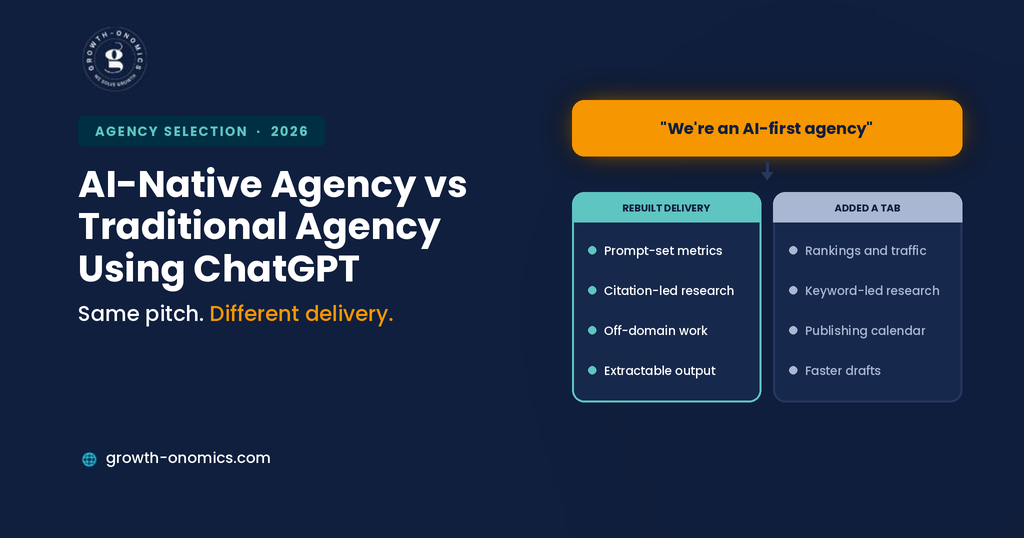
Every agency website says the same thing now.
AI-powered. AI-first. Built for the age of AI search.
Behind roughly half of those claims is a genuine change in how work gets done. Behind the other half is a content writer with a ChatGPT tab open, producing the same deliverables slightly faster, billed at the same rate.
While both look identical during a pitch, both use the same terminology. The difference becomes apparent in month three, when one ships work you could not have produced internally and the other sends you documents that read like a competent summary of what already ranks.
There’s a fair version of this comparison, and it is not that one type is good and the other bad. Plenty of traditional agencies do excellent work with AI as an accelerant, and plenty of self-described AI-native shops are wrappers with a pricing page.
The useful question is narrower: what is this agency actually doing differently, and can they show me?
This article covers what genuinely distinguishes the two, the questions that separate them in a single call, and the tells that appear in the work itself.
What “AI-Native” Should Mean
The term is doing almost no work as currently used, so it is worth proposing a definition strict enough to be falsifiable.
An AI-native agency has rebuilt its delivery around what AI changed. Not its marketing, its delivery. The measurement layer, the research process, the production workflow, and the reporting all assume AI systems are both a channel and a tool.
A traditional agency using AI has kept its delivery and accelerated parts of it. Briefs get drafted faster, research gets summarized, first drafts arrive sooner. The workflow, the deliverables, and the metrics are what they were 3 years ago.
The second isn’t a failure. Faster production is valuable, and many clients need exactly that. The problem arises when it gets sold as the first, for the same price, to buyers who assumed they were getting something structurally different.
The distinction is testable, which is the point of defining it this way. An agency that has rebuilt delivery can describe what changed and show you the artifacts. An agency that has added a tool will describe capabilities rather than changes.
Quick Comparison
| Dimension | AI-Native | Traditional Using AI |
| Measurement | Prompt sets, citation tracking, per-platform | Rankings, traffic, conversions |
| Research input | Live retrieval, citation source analysis | Keyword tools and desk research |
| Content target | Extractable passages and third-party sources | Ranking pages |
| Reporting | Visibility and citations beside organic | Organic performance, AI as an add-on slide |
| Where AI sits | In the workflow | In the drafting step |
| What they can show | Prompt sets, source analyses, workflow docs | Faster turnaround |
| Honest pitch | “We rebuilt how we measure and produce” | “We produce more, faster” |
The Four Real Differences
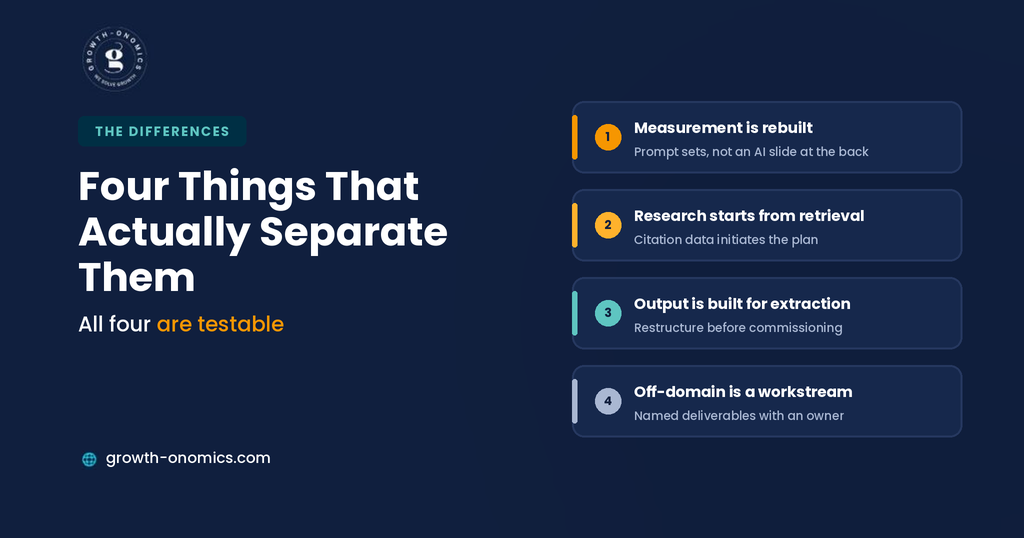
4 things separate genuine reconstruction from acceleration, and all four are visible if you ask.
1. Measurement is rebuilt, not extended
AI-native: Visibility is tracked per platform against a frozen prompt set, with mentions and citations reported separately, plus citation source analysis showing which domains answer the category’s questions. This exists because the agency believes the outcome has changed, not because a client asked for an AI slide.
Traditional use of AI: Rankings, traffic, and conversions, with an AI visibility number added to the monthly deck. The numbers are genuine. It is also disconnected from anything else the report says.
The tell is whether AI metrics appear alongside organic performance in one interpretation, or in a separate section nobody references again. Ask for a sample report and look at the structure before reading a word of it.
2. Research starts from retrieval
AI-native: The content plan begins with what assistants actually say about the category like which sources they cite, how competitors are described, and where the gaps are. Keyword data informs it; citation data initiates it.
Traditional use of AI: The content plan begins with a keyword export, and AI accelerates the writing. This produces content that ranks and often fails to get cited, because it synthesizes what already ranks rather than adding what is missing.
Growth-onomics builds content plans from citation source analysis for this reason: the domains cited in your category tell you what to build far more precisely than search volume does, and they surface the off-domain work keyword research cannot see.
We also have an obvious interest in how this comparison unfolds, so ask us the questions below as readily as anyone else; if they do not produce specific answers, that is a useful finding for whoever is on the call.
3. The output is structured for extraction
AI-native: Pages are built answer-first, with question-shaped headings, tables for comparisons, and specifics worth attributing. Existing pages get restructured before new ones get commissioned, because that is the faster return.
Traditional use of AI: Pages are built to rank, comprehensive, well-researched, and organized as narrative. This isn’t wrong, and it is what worked for a decade. It just leaves retrieval performance on the table.
Ask to see a page they restructured and the before-and-after. An agency doing this work has examples. One that does not will offer a new page instead.
4. Off-domain work is a workstream not mention
AI-native: Review profile maintenance, community participation, and outreach to cited sources are named deliverables with an owner and a cadence, because citation analysis keeps showing that half the sources sit off the client’s domain.
Traditional use of AI: Off-domain work is described as “digital PR” and scoped as a bolt-on, or referenced in the pitch and absent from the statement of work.
This is the single most reliable differentiator, because it requires believing something about how AI answers get assembled. An agency that has not internalized that will keep proposing publishing calendars.
Where the Distinction Is Inconsequential
4 situations where this whole comparison is beside the point, and recognizing them saves a pointless procurement exercise.
1. When your problem is production capacity.
If you know what to build and need more of it faster, a traditional agency using AI well is a perfectly good purchase and probably cheaper.
2. When your site cannot be read by machines.
No agency of either type can help until rendering is fixed. That is an engineering task, and buying either kind of agency first wastes a quarter.
3. When you need one specific deliverable.
A comparison page set, a documentation restructure, a security summary. Judge on the output rather than the philosophy.
4. When the team decides the outcome.
Agency quality varies more by who is staffed on your account than by which category the agency puts itself in. A strong practitioner at a traditional agency beats a junior one at an AI-native shop every time, and no workflow diagram compensates for that.
The distinction counts when you are buying a program rather than production or when the question is what to do rather than how much to produce.
Questions That Separate Them in One Call
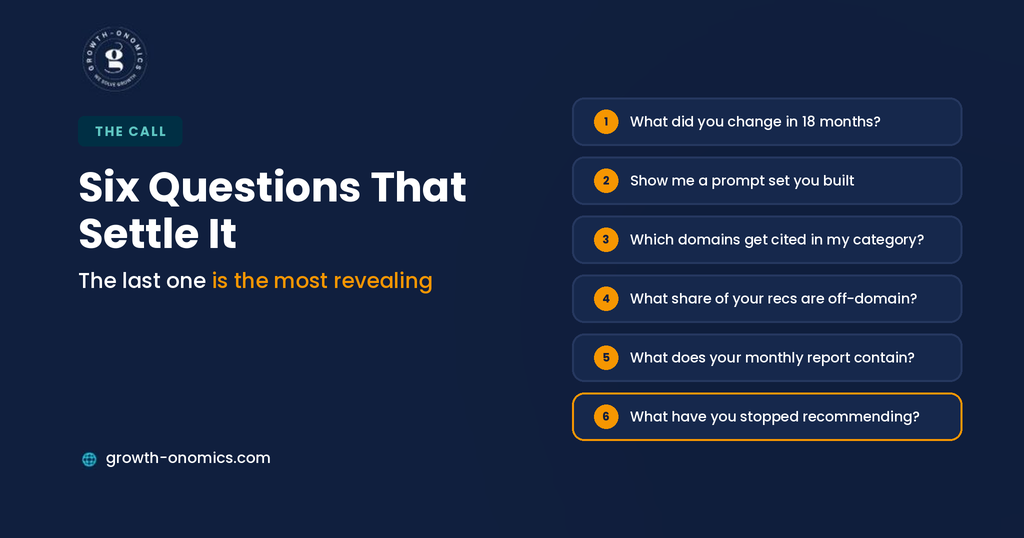
6 questions, and the answers are more revealing than any case study.
“What did you change about how you work in the last 18 months?” An agency that rebuilt something will describe process changes: how measurement works now, what the content brief contains that it did not, what they stopped doing. An agency that added a tool will describe capabilities.
“Show me a prompt set you built for a client.” Redacted is fine. Its existence, structure, and segmentation by buying stage tell you whether this is a practice or a slide.
“Which domains get cited in my category, and how do you know?” A genuine answer comes with a method and a list. A vague one comes with adjectives.
“What percentage of your recommendations are off-domain?” If the answer is near zero, they are proposing a publishing calendar regardless of what the pitch said.
“What does your monthly report contain?” Ask for a sample. Look at whether AI metrics and organic performance belong to the same interpretation or in two disconnected sections.
“What have you stopped recommending?” The most revealing question on the list. An agency that has genuinely updated its practice can name something it used to sell and no longer does. One that has only added AI to an existing offer will struggle, because nothing was subtracted.
Tells in the Work Itself
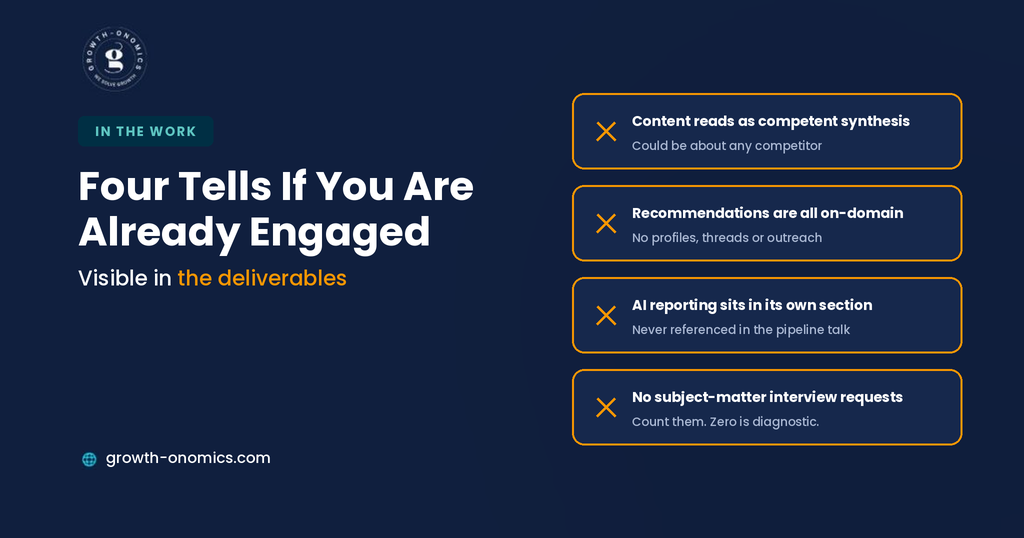
If you are already engaged and trying to work out which you bought, four signals appear in the deliverables.
Content that reads as a competent synthesis. Accurate, well-organized, and indistinguishable from the top-ranking pages it was derived from. This is the signature of AI-accelerated production without proprietary input, and it is the most common failure in the category.
Recommendations that are entirely on-domain. 12 pages to publish, no mention of review profiles, community threads, or the roundups your buyers actually read.
Reporting that treats AI as a separate topic. A visibility slide at the back, unconnected to the pipeline discussion at the front.
No subject-matter interview requests. An agency producing differentiated content asks for time with your solutions engineers, your support team, and your customers. One that never asks is synthesizing what already exists, which is exactly what produces the middle-of-the-category content nobody cites.
That last one is the fastest tell available, and it costs nothing to check. Count the subject-matter interview requests in the first two months of an engagement.
Zero means the content is being assembled from what already exists, which is precisely the content that ranks acceptably and gets cited by nothing.
The Wrapper Problem
A specific version of this is worth naming, because it is common and the pricing is aggressive.
Some agencies have built delivery almost entirely around AI tooling with minimal human judgment: automated research, generated content, templated recommendations, and a dashboard. The economics are excellent, and the output is fast.
The problem is not the tooling. It’s that the parts requiring judgment like deciding what matters, knowing your category, exercising editorial taste, correcting what a model got wrong are the parts that produce differentiation, and they are exactly the parts removed to make the economics work. The saving comes from the value.
How to detect it: ask who reviews the output before it reaches you, and what they change. A specific answer describes an editorial process. A vague one describes a pipeline.
How to detect it later: look for the errors. Generated content describes products by pattern-matching similar ones, which produces confident sentences about capabilities you do not have. If a first draft contains a feature you do not offer, or a limitation that belongs to a competitor, nobody with product knowledge read it before it was sent to you.
When a Traditional Agency Is the Better Choice
3 situations, and they are more common than the category’s marketing suggests.
When the practitioners are genuinely senior. A traditional agency with a decade of category experience and a strong editor will produce better content than an AI-native shop staffed with juniors, whatever the workflow diagram says.
When your gap is craft rather than method. If your content is structurally fine and just badly written, that is an editorial problem, and editorial skill is not distributed by agency category.
When they are honest about it. An agency saying “we use AI to accelerate research and drafting, our differentiation is our people and our category knowledge” is describing a coherent offer at an appropriate price.
That is a better purchase than an inflated AI-native claim, and the willingness to describe the offer plainly is itself a signal about how they will handle a difficult month.
How to Structure a Trial
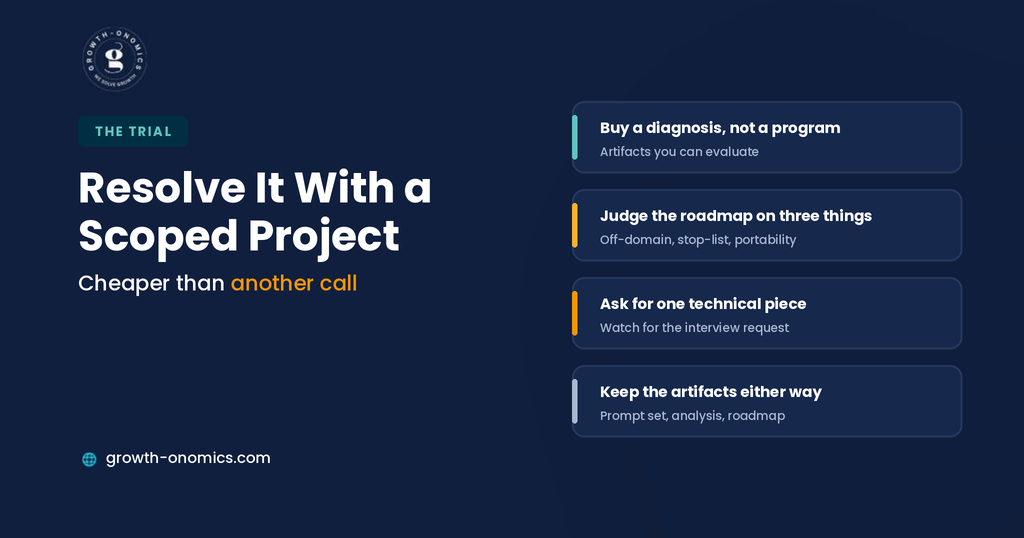
The fastest way to resolve this is a scoped project rather than a longer conversation.
Buy a diagnosis, not a program. A fixed-scope audit produces artifacts you can evaluate independently: a prompt set, a source analysis, a roadmap. Whether those exist, and how specific they are, answers the AI-native question more definitively than any reference call will.
Judge the roadmap on 3 things. Does it include off-domain work. Does it name what to stop doing as well as what to start. Could someone else execute it without the author in the room.
Ask for one piece of content. Ideally something technical enough to require real product knowledge. Whether they ask for a topical interview before writing it tells you most of what you need to know about how the rest of the engagement will run.
Keep the artifacts either way. The prompt set, the source analysis, and the roadmap should be yours regardless of what happens next. Growth-onomics scopes audits so the output is executable by whoever ends up doing the work, because a roadmap that only functions with its author present is a sales document rather than a diagnosis.
Conclusion
The label is not the thing. An agency describing itself as AI-native may have rebuilt its measurement, research, and production around what changed or may have added a tab to an unchanged workflow and updated its homepage.
The difference is testable in a single call, and the questions are not technical. What did you change in the last 18 months. Show me a prompt set. What percentage of your recommendations are off-domain. What have you stopped recommending. An agency that rebuilt something can answer all four with specifics. One that did not will answer with capabilities.
The fair version of this comparison is worth restating, though. A traditional agency using AI honestly, staffed with senior practitioners who know your category, is frequently a better purchase than an AI-native shop running a thin pipeline at scale. The failure mode is not using AI; it is removing the judgment that makes work differentiated, then charging for the judgment anyway.
If you want a diagnosis that produces artifacts you can evaluate like a prompt set, a source analysis, and a roadmap your own team could execute, Growth-onomics can scope one before any conversation about a longer engagement.
FAQs
Does it make a difference whether an agency is AI-native?
Only when you are buying a program rather than production capacity. If you know what to build and need more of it faster, a traditional agency using AI well is a wise purchase and often cheaper. The distinction is critical when the question is what to do because that requires the agency to have rebuilt how it measures and researches, not just how quickly it drafts. Test the claim instead of accepting it, since the label is free to adopt and is already available on most agency websites.
How can I tell if content was mostly AI-generated?
Look for competent invisibility. AI-accelerated content without proprietary input reads accurately, organizes sensibly, and could have been written about any competitor because it was synthesized from what already ranks. The specific tells are an absence of anything only your company knows, no customer language, original data, and no acknowledged trade-offs. The strongest signal is upstream, though: if nobody asked to interview your solutions engineer before writing about a technical topic, the content is a synthesis regardless of what tools were used.
Should agencies disclose their use of AI?
Yes, and how they use it rather than whether. Almost every agency uses AI somewhere now, so a blanket disclosure tells you nothing. What’s critical is where it appears in the workflow, what a human reviews before it reaches you, and what gets changed at that review. An agency comfortable describing its process specifically- AI for research synthesis and first drafts, human editing for accuracy and positioning, topical interviews for anything technical is telling you something useful. Vagueness on this point is itself an answer.
Are AI-native agencies cheaper?
Sometimes, and it is worth understanding why before treating it as an advantage. Where the savings come from automating genuinely mechanical work like research aggregation, formatting, reporting assembly, it pays off. Where it comes from removing editorial review and editorial input, you are buying a discount on the parts that produce differentiation. Ask what the price reflects. An agency that can explain which steps it automated and which it deliberately did not is describing a considered process rather than a cost structure.
Is a small AI-native agency riskier than an established traditional one?
Differently risky rather than more so. A newer agency built around current practice may have sharper methods and a thinner bench, meaning quality depends heavily on one or two people and capacity is fragile. An established agency has resilience and process but may be running a decade-old playbook with AI bolted on. Neither risk is inherently worse. What resolves it is asking who specifically will be on your account, what happens if they leave, and requesting a scoped project first so you are evaluating output rather than reputation.
What should I ask for in a first project?
Artifacts you can evaluate independently. A documented prompt set segmented by buying stage. A citation source analysis listing actual domains rather than a summary. A roadmap covering technical, content, and off-domain work, specific enough that a different team could execute it. And one piece of content on a topic technical enough to require product knowledge. Those 4 outputs answer the AI-native question definitively, cost far less than a retainer, and remain useful regardless of who you engage afterwards.
