
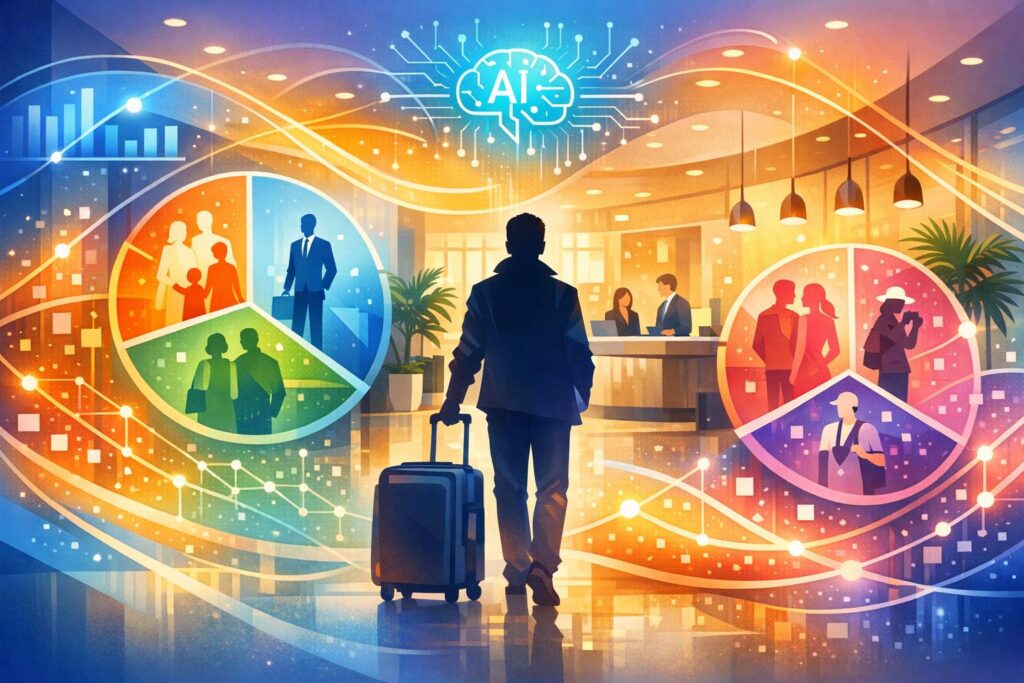
Hotels struggle with customer churn because guests don’t cancel subscriptions – they simply stop booking. AI offers a solution by analyzing guest data to predict churn risks and identify patterns of disengagement. Here’s how AI helps:
- Detects early churn indicators: Drop in booking frequency, email engagement, or spending habits.
- Dynamic segmentation: Updates guest profiles in real-time based on interactions.
- Personalized retention strategies: Tailors offers like discounts or upgrades to re-engage at-risk guests.
- Churn models: Uses techniques like BG/NBD to predict guest activity in non-contractual settings.
AI-driven strategies have shown measurable results, such as a 23% increase in repeat bookings and a 40% rise in direct reservations. By acting on early warning signs, hotels can retain guests more effectively and reduce acquisition costs.
Using Machine Learning (AI) to Predict Churn with XGBoost, Chapter 9 Fighting Churn With Data
Data Features Used in AI Churn Segmentation
Building on AI’s role in dynamic segmentation, a wide range of data points powers accurate churn predictions. By pulling information from various systems, AI creates a detailed view of churn risk, enabling hotels to identify at-risk guests early. Here’s how AI evaluates guest data to predict and segment churn likelihood.
Booking and Transaction Patterns
At the core of churn prediction lies the RFM framework: Recency (time since the last stay), Frequency (number of stays over a specific period), and Monetary (total spending). These metrics are essential for identifying potential churn. For example, if a guest who typically books monthly hasn’t stayed in 90 days, it raises a red flag.
AI also looks at temporal cues, like shorter stays or longer booking lead times, to assess churn risk. A key tool in this process is the BG/NBD model (Beta-Geometric/Negative Binomial Distribution), which predicts whether a guest is still active based on their transaction history, even without a formal cancellation.
In June 2025, a major North American hotel chain adopted a churn management system combining BG/NBD modeling with reinforcement learning. A study published in the Journal of Big Data revealed that targeting guests who hit a 75% churn risk threshold with a 20% discount email was the most effective way to retain them. After several weeks of testing, this strategy proved to be the sweet spot for maximizing conversions while minimizing guest loss.
"Machine Learning allows hotels to act before it’s too late, protecting revenue and strengthening guest relationships." – Luciano Viverit, CEO, Hotelnet
AI doesn’t stop there – it dives deeper into guest behavior to detect disengagement early.
Behavioral and Interaction Data
Beyond booking patterns, AI examines a guest’s digital and on-property activities to uncover motivations and potential risks. These behaviors provide real-time insights into a guest’s engagement level. AI tracks everything from website logins and app usage to email interactions and on-property services like dining, spa visits, or room service requests. It assigns greater importance to high-value interactions, such as a hotel stay, over smaller actions like opening an email .
Declining engagement is often an early warning sign. For instance, a guest who used to open every promotional email but hasn’t clicked on one in three months, or a frequent app user who suddenly stops logging in, might be showing signs of churn. Sentiment analysis on feedback and complaints also helps identify dissatisfaction before a guest officially decides to leave. Properties using enhanced guest profiles have reported a 65% drop in routine inquiry handling times and a 40% decrease in service complaints.
| Interaction Category | Specific Data Points | Churn Risk Indicator |
|---|---|---|
| Digital Activity | Website logins, app usage, clickstreams | Fewer logins or higher bounce rates |
| Communication | Email opens, click-through rates, responses | Ignored promotions or survey unresponsiveness |
| On-Property Service | Dining, spa visits, room service requests | Lower ancillary spending or frequent complaints |
| Booking Patterns | Lead times, preferred channels, cancellations | Shift to OTAs or increased cancellation rates |
AI also considers demographic and psychographic details to refine its understanding of guest behavior.
Demographic and Psychographic Factors
While demographics provide a basic framework, psychographic data adds depth to segmentation. AI categorizes guests by factors like age (e.g., under 45), group type (families vs. solo travelers), and trip purpose (business, leisure, or "bleisure"). It also tracks values like eco-consciousness, tech preferences, wellness interests, and whether a guest prioritizes experiences or efficiency .
For instance, 76% of guests value eco-friendly practices, and 68% are willing to pay a 10–15% premium for them. AI identifies these sustainability-focused travelers and tailors retention strategies, such as sharing updates on green certifications or carbon-offset options. Similarly, "Digital Natives" expect mobile check-ins and keyless entry, while "Traditional Guests" may prefer personal interaction. Misaligning services with these preferences can increase churn risk.
The "bleisure" segment, which blends business and leisure travel, has grown by 60% year-over-year and generates 35% higher ancillary spending, making it a prime target for retention strategies.
Hotels that use detailed segmentation and AI-driven automation have reported a 28% boost in guest satisfaction and a 35% cut in operational costs. Additionally, segment-based pricing and personalized offers can increase RevPAR (Revenue per Available Room) by 15–25% .
AI Models for Churn Prediction
AI Model Comparison for Hotel Churn Prediction
Once you’ve gathered your data, the next step is selecting an AI model to predict guest churn. Hotels have several options, each suited to different levels of data complexity and specific goals.
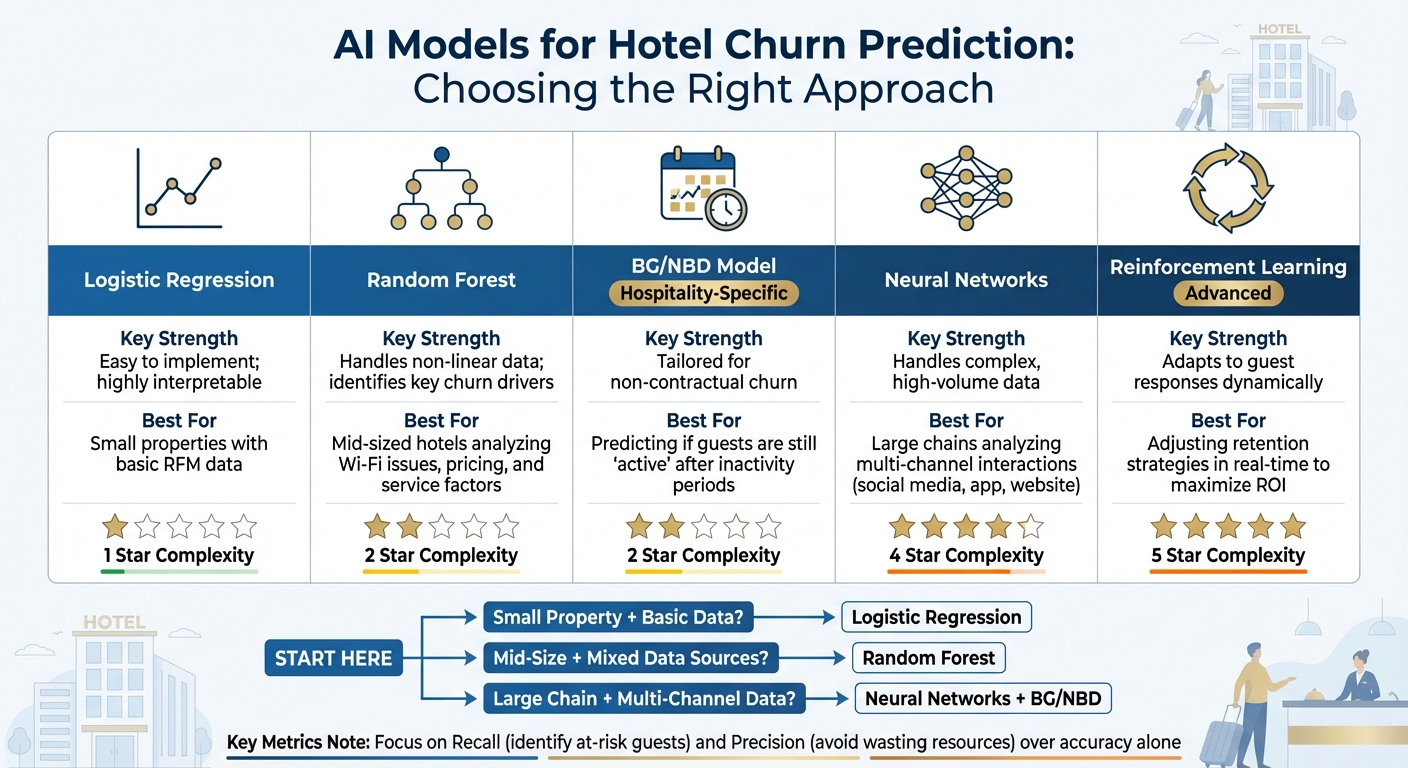
Logistic Regression is a straightforward choice, especially for smaller properties working with basic RFM (Recency, Frequency, Monetary) metrics. It’s simple to implement and easy to interpret, making it a great entry point for churn prediction. On the other hand, Random Forests are better suited for more complex datasets. They excel at identifying which factors – like Wi-Fi complaints, pricing concerns, or room preferences – are driving churn. Plus, they rank these factors by importance, giving you clear insights into guest behavior.
For hotels managing large, multi-channel datasets – such as social media interactions, app usage, and website activity – Neural Networks can detect intricate patterns in the data. However, they come with a trade-off: their predictions are harder to explain. Similarly, Support Vector Machines (SVM) handle high-dimensional data effectively, making them ideal for analyzing complex guest segments. But like Neural Networks, they can be challenging to interpret.
A model specifically designed for the hospitality industry is the BG/NBD model (Beta-Geometric/Negative Binomial Distribution). It’s perfect for non-contractual settings like hotels, where guests don’t formally cancel but simply stop booking. This model estimates the likelihood that a guest is still "active" even after a long period of inactivity. For a more dynamic approach, Reinforcement Learning can be combined with BG/NBD to fine-tune retention strategies based on how guests respond to offers over time.
"The value of customer churn prediction lies in its ability to help the hospitality industry identify potential churn customers in advance and take timely intervention measures." – Jiajun Cheng, Hyatt Hotel Management Co.
Comparison of AI Techniques
Each model has its strengths and is suited to specific tasks within the hotel industry. Here’s a breakdown of how they compare:
| Technique | Strength | Practical Application in Hotels |
|---|---|---|
| Logistic Regression | Easy to implement; highly interpretable | Estimating churn probability using basic RFM data |
| Random Forest | Handles non-linear data; identifies key churn drivers | Pinpointing which factors (e.g., Wi-Fi issues, pricing) impact loyalty the most |
| BG/NBD Model | Tailored for non-contractual churn | Predicting if a guest is still "active" after periods of inactivity |
| Neural Networks | Handles complex, high-volume data | Analyzing multi-channel interactions like social media, app, and website behavior |
| Reinforcement Learning | Adapts to guest responses | Adjusting retention strategies dynamically to maximize ROI |
When choosing a model, don’t focus solely on accuracy – it can be misleading, especially with churn datasets where far fewer guests leave compared to those who stay. Instead, prioritize metrics like Recall (to identify as many at-risk guests as possible) and Precision (to avoid wasting resources on loyal guests) . To address imbalances in the dataset, techniques like SMOTE (Synthetic Minority Oversampling Technique) can help ensure the model doesn’t favor the majority class.
Choosing the Right Model for Your Hotel
The best model for your hotel depends on your data scale and how much interpretability you need. For smaller properties with basic transaction data, Logistic Regression is a practical starting point. It’s easy to use and provides clear insights into why a guest might be at risk.
For mid-sized hotels with a mix of data sources – like booking patterns, service usage, and guest feedback – Random Forests strike a good balance between accuracy and interpretability. They also highlight the most influential factors in churn.
Large hotel chains managing vast datasets, including clickstreams, social media activity, and multi-property stays, can benefit from Neural Networks or SVM. These models excel at uncovering complex patterns but are harder to explain to non-technical teams. If interpretability is a priority, consider sticking with Random Forests or using Explainable AI (XAI) tools like SHAP values to better understand predictions.
For any hotel, the BG/NBD model is particularly valuable because it’s designed for non-contractual scenarios where guests don’t formally cancel but stop booking. Pairing it with Reinforcement Learning allows you to dynamically adjust retention strategies based on guest responses.
Finally, if timing matters, consider Survival Analysis (like Cox Proportional Hazards). This approach predicts when a guest is likely to churn, helping you send "win-back" offers at just the right moment. Start with a simple model, test its performance in real campaigns, and refine it based on what actually influences guest behavior.
sbb-itb-2ec70df
Case Studies: AI in Hotel Churn Management
The use of AI in hotel churn management has reshaped how the industry approaches revenue growth and guest retention, demonstrating measurable success in real-world applications.
US Hotel Chain: Personalized Offers with AI
A prominent US hotel chain implemented a three-tier AI system to tackle guest churn proactively. This system included:
- A propensity model to predict the likelihood of a guest making a booking.
- A room-tier classifier to identify preferred room types and assess sensitivity to discounts.
- An optimizer to calculate the most valuable offer while preserving profit margins.
This AI-powered approach to hyper-personalization led to a 56% revenue increase and doubled the chain’s marketing ROI from 500% to 1,000%. Rigorous A/B testing confirmed that tailored offers – such as spa upgrades for leisure travelers or late checkouts for business guests – consistently outperformed generic promotions.
Inspired by these results, other major hotel brands have adopted predictive analytics to drive operational improvements and enhance guest experiences.
Reducing Churn with Predictive Analytics
Hilton Hotels took dynamic segmentation to the next level by deploying enterprise AI across its 6,500+ properties. Using advanced techniques like Bayesian inference and Recurrent Neural Networks, Hilton’s AI system analyzed guest behavior to anticipate preferences based on context – whether a guest was traveling for business or leisure, solo or with family. Remarkably, the project transitioned from prototype to full-scale implementation in just six months.
The results were impressive:
- Hilton Honors retention jumped from 61% to 82%.
- Net Promoter Score rose from +32 to +48.
- In-app upsell conversions increased from 8.7% to 12.3%.
- Front-desk queries dropped by 35%.
- Over 70% of guest requests were handled by the AI concierge.
"This AI infrastructure elevated our brand experience. With AgixTech, we’re delivering luxury personalization at Hilton scale".
In another example, a resort hotel identified a high-risk segment: guests who booked once during July or August through online travel agencies and never engaged with follow-up emails. This group had a churn rate of 78%. By targeting them with "welcome back" offers in June, the hotel reduced churn by 20% and achieved a fivefold higher ROI compared to standard Facebook ads.
These examples highlight how AI-driven strategies can redefine guest engagement and retention, offering tailored solutions that resonate with specific customer needs.
Strategies to Reduce Churn Using AI
Real-Time Customer Segmentation for Retention
AI has transformed how hotels understand and engage with their guests by moving beyond static customer profiles. Instead of relying on outdated segmentation, AI dynamically updates guest profiles based on real-time behavior. For instance, if a guest opens an email about spa services or books a family suite, their profile is instantly adjusted, influencing future communications. This approach helps identify early warning signs – like reduced spending, less frequent bookings, or decreased email engagement – and triggers retention strategies before the guest completely disengages.
Rather than waiting for guests to cancel or vanish, real-time segmentation enables hotels to pinpoint highly specific customer groups. For example, single business travelers staying five or more nights can be targeted with tailored offers, resulting in higher engagement. Properties using AI-powered systems have also drastically improved response times – from an average of 4.2 hours to under 3 minutes. This speed matters because retaining an existing customer costs significantly less than acquiring a new one – up to five times less, in fact. By staying proactive, hotels can address churn before it becomes a problem.
Customized Loyalty Programs and Offers
AI has also redefined loyalty programs, turning them into tools that anticipate guest needs rather than just rewarding past behavior. Instead of offering generic perks like a free night after a set number of stays, AI uses predictive analytics to determine the best time and way to engage each guest. For example, if a business traveler suddenly books a weekend stay – a departure from their usual pattern – AI can instantly recommend a spa upgrade or late checkout to enhance their experience.
This level of personalization aligns with consumer expectations: 71% of guests want brands to tailor their interactions, while 76% feel frustrated by a lack of personalization. Hotels that leverage detailed segmentation and AI-driven automation have reported a 28% boost in guest satisfaction scores. By analyzing RFM (Recency, Frequency, Monetary) data, hotels can deliver precisely timed offers that resonate with individual guest preferences, avoiding the pitfalls of one-size-fits-all marketing.
"Predictive AI can help set the strategy, and generative AI can help execute it." – Alfred, Head of Personalization, Amperity
Feedback Loops for Continuous Improvement
AI doesn’t stop at segmentation and tailored offers – it thrives on continuous learning. Effective churn management relies on a feedback loop where AI evaluates guest responses, such as email opens or booking conversions, to refine future strategies. For example, a major North American hotel chain implemented a churn management framework using reinforcement learning in June 2025. During a testing phase, the system analyzed how guests responded to targeted emails, optimizing discount budgets based on the likelihood of churn in real time.
AI models can assign more weight to meaningful actions – like actual hotel stays – over less impactful ones, such as email opens. By incorporating real-time data like guest review sentiment and engagement metrics, hotels gain a clearer understanding of what drives loyalty or disengagement. Sharing these insights with on-property staff, like front-desk or concierge teams, allows hotels to create personalized experiences that strengthen guest relationships during their stay. Regular A/B testing and adaptive thresholds ensure that discounts are offered at the right moment – neither too early for loyal guests nor too late to win back disengaged ones.
"Machine Learning allows hotels to act before it’s too late, protecting revenue and strengthening guest relationships. Ultimately, those who learn to anticipate – not just react – will lead the future of hospitality." – Luciano Viverit, CEO, Hotelnet
Conclusion
AI has reshaped how hotels tackle customer retention, moving the focus from simply reacting to problems toward actively engaging guests. Instead of waiting for guests to stop returning, hotels can now spot early signs of disengagement and respond with well-timed, personalized offers. This shift matters because keeping a current guest is far more cost-effective than acquiring a new one.
The numbers back this up. Hotels using advanced segmentation systems have seen a 23% boost in repeat guest retention, 40% increase in direct bookings, 35% cut in operational costs, and a 28% rise in guest satisfaction scores. On top of that, the hospitality AI market is expected to grow by 60% annually through 2033, reaching a staggering $8 billion.
What makes AI so effective? It’s the combination of predictive and generative technologies. Predictive AI pinpoints which guests are likely to churn and when to step in, while generative AI creates tailored messages that deliver stronger results. This allows for microsegmentation – targeting highly specific guest groups based on their real-time behavior instead of relying on broad demographic categories.
"In hospitality, where stays are often irregular, the definition [of churn] is more nuanced… Machine Learning allows hotels to act before it’s too late, protecting revenue and strengthening guest relationships." – Luciano Viverit, CEO, Hotelnet
FAQs
How does AI help identify hotel guests who might stop booking?
AI helps hotels spot signs that a guest might stop booking by analyzing patterns in booking frequency, transaction history, loyalty program activity, and engagement with emails or apps. With machine learning models, it can pick up on unusual changes or downward trends in these behaviors, which may indicate a risk of churn.
For instance, let’s say a guest who usually books every three months suddenly skips their usual booking or stops interacting with promotional emails. AI can flag this as a warning sign. This gives hotels the chance to step in with personalized offers or targeted messages to reconnect with the guest and encourage them to return.
How does the BG/NBD model improve hotel churn prediction?
The BG/NBD model offers a smart way to predict hotel guest churn by analyzing two key factors: how frequently guests are likely to return and the chances of them becoming inactive. This approach works particularly well for non-contractual customers, like those who book hotel stays irregularly.
By delivering precise insights into guest behavior and lifetime value, the BG/NBD model enables hotels to pinpoint guests at risk of leaving. This allows for tailored retention strategies that can strengthen customer loyalty and, in turn, increase revenue.
How does AI help hotels create personalized offers to boost guest loyalty?
AI gives hotels the power to create personalized offers by diving deep into guest data – everything from booking history to app usage and even preferences during their stay. This insight helps hotels anticipate what guests might need and deliver tailored perks like spa treatments, late checkouts, or room upgrades exactly when guests are most likely to appreciate them. These well-timed, thoughtful gestures go a long way in creating unforgettable stays and building emotional connections with guests.
The benefits are clear. Personalized offers not only encourage guests to spend more on upgrades but also drive direct bookings when shared through familiar platforms like email or mobile apps. Beyond boosting revenue, this approach enhances guest satisfaction and loyalty, reducing the chances of guests looking elsewhere for their next trip.