

Most marketers are stuck with outdated attribution models that misallocate budgets and fail to reflect how people shop today. Here’s why AI-driven, NLP-based attribution is changing the game:
- Old models are inaccurate: Last-click attribution, still used by 73% of advertisers, overvalues final interactions and undervalues early touchpoints, distorting ROI measurement.
- AI models are smarter: Using machine learning and NLP, these systems analyze complex customer journeys, boosting accuracy from 60-70% (old models) to 90-95%.
- Better results: Companies switching to AI-driven attribution report a 15-30% ROI increase in just six months.
Google’s 2023 move to retire outdated attribution models signals a clear shift toward AI-powered solutions. If you’re still relying on rule-based systems, now’s the time to rethink your strategy for more accurate insights and better performance.
1. Traditional Attribution Models
Mechanics and Data Processing
Traditional attribution models rely on fixed rules to distribute credit across touchpoints, rather than letting data reveal the true story. This rules-based approach involves manual mapping and normalization, which can take anywhere from 25 to 40 hours per cycle.
These models fall into two main categories. Single-touch models assign all the credit to one specific interaction. For instance, first-touch attribution gives 100% of the credit to the initial point of contact, while last-touch attribution focuses entirely on the final click before conversion. On the other hand, multi-touch models provide a more detailed perspective. For example:
- Linear attribution splits credit equally across all touchpoints.
- Position-based attribution (also called U-shaped) assigns 40% of the credit to both the first and last interactions, with the remaining 20% spread across the middle steps.
- Time-decay attribution gives more weight to touchpoints closer to the moment of conversion.
The majority of traditional tracking relies on client-side methods, such as browser cookies. While these methods are easy to set up, they are increasingly vulnerable to ad blockers and stricter privacy regulations. This creates significant data gaps before the analysis even begins, setting the stage for the performance challenges discussed below.
Performance Metrics
Accuracy is a major issue with traditional attribution models. According to Nielsen:
By arbitrarily applying rules, these methods fail to measure the contribution of every touchpoint in the consumer journey accurately
This shortfall often leads to poorly informed budget decisions. For instance, last-click attribution underestimates the performance of upper-funnel campaigns by 23% to 47%, undervaluing the early interactions that are crucial for driving eventual conversions.
But the problem goes beyond measurement errors – it also impacts how budgets are allocated. Rules-based models treat every customer journey as if it follows the same predefined path. This rigid approach ignores the fact that 8 out of 10 online purchases involve multiple touchpoints across a variety of channels and devices.
ROI Impact
These inaccuracies in measurement have a direct impact on financial outcomes and budget strategies. Businesses relying on last-click attribution often over-invest in branded search campaigns by 41%, while under-investing in prospecting campaigns by 28%. Google’s Kamal Janardhan, Senior Director of Product Management for Analytics, explains the core limitation:
Traditional MMMs, largely built to measure the brand impact of offline media, have struggled to accurately measure online media
.
The financial consequences of these limitations are clear. Companies that move away from traditional models and adopt AI-driven strategies report an average 34% improvement in ROAS. This shift underscores the growing importance of transitioning to more advanced, NLP-driven attribution methods.
2. NLP-Driven Attribution Models
Mechanics and Data Processing
NLP-driven attribution models take a different approach compared to traditional rule-based systems. These models rely on transformer-based neural networks to analyze the entire customer journey. By converting unstructured campaign data – like search queries, ad copy, and creative content – into detailed vector representations (also known as embeddings), they capture the deeper semantic impact of marketing interactions. For instance, attention mechanisms in transformers can identify coherent customer journeys even when actions are spaced out over time. Time Absolute Position Encodings (tAPE) further enhance this by interpreting irregular time gaps, ensuring every interval contributes to the overall context.
These models also deliver impressive operational efficiency. Tasks that previously required 25–40 hours can now be completed in just 3–6 hours thanks to automated workflows. Additionally, when data gaps arise due to privacy regulations like GDPR, these systems can intelligently fill in the blanks. They do this by using probabilistic methods to inject aggregated impressions back into user paths, leveraging owned-channel proxies.
Performance Metrics
The results speak for themselves. AI-powered multi-touch attribution achieves an impressive 92% accuracy and provides insights that are three times more precise than traditional last-click models. Take LinkedIn‘s LiDDA system as an example: in January 2025, it identified a 150× increase in credit for upper- and mid-funnel campaigns, which contributed to an estimated 5% boost in marketing-driven revenue. Marketers using first-party data have also seen a 30% improvement in performance, with model confidence scores consistently reaching 90%.
ROI Impact
Switching to AI-driven attribution delivers tangible financial benefits. Agencies have reported a 15–30% increase in ROI within the first six months of implementation. Businesses, on average, have seen a 34% improvement in ROAS after adopting these models. For instance, a B2B SaaS company discovered that while traditional models attributed just 8% of revenue to content syndication, an AI-driven model revealed that content influenced 67% of deals. This insight led to a 300% increase in their content budget and a 45% improvement in pipeline quality. Similarly, predictive lifetime value (LTV) modeling has boosted multi-channel marketing ROI by 40–60%. In another example, an e-commerce brand found that Instagram-driven automation increased email conversion rates by 34% and boosted paid search performance by 28%, prompting a 40% reallocation of creative resources toward social content. These measurable improvements are helping marketers fine-tune their campaigns on a daily basis.
Real-World Applications
These performance gains are not just theoretical – they’re driving real-world results. Many marketers are now combining these advanced attribution models with Marketing Mix Modeling (MMM). This integration aligns detailed campaign insights with high-level strategic planning, enabling both day-to-day optimizations and long-term budget decisions.
Kamal Janardhan, Senior Director of Product Management for Analytics at Google, highlights the advantage of real-time data processing:
Data-driven attribution, powered by Google AI, accurately assigns credit to each interaction in real time and is always on.
Advertisers using enhanced conversions for leads have reported an 8% increase in conversions compared to standard offline imports. With 8 out of 10 online purchases now involving multiple touchpoints across channels and devices, the shift to privacy-first modeling has become essential. Companies are increasingly adopting server-side tracking and first-party data strategies to maintain accurate measurement in the post–third-party cookie era.
Webinar: Using Machine Learning to Understand and Predict Marketing ROI
sbb-itb-2ec70df
Pros and Cons
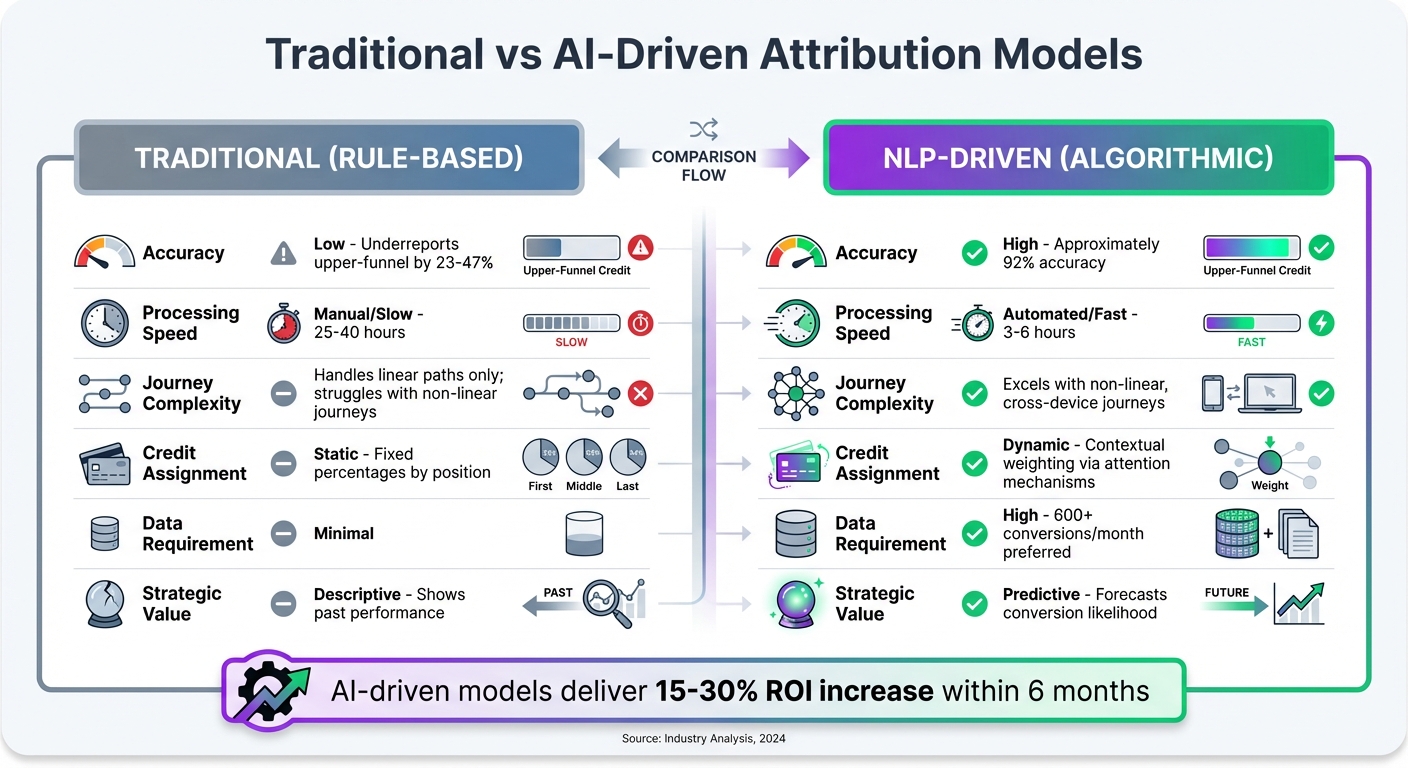
Traditional vs AI-Driven Attribution Models: Performance Comparison
When comparing traditional and AI-driven attribution models, it’s clear each has its own strengths and weaknesses. Here’s a closer look at the trade-offs involved:
Traditional rule-based models are straightforward to set up and require only minimal data, making them a practical choice for smaller teams or businesses without extensive resources. However, these models have a major downside – they tend to underreport upper-funnel campaign performance by anywhere from 23% to 47%. This underreporting can create blind spots, leading to less-than-optimal budget allocations.
On the other hand, NLP-driven models bring impressive accuracy levels of 92% and can significantly reduce manual effort. Tasks that might take 25–40 hours manually can be completed in just 3–6 hours using automated workflows. These models shine when it comes to handling complex, non-linear customer journeys, utilizing attention mechanisms to assign credit dynamically based on context rather than relying on static rules. But there’s a catch: they require substantial data – ideally 15,000 or more clicks and at least 600 conversions per month. Transfer learning can lower this threshold to around 200 conversions, but the data demands remain a challenge for smaller campaigns.
Another key drawback of AI-driven models is the "black-box" problem. Their deep learning structures can be difficult for marketing teams to interpret or explain, especially to stakeholders or executives. This often necessitates collaboration with data scientists to bridge the gap. As FTF Strategy puts it:
At its core, AI attribution replaces assumptions with adaptation
. However, this adaptability often comes at the expense of transparency.
Here’s a side-by-side comparison of the two approaches:
| Feature | Traditional (Rule-Based) | NLP-Driven (Algorithmic) |
|---|---|---|
| Accuracy | Low (Underreports upper-funnel by 23–47%) | High (Approx. 92% accuracy) |
| Processing Speed | Manual/Slow (25–40 hours) | Automated/Fast (3–6 hours) |
| Journey Complexity | Handles linear paths only; struggles with non-linear journeys | Excels with non-linear, cross-device journeys |
| Credit Assignment | Static (Fixed percentages by position) | Dynamic (Contextual weighting via attention mechanisms) |
| Data Requirement | Minimal | High (600+ conversions/month preferred) |
| Strategic Value | Descriptive (Shows past performance) | Predictive (Forecasts conversion likelihood) |
These differences highlight a pivotal shift in how attribution strategies are evolving. While traditional models are simpler and more accessible, AI-driven approaches offer deeper insights and predictive capabilities – but only if you have the right data infrastructure in place.
To make AI models work effectively, consistent, high-quality data is a must. This includes unified UTM parameters and well-maintained tagging systems, as these are critical for generating actionable insights.
Conclusion
The takeaway is simple: NLP-powered attribution models can significantly boost ROI when applied under the right circumstances. For campaigns involving intricate, multi-channel customer journeys, these AI-driven models have shown the potential to increase ROI by 15% to 30% within just six months.
To validate these results, start with controlled testing. Consider running a dual-track pilot alongside your current rule-based system for 14 to 30 days. This allows you to compare outcomes and confirm improvements before making a full transition. Additionally, use incrementality experiments like Brand Lift or Conversion Lift tests to gather "ground truth" data, which helps fine-tune your AI predictions .
Switching to AI-driven attribution isn’t merely about better analytics – it’s about real-time decision-making. By integrating Multi-Touch Attribution for daily optimizations, Marketing Mix Modeling for long-term strategy, and incrementality testing for accuracy, you build a measurement system that delivers tangible business results – not just surface-level metrics . As Kamal Janardhan from Google highlights, marketers leveraging first-party data with AI have reported a 30% improvement in performance.
FAQs
How does NLP enhance the accuracy of attribution models?
NLP, or Natural Language Processing, improves the accuracy of attribution models by diving into the complexities of customer behavior across multi-touch campaigns. Instead of sticking to rigid rules or assumptions, it uses data patterns and relationships to dynamically assign credit to various touchpoints.
This method gives businesses a clearer picture of how individual interactions drive conversions. The result? More accurate ROI tracking and smarter, data-driven marketing strategies.
What challenges come with using AI-driven attribution models in marketing?
Using AI-powered attribution models in marketing comes with its fair share of challenges. For starters, integrating these sophisticated systems into existing marketing operations demands technical know-how and considerable resources. Developing and managing models like deep learning networks or probabilistic frameworks isn’t just intricate – it’s also a time-intensive process.
Then there’s the issue of computational demands. These models often need to process massive amounts of real-time data, which means businesses must invest in a solid infrastructure to keep things running smoothly. On top of that, privacy concerns are becoming a major hurdle. With stricter regulations around consumer data, companies are under pressure to adopt practices that prioritize user privacy.
Another key challenge is ensuring the accuracy and flexibility of these models. To keep up with shifting consumer behaviors and evolving market trends, the models need frequent updates. Without this, the insights they provide could quickly become outdated. Overcoming these obstacles requires a thoughtful strategy that blends technical advancement, careful planning, and a strong focus on safeguarding data privacy.
How can businesses collect the right data for AI-driven attribution models?
To gather the right data for AI-driven attribution models, businesses need to focus on collecting detailed and accurate customer information from every relevant touchpoint. This means pulling data from sources like social media platforms, website analytics, ad campaigns, and sales systems to piece together a full picture of the customer journey.
The quality of your data matters. Detailed, high-resolution data helps uncover patterns and ensures credits are assigned correctly. To maintain accuracy, implement strong data cleaning and normalization processes to eliminate errors or biases. At the same time, it’s critical to respect data privacy and comply with regulations like GDPR, which helps build trust and ensures ethical practices.
By combining meticulous data collection with cutting-edge AI tools, businesses can unlock deeper insights into multi-touch campaigns and make smarter decisions to boost ROI.
