

AI dashboards are transforming how businesses interact with data by combining artificial intelligence with user-friendly interfaces. These tools use Natural Language Processing (NLP) to let users explore data and get insights simply by asking questions in plain language, like "Why did sales drop in Q3?" They go beyond traditional dashboards, offering predictive insights, real-time alerts, and easy-to-understand narratives.
Key Features of AI Dashboards:
- Natural Language Querying (NLQ): Ask questions in everyday language and get instant visual answers.
- Natural Language Generation (NLG): Translates complex charts into simple, written explanations.
- Predictive Insights: Forecast future trends like customer churn or demand spikes.
- Real-Time Alerts: Monitors data for unusual patterns and notifies users instantly.
- Accessibility for Non-Experts: Eliminates the need for technical skills, making data insights available to everyone.
Why It Matters:
- Only 20% of decision-makers use traditional BI tools due to complexity. AI dashboards remove these barriers, boosting adoption rates.
- Predictive analytics shifts businesses from reactive to proactive decision-making, reducing risks and improving outcomes.
- Use cases show increased revenue, faster decision-making, and improved customer engagement when AI dashboards are implemented effectively.
AI dashboards powered by NLP are not just about making data easier to understand – they help businesses anticipate trends, make smarter decisions, and stay competitive. With organizations increasing their AI investments, these tools are becoming essential for modern analytics.
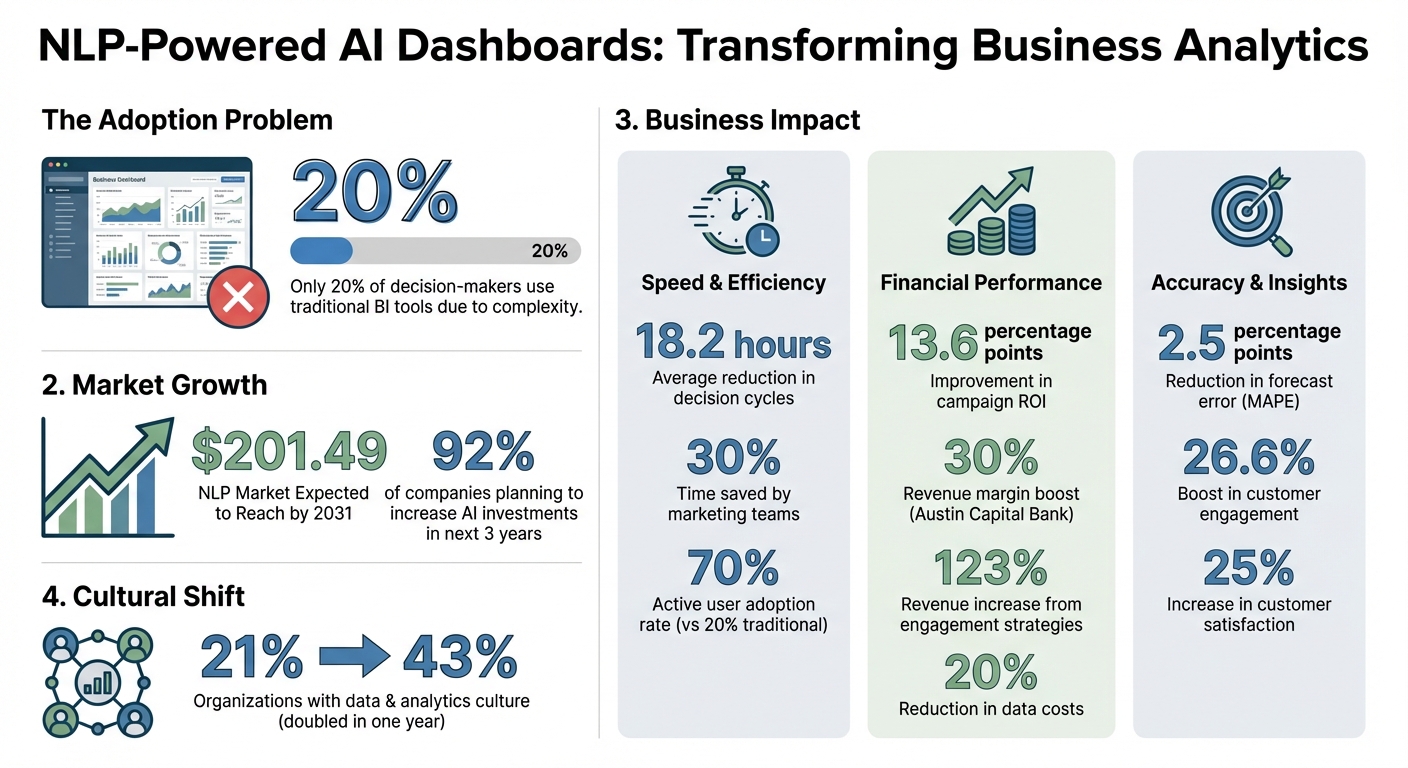
NLP-Powered AI Dashboards: Key Statistics and Business Impact
Latest Innovations in AI/BI Dashboards and Genie
Core Components of NLP in Predictive Analytics
Three key technologies work together to transform AI dashboards into powerful predictive tools: Natural Language Querying (NLQ), text analysis, and machine learning. While each plays a unique role, their combined functionality creates a system capable of delivering actionable insights. Let’s break down how each contributes to improving predictive analytics.
Natural Language Querying
Natural Language Querying (NLQ) makes data exploration simple and intuitive, translating user questions into visualizations without requiring technical expertise. Instead of writing SQL queries or navigating complex interfaces, users can type something like "show me sales trends by region" and instantly receive a relevant chart. The system automatically selects the best visualization, making it easier for business professionals – like marketing managers and sales directors – to analyze data quickly.
Advanced NLQ systems go a step further by understanding the context of follow-up questions. For instance, after viewing sales trends, you could ask, "Why did that happen?" without needing to rephrase or repeat the original query. This conversational capability turns dashboards into interactive tools that help users dig deeper into their data. For example, Austin Capital Bank used NLQ to streamline operations, boosting revenue margins by nearly 30% by enabling staff to explore data effortlessly through natural language queries.
This approach also speeds up decision-making. On average, organizations using AI-driven business intelligence (BI) tools reduce decision cycles by 18.2 hours and improve campaign ROI by 13.6 percentage points. Additionally, NLQ systems proactively suggest interesting data points to analyze, bridging the gap between simple reporting and forward-looking predictions.
Text Analysis for Unstructured Data
Text analysis helps transform unstructured data – like customer reviews, social media posts, and support tickets – into structured insights that traditional dashboards often miss. This process opens up a wealth of information that can drive better business decisions.
- Sentiment analysis gauges the emotional tone of customer feedback, offering early warnings about potential churn or shifts in brand loyalty.
- Topic modeling uncovers recurring themes across large datasets, helping businesses identify market trends before they show up in revenue reports.
- Named Entity Recognition (NER) pinpoints specific names, organizations, or locations mentioned in text, connecting unstructured data to actionable business insights.
AI-powered dashboards monitor these unstructured data streams in real time, flagging unusual patterns like a surge in negative feedback or repeated product complaints. This allows companies to address issues before they escalate.
The growing importance of unstructured data is reflected in the Natural Language Processing market, which is expected to reach $201.49 billion by 2031. However, effective implementation requires clean, high-quality data. Poor data quality can lead to inaccurate insights, so human oversight is critical to refine AI outputs and correct potential biases in sentiment or topic analysis.
Machine Learning Integration
Machine learning (ML) is the engine that connects NLP’s ability to understand user queries with predictive analytics’ power to forecast outcomes. By analyzing historical trends and deviations, ML models provide actionable recommendations based on both structured and unstructured data. Over time, these systems learn and adapt, improving their ability to align with user intent.
To ensure accuracy, ML systems rely on "constrained generation", which grounds the AI in business metadata to prevent errors or "hallucinations". This approach has led to significant improvements in forecast accuracy, with dashboards showing a 2.5 percentage point reduction in Mean Absolute Percentage Error (MAPE). Additionally, organizations integrating AI at scale have reported up to 20% reductions in data costs.
Modern dashboards also use ML for continuous improvement, identifying anomalies and explaining their root causes. Interestingly, research shows that about one-third of the gains in AI dashboard accuracy come from user adoption. In other words, how well users embrace these tools is just as important as the technology itself. By integrating NLP with ML, businesses can remove technical barriers and unlock the full potential of predictive analytics, enabling them to anticipate trends and make smarter decisions in real time.
Business Benefits of NLP-Powered Dashboards
NLP-powered dashboards are reshaping how businesses operate by driving improvements in three key areas: marketing performance, customer relationships, and strategic decision-making. This shift from traditional analytics to AI-driven insights isn’t just about adopting new technology – it’s about rethinking how companies compete and thrive in their markets. By enhancing marketing efforts, improving customer engagement, and enabling smarter decisions, these tools provide a competitive edge in today’s fast-paced business landscape.
Better Marketing Campaign Performance
Imagine having the ability to track real-time trends – keywords, hashtags, and even shifts in public sentiment – without waiting days for manual reports. That’s exactly what NLP dashboards offer. They analyze public opinion as it unfolds, allowing marketing teams to tweak messaging and budgets on the fly. This real-time adaptability not only shortens decision cycles but also drives a noticeable return on investment by capturing emerging trends and acting on them immediately.
Another game-changer? Social prospecting and lead identification. By monitoring brand mentions and analyzing customer behavior patterns, NLP tools can identify new opportunities and relationships. Marketing teams using these tools report saving up to 30% of their time, which can be redirected toward strategic initiatives. It’s a clear example of how predictive insights can transform marketing efforts.
Stronger Customer Engagement
Customer sentiment is the heartbeat of engagement strategies, and NLP-powered dashboards make it easier to understand. Companies integrating NLP into their CRM systems have seen a 26.6% boost in engagement and a 25% increase in customer satisfaction. By analyzing data from support tickets, reviews, and social media, these tools help businesses deliver personalized experiences that strengthen customer loyalty.
But the benefits don’t stop at satisfaction. Businesses that prioritize engagement strategies backed by NLP insights report revenue increases of up to 123%. Even consistent branding, informed by sentiment analysis, can lead to an average revenue growth of 23%. These dashboards go beyond just identifying customer needs – they detect emotional tones in feedback, enabling teams to respond with empathy and resolve issues before they escalate.
Data-Driven Decision Making
Traditional dashboards often act like a "rear-view mirror", showing what has already happened. In contrast, NLP-powered systems take things a step further by forecasting future trends and recommending actions. This proactive intelligence allows businesses to prepare for what’s coming rather than just analyzing the past.
"Traditional dashboards show you what happened. AI dashboards tell you what it means and what might happen next." – monday.com
One of the biggest barriers to using traditional self-service BI tools is their complexity; only 20% of decision-makers actively use them. NLP-powered dashboards eliminate these hurdles by letting non-technical users ask questions in plain English, such as, "Why did customer acquisition costs increase last month?" This accessibility has contributed to a rise in organizations developing a "data and analytics culture", doubling from 21% to 43% in just a year, thanks in large part to advancements in generative AI.
The ability to ask straightforward questions and get actionable insights empowers teams to make faster decisions. For example, businesses leveraging these tools report monthly revenue growth increases of up to 1.8 percentage points. These capabilities set the stage for the implementation strategies explored in the next section.
sbb-itb-2ec70df
How to Implement NLP-Powered Dashboards
Creating NLP-powered dashboards isn’t just about plugging in technology; it’s about aligning tools with your specific business goals. Companies that skip thoughtful planning often end up with dashboards that users don’t trust or fully utilize. To avoid this, focus on three key steps: defining clear objectives, preparing clean data, and choosing the right technology partner. These steps build on the earlier discussion of predictive analytics, setting the groundwork for effective implementation.
Define Your Business Objectives
Start by identifying who will use the dashboard and the decisions they need to make. Tailor dashboards to meet the needs of different users, focusing on 5–7 critical KPIs that influence key decisions. For example, your sales team might need metrics like pipeline velocity and at-risk deals, while marketing teams benefit from tracking lead quality and customer acquisition costs.
To make the leap from analyzing "what happened" to predicting "what’s next", frame your dashboard’s purpose in plain language. For instance, you might say: "I need a daily sales dashboard that shows pipeline health and at-risk deals, so I can compare performance against targets." This kind of clarity allows natural language queries to deliver actionable insights. Align these objectives with the predictive capabilities discussed earlier.
"For me, success is when users across the board champion the cause of data by being able to use it effectively".
Once you’ve outlined your objectives, ensure your data infrastructure is equipped to support them.
Prepare and Integrate Your Data
Clean, organized data is the backbone of any successful dashboard. Start by identifying all relevant data sources – databases, cloud storage, spreadsheets, APIs – and work on improving their quality. This includes removing duplicates, fixing inconsistencies, addressing missing values, and managing outliers.
Transform the raw data to make it usable. This might involve type conversion, normalization, aggregation, or feature engineering. Once your data is ready, set up live connectivity using the appropriate credentials. Modern platforms often emphasize live query capabilities, ensuring your insights are always up-to-date.
Choose the Right Technology Partner
Selecting the right technology partner is critical. Look for a platform that meets your business’s needs for data connectivity, security, and scalability. The ideal solution should support multiple data sources, offer live query capabilities to avoid outdated insights, and ensure compatibility with multi-cloud environments to avoid vendor lock-in. Additionally, it should include natural language understanding tailored to your business terminology and provide clear reasoning behind its insights.
Security is non-negotiable. Choose a platform with robust features like row-level security, role-based access controls, audit trails, and compliance with standards such as GDPR and SOC 2. Scalability also matters – your platform should handle thousands of users and integrate seamlessly with existing BI tools and cloud warehouses like Snowflake or Databricks.
When considering costs, keep in mind that enterprise AI dashboard platforms typically range from $50,000 to $500,000 annually, depending on data volume and user count. Agencies like Growth-onomics (https://growth-onomics.com) can guide businesses through these decisions, helping align technology choices with growth strategies. Their expertise in data analytics implementation ensures your NLP-powered dashboard delivers real, measurable value.
Use Cases and Trends
Case Studies: NLP in Growth Marketing
Case studies show how NLP-powered dashboards are driving measurable results. Take NeuroFlow, a digital mental health company, for example. By adopting AI-driven dashboards, their team could analyze data using natural language instead of relying on SQL queries. The result? 70% active user adoption across the organization – far surpassing the typical 20% adoption rate seen with traditional BI tools. Similarly, Fabuwood, a manufacturer struggling with low engagement on its legacy Power BI dashboards, saw its internal analytics adoption rate double after implementing natural language querying. With this upgrade, business users could get answers in seconds without waiting for technical support.
These examples illustrate how NLP eliminates technical hurdles, empowering teams to act quickly and efficiently. Beyond simplifying data queries, NLP also supports proactive anomaly detection. It flags unusual patterns – like sudden spikes in customer churn or dips in lead quality – before they turn into bigger issues. These real-world wins underscore the growing potential of AI dashboards in reshaping analytics.
Future Trends in NLP and Predictive Insights
The successes of companies like NeuroFlow and Fabuwood highlight how NLP is already reshaping analytics. But the future promises even more transformative advancements. The next generation of AI dashboards will go beyond visualization, evolving into autonomous analytics. These systems won’t just predict outcomes – they’ll act on them. Imagine dashboards that automatically adjust operations based on live predictive models.
Conversational analytics is also becoming smarter. Advanced systems now retain context during multi-turn conversations, allowing users to dig deeper into insights effortlessly. For instance, marketing managers can ask follow-up questions like, "What caused that spike?" without needing to restate the context. On top of that, Natural Language Generation (NLG) is turning static charts into dynamic narratives. Instead of just showing numbers, dashboards now generate summaries explaining why revenue grew by 23% or which product launches had the biggest impact.
The adoption of AI in organizations has skyrocketed, more than doubling since 2017. For companies scaling AI effectively, the benefits are clear, including up to 20% reductions in data costs. As Scott Stevens from The Data Chief puts it:
"Business intelligence tends to have this notion of looking backwards. It’s not thinking about prescriptive or predictive analytics, or live analytics, powered by the new capabilities that we’re seeing".
This shift from retrospective reporting to forward-looking predictions marks a pivotal change in how businesses leverage data today.
Conclusion
NLP-powered dashboards are reshaping analytics, turning static reports into dynamic tools that not only clarify metric changes but also suggest actionable steps. This evolution enables faster, more informed decisions across all areas of a business.
One standout advantage is the way these tools make data more accessible. Non-technical team members can now ask questions in plain English and get immediate, clear answers, eliminating the delays caused by reliance on specialized analysts. As Bernard Marr aptly puts it:
"Once the top of the organization understands what can be done, then it’s really important to take everyone with you on this journey. It’s about communicating [and] engaging".
The results speak for themselves: companies leveraging AI effectively have cut data costs by up to 20%, while predictive strategies powered by AI have delivered a 13.6 percentage point boost in campaign ROI. By combining natural language processing with machine learning, these dashboards equip teams to anticipate and respond to market changes more effectively.
To unlock these benefits, businesses must prioritize data readiness and system reliability. Experts recommend dedicating 50–70% of the implementation timeline to tasks like data normalization and governance. Start with your most reliable datasets and focus on 5–7 key performance indicators (KPIs) that directly impact decision-making. Choosing platforms that deliver dependable, actionable insights is equally critical.
The future of analytics lies in building systems that not only analyze but also anticipate trends, explain their findings, and empower everyone in the organization to act decisively. With 92% of companies planning to increase their AI investments in the next three years, the real question isn’t whether to adopt NLP-powered dashboards – it’s how quickly you can implement them to stay ahead. This forward-thinking, data-driven approach aligns perfectly with Growth-onomics’ mission to drive sustainable growth through performance marketing strategies rooted in advanced analytics.
FAQs
How do AI dashboards with NLP make data insights accessible for everyone?
AI dashboards powered by natural language processing (NLP) take complex data and turn it into easy-to-understand, conversational insights. This means users without any technical background can ask questions like “What’s the expected customer churn next quarter?” and immediately get clear visualizations paired with straightforward explanations. No need to learn SQL or wait around for detailed reports – decisions can be made faster and with confidence.
What sets NLP apart is its ability to provide context-aware insights. For example, it understands that a 5% change in sales might carry a different weight than the same change in website traffic, tailoring its explanations accordingly. These dashboards don’t stop at just presenting data – they suggest actionable steps, like starting a retention campaign, and even use predictive features to forecast trends, identify anomalies, or recommend strategies. Growth-onomics takes it a step further by customizing these tools specifically for U.S. businesses. Insights are presented in familiar formats – think dollar signs ($), MM/DD/YYYY dates, and imperial units – making it easier for teams to act quickly and confidently, driving growth through smart, data-driven decisions.
How does machine learning improve predictive insights in AI dashboards?
Machine learning brings a new level of precision to AI dashboards by diving into vast amounts of historical data to uncover patterns and trends. This ability to analyze data helps dashboards predict future outcomes with improved accuracy.
What makes it even better? Machine learning algorithms can adapt and improve over time, refining predictions as fresh data comes in. This means businesses can stay ahead of the curve, making smarter, data-backed decisions to tackle challenges or seize opportunities as they arise.
What steps can businesses take to ensure accurate and reliable insights from NLP-powered dashboards?
To get the most out of NLP-powered dashboards, businesses need to prioritize clean, well-integrated data. High-quality data lays the foundation for accurate insights, so regular data cleaning and integration are a must. Beyond that, consistently validating and fine-tuning NLP models ensures they perform better and stay relevant over time.
It’s also crucial to align dashboard metrics with specific business objectives. This makes the insights not only relevant but also actionable. Adding features like drill-down analytics allows users to explore data in greater depth, while a human-in-the-loop review process helps verify outputs. Together, these steps reduce errors and build trust in the results, making them more valuable for informed decision-making.