


Affiliate marketing is a proven way to boost revenue and drive long-term growth. Unlike paid ads, which stop delivering results when funding ends, affiliate partnerships create lasting value by continually generating traffic and conversions. Here’s why affiliate programs are so effective:
- Higher Conversion Rates: Shoppers engaging with affiliate channels are 46% more likely to convert.
- Increased Spending: Affiliate customers spend 29% more per purchase and generate 88% more revenue per shopper.
- Revenue Contribution: 74% of brands report that affiliate marketing accounts for 11-30% of their total revenue.
Key strategies for success include diversifying your affiliate base, using data to measure lifetime customer value, and implementing advanced attribution models. Case studies show brands like Zenni Optical and Decathlon Canada uncovering millions in hidden value and achieving triple-digit revenue growth by optimizing their affiliate programs. By focusing on metrics like Customer Lifetime Value (CLV) and incrementality, businesses can ensure their affiliate efforts deliver sustainable results.
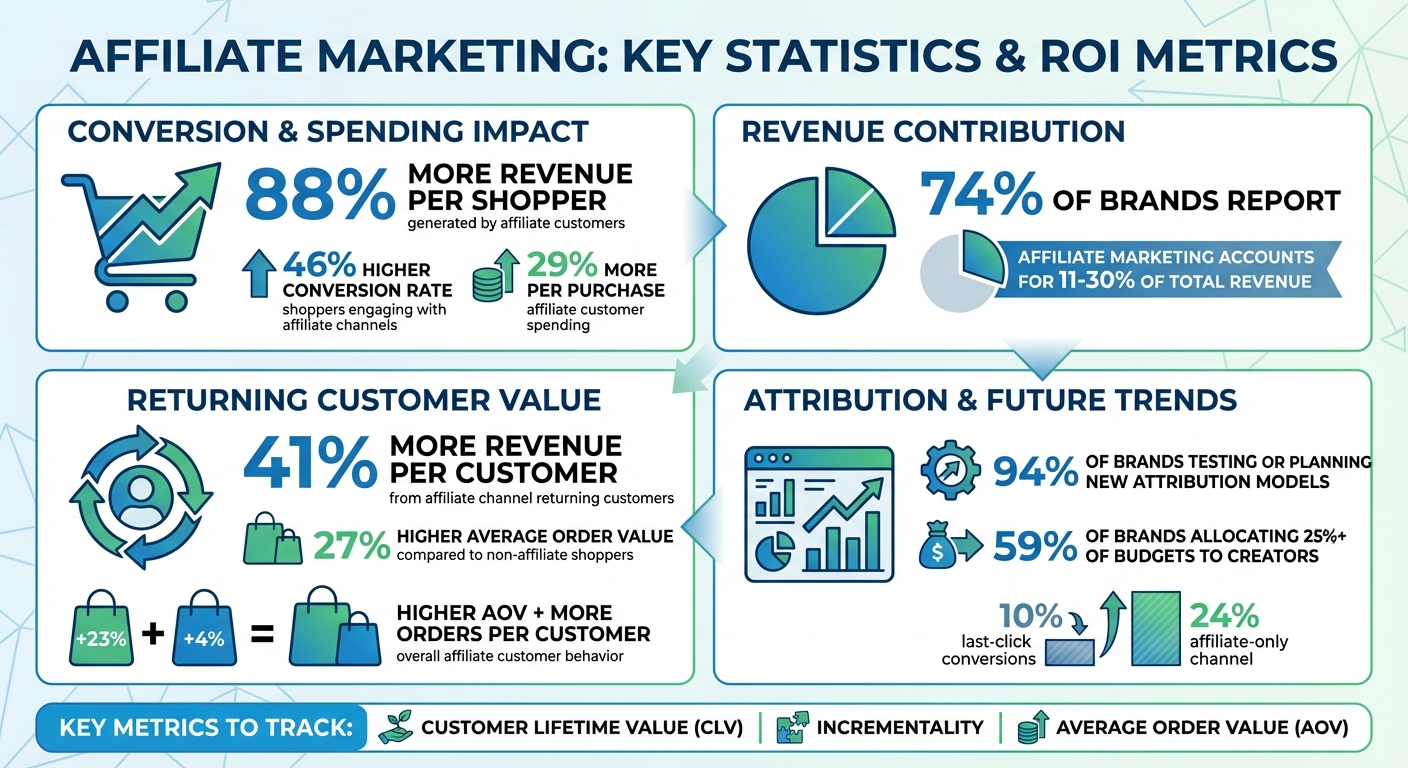
Affiliate Marketing ROI Statistics and Long-Term Impact
How should CMOs invest and measure ROI from affiliate marketing programs? feat Kerry Curran
sbb-itb-2ec70df
How Affiliate Partnerships Drive Revenue Growth Over Time
Affiliate partnerships aren’t just about quick wins – they’re a long game that pays off significantly over time. Unlike paid ads that vanish the moment you stop funding them, affiliate content keeps working for you long after it’s created. Todd Crawford, Co-founder of impact.com, explains it perfectly:
"The links are out there, some years old, still getting traffic and driving value".
This persistence effect is what makes affiliate content so powerful. Affiliates create content that ranks on search engines, gets shared across social platforms, and remains accessible for months or even years. Each piece essentially becomes a long-term asset, consistently bringing in new customers without requiring constant reinvestment. On top of that, when it comes to returning customers, the affiliate channel delivers 41% more revenue per customer and a 27% higher average order value compared to non-affiliate shoppers.
Case Studies of Long-Term Affiliate Success
Real-world examples highlight how affiliate partnerships can drive consistent, long-term growth. Take A.L.C., a luxury fashion brand, for instance. They realized they were too reliant on a single affiliate partner and decided to diversify. By collaborating with January Digital during Q4, they onboarded 10 new high-performing affiliates like Capital One Shopping and ShopMy. They also raised their commission rate with LTK from 10% to 16%, earning "premier advertiser" status. The results? Rakuten Rewards’ share dropped from 33% to 22%, while the new partnerships brought in fresh growth. At the same time, they optimized cashback events with Rakuten, achieving a 60% revenue increase from Rakuten alone while building a more balanced affiliate network.
Le Col, a cycling apparel brand, took a different route. They worked with Acceleration Partners to turn their affiliate program into a primary revenue engine. Their efforts resulted in a 282% increase in affiliate revenue, transforming the channel from a side strategy to a core business driver.
Similarly, Unbound Merino adopted unconventional affiliate strategies with Acceleration Partners and saw a 148% boost in revenue. What ties these stories together? Each brand treated affiliate partnerships as long-term investments rather than quick transactions, leading to outstanding results.
The Compounding Effect of Brand Alignment
The most effective affiliate programs go beyond chasing numbers – they focus on aligning with partners who share their brand’s values. When affiliates genuinely connect with a brand’s mission and audience, their content feels more authentic, which drives not only immediate sales but also lasting customer loyalty.
This alignment creates a ripple effect. Affiliates who truly understand and believe in a brand produce better content, which attracts loyal, high-value customers. These customers tend to spend more per transaction and shop more frequently. In fact, affiliate customers generate a 23% higher average order value and place 4% more orders per customer compared to non-affiliate shoppers.
Brands are catching on to this and diversifying their affiliate strategies. Many are building ecosystems with a mix of creators, publishers, and brand advocates to engage customers at every stage of their journey. By spreading their efforts across multiple partner types, brands reduce risk while expanding their reach. Instead of relying on a single high-performing partner, they create multiple touchpoints that reinforce their message across various channels and audiences.
The rise of creator partnerships highlights this shift. Today, 59% of brands plan to allocate at least 25% of their affiliate budgets to creators. Creators not only drive immediate sales but also build long-term trust through authentic endorsements. This trust turns casual browsers into repeat customers, delivering both short-term gains and lasting brand loyalty.
Using Data and Analytics to Improve Affiliate ROI
Affiliate partnerships are known for their long-term benefits, but leveraging data can take their performance to a whole new level. The difference between a thriving affiliate program and a mediocre one often comes down to how effectively data and analytics are used. By identifying the partners who bring real value and continuously refining their contributions, you can significantly boost your results.
Traditional last-click attribution models fall short in capturing the full scope of an affiliate’s impact. In fact, 94% of brands are either testing or planning to implement alternative attribution models that recognize affiliates who play a role earlier in the customer journey. These new models allow brands to reward partners fairly and allocate budgets more effectively, especially to those who create lasting value. This shift in attribution is paving the way for a more nuanced understanding of affiliate performance.
Using Data to Identify High-Performing Affiliates
To pinpoint your most effective affiliates, focus on metrics like Customer Lifetime Value (CLV) and Average Order Value (AOV). For instance, an affiliate might not generate a high volume of clicks, but if their referred customers make larger purchases or stick around longer, their impact on your bottom line is far greater than it appears at first glance.
Another key metric is incrementality, which measures the additional sales driven by an affiliate that wouldn’t have occurred otherwise. You can calculate this by comparing groups exposed to an affiliate campaign against control groups that weren’t. This helps you separate affiliates who generate new demand from those who simply capture existing intent.
For B2B SaaS companies, the metrics shift slightly due to longer sales cycles. Conversion rates typically range from 3% to 7%, and cookie durations should be set between 90 and 180 days to reflect this timeline. Additionally, tracking trial-to-paid conversion rates – which often fall between 10% and 25% – can reveal which affiliates are bringing in high-quality leads. Once you’ve identified your top performers, keeping a close eye on their activity ensures ongoing improvement in ROI.
Continuous Optimization Through Performance Dashboards
Real-time dashboards are game-changers when it comes to turning raw data into actionable insights. Companies using these tools report a 20–30% boost in ROI, with 82% experiencing a 25% reduction in Cost Per Acquisition (CPA). The most effective dashboards prioritize metrics like CLV, Return on Ad Spend (ROAS), and AOV, rather than vanity metrics like total clicks. Multi-touch attribution is often integrated to provide a clearer picture of how each affiliate contributes across the entire customer journey.
Transparency is another critical factor. When affiliates have real-time access to their performance data – such as clicks, conversions, and commissions – they’re more likely to stay engaged and prioritize your brand. Automated tools can also flag unusual patterns early, helping protect your ROI. For example, PUMA successfully reduced fraudulent activities by over 90% through a combination of protective contract clauses and consistent monitoring.
With the growing adoption of AI, automation has become the norm in affiliate marketing. AI-powered dashboards can predict affiliate ROI, recommend optimal commission structures, and even suggest new partners who align with your brand’s goals. These insights help eliminate inefficiencies and ensure that every affiliate partnership contributes to long-term growth. By focusing on what works and cutting out what doesn’t, data-driven strategies pave the way for sustained affiliate success.
Maintaining Quality While Scaling Affiliate Programs
Scaling an affiliate program is a tightrope walk. As you bring in more partners, the potential for quality issues grows dramatically. In fact, 23% of brands identify affiliate quality as a major concern. And they’re not wrong – invalid traffic rates for lead generation typically range from 8.5% to 25%, with extreme cases reaching an alarming 90%. The solution? Build systems that catch issues early without stifling growth. While data-driven strategies enhance performance, having strong quality controls in place is just as critical.
To avoid spreading your team too thin, many successful brands use a tiered management model. High-performing affiliates – those driving the most revenue – receive personalized attention and dedicated resources. Mid-tier partners are managed in groups through webinars and batch communications, while low-tier affiliates rely on self-service tools and automation. This structure ensures consistent oversight across your network without overloading your team.
Methods for Vetting and Onboarding Affiliates
The vetting process should start well before affiliates begin promoting your products. PUMA, for example, introduced a structured Marketing Quality Assurance (QA) framework in 2025. This included protective clauses in contracts and regular monitoring, which helped reduce fraudulent activity and cut their cost-per-acquisition (CPA) by 30%. By treating vetting as a strategic priority rather than a formality, they complemented earlier fraud detection efforts with impressive results.
A solid QA framework often operates in three phases:
- Phase 1: Manual vetting using checklists to confirm compliance and brand alignment.
- Phase 2: Real-time traffic monitoring to detect red flags like sudden spikes in bounce rates or unusually fast click-to-conversion times (less than 5 seconds often signals bot activity).
- Phase 3: Automated fraud detection using tools like behavioral analytics and device fingerprinting to uncover patterns that manual reviews might miss.
"Before we bring on a partner, we build a ‘success scorecard’ that defines what a win looks like, what compliance standards must be met, and what partner behavior will make the relationship work." – Sid Jashnani, CEO, Rekruuto
Setting clear quality benchmarks during onboarding can prevent future headaches. For instance, requiring new affiliates to meet minimum standards – like a Domain Rating of 60+ and steady organic growth – helps ensure they’re a good fit. IG Group applied this strategy in the regulated trading sector by using automated tools to monitor influencer content for compliance. This approach resulted in a 128% rise in productive and compliant affiliates.
Balancing Growth with Credibility
The pressure to scale quickly can sometimes lead to shortcuts that harm your brand’s credibility. Brand bidding violations, where affiliates compete for your own keywords in paid search, are a common issue – impacting 31% to 43% of brands. This practice forces companies to pay for customers they might have gained organically. To address this, Rosetta Stone used features like Tracking Detail Reporting and "Protect" tools to validate sales data and identify unauthorized activities, saving $120,000 in the process.
Diversifying your affiliate pool can also help balance growth and integrity. Adding a mix of content creators and mass media publishers allows you to expand your reach while staying true to your brand’s core values – provided each partner aligns with your audience.
"Look for alignment in values and audience. Even the most compliant partner can harm brand equity if there’s a mismatch." – Dario Markovic, Forbes Council
As programs scale, automation becomes a game-changer. Today, 97% of brands and 96% of creators rely on AI to manage tasks like payouts, commission calculations, and fraud detection. This reduces human error and frees up your team to focus on building strategic relationships. For instance, B&Q used custom data reporting to compare first-party and third-party sales, fine-tuning their affiliate strategy and boosting sales by 30%. The right tech can help you grow efficiently while still maintaining the personal touch that keeps your top partnerships thriving.
Measuring ROI and Long-Term Value from Affiliate Relationships
Many brands still rely on last-click attribution to evaluate affiliate performance, but this method doesn’t show the full picture. It overlooks the long-term value affiliates bring to the table. The real question isn’t just how much revenue an affiliate generates today – it’s about the value they continue to contribute over the years.
To shift the focus from short-term results to long-term benefits, brands need to track metrics that go beyond immediate conversions. Customer Lifetime Value (CLV) is a key metric here. It reflects the total profit a customer brings throughout their relationship with your brand, making it a powerful tool for assessing affiliate performance. Affiliates who drive higher CLV are worth prioritizing, even if it means adjusting commission structures. This approach moves beyond traditional metrics and highlights the lasting impact of affiliate partnerships.
Tracking Lifetime Customer Value
To calculate CLV, multiply the average revenue per customer by their lifespan, then subtract the total service costs. Breaking this data down by affiliate partner can reveal their true impact. For instance, orders involving affiliates often show a 27% higher average order value.
For subscription-based businesses, CLV becomes even more critical. Using a retention model formula – where you divide the average monthly revenue per customer (adjusted for gross margin) by the monthly churn rate – you can determine how much you can afford to spend on affiliate-driven customer acquisition. A real-world example: In April 2023, Acceleration Partners applied this method for a B2B service provider, achieving a monthly product purchase rate at sign-up of 8.5% (well above the 6.25% target) and a 40% active seller rate over three months, surpassing the 25% goal.
"Customer lifetime value is an important metric because it represents an upper limit on spending to acquire new customers." – Wikipedia
Aligning affiliate commissions with CLV is a smart move. Reward affiliates who bring in loyal, high-retention customers rather than focusing solely on clicks. Metrics like the "void rate" – which tracks cancellations and returns – help paint a clearer picture of profitability. Considering that 42% of sales leaders identify recurring revenue as their top revenue source, it’s clear why long-term tracking matters.
Distinguishing Short-Term Wins from Long-Term Gains
Beyond CLV, evolving attribution models help uncover the lasting contributions of affiliates. Traditional last-click models only credit the final touchpoint, ignoring affiliates that drive early awareness or mid-funnel engagement. Interestingly, only 10% of conversions involve an affiliate as the last touch, while 24% show the affiliate as the sole channel.
Incrementality measurement fills this gap by identifying the unique sales that wouldn’t have happened without a specific affiliate’s efforts. Take Zenni Optical as an example – they discovered $1.5 million in hidden partnership value by moving beyond last-click attribution. Kayla Castro, Senior Manager of Affiliates and Partnerships at Zenni Optical, explains:
"I typically define incrementality as the additional value… whatever that means to a brand, whether it’s a sale, an email sign-up, or a lead, whatever it is, the additional value that an affiliate would bring to the relationship that otherwise would be lost." – Kayla Castro, Senior Manager of Affiliates and Partnerships, Zenni Optical
Rugs Direct took a step further in 2024 by adopting a U-shaped attribution model that rewards affiliates at both the discovery and conversion stages. This shift resulted in 600% year-over-year revenue growth and an 800% return on ad spend.
Another way to assess affiliate performance is by distinguishing between new customer acquisition and repeat buyer targeting. Identifying which affiliates bring in "new-to-file" customers versus those engaging existing buyers can clarify their strategic role in driving long-term revenue.
The longevity of affiliate content also highlights its enduring value. Reviews, tutorials, and comparison guides can continue generating traffic and sales months or even years after publication. As Todd Crawford, Co-founder of impact.com, puts it:
"The links are out there, some years old, still getting traffic and driving value." – Todd Crawford, Co-founder, impact.com
This suggests that a standard 30-day attribution window may cut off a significant portion of long-term gains. With 83.8% of retail dollars still spent in-store, despite most research happening online, extended attribution windows and cross-channel tracking are essential for capturing delayed value.
Lastly, tracking Average Order Value (AOV) alongside volume metrics is crucial. Affiliates driving high volumes but low AOV may boost short-term revenue while hurting long-term profit margins. Mapiful used this insight to achieve a 1,200% revenue increase in one year by identifying top-performing partners and recruiting 13,000 new affiliates modeled after them.
The takeaway? 94% of brands are testing or planning to adopt new attribution models. Traditional last-click measurement leaves too much value untapped. By adopting multi-touch or algorithmic attribution models, brands can uncover the true, lasting impact of affiliate partnerships and set the stage for sustained growth.
At Growth-onomics, we use these data-driven strategies to help brands maximize the long-term potential of their affiliate programs.
Conclusion
Affiliate partnerships create a powerful engine for growing revenue over time. Affiliates are shown to drive 88% more revenue per shopper, achieve 27% higher average order values, and deliver a 3x higher customer lifetime value when evaluated thoroughly. On top of that, 74% of brands report that affiliate marketing contributes between 11% and 30% of their total revenue, proving its role as a key driver for long-term growth.
To fully harness this potential, moving away from outdated last-click attribution models is critical. With 94% of brands either testing or planning to adopt new attribution methods, it’s clear that traditional approaches often fail to capture the full value affiliates bring to the table.
Success in affiliate marketing revolves around three key principles: measuring incrementality, broadening your partner base, and focusing on lifetime value. Affiliates who bring in loyal, repeat customers should take precedence over those who only generate one-time, discount-driven sales. Additionally, affiliate content often continues to drive meaningful traffic and sales well beyond its initial publication.
Case studies consistently highlight how data-driven affiliate programs deliver lasting results. Leading brands use data to pinpoint their top-performing affiliates, refine winning strategies, and eliminate approaches that don’t work. They measure contributions across the entire funnel, reward affiliates fairly, and create systems that keep customers engaged at every stage of their journey. These practices emphasize the importance of using data to shape affiliate strategies. At Growth-onomics, we specialize in helping brands unlock the full potential of their affiliate programs through these proven methods.
The question isn’t whether affiliate marketing works – it’s whether you’re measuring and managing it in a way that captures its true, lasting impact.
FAQs
How do I measure the long-term ROI of affiliate partnerships effectively?
To truly understand the long-term ROI of your affiliate partnerships, you need to look beyond basic metrics like clicks or signups. One powerful method is incrementality analysis. This approach helps you figure out how much extra revenue affiliates bring in by focusing on the sales they generate that wouldn’t have happened otherwise – separate from existing customers or organic traffic. It’s a way to ensure your partnerships are genuinely contributing to growth.
In addition, tracking metrics like customer lifetime value (CLV), retention rates, and overall revenue growth over time can give you a clearer picture of the lasting effects of these relationships. Regularly evaluating these data points and fine-tuning your strategy allows you to use your resources wisely and get the most out of your affiliate efforts in the long run.
How can I diversify my affiliate partnerships to achieve long-term growth?
Diversifying your affiliate partnerships is a smart way to create a program that can stand the test of time. Think beyond the usual suspects and bring in a mix of partners – like influencers, publishers, loyalty platforms, and content creators. This broader network not only reduces your reliance on a handful of affiliates but also opens doors to new audiences and strengthens your brand’s visibility.
Take the time to conduct a competitive analysis to pinpoint any gaps in your strategy. This can help you discover untapped opportunities that could bring significant value. Prioritize partnerships that align with your business objectives, and rely on data to fine-tune your performance. By actively expanding and balancing your affiliate base, you’ll set the foundation for a program that delivers steady results and long-term growth.
How can I identify and fairly reward top-performing affiliates beyond last-click attribution?
To move beyond last-click attribution and ensure top-performing affiliates are rewarded fairly, it’s crucial to assess their incremental impact and long-term contributions. Don’t just focus on immediate conversions – consider advanced attribution models that track metrics like customer lifetime value, retention rates, and the total revenue they help bring in. This gives you a more accurate understanding of their overall value.
Once you’ve pinpointed your standout affiliates, adjust your reward programs to motivate them to continue building brand trust, customer loyalty, and steady growth. Acknowledging their broader role helps nurture stronger, enduring partnerships that can drive sustained success for your business.
