


Affiliate attribution models determine how credit is assigned to various customer interactions that lead to a conversion. Choosing the right model can improve revenue and provide fair compensation to affiliates. Here’s a quick breakdown of six common models and their key points:
- First-Touch: Rewards the first interaction entirely. Simple but ignores later touchpoints. Best for awareness campaigns.
- Last-Touch: Credits the final interaction. Easy to implement but overlooks earlier efforts. Works well for short sales cycles.
- Linear: Distributes credit equally across all touchpoints. Fair but may oversimplify complex journeys. Ideal for long sales cycles.
- Position-Based: Prioritizes the first and last interactions (40% each) while giving 20% to the middle. Balanced but may undervalue mid-funnel activities. Suited for multi-channel strategies.
- Time Decay: Assigns more credit to recent interactions. Great for long sales cycles but undervalues early touchpoints.
- Custom: Fully adjustable to fit specific business needs. Offers flexibility but requires advanced tools and expertise.
Each model has strengths and weaknesses, so your choice should align with your sales cycle, goals, and available resources. For businesses with complex journeys, multi-touch models like position-based or custom are often more effective.
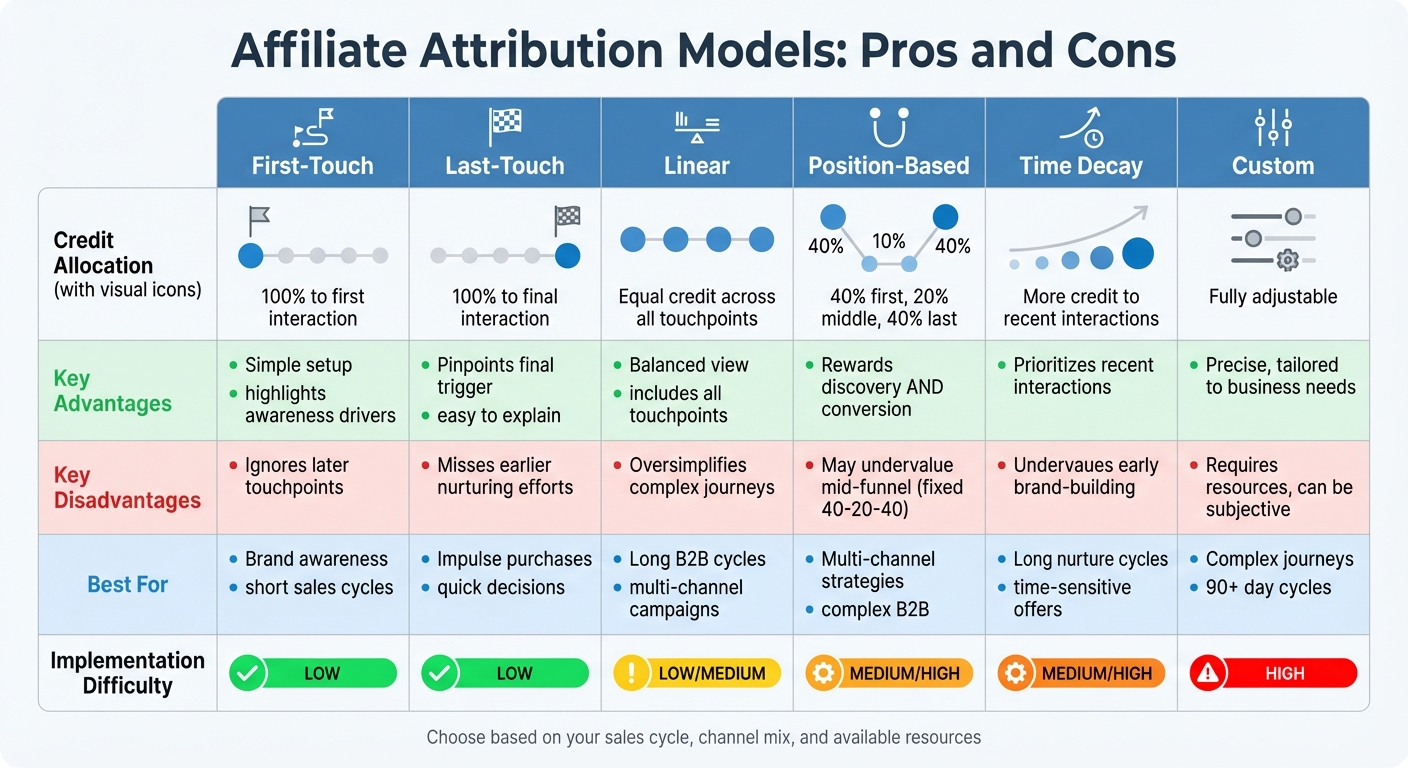
Affiliate Attribution Models Comparison: Pros, Cons, and Best Use Cases
1. First-Touch Attribution
Credit Allocation
First-touch attribution gives 100% of the credit for a conversion to the very first interaction a customer has with your brand. In affiliate marketing, this means the affiliate who introduces the customer to your product earns the full commission, regardless of any later touchpoints. For instance, if a customer clicks an affiliate’s blog link on Day 1 but interacts with other ads or emails before finally purchasing on Day 30, the Day 1 affiliate still receives the entire commission. While straightforward, this method has both advantages and drawbacks, which we’ll break down below.
Strengths
The simplicity of first-touch attribution is its biggest strength. It’s easy to set up and explain, making it a popular choice for affiliate programs. Because it rewards only one partner, disputes over commission are less likely. This model is also great for identifying which affiliates are best at driving brand awareness by sparking that crucial first interaction. As MNTN puts it:
"The initial connection between a customer and your brand is the most important, as no subsequent touchpoints could have occurred if not for that initial engagement".
This makes it a solid choice for measuring the effectiveness of top-of-funnel activities, such as campaigns designed to introduce your brand to new audiences.
Weaknesses
Despite its simplicity, first-touch attribution has notable limitations. It overlooks all the other touchpoints in the customer journey – like follow-up emails, retargeting ads, or the final click that leads to a purchase. This can skew performance data, especially since modern buyers often engage with a brand seven to nine times before converting. Affiliates or channels that play a key role in nurturing or closing the sale may be undervalued, while early-stage interactions may be overcompensated.
Best Use Cases
First-touch attribution works best for brand awareness campaigns aimed at reaching new customers. It’s particularly effective for new product launches or market entry efforts, where the goal is to make a strong first impression. Additionally, it’s ideal for products with short sales cycles – such as low-cost or impulse purchases – where customers are more likely to convert quickly after their initial interaction.
sbb-itb-2ec70df
What are attribution models?
2. Last-Touch Attribution
Last-touch attribution takes a different approach to assigning credit compared to first-touch attribution, focusing entirely on the final interaction before a customer converts.
Credit Allocation
In this model, 100% of the credit goes to the last tracked interaction before a conversion occurs. For affiliate marketing, this means the affiliate responsible for that final interaction gets the entire commission. For example, even if an earlier affiliate introduced the customer to your brand, the last one in the chain – such as a coupon site – receives full credit. A popular variation called "last non-direct click" excludes direct traffic (like someone typing your URL) and instead credits the last measurable marketing touchpoint, such as an affiliate link or a paid ad.
Strengths
The main appeal of last-touch attribution is its simplicity. It’s the default model in tools like Google Analytics and Salesforce, requiring little to no technical setup. This model is particularly useful for pinpointing the specific offer or call-to-action that led directly to a conversion. As Channel99 puts it, this approach answers the question: "What got someone to act?" Its integration with analytics platforms also makes it cost-effective and easy to implement, especially for teams focused on tracking the final steps before a deal closes.
Weaknesses
The biggest issue with last-touch attribution is that it ignores all prior interactions. Imagine a customer discovers your product through an affiliate’s blog, engages with other channels, and finally clicks a coupon link to make a purchase. In this scenario, only the coupon site gets credit, leaving earlier touchpoints unrecognized. This creates a skewed view of performance, often leading to over-investment in closing tactics (like retargeting or branded search) at the expense of awareness-building efforts that establish trust. Channel99 sums it up well:
"If you’re using last-touch to guide strategy, you’re mistaking the final push for the full journey".
This shortcoming becomes even more critical for B2B companies, where buying decisions often involve multiple stakeholders and take place over longer periods.
Best Use Cases
Last-touch attribution shines in scenarios with short buying cycles where customers make quick decisions with minimal research. It’s particularly effective in product-led growth strategies, such as campaigns driving free trial sign-ups or promotions with immediate conversion goals, like flash sales. Additionally, it’s helpful for testing bottom-of-funnel campaigns to see which landing pages or offers drive the most immediate action. However, relying solely on this model can be limiting. To get a more comprehensive view of the customer journey, it’s wise to pair last-touch attribution with other models. Up next, we’ll dive into linear attribution, which takes a more balanced approach by spreading credit across all touchpoints.
3. Linear Attribution
Credit Allocation
Linear attribution takes a straightforward approach: it divides credit equally among all touchpoints in a customer journey. Instead of prioritizing the first or last interaction, each touchpoint gets the same share of credit – calculated as 1 divided by the total number of interactions (1/n). For instance, if a customer engages with four channels – like a blog post, a LinkedIn ad, a webinar, and a paid search ad – each channel would earn 25% of the credit for the conversion. This method ensures that every step in the journey, including those in the middle, is acknowledged.
Strengths
One of the standout features of linear attribution is its straightforwardness and fairness. As Chris Larkin, Managing Partner and CTO at Arcalea, puts it:
"The benefit of linear attribution is its simplicity and inclusiveness. No touchpoints are ignored as potentially insignificant."
This model is especially helpful for marketers transitioning from single-touch approaches. It also provides a broad overview of how different channels contribute to the customer journey. Lukas Toma, Data Manager at Zapier, emphasizes this, saying:
"Linear attribution builds a much fuller picture of how various efforts contribute to conversions: for marketing attribution, it’s the most robust in determining the effectiveness of your full marketing mix."
Weaknesses
While linear attribution is easy to use, it has its drawbacks. The assumption that all touchpoints are equally influential doesn’t always reflect reality. For example, actions like requesting a product demo often have a bigger impact than passive interactions, such as seeing a display ad. This equal weighting can result in over-crediting low-impact activities and under-crediting those that drive conversions. Additionally, in complex sales cycles with many touchpoints, the credit per interaction can become so small – just 1-2% – that it’s difficult to extract meaningful insights.
Best Use Cases
Linear attribution works well for longer sales cycles where multiple touchpoints collectively build trust and familiarity. It’s particularly useful for B2B products or subscription services, where a mix of channels – ads, emails, blogs, webinars – gradually leads to a conversion. For small businesses or startups without access to advanced data science tools, this method offers a practical solution. On the other hand, for quick, impulse-driven purchases or short sales cycles, simpler models like last-touch attribution might provide a more accurate reflection of customer behavior, as the final interaction often plays a decisive role.
This even-handed credit distribution sets the stage for position-based attribution, which shifts focus by giving more weight to the first and last touchpoints while still considering middle interactions.
4. Position-Based Attribution
Position-based attribution, often referred to as the U-shaped model, strikes a balance by focusing on the most critical parts of the customer journey: the beginning and the end.
Credit Allocation
In this model, 40% of the credit is typically given to the first touchpoint (where the customer first discovers the brand) and another 40% to the last touchpoint (the moment of conversion). The remaining 20% is divided equally among the interactions in the middle of the journey.
For instance, imagine a customer’s journey includes six touchpoints: a blog post, a social media ad, two email newsletters, a webinar, and a retargeting ad. Under this model, the blog post (first touchpoint) and the retargeting ad (last touchpoint) each receive 40% of the credit. The other four interactions split the remaining 20%, with each getting 5%.
This method provides a structured way to evaluate how different touchpoints contribute to a successful conversion.
Strengths
One of the standout benefits of position-based attribution is its ability to reward both the discovery phase and the final conversion. Affiliates or campaigns responsible for introducing customers to the brand, as well as those that seal the deal, are both acknowledged. This makes it a useful model for justifying investments in both top-of-funnel activities (like content marketing or paid ads) and bottom-of-funnel efforts (like retargeting).
Unlike linear attribution, which treats all touchpoints equally, this model recognizes that not every interaction has the same level of influence. By prioritizing the first and last touchpoints, it reflects the critical role these stages play in guiding customers through the journey.
Weaknesses
However, the fixed 40/20/40 split can be a drawback. It doesn’t always align with every customer journey, especially in cases where mid-funnel activities – like signing up for a newsletter, attending a webinar, or trying a product demo – play a significant role in influencing the decision-making process. These middle interactions often receive only a small portion of the credit, which can undervalue their importance.
Additionally, the model assumes the first and last touchpoints are always the most impactful. This assumption may not hold true in industries with lengthy or complex sales cycles, such as technical or B2B sales, where ongoing nurturing efforts are crucial. When a journey includes numerous middle touchpoints, the minimal credit assigned to each can also make it challenging to draw actionable insights.
Best Use Cases
Position-based attribution is particularly effective for multi-channel strategies that focus on both acquisition and conversion. It’s well-suited for affiliate programs that involve a mix of content creators (who drive awareness) and platforms that help close the sale.
B2B companies can also benefit from this model, especially when buying decisions involve multiple stakeholders. It ensures that both the initial influencer and the final decision-maker are appropriately credited. However, if mid-funnel nurturing is a priority or the sales cycle is especially intricate, it may be worth adjusting the credit distribution or exploring more advanced attribution models.
5. Time Decay Attribution
Time decay attribution takes a more dynamic approach to assigning credit, focusing on the timing of interactions. The idea is simple: the closer a touchpoint is to the actual conversion, the more credit it gets. This model values all touchpoints but gives more weight to the recent ones, acknowledging their stronger influence on the final decision.
Credit Allocation
This model uses a mathematical decay curve, often based on a "half-life" parameter. For instance, platforms like Google Analytics typically set the default half-life at 7 days. This means a touchpoint 7 days before the conversion gets half the credit of one on the same day, while one 14 days prior gets only 25%. The formula looks like this:
$y = 2^{(-x/\text{half-life})}$
Here, x represents the number of days before the conversion. Unlike linear or last-touch models, time decay attribution adjusts credit based on timing. For example, if a customer interacts with a social media ad 21 days before purchase, views a display ad 14 days prior, discovers the brand via organic search 7 days before, and clicks an email link on the day of purchase, the email interaction gets the most credit, followed by organic search, then the display ad, with the social media ad receiving the least.
Strengths
This model aligns with the idea that recent actions often hold the most sway in decision-making. By giving credit to all touchpoints while prioritizing those closer to conversion, it provides a broader perspective than single-touch models. It also highlights mid-funnel activities, such as email campaigns and webinars, which might be ignored in other models. Additionally, time decay attribution is easy to implement on platforms like Google Analytics or Adobe Analytics, making it accessible for most businesses.
Weaknesses
However, time decay attribution has its downsides. It tends to undervalue early touchpoints that build brand awareness, such as social media or content marketing. These initial interactions might have sparked interest but lose credit as time passes. At the same time, bottom-funnel channels like paid search and retargeting often receive more credit simply because they occur closer to the conversion, even if they weren’t the key driver. As Dan Wakefield from CallRail puts it:
"Time-decay attribution is a multi-touch attribution model that gives some credit to all the channels that led to your customer converting, with that amount of credit being less (decaying) the further back in time the channel was interacted with."
Despite these limitations, the model can still provide valuable insights in specific contexts.
Best Use Cases
Time decay attribution works particularly well for long B2B sales cycles, where decisions often span weeks or months. Research shows that 71% of B2B buyers download multiple pieces of content during their decision-making process, making this model ideal for tracking those extended journeys. It’s also effective for Account-Based Marketing strategies, where engagement ramps up as deals near completion. Industries like travel and hospitality, where customers research extensively but make final decisions closer to departure dates, can also benefit. For performance marketing channels like affiliate programs or short-term promotional campaigns, time decay attribution helps pinpoint which final interaction sealed the deal.
For longer sales cycles – lasting two months or more – it’s worth adjusting the half-life to 30 or 45 days. This ensures that upper-funnel activities, like brand awareness campaigns, don’t lose too much credit over time. By refining credit allocation, time decay attribution sets the stage for exploring custom models tailored to specific business needs.
6. Custom Attribution
Custom attribution takes the idea of assigning credit to marketing touchpoints and puts the control in your hands. Unlike preset models with rigid rules, this approach lets you decide how much credit each touchpoint deserves based on what truly matters to your business. For instance, you could start with a W-shaped model but tweak the weights to 15% for the first touch, 35% for the middle, and 50% for the last to emphasize conversions closer to the bottom of the funnel.
Credit Allocation
The flexibility of custom attribution allows you to fine-tune your model to fit your business goals, sales cycle, and marketing channels. For example, if direct mail plays a critical role in driving digital engagement for your company, you can assign it a higher weight – something automated models might overlook entirely. Factors like the length of your sales cycle, the importance of specific interactions (like webinars or demo requests), and the dynamics within your team all come into play when distributing credit. As Darshil Gandhi, Director of Product Marketing at Amplitude, puts it:
"Custom attribution models enable you to decide which touchpoints are most important based on the customer journey you’ve designed."
By assigning weights that reflect your actual customer journey, you can ensure your model aligns with your business’s unique needs. Even with AI-driven attribution influencing most decisions today, custom models remain critical for businesses that require manual control and precision.
Strengths
Custom attribution shines where standard models fall short. It recognizes the touchpoints that drive and nurture demand, adapting to the specific nuances of your customer journey. Unlike fixed frameworks, custom models allow you to adjust weights dynamically based on engagement signals unique to your funnel. Businesses that implement advanced multi-touch models, including custom ones, often see up to a 30% increase in marketing ROI by pinpointing the true drivers of conversion. The ability to tailor the model ensures you’re not boxed into predefined rules but instead can highlight what truly influences your customers.
Weaknesses
However, this flexibility comes with challenges. Since you’re in charge of setting the rules, subjectivity can creep in, leading to biased outcomes. Teams like SEO or PPC may push for weightings that favor their channels to protect their budgets. As the Adobe Experience Cloud Team warns:
"Because people don’t want to lose their portions of the budget, they can run attribution models that purposely make their own work seem more impactful than it might be."
Frequent adjustments can also be a problem. Changing weightings too often can distort historical comparisons and lead to unreliable insights. Additionally, custom attribution requires a robust tech stack, such as a data warehouse like Snowflake, along with specialized tools to build and visualize your custom rules.
Best Use Cases
Custom attribution is ideal for businesses with complex, multi-channel customer journeys that standard models can’t fully address. If your sales cycle stretches beyond 90 days, for instance, a first-touch model might overlook crucial top-of-funnel campaigns. It’s particularly effective for scenarios like offline-to-online interactions or tracking key mid-funnel actions, such as webinar attendance or demo requests. Tools like Amplitude or Adobe Analytics can help you compare models and identify gaps that custom rules can address. To maintain objectivity, assign a dedicated team to oversee the model and ensure fair credit distribution across departments. Adjust your custom model quarterly to reflect changes in strategy or the addition of new channels.
This tailored approach provides the flexibility to align your attribution model with the unique demands of your business, ensuring a more accurate understanding of what drives success.
Comparison Table: Pros and Cons
The table below outlines the strengths and weaknesses of different attribution models, along with their ideal use cases and the level of effort required for implementation. Use this as a quick reference to understand how each model performs in various scenarios.
| Model Name | Advantages | Disadvantages | Recommended Use Cases | Implementation Difficulty |
|---|---|---|---|---|
| First-Touch | Highlights awareness drivers and is simple to set up. | Ignores later interactions, overemphasizing early touchpoints and missing the full customer journey. | Ideal for brand awareness campaigns, acquiring new customers, and short sales cycles. | Low |
| Last-Touch | Pinpoints the final trigger for a purchase and is easy to explain to stakeholders. | Fails to credit earlier stages like SEO or nurturing channels, giving an incomplete view of the customer journey. | Best for impulse purchases, low-cost items, short sales cycles, and bottom-of-funnel strategies. | Low |
| Linear | Offers a balanced view by including all touchpoints, ensuring fair credit across channels. | Treats every interaction equally, which can oversimplify complex journeys. | Works well for long decision-making cycles (e.g., B2B), multi-channel campaigns, or businesses new to multi-touch attribution. | Low/Medium |
| Position-Based | Gives weight to both the first and last touchpoints while recognizing key milestones in between. | Fixed weighting (e.g., 40-20-40) may undervalue middle-funnel efforts and adds complexity to analysis. | Suited for multi-channel journeys, complex B2B sales, and mid-to-long sales cycles with defined lead milestones. | Medium/High |
| Time Decay | Prioritizes recent interactions, aligning with rising purchase intent and recency effects. | Can undervalue early brand-building efforts and relies on intricate weighting formulas. | Best for short-term promotions, time-sensitive offers, or high-consideration purchases with long nurture cycles. | Medium/High |
| Custom/Data-Driven | Delivers precise results by incorporating cross-device paths and machine learning. | Requires significant resources, is costly, and can feel opaque to stakeholders due to its complexity. | Ideal for large e-commerce operations, high-budget campaigns, and tech companies managing complex multi-channel data. | High |
This breakdown highlights the trade-offs of each model. Recent surveys reveal that over half of marketers find last-touch attribution "somewhat effective", and nearly 50% still rely on single-touch models despite their limitations. Chris Larkin, Managing Partner and CTO at Arcalea, explains:
"The analytics are within reach, and the hardest part is having the discipline to let data, not intuition, guide decisions".
Ultimately, the best model depends on your sales cycle, channel mix, and available resources. Single-touch models are better for straightforward journeys, while more intricate campaigns benefit from advanced attribution methods. Choose the model that aligns with your customer journey and business objectives. Stay tuned to learn how to select the right model for your needs.
How to Choose the Right Attribution Model
Selecting the best attribution model means aligning it with your business’s specific needs. Start by assessing your current setup. If you’re just starting out with a few marketing channels, last-touch attribution can help pinpoint immediate drivers of purchases. However, businesses using five or more channels often benefit from multi-touch models, which capture the complexity of customer interactions. This initial evaluation helps you match your approach to the scale of your operations.
The nature of your sales cycle also plays a big role. For straightforward products with short sales cycles, position-based or last-touch models work well. On the other hand, businesses with longer, more complex B2B sales cycles might opt for linear or time decay models to reflect the cumulative influence of multiple touchpoints. As Jimmy Shang, Director of Marketing Analytics and Insights at AdRoll, explains:
"Choosing the right marketing attribution model will… help you craft effective campaigns for customers who are ready to convert".
Your available resources – both in terms of budget and data – will also shape your decision. Algorithmic models require robust datasets, advanced analytics tools, and a considerable budget to implement effectively. If you’re working with limited historical data or a smaller budget, simpler rules-based models like linear or position-based attribution might be more practical. Chris Liversidge, CEO of QueryClick, emphasizes this point:
"Identifying which model is right for your brand or your business is going to be impacted by a range of different factors from the stage, scale and maturity of your marketing activity to how much time, budget and effort you are able to apply to it".
Transparency is another factor to consider, especially when working with affiliates. While data-driven models often provide greater accuracy, they can be less transparent, which may lead to confusion or mistrust among affiliates regarding compensation. Simpler models can help maintain clarity and trust. Additionally, ensure your technical infrastructure supports cross-device tracking and complies with privacy regulations like GDPR and CCPA.
Ultimately, your attribution model should reflect your business’s current stage and technical capabilities. For those looking to implement advanced attribution without in-house expertise, companies like Growth-onomics specialize in Customer Journey Mapping, Performance Marketing, and Data Analytics to help businesses translate insights into actionable strategies. To get the most out of your model, audit your customer journey, balance complexity with cost, and adjust lookback windows to fit your product’s buying cycle. Regularly review conversion data and gather feedback from affiliates to refine your approach as your business grows.
Conclusion
Selecting the right attribution model isn’t about finding a perfect fit – it’s about aligning the model with the realities of your business. While single-touch models offer straightforward insights, multi-touch models like linear, position-based, and time decay provide a broader view of intricate customer journeys. As Jason Perumal from impact.com explains:
"Marketing attribution models serve the same purpose as instant replays in sports – to help marketers determine which touchpoints contribute to the winning outcome".
When deciding, factors like your sales cycle length, marketing goals, and resources should lead the way. For short buying cycles with minimal interactions, last-touch or time decay models often work best. On the other hand, longer B2B cycles spanning over 90 days benefit from multi-touch models that capture the influence of early-stage interactions. If you’re just starting out and using fewer channels, a simple last-click model may be a practical starting point. For brands with multiple channels and robust historical data, more advanced, data-driven attribution can unlock deeper insights.
The growing complexity of customer journeys is reflected in the market for multi-touch attribution technology, which is expected to grow from $2.43 billion in 2025 to $4.61 billion by 2030. However, algorithmic models require a minimum of 1,000 monthly conversions to deliver accurate results, so it’s essential to evaluate your data volume before diving into these sophisticated solutions.
To keep pace with changing strategies and behaviors, review your attribution model quarterly. Using multiple models simultaneously can also provide a more nuanced understanding – like applying U-shaped models for budget planning and last-click models for assessing sales performance. Transparent communication about your attribution approach fosters trust with affiliates and ensures fair compensation.
FAQs
How do I choose the best attribution model for my sales cycle?
Choosing the right attribution model hinges on a few key factors: the complexity of your customer journey, the length of your sales cycle, and the depth of your data capabilities. If your sales cycle is short and straightforward, single-touch models – like first-touch or last-touch – might be sufficient. However, for longer journeys with multiple touchpoints, multi-touch models provide a clearer picture by distributing credit across various interactions. Take a close look at your touchpoints and the strength of your analytics tools to ensure the model you select aligns with your marketing strategy and helps you measure ROI effectively.
Can I use more than one attribution model at the same time?
Yes, it’s possible to use multiple attribution models at the same time. Each model – whether it’s first-touch, last-touch, or multi-touch – offers a different perspective on the customer journey. By combining these models, you can gain a broader view of performance and make more informed decisions about how credit is distributed across various touchpoints.
What data volume is needed for a custom or data-driven model?
The amount of data needed for a custom or data-driven attribution model largely depends on two factors: the complexity of the model and the volume of interaction data you have. In general, having more data improves the model’s precision and dependability. That said, the exact data requirements can differ based on the type of model you’re using and the specific industry you’re working in.