

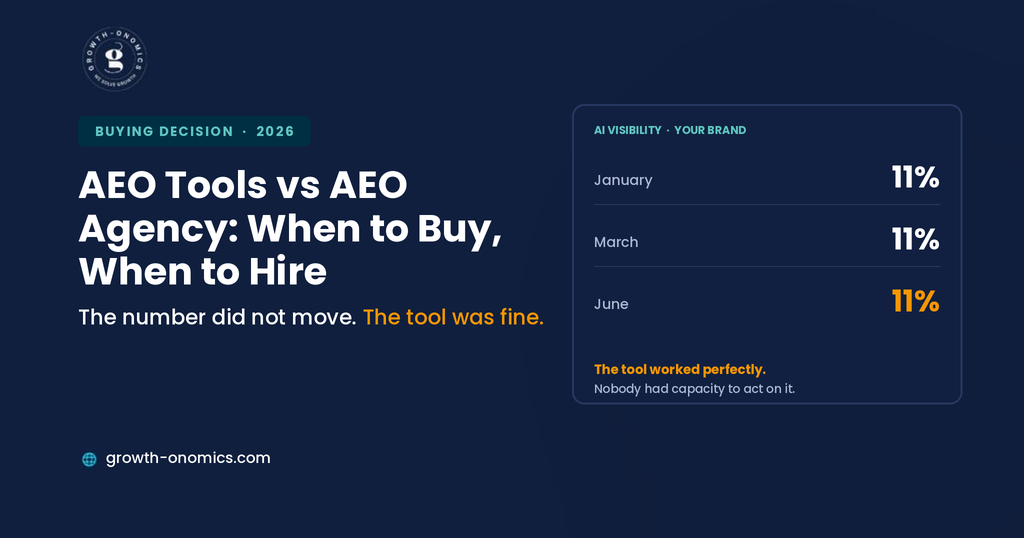
A SaaS company buys an AI visibility platform in January.
By March they have a dashboard showing their brand appears in 11% of tracked answers, a competitor appears in 34%, and the sources being cited are mostly review platforms and a roundup on a publication nobody has pitched.
By June the dashboard still says 11%.
Nothing malfunctioned. The tool did exactly what it was built to do, it measured a gap accurately, week after week, while nobody had the capacity to close it.
That’s the most common outcome of an AEO software purchase, and it has nothing to do with the software being bad.
The decision people frame as tools versus agency is really a question about which constraint is binding. If you cannot see the problem, buy visibility.
If you can see it and cannot act, buy capacity. If you can act but do not know what to do, buy judgment. Those are 3 different purchases, and the failure mode in each direction is buying one when you needed another.
This article works through when each answer is right, what the hybrid looks like, and the questions that resolve it faster than any vendor comparison will.
What Each One Specifically Provides

Both get sold as “AEO,” which obscures that they deliver almost nothing in common.
A tool provides measurement. It runs a prompt set across answer engines on a schedule, records mentions and citations, tracks share of voice against competitors, and shows which sources are being cited. Some add recommendations. None of them write your comparison page, update your G2 profile, fix your rendering, or decide what counts this quarter.
An agency provides diagnosis, judgment, and execution. It interprets what the measurement means, decides which gap to close first, and does or directs the work. Most agencies use a tool as part of that; the measurement layer is table stakes rather than the offering.
The distinction that’s critical commercially is this: software scales observation; services scale action. A tool with no one to act on it produces an expensive report.
An agency with no measurement produces confident work you cannot evaluate.
Growth-onomics runs measurement as the first step of an engagement rather than the product for exactly that reason. The audit exists to decide what gets built, not to be the deliverable.
Recognizing which of those you are missing is the whole decision, and it is answerable without talking to a single vendor.
Quick Comparison
| Dimension | AEO Tool | AEO Agency |
| What you get | Measurement and tracking | Diagnosis, judgment, execution |
| Internal capacity needed | High; someone must act | Low to moderate |
| Time to first value | Days | Weeks |
| Cost profile | Predictable subscription | Retainer or project |
| Scales with | Number of prompts and brands | Scope of work |
| Fails when | Nobody has capacity to act | Measurement is absent or unowned |
| Best when | You know what to do | You know something is wrong |
When to Buy Software
4 conditions make a tool the right first purchase. If most of them hold, buy software and skip the agency conversation for now.
You have execution capacity but no visibility. A content team shipping consistently, a developer who can fix technical issues, and someone who owns organic performance but no idea whether any of it is producing citations. The tool closes the only gap you have.
You already know your weaknesses. If you can name the pages you have not built and the review profiles you have not updated, you do not need a diagnosis. You need to watch whether fixing them works.
You are running an in-house program that needs reporting. Leadership wants a number for AI visibility. A tool produces it repeatedly and cheaply, and the reporting alone can justify the cost.
You need to establish a baseline before doing anything. Whatever else you decide, you cannot demonstrate improvement without a starting point measured on a stable prompt set. This is the strongest single argument for buying a tool early, and it applies even if you later hire; a baseline you never recorded cannot be recreated retrospectively.
The tool purchase fails when execution capacity is the actual constraint. A dashboard showing an unchanged number for 6 months isn’t a measurement problem, and no amount of additional prompt coverage fixes it.
When to Hire an Agency
4 different conditions point the other way.
You can see the problem and cannot close it. The most common situation by some distance. Citation source analysis shows answers coming from review platforms you have not updated, comparison pages you have not written, and community threads nobody is watching. That is 3 workstreams with no owner, and adding a fourth dashboard changes nothing except the precision with which you can describe the problem.
The diagnosis is genuinely unclear. Visibility is poor and you do not know whether it is a rendering problem, a content gap, an entity confusion issue, or an authority deficit. These have entirely different fixes, and picking wrong costs a quarter. Working out which is which is a judgment task, not a measurement task.
The work spans functions nobody owns together. AEO touches technical SEO, content production, product marketing, and off-domain reputation. In most SaaS companies, those sit with 4 different people, none of whom is accountable for the outcome. An agency provides the connective layer that is otherwise nobody’s job.
You need it to happen faster than hiring allows. Building an in-house capability takes a quarter to recruit and another to become productive, assuming the hire works out. If AI visibility is a current commercial problem rather than a next-year priority, that timeline may not work, and an agency is a way of buying time rather than avoiding the eventual hire.
The agency purchase fails when there is nobody internal to work with. Every engagement depends on someone supplying product knowledge, approving work, and getting things shipped.
An agency with no internal counterpart produces recommendations that sit in a document.
When You Need Both
Most mature programs run both, and the split is fairly consistent.
The tool owns measurement continuity. A frozen prompt set, run on schedule, producing comparable data over quarters. This should survive agency changes, which is an argument for owning the subscription yourself rather than accessing your agency’s instance and losing the history when the relationship ends.
The agency owns interpretation and execution. What the movement means, which gap to close first, and either doing the work or directing it. Some agencies include tooling; some work with yours. What really counts is that the data is not the deliverable.
You own the accounts. Analytics, Search Console, the visibility tool, and any prompt sets should sit in accounts you control. This is a straightforward exit-cost decision; it costs nothing to arrange at kickoff, and it is considerably harder to negotiate once a relationship is ending.
A practical structure that works: buy the tool, run it yourself for a month to establish a baseline and understand your own data, then bring in help for the parts you cannot execute. You will be a considerably better-informed buyer after that month, and the agency conversation will be about specific gaps rather than a general offer.
What the Hybrid Looks Like in Practice
Most funded B2B SaaS teams end up running a version of the same structure, and it is worth describing concretely rather than as a principle.
Measurement runs continuously and cheaply. A frozen prompt set of 20 to 40 buying-stage questions, run weekly, in a subscription you own. Nobody reviews it weekly; the value is in the trend, and someone reads it monthly.
Diagnosis happens quarterly. Citation source analysis, a look at which gaps opened or closed, and a decision about where the next quarter’s effort goes. This is the judgment layer, and it is where an agency earns its retainer or where an experienced internal owner does.
Execution splits by function. Technical fixes go to engineering, content restructuring goes to whoever owns the pages, off-domain work goes to whoever owns reviews and communities. The common failure is that the third has no owner at all, which is frequently the specific gap an agency is hired to fill.
Reporting merges layers. Citation share and answer accuracy reported alongside organic performance and influenced pipeline, in one review rather than two. Separated, the AI metrics look either alarming or irrelevant depending on which way they happened to move that month, and neither reading survives a follow-up question.
What distinguishes teams that make this work is not budget. It is that one person is accountable for the outcome across all three execution streams, whether that person sits internally or at an agency.
When You Need Neither Yet
Two situations where both purchases are premature, and recognizing them saves real money.
Your pages are not readable by machines. If your key content only appears after JavaScript executes, no crawler feeding AI answers is reading it, and no visibility tool will report anything useful because there is nothing to report. Fix rendering first. This is an engineering task, not an AEO purchase.
You have no content answering commercial questions. If your site does not explain pricing structure, confirm integrations, or compare you to alternatives, measurement will tell you what you already know, and an agency will spend the first 2 months building the pages you could have specified yourself. Publishing those 4 or 5 pages costs less than either purchase and moves the needle more.
There’s a third, less comfortable case. If AI-assisted research is not yet how your buyers behave in some categories, genuinely lag, then this is a next-year priority and the honest answer is to establish a cheap baseline and revisit.
A quarterly manual prompt check costs nothing and tells you when the situation changes.
The Cost Comparison Nobody Runs
Tool pricing is visible, and agency pricing usually is not, which makes the comparison look one-sided. Running it properly changes the picture.
The tool’s real cost includes the internal time to act on it. A subscription plus someone’s hours reviewing dashboards, deciding what to fix, and doing it. In most teams that time comes from a person who was already fully committed, which means the work happens slowly or not at all, a cost that does not appear on any invoice.
The agency’s real cost includes your internal time too. Product knowledge, approvals, and getting engineering to ship changes. Agencies who tell you the engagement requires nothing from you are describing an engagement that will not work, and the ones who ask for a named internal counterpart at kickoff are the ones who have done this before.
The comparison that has weight is cost per gap closed. A tool that identifies 12 gaps and results in 2 being fixed has different economics than a retainer that closes 8. Neither number is knowable in advance, but asking the question changes what you look for in a proposal.
And the null option has a cost. Doing neither means competitors are being described in answers where you are absent, and the effect runs against you as their presence in cited sources deepens. That cost is invisible and definite, which is the hardest kind to argue about internally and the reason why this decision often gets deferred rather than made.
Questions That Resolve the Decision
6 questions, answerable in an afternoon, that settle this faster than any vendor comparison.
Can we name 3 things we would fix if we had the data? If yes, execution is not your constraint and a tool may be enough. If no, you need diagnosis.
Who would act on the dashboard on a Tuesday? Name the person, not the team. If nobody has capacity, a tool becomes a report.
Do our key pages render without JavaScript? If not, neither purchase helps until that is fixed.
Do we have pages answering pricing, integrations, security, and comparison questions? If not, build those before buying anything.
Would we still be able to measure this if we changed vendors? If the answer depends on an agency’s tooling, negotiate account ownership before signing.
What would we consider a disappointing outcome in 6 months? Write it down before the purchase. It is the only way to evaluate either option honestly, and it is the question most likely to reveal that expectations differ between the person buying and paying.
Growth-onomics starts engagements with a version of these questions rather than a package, because the answers determine whether a client needs a full program, a scoped audit, or a recommendation to fix their rendering and come back in a quarter.
Conclusion
The tools-versus-agency framing is a category error, in the same way “hammer or carpenter” would be. One measures, the other decides and builds, and which you need depends entirely on which of those you are currently missing.
The reliable diagnostic is to ask what happens after the data arrives. If your team can look at a citation source report and immediately know what to build, who will build it, and when it ships, buy the tool; you have everything else.
If that report would produce agreement that something should be done and no clear path to doing it, the constraint is capacity or judgment, and more measurement makes it worse rather than better by adding certainty to a problem you cannot act on.
The mature answer for most funded B2B SaaS companies is both, sequenced deliberately: own the measurement so it survives vendor changes, buy the judgment and execution you lack, and keep the accounts in your name. Start by establishing a baseline yourself, because a month of your own data makes you a far better buyer of everything that follows.
If you want help working out which of the 3 constraints is actually binding for your program, the Growth-onomics team can run the diagnosis before anyone talks about scope.
FAQs
Do I need an AEO tool if I already have an agency?
Usually yes, and ideally in your own account rather than theirs. The tool provides measurement continuity that survives a vendor change, which helps because a frozen prompt set only produces comparable data if it persists. Agencies frequently include tooling, and that is fine for the working relationship; the question is what happens to your historical baseline if you switch. Owning the subscription costs relatively little and removes an exit cost that is easy to overlook at signing and expensive to discover later.
Can a tool replace an agency entirely?
Only if execution and judgment already exist internally. A tool tells you your brand appears in 11% of tracked answers and that competitors are cited from review platforms and roundups. It does not update your G2 profile, write the comparison page, correct the community thread, or decide which of those is most important this quarter. Teams with a content function, a developer who responds, and someone accountable for organic performance can absolutely run this with software alone. Teams without those find the dashboard becomes a recurring reminder of work nobody is doing.
What is the minimum I should spend to get started?
Less than most vendors suggest. A month of manual prompt testing costs nothing but time and establishes whether you have a visibility problem at all. Building the 4 or 5 pages that answer commercial questions; pricing structure, integrations, security, main comparison costs content time and frequently moves the needle more than either purchase. Only after that does a tool subscription earn its place, because you now have something to measure the effect of. Buying software before doing any of that produces a baseline measurement of an unaddressed problem.
How do I evaluate an AEO agency proposal?
Look for 3 things. First, whether the proposal starts with diagnosis or with a package; an agency that knows what you need before looking at your data is selling a template.
Second, whether it addresses all 3 layers: technical readability, content gaps, and off-domain sources. Proposals covering only one are scoped for what is easy to deliver.
Third, whether it states what it cannot control, since anyone guaranteeing citations is describing a system nobody controls. Ask what a disappointing 6 months would look like and listen for a specific answer.
Should the tool remain in our account or the agency’s?
Yours, in almost every case. The tool holds your baseline, your frozen prompt set, and your historical trend, and all 3 lose their value if they end when a contract does. Agencies frequently offer their own tooling as part of a package, and using it during the engagement is fine; the question is what you retain afterwards.
Negotiating account ownership at signing costs nothing and takes a conversation. Discovering the issue during an offboarding costs you the ability to demonstrate a year of progress.
When is it too early to invest in AEO at all?
When your pages are not machine-readable, when your site does not answer basic commercial questions, or when your buyers genuinely are not using AI assistants to research your category yet. The first two are prerequisites rather than reasons to wait; fix them, and you have done meaningful AEO work without buying anything.
The third is a true timing question, and the honest answer is to run a quarterly manual prompt check so you notice when it changes. What you should not do is skip the baseline, because you cannot demonstrate improvement against a starting point you never recorded.
