


Advocacy is no longer just about customer loyalty – it’s a proven driver of revenue growth. Here’s what you need to know:
- Customer advocacy boosts revenue: A 12% increase in advocacy can double revenue growth, and companies with structured advocacy programs see 25% higher annual revenue growth.
- Word-of-mouth is powerful: 92% of consumers trust recommendations from friends or family, which are 50x more likely to lead to purchases compared to ads.
- Advocates spend more: Advocates spend 33% more, have 4-8x higher lifetime value, and generate 67% more revenue than non-advocates.
- Referrals outperform ads: Referral programs deliver 5.7x ROI on average, with mature programs achieving 8-12x ROI. Referrals also reduce customer acquisition costs by 25-35%.
- Shorter sales cycles: Referral-based leads close 69% faster, with higher win rates and larger deal sizes.
Companies like Workiva and Okta have demonstrated how data-driven advocacy strategies can significantly impact revenue by leveraging referrals, improving customer lifetime value, and shortening sales cycles. By tracking metrics like Net Promoter Score (NPS), referral rates, and Advocate Lifetime Value (ALV), businesses can measure and optimize advocacy’s financial impact.
The takeaway? Advocacy isn’t just a feel-good metric – it’s a measurable strategy for driving growth.
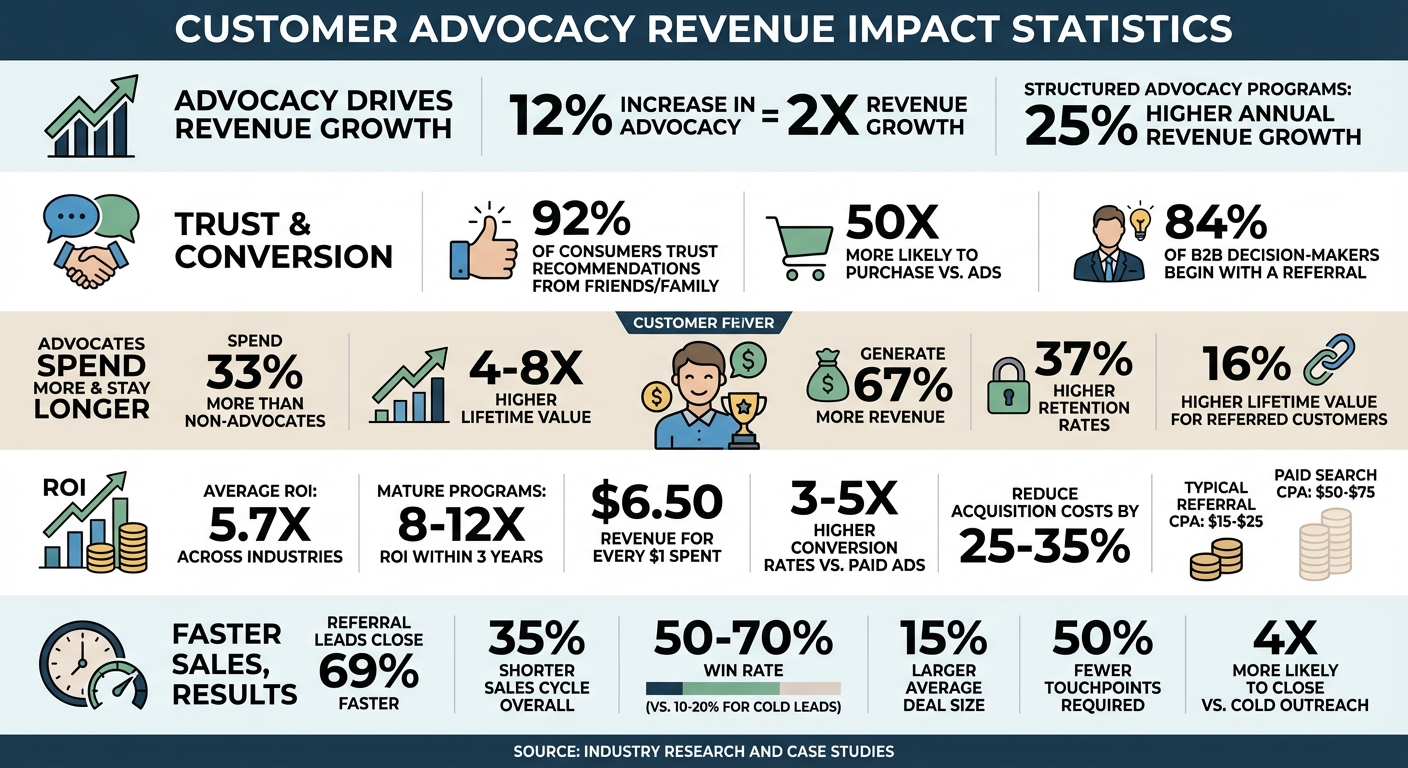
Customer Advocacy Revenue Impact: Key Statistics and ROI Metrics
Can Advocacy Generate Revenue with Christian Jakenfelds
sbb-itb-2ec70df
How Advocacy Metrics Connect to Revenue
Advocacy isn’t just about creating loyal customers – it’s about driving measurable financial growth. By tracking the right metrics, businesses can directly link advocacy efforts to revenue. These insights reveal which customers contribute the most, where acquisition costs are decreasing, and how advocates outperform regular customers in value.
Net Promoter Score (NPS) and Revenue Connection
NPS divides customers into three categories: Promoters (scores of 9-10), Passives (7-8), and Detractors (0-6). Monitoring NPS at the account level helps identify high-risk accounts that may churn and high-value accounts ripe for growth opportunities. Promoters aren’t just loyal – they’re predictive of future purchases and referrals. By segmenting NPS data by factors like revenue tier, tenure, or industry, companies can uncover which advocacy behaviors contribute most to revenue.
From there, referral metrics provide even clearer evidence of advocacy’s direct financial impact.
Referral Metrics and Revenue Effects
Referral metrics such as Client Referral Rate (percentage of new clients acquired through referrals), Referral Close Rate (percentage of referred leads that convert), and Referral Velocity (rate of new referrals over time) offer a clear picture of how advocacy translates into revenue. On average, referral programs deliver a 5.7x ROI across industries, with mature programs achieving 8-12x ROI within three years. Referrals also outperform paid advertising, with 3-5x higher conversion rates, and for every $1 spent on referral marketing, companies earn $6.50 in revenue. Additionally, referral programs lower customer acquisition costs (CPA) by 25-35%, with typical costs ranging from $15-$25 compared to $50-$75 for paid search advertising.
Take Jobber, for example. In 2024, they replaced their internal referral program with a dedicated platform under Rebecca Kapler’s leadership. The results? Referred customers had a 5% higher lifetime value and an 18% higher average selling price than non-referred customers. Similarly, Okta found in 2025 that only 43% of their references were being utilized. By improving tracking and visibility for their sales teams, they increased reference utilization by 62% and shortened enterprise sales cycles by 24%. These outcomes highlight how referrals contribute to long-term customer value.
Customer Lifetime Value (CLV) of Advocates
Advocates don’t just bring in more customers – they bring in better ones. Referred customers exhibit 16% higher lifetime value, 37% higher retention rates, and are 14 times more likely to make additional purchases compared to customers acquired through other channels. This creates a loyalty ripple effect, where advocates drive 67% more revenue than standard customers.
The concept of Advocate Lifetime Value (ALV) takes this further by measuring not just an advocate’s direct purchases but also the revenue generated from their referrals. For B2B companies, the results are even more striking: 54% of their pipeline comes from referrals and word-of-mouth. Companies with strong referral programs grow revenue 86% faster over two years compared to those without.
"Customer advocates are revenue multipliers, turning passionate brand loyalty into sustained business growth through organic referrals and repeat purchases." – Alexander Jarvis
How Advocacy Shortens Sales Cycles
Advocacy has a powerful effect on speeding up lead conversion. In B2B settings, leads generated through referrals close 69% faster than those from other sources, and the overall sales cycle for referral-based opportunities is 35% shorter. Why? It all comes down to trust. When buyers encounter social proof early in their journey, they feel more confident, reducing the need for lengthy vetting processes. This also slashes the number of touchpoints required by 50%, helping prospects move through decision stages more efficiently.
But it’s not just about speed – deal quality improves, too. Referral-based deals in B2B are four times more likely to close compared to cold outreach, with win rates ranging from 50–70%, compared to just 10–20% for cold leads. On top of that, these deals tend to be more lucrative, with an average deal size 15% larger than non-referral deals. And here’s a telling statistic: 84% of B2B decision-makers begin their buying process with a referral. This makes advocacy a key driver for securing high-value opportunities and highlights the importance of structured reference programs in maximizing these benefits.
Reference Program Participation and Results
Take Okta’s example from June 2025. The company identified untapped potential in its reference pool. By improving how they tracked and provided visibility into references for their sales teams, Okta boosted efficiency and engagement with top advocates. The result? Sales cycles became 38% faster, cutting lead costs and driving revenue growth.
Workiva offers another success story. In February 2026, their advocacy team, led by Senior Director Shelby Allen, revamped their reference and Customer Advisory Board programs. These efforts played a role in influencing over 30% of the company’s year-over-year revenue growth. By shifting from sporadic email requests to a structured, data-driven SEO content strategy, Workiva introduced innovative solutions like "many-to-one" group reference calls. This allowed a single advocate to connect with multiple prospects simultaneously, reducing burnout among advocates. Shelby Allen explained the shift:
"Leadership didn’t quite ‘get’ advocacy because we weren’t speaking their language. That changed when we started tying our efforts to a dollar amount".
Jim Williams, Vice President of Marketing at Influitive, echoed this sentiment:
"The responsibility for generating referrals can’t rest solely on the shoulders of front-line sales reps. Simply asking individual prospects and clients for one-off referrals won’t get you to your revenue goals".
Methods for Measuring Advocacy’s Sales Impact
To fully understand advocacy’s impact on sales, companies need more than just participation numbers – they need precise metrics. Multi-touch attribution is one effective way to connect advocacy activities to sales outcomes. For example, HubSpot implemented a system to track direct referrals, customer-created content, and reference influence. Their findings? Advocates were responsible for 28% of new revenue.
Here are some key ways to measure advocacy’s impact:
- Reference-influenced revenue tracking: Calculate total revenue from deals where customer references played a role.
- Reference stage impact: Compare conversion rates in deals where references were used versus those without.
- Cohort comparison analysis: Look at metrics like average selling price and lifetime value for advocate-driven deals versus non-advocate deals.
Integrating advocacy platforms with CRM systems like Salesforce or HubSpot can simplify this process. These tools can automate attribution, track how often references are used, and flag underutilized advocates, avoiding duplicate outreach.
To keep advocacy programs effective, companies should implement reference rotation systems. This ensures advocates aren’t overused while maintaining a healthy 15–25% participation rate for B2B SaaS companies. Active participation from references not only accelerates deals but also ensures advocates remain engaged and impactful.
What Recent Studies Show About Advocacy and Revenue
Wharton School and Industry Data Findings

Research highlights a clear connection between advocacy programs and business success. Companies with structured advocacy initiatives experience 37% higher retention rates and a 25% boost in annual revenue growth. Advocates, those loyal customers who actively promote a brand, tend to spend 33% more with the companies they support. Even more compelling, customers gained through referrals generate 2.5x more total revenue over three years. These referred customers don’t just stop there – they’re 4x more likely to refer others, creating a ripple effect of growth.
For example, an Australian car servicing company discovered that its top-performing 20% of stores brought in 78% of new customers through advocacy efforts like referrals and reviews. This advocacy-driven approach resulted in 24% higher year-over-year sales growth compared to the company’s bottom 20% of stores.
Behavioral Signals and Revenue Forecasting
Advocacy’s impact on revenue isn’t just historical – it’s also predictable. By analyzing behavioral data, businesses can identify potential advocates and estimate the revenue they may influence. For instance, segmenting Net Promoter Score (NPS) by categories like customer tenure, revenue levels, or industry type reveals patterns linking advocacy to revenue growth. Furthermore, comparing metrics such as Average Selling Price (ASP) and churn risk between advocates and non-advocates helps refine revenue forecasts. These insights allow companies to build more accurate models for predicting future performance, leveraging advocacy as a key driver.
How to Use Advocacy to Drive Revenue
Customer Journey Mapping for Better Advocacy
Mapping out your customer journey helps you uncover the key moments when customers are most likely to become advocates. These moments, often referred to as "earned moments", are emotional milestones where customers achieve meaningful success with your product or service – like completing onboarding, hitting a significant goal, or resolving a major issue. The best time to ask for advocacy, such as a testimonial or referral, is right after these positive experiences. For instance, if a customer reports saving 200 hours per quarter using your solution, that’s the perfect opportunity to request their story.
Growth-onomics takes Customer Journey Mapping to the next level by identifying "certainty gaps" – those psychological barriers where trust might falter. They help businesses turn these gaps into opportunities for advocacy. By mapping the entire customer experience, you can pinpoint the best times to ask for reviews, invite participation in reference programs, or offer referral incentives.
These touchpoints also provide a foundation for tracking and measuring advocacy, which leads seamlessly into the next step: using data analytics.
Using Data Analytics to Track Advocacy Performance
Once you’ve mapped your customer journey, data analytics becomes essential for measuring how advocacy impacts your bottom line. Go beyond traditional lifetime value metrics. For example, Huel discovered that referred customers were 3.5 times more likely to refer others. This insight allowed them to grow the share of referral-driven new customers from 10% to nearly 20%, with a goal of reaching 27%.
You can also track how effectively your reference pool is being used. Okta found that only 43% of their reference pool was utilized by their sales teams. After implementing tracking systems and improving visibility, they boosted reference utilization by 62% and cut enterprise sales cycles by 24%.
Growth-onomics provides Data Analytics services to help businesses measure and refine advocacy efforts. Their multi-touch attribution models track everything from direct referrals to the influence of case studies and the impact of customer references on sales acceleration. Addressing data inconsistencies early on ensures you build reliable metrics that can drive revenue growth.
Conclusion
Customer advocacy isn’t just a feel-good concept – it directly impacts revenue. In fact, it can double growth with a 12% boost in revenue. Research shows that advocates spend 33% more, have a lifetime value 4–8 times higher, and influence 50–80% of purchasing decisions. For instance, Workiva’s data-driven advocacy approach led to over 30% year-over-year revenue growth.
The key to success lies in moving from scattered tactics to a structured strategy. Shelby Allen from Workiva explained it best:
Leadership didn’t quite ‘get’ advocacy because we weren’t speaking their language. That changed when we started tying our efforts to a dollar amount.
This highlights the importance of addressing data challenges first and then creating measurement systems to track how advocacy directly drives sales. A systematic framework allows businesses to measure advocacy’s impact with precision.
Growth-onomics provides tools to map customer journeys and measure advocacy performance. Their approach pinpoints the exact moments when customers are ready to advocate and tracks how those actions contribute to revenue. Whether you’re analyzing referral conversion rates, reference program effectiveness, or the hidden value of low-spending customers who generate high referrals, having the right data infrastructure is critical.
Start small by conducting targeted customer interviews to refine your strategy. Then, automate routine tasks while ensuring personal interactions remain a priority. The companies thriving today aren’t necessarily spending more on marketing – they’re activating the advocates they already have. By channeling customer enthusiasm into organized, data-driven strategies, businesses can achieve measurable growth.
FAQs
How do I prove advocacy drives revenue?
To show that advocacy can drive revenue, it’s crucial to rely on data and measurable results. Take Jobber, for instance – they achieved a 5% boost in customer lifetime value after rolling out advocacy initiatives. Similarly, Workiva credited over 30% of their year-over-year revenue growth to advocacy efforts, including reference programs and customer stories. These examples highlight how well-structured programs paired with data-driven tracking can directly connect advocacy to revenue growth.
What metrics should I track first?
To gauge advocacy potential, begin by monitoring metrics that showcase customer satisfaction and loyalty. Key indicators include Net Promoter Score (NPS), Customer Satisfaction Score (CSAT), referral rates, and Customer Lifetime Value (CLV). Additionally, reviews and testimonials offer meaningful insights into how customers feel about your brand. For SaaS and B2B companies, referral and reference rates play a crucial role in measuring how advocacy influences growth and revenue.
How do I avoid overusing top advocates?
To avoid relying too heavily on your top advocates, it’s essential to spread out your efforts. Incorporate different types of advocates, such as reference groups, advisory boards, and customer stories, to diversify your approach. You can also scale your programs by using group reference calls or organizing structured initiatives, which help distribute the workload more evenly.
Make it a point to rotate advocates regularly and show appreciation for their efforts. Recognizing their contributions keeps them motivated and prevents burnout. This thoughtful strategy not only sustains advocacy programs but also ensures advocates feel engaged and valued over time.