


Spend the first $10,000 on paid search, and spend it on the narrowest, highest-intent keywords in your category. Not because paid is better than SEO, it is not, but because at $10,000 you are buying information, and paid search returns it in weeks while SEO returns it in quarters.
The reasoning is about sequence, not channel quality. SEO builds over time, and paid does not, which makes SEO the better long-term investment and the wrong first one. $10,000 is not enough to build organic visibility in a competitive B2B category.
It is enough to find out which queries produce demos, what a qualified lead costs you, and whether your landing pages convert, a trio of data points that make every subsequent dollar, organic or paid, considerably more effective.
There are exceptions, and they are specific rather than vague. If your category has almost no paid competition, if your sales cycle is long enough that a quarter’s delay is irrelevant, or if you already have the demand data, the calculation changes. Those cases are covered below.
This article covers what $10,000 actually buys in each channel, the sequence that works, what to spend it on precisely, and how to know when to switch.
Why Sequence Counts More Than Channels
The SEO-versus-paid debate is usually argued on returns, and returns are the wrong frame for a first budget. There are 3 structural facts that decide the sequence.
1. Paid returns information immediately.
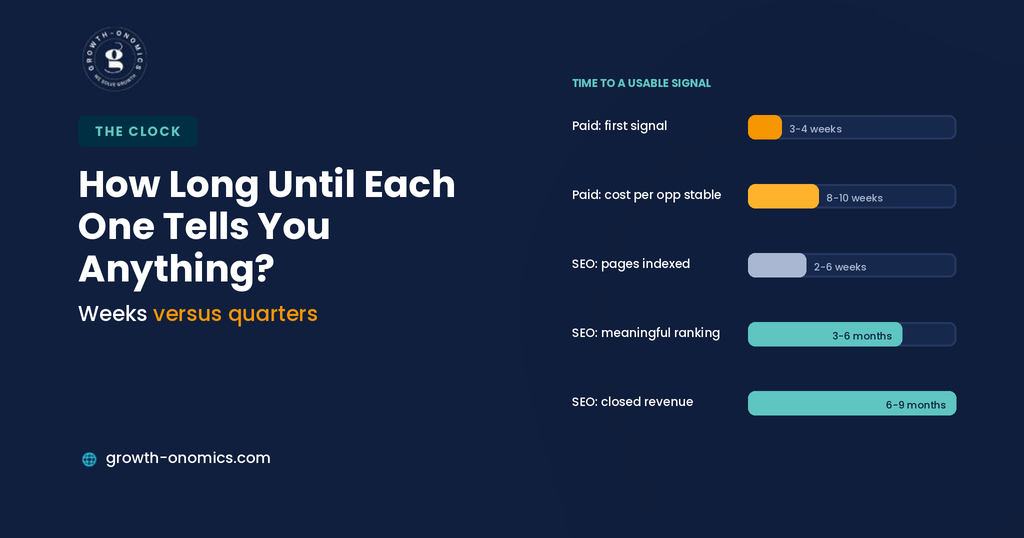
Within 3 to 4 weeks, you know which queries convert, what a demo costs, and whether your landing pages work. That is diagnostic data you cannot buy any other way at this budget, and it does not require anyone to guess.
2. SEO returns nothing for a quarter, then compounds.
Content published in month one is indexed in month two and starts producing in month four at the earliest, later in a competitive category. The eventual cost per lead is far lower than paid and it keeps falling. The wait between publishing and any of that is actual and cannot be bought down.
3. Paid data makes SEO cheaper.
Knowing which specific queries produce demos tells you which pages to build. Without that, an SEO programme targets keywords chosen on volume and difficulty; plausible proxies for commercial value, and frequently wrong ones.
That third point is the actual argument, and it is the one that usually gets skipped. Paid search is not merely the faster channel at this budget; it is the research that makes the slower channel precise enough to be worth funding. Growth-onomics sequences engagements this way for early-stage clients: a short paid test to establish which queries carry commercial intent, then content built against the queries that proved out.
What Does $10K Buy in Each Channel?
| Dimension | Paid Search | SEO |
| $10K buys | 6–10 weeks of tightly scoped spend | 8–15 pages, or a technical fix and 5 pages |
| First signal | 3–4 weeks | 3–6 months |
| What you learn | Which queries convert and at what cost | Whether pages rank, eventually |
| When spend stops | Traffic stops the same day | Pages keep working |
| Cost per lead over time | Flat or rising | Falls sharply |
| Main risk | Spending on the wrong queries | Building the wrong pages |
| Best used for | Demand capture and diagnosis | Compounding demand capture |
The comparison people miss: $10,000 of paid produces a dataset, and $10,000 of SEO produces an asset. At the start, you need the dataset, because it determines which asset is worth building.
What Should the First $10K Actually Fund?
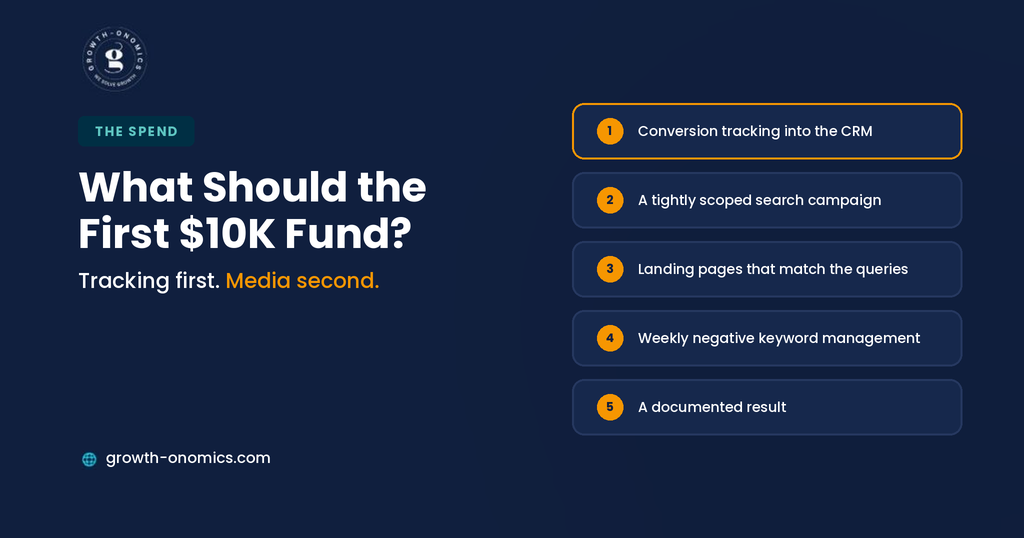
Fund these five in sequence. Getting the order right does more for the result than getting the percentage split right.
Conversion tracking that reaches your CRM. Before any media spend: click identifiers captured at form submission, stored on the CRM record, and opportunity data flowing back to the ad platform. Skip this and you will optimise toward form fills, learn what a cheap form fill costs, and finish the test knowing nothing about revenue. It is a few days of work and it decides whether the remaining spend teaches you anything at all.
A tightly scoped search campaign. Exact and phrase match on the highest-intent terms only, competitor comparisons, “[category] software”, “[job to be done] tool”, pricing modifiers. No broad match, no display, no Performance Max at this budget. You are buying clarity, and broad targeting destroys it.
2 or 3 landing pages that match the queries. Not the homepage. A comparison query needs a comparison page, an integration query needs that integration’s page. This is usually the single biggest determinant of whether the test produces usable data, and it is the step teams skip when they want more clicks for the same money.
Negative keyword management, weekly. Jobs, free, tutorial, courses, salary, and whatever your category attracts. At this budget wasted spend is a meaningful share of the total rather than a rounding error, and an hour a week removes almost all of it.
A documented result. At the end, you should be able to name which queries produced opportunities, what each one cost, and which landing pages converted. That document is the input to your SEO plan and your second budget. Without it, the exercise was buying traffic rather than buying information, which is the difference between a test and an expense.
The rough allocation most teams opt for: a few hundred dollars of setup, the bulk on media, and enough held back to build the pages properly. Skimping on the pages to buy more clicks is the most common way this budget gets wasted.
What Should the Paid Test Actually Target?
The keyword selection determines whether the $10,000 produces information or clutter, so it is worth being specific about which queries belong in a first test.
Competitor comparison terms. “[Competitor] alternatives,” “[competitor] vs,” “[competitor] pricing.” Expensive clicks, poor quality scores, and the highest-intent traffic available; someone searching these has already decided to leave. Judge them on cost per opportunity, never on CPC.
Category terms with commercial modifiers. “[Category] software,” “[category] platform,” “[category] tool for [role].” These carry purchase intent rather than research intent, which is the only distinction worth paying for at this budget.
Job-to-be-done terms. How your buyers describe the problem before they know the category name. Pull these from sales calls rather than a keyword tool, because buyers’ phrasing rarely matches the phrasing marketers assume.
Your own brand. Cheap, high-converting, and worth defending if competitors bid on it. Report it separately from everything else, or it will flatter your blended numbers and hide whether acquisition is working.
What to leave out entirely. Broad category education terms, anything informational, display, and Performance Max. All four buy volume at this budget and none produces a clean signal about what converts.
When Should You Start With SEO Instead?
4 situations make going with SEO a better call. They are narrower than SEO advocates claim, and they are valid.
Your category has almost no paid competition. If the highest-intent terms cost very little and volume is thin, paid will not teach you much and organic may be genuinely cheap to win. Check actual CPCs before assuming.
You already have the demand data. If you have been selling for 2 years and know exactly which problems buyers name and which competitors they compare you against, you do not need paid to discover it. Build the pages.
Your buyers do not search. Some categories are sold almost entirely through networks, events, and outbound. If your existing customers cannot recall searching for you, both channels are questionable, and the money belongs elsewhere.
Your site is technically broken. If your key pages need JavaScript to render, or carry snippet directives nobody deliberately chose, fix that before spending on either channel. It costs less than a month of media, and it blocks both at once: paid landing pages that convert badly and organic pages that never surface in the first place.
That last one is a prerequisite rather than a strategy. We at Growth-onomics check rendering and tracking before recommending either channel, because a paid test on pages that do not convert and an SEO programme on pages machines cannot read fail for the same reason and cost the same quarter.
What Does the Second $10K Look Like?
It should look different from the first, and that shift is the entire reason for running the test.
Keep paid running on what worked. The queries that produced opportunities stay funded, and everything else gets paused. This is demand capture now rather than research, and it should be the smaller half of the second budget.
Move the rest to organic on proven queries. Build pages targeting the terms your paid data showed produce demos. You are no longer guessing which topics carry commercial intent; you have the receipts.
Fix what the test exposed. Almost every first paid test reveals a conversion problem, a positioning gap, or a page nobody has written. That list is worth more than the leads it produced.
Add the pages that answer disqualifying questions. Pricing structure, security posture, integrations. Paid data usually shows these queries converting well while organic coverage is missing entirely, which makes them the cheapest gap on the list to close and the fastest to show a return.
The pattern: paid finds the queries, organic makes them cheap, and paid keeps running on the ones organic cannot reach.
What Do Most Teams Get Wrong?
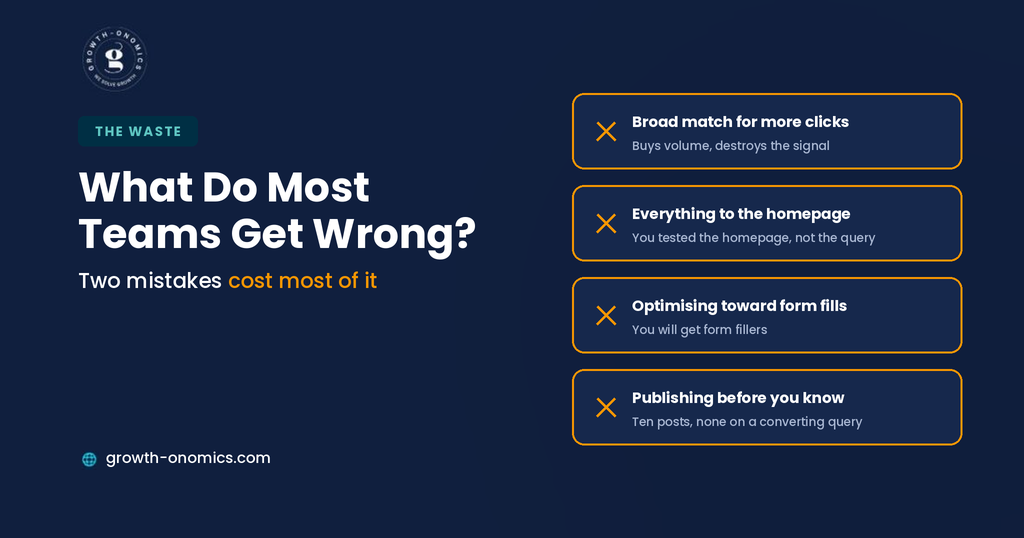
5 mistakes come up repeatedly, and the first 2 burn most of the wasted budget.
Mistake #1: Spending on broad match to get more clicks.
At $10,000, broad match buys volume and destroys the signal. You end up with cheap conversions from adjacent queries and no way to tell which terms produced anything meaningful.
Mistake #2: Sending everything to the homepage.
The ad promises a comparison, the page delivers a general pitch, and the test measures your homepage rather than the query. This invalidates the exercise more thoroughly than anything else on the list.
Mistake #3: Optimising toward form fills.
Automated bidding pursues whatever conversion you defined. Define a content download and you will get downloaders. At this budget, that means learning something true about a segment that will never buy.
Mistake #4: Publishing content before knowing what converts.
10 posts chosen by search volume, none of them targeting a query that produces demos. This is the SEO-first version of the same mistake.
Mistake #5: Judging the test at 4 weeks on cost per lead.
In B2B, 4 weeks shows conversions rather than qualification, and those rank campaigns in almost opposite orders. Look at lead quality signals and opportunity creation, and accept that the complete answer takes a full sales cycle to arrive.
How Do I Know When to Shift the Split?
Watch for 4 signals. None of them is a date on the calendar.
Signal #1: Paid cost per opportunity stabilises.
Once you know what an opportunity costs from paid and the number stops moving, the research phase is done. Continued spending is now demand capture, which is a different decision.
Signal #2: You have identified the converting queries.
The moment you can name the 5 terms that produce opportunities, you have what you need. Build pages against them.
Signal #3: Organic starts producing on those terms.
As pages rank, the same query costs nothing. Reduce paid spend on terms where organic covers you, and keep it on terms where competitors outbid you, or you rank poorly.
Signal #4: Your paid CPCs exceed what the lead is worth.
In expensive categories, this happens within the first test rather than later. It is a signal to shift toward organic and third-party presence, not to increase the budget and hope efficiency improves.
The failure mode in the other direction: running paid indefinitely without ever building organic coverage of the queries you proved. That is renting demand you could own, and the rent rises.
What Should the Split Look Like at Each Stage?
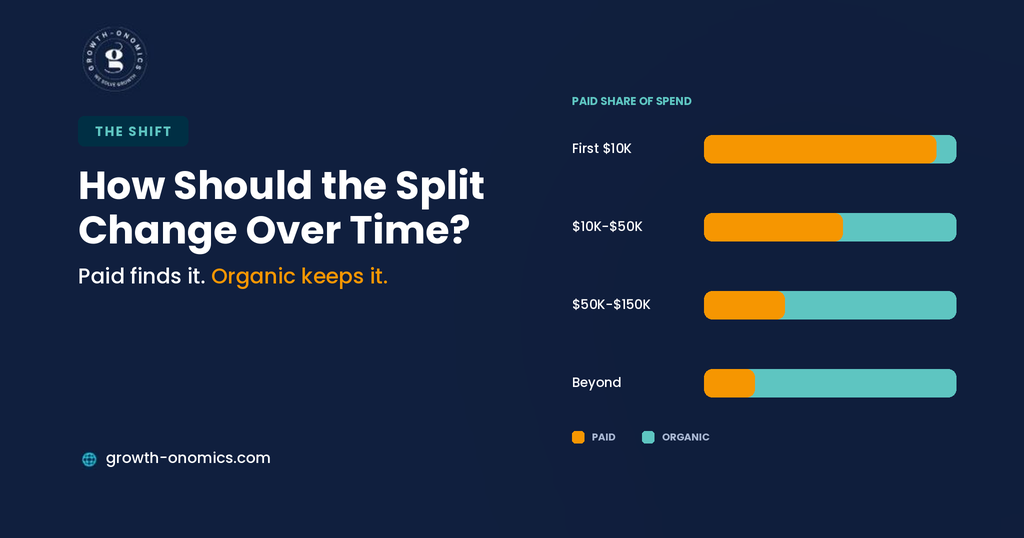
The split moves through 4 stages. Treat the ratios below as directional rather than as targets.
First $10K. Nearly all paid, tightly scoped, with tracking and landing pages funded first. You are buying a dataset.
$10K–$50K cumulative. Roughly balanced. Paid holds the proven queries, organic builds against them, and the technical foundation gets fixed properly.
$50K–$150K cumulative. Organic takes the larger share as pages start producing. Paid concentrates on branded defence, competitor terms, and high-intent queries where organic cannot win quickly.
Beyond that. Organic carries the compounding load, paid handles capture and testing, and a third line appears: off-domain presence and AI visibility, which neither channel covers and which increasingly determines whether you appear in the answers buyers see before they search at all.
That third line is new enough that most budget templates omit it. It is worth naming at the point where organic starts working, because the sources feeding AI answers are the same ones that feed the shortlists your paid campaigns are competing for.
Conclusion
The honest answer to where the first $10,000 goes is that it goes to whichever channel resolves your biggest unknown, and for most early-stage B2B SaaS companies the biggest unknown is which queries produce revenue. Paid search answers that in weeks. SEO answers it in quarters, if at all, because organic visibility on the wrong keywords teaches you nothing.
That is a sequencing argument, not a claim that paid is the better channel. SEO produces a far lower cost per lead over time, and it keeps working when spending stops, which is why every dollar after the first 10,000 should be moving in its direction. The first ten thousand exists to make those dollars precise.
Fund the tracking before the media. Match the landing page to the query. Keep the targeting narrow enough that the data means something. And write down what you learned, because that document, not leads is what you actually bought.
If you want the first budget structured so it produces a usable dataset rather than a month of traffic, Growth-onomics can scope the test and the measurement together.
FAQs
Should a B2B SaaS startup start with SEO or paid search?
Paid search, in most cases, and for a reason that’s about information rather than returns. At a first budget of around $10,000, paid tells you within 3 to 4 weeks which queries produce demos, what an opportunity costs, and whether your pages convert. SEO cannot produce that signal for a quarter or more, and content built before you know which queries carry commercial intent frequently targets the wrong ones. Start with SEO only if your category has negligible paid competition, you already have demand data from 2 years of selling, or your buyers do not search at all.
How much should a B2B SaaS company spend on paid search to test a channel?
Enough to reach statistical usefulness on a narrow query set, which for most B2B categories means several thousand dollars over 6 to 10 weeks rather than a larger amount spread thin. The most important variable is scope: exact and phrase match on the highest-intent terms only, with matched landing pages and weekly negative keyword management. A smaller budget on ten well-chosen keywords produces a usable dataset. A larger one on broad match produces volume and no clarity.
Why does SEO take so long to show results for B2B SaaS?
3 accumulating delays. Publishing to indexing takes days to weeks. Indexing to meaningful ranking takes months in a competitive category, because authority accrues slowly and competitors already have it. And ranking to pipeline adds your sales cycle on top; a page that starts producing demos in month four contributes to closed revenue in month seven or later. None of that makes SEO a poor investment; the eventual cost per lead is far lower than paid. It makes SEO a poor first investment when you do not yet know which pages to build.
Can I run both channels on $10,000?
You can, and it usually produces two underfunded tests instead of one conclusive one. Split across both, the paid campaign lacks the spend to reach significance on any query, and the content programme produces too few pages to rank for anything competitive. The exception is when part of the budget goes to fixing technical problems rather than to media or content, like rendering issues, tracking gaps, missing conversion imports. That spending improves the return on both channels and should come first regardless of how you split the rest.
Does this advice change if we already have organic traffic?
Yes, meaningfully. If you already rank for commercial terms and have analytics showing which pages convert, you have much of the dataset a paid test would buy, so the argument for paid-first weakens, and the money is better spent extending what already works. Check Search Console for queries where you rank on page one and convert, then decide whether paid is worth adding on the terms where competitors outbid you. Existing organic performance is the strongest reason to skip the sequence described here.
What should I have to show at the end of the first $10K?
A complete document, not just leads. It should name the queries that produced opportunities and what each cost, the queries that produced volume and nothing else, which landing pages converted and which did not, and the gaps the test exposed: pages you do not have, questions you do not answer, positioning that did not land. That document is the input to your SEO plan and your second budget. Teams that finish a first paid test with only a lead count have bought traffic rather than information.