

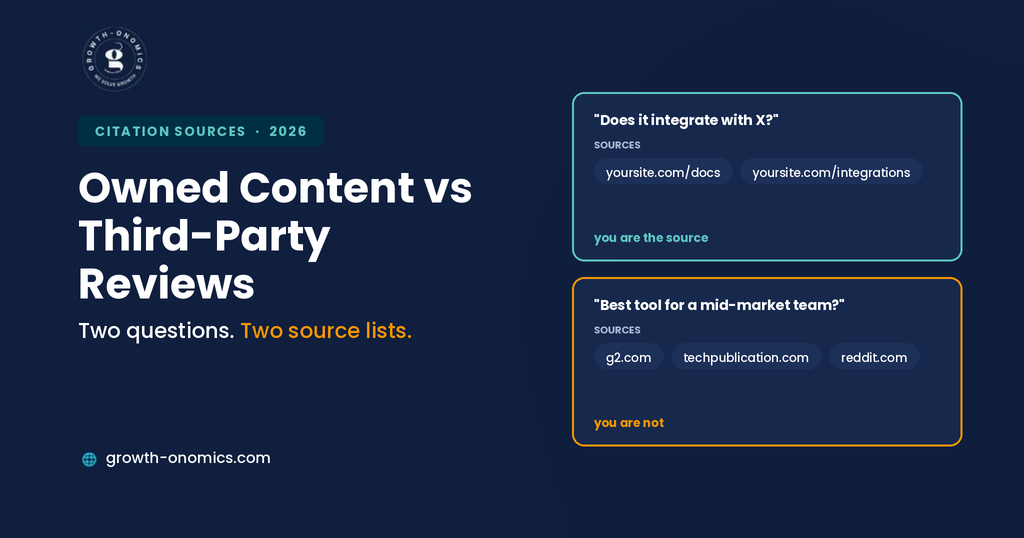
Ask an assistant which tool is best in your category, then ignore the answer and read the sources.
A review platform will be there. Probably a roundup on a publication you have never pitched. Likely a Reddit thread from last year. Somewhere in the list, if you are fortunate, one page from a vendor site, and there is a reasonable chance it belongs to a competitor rather than you.
Now do the same for a factual question. Ask whether your product integrates with a specific tool, or what it costs. The source list changes character entirely: documentation, pricing pages, integration pages, the vendor’s own site.
That contrast is the whole answer, and it explains why this debate keeps producing bad advice. Owned content and third-party presence do not compete for the same queries. They win different questions, they move at different speeds, and a content plan resourcing only the first addresses roughly half of what determines whether you get recommended.
This article separates which one wins which query type, how quickly each moves, and how to sequence them when you cannot do both at once.
2 Different Question Types
Buyers ask assistants two structurally different kinds of question, and the source mix differs sharply between them.
1. Factual questions about a specific product.
Does it integrate with Salesforce? What does it cost? Is it SOC 2 compliant?
How long does implementation take? For these, the vendor is the authoritative source, and models reach for documentation, pricing pages, and integration pages accordingly.
2. Evaluative questions across a category.
Which tool is best for a mid-market team? What are the alternatives to a named competitor? Which of these two should I choose?
For these, a vendor claiming to be the best option is doing what every vendor does, so models weight independent sources like reviews, roundups, community discussion considerably more heavily.
The commercial problem is that evaluative questions determine shortlists. A buyer who has never heard of you asks the second kind of question, and no amount of excellent documentation puts you in that answer.
Conversely, a buyer already considering you asks the first kind, and no volume of third-party mentions substitutes for a pricing page that does not exist.
Growth-onomics runs citation source analysis before recommending content work for exactly this reason, the domains appearing in your category’s answers tell you which of these two problems you actually have, and the remediation is entirely different.
The question type also predicts where in the funnel the answer is relevant. Factual questions arrive from buyers already considering you, so getting them wrong loses a deal in progress. Evaluative questions arrive from buyers who have never heard of you, so being absent loses a deal you never knew existed. The second failure is larger and completely invisible.
Quick Comparison
| Dimension | Owned Content | Third-Party Sources |
| Wins | Factual, product-specific questions | Evaluative, category-level questions |
| Control | Total | Partial to none |
| Time to publish | Days | Not applicable |
| Time to influence answers | Weeks | Weeks to quarters |
| Cost | Content production time | Outreach, participation, review generation |
| Decays through | Staleness | Age of reviews, thread drift |
| Risk | Reads as marketing | Reputational, if handled badly |
| Ceiling | Being the cited authority on your product | Being recommended at all |
Where Owned Content Wins
5 question types where your own pages are the source models reach for, and where third-party presence contributes almost nothing.
Capability confirmation. Whether your product does a specific thing. Documentation and integration pages answer this with an authority no review can match, because a reviewer describes their experience while your docs describe the product.
Pricing structure. What drives cost, what tiers include, what the adjacent expenses are. When no vendor page explains this, models answer from directory estimates and forum speculation, which are usually wrong and rarely flattering.
Security and compliance. Certifications, data residency, retention policies. These are binary facts, and a crawlable page stating them is the only reliable source.
Implementation reality. How long setup takes, what it requires from the customer, what breaks during migration. Buyers ask this before contacting sales, and a specific honest answer beats a review saying onboarding was “smooth.”
Technical detail. API capabilities, data models, rate limits. Documentation is disproportionately cited here because it is precise, current, and structured.
The pattern is that owned content wins wherever the question has a factual answer only you can supply. Those questions are commercially important; they are entirely within your control, and the gaps are usually obvious once you look, which is why they are worth closing first regardless of what your third-party position looks like.
Where Third-Party Sources Win
4 question types where your own site contributes little regardless of quality.
Category recommendations. “Best tools for X” is answered from roundups and review platforms, because those are the sources structured as assessments. Your homepage claiming to be the best is not evidence.
Competitive comparison. Buyers asking which of two products to choose get answers weighted toward independent comparisons and user reviews, since both vendors have obvious incentives.
Practical experience. What breaks, what support looks like, and what migration takes. No vendor page will contain this credibly, and community threads are the only source that does.
Credibility and market position. Whether a vendor is established, well-funded, or widely used. This comes from editorial coverage, review volume, and analyst mentions rather than anything you publish.
The uncomfortable part is that these 4 cover most of what happens before a buyer knows your name. Being excellent at the owned-content questions while absent from these means you win every answer to a question nobody asks about a company they have not heard of.
The Speed Question
The title asks which is faster, and the honest answer has 3 parts.
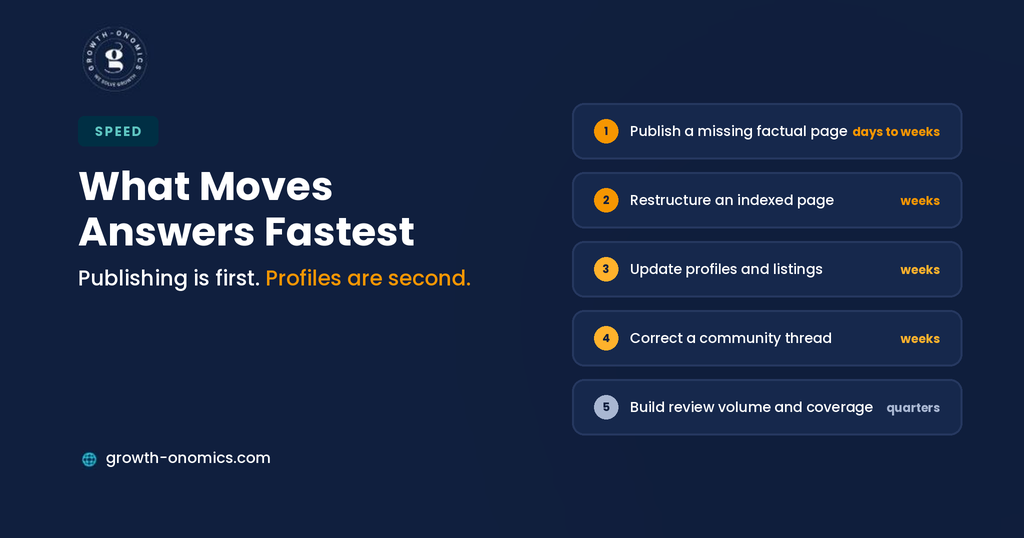
Owned content moves fastest for factual gaps. Publishing a pricing explainer or integration page on an established domain gets indexed within days and can become the best available source for that question almost immediately, because previously no good source existed. This is the fastest intervention available in the whole discipline.
Restructuring existing owned pages is nearly as fast. The page is already crawled and carrying authority; changing its internal organization so sections answer directly can register within weeks.
Third-party sources are slower but not slow. Updating a review profile changes what a model reads as soon as that page is recrawled, which is weeks rather than months. Correcting a factual error in a community thread works the same way. What genuinely takes quarters is accumulating review volume, earning editorial coverage, and building a presence across enough sources to shift consensus.
So the honest ranking is: owned factual content first for speed, then profile and thread corrections, which are cheap and quick, then the subsequent work of review generation and earned coverage.
That ordering is vital because it contradicts common instinct. Teams typically treat third-party work as a long-term project to start later, when the maintenance half of it, updating profiles, correcting threads, refreshing listings, is available immediately and takes an afternoon.
Why Reviews Punch Above Their Weight
There are 4 structural reasons review platforms appear so frequently in AI answers, disproportionate to their apparent authority.
They are structured for comparison. Feature breakdowns, pricing signals, company size segments, and pros and cons are already organized the way an evaluative question needs, which makes them efficient to draw from.
They carry independence. A model weighing sources for a recommendation discounts vendor claims and weights user assessment, which is the correct heuristic and works against you regardless of your content quality.
They contain specifics vendors avoid. Limitations, support experience, and implementation friction appear in reviews and rarely on vendor sites. That specificity is exactly what makes a source citable.
They aggregate sentiment. A view of what many users think is difficult to source anywhere else, and it answers questions about credibility that no single page can.
None of this means reviews outrank documentation in general. It means they win the specific query type that determines shortlists, which is why a strong owned-content program with a neglected G2 profile produces the frustrating pattern of being invisible in category answers while being accurately described in product ones.
What You Control on Third-Party Platforms
More than most teams assume, and this is where the fastest third-party wins lie.
Review profile content. The description, feature lists, category placement, screenshots, and media are yours to write. Most were written during a launch, describe a product two versions old, and sit in a category the company has outgrown.
Review volume and recency. You cannot control what reviewers say, but you can influence how many recent reviews exist through a systematic generation cadence tied to customer milestones. Recency factors in because models favor current sources, and a profile whose newest review is two years old reads as a product nobody buys anymore.
Responses to reviews. Public replies are read by buyers and cited by models. A thoughtful response to a critical review noting a since-shipped fix changes what a model reads about that limitation.
Marketplace and directory listings. Partner marketplaces, integration catalogs, and category directories are frequently cited and almost universally stale, because nobody owns them after launch.
Factual corrections in community threads. You cannot manufacture community sentiment, and attempting it backfires visibly. You can correct a factual error about your product with evidence and disclosure, which is both legitimate and effective.
What you do not control is the sentiment itself, editorial inclusion in roundups, or what a competitor’s comparison page says about you. Those require earning rather than editing.
What Happens When One Side Is Missing
2 failure patterns show up repeatedly, and each is diagnosable from a single prompt.
Strong owned content, absent third-party presence. The company is described accurately whenever someone asks about it by name like pricing right, integrations confirmed, capabilities clear. Ask the category question and it does not appear at all. The pattern is common among engineering-led companies with excellent documentation and a review profile nobody has opened since launch. The commercial cost is invisible, because the deals lost were never in the pipeline.
Strong third-party presence, thin owned content. The company appears in roundups and has healthy review volume, so it gets recommended. Then the buyer asks what it costs or whether it integrates with their warehouse, and the answer comes from a directory estimate that is wrong. This pattern is common among marketing-led companies with good PR and a website that avoids specifics. The cost is visible, deals stall at evaluation for reasons nobody traces back to a missing page.
The second failure is faster to fix. Publishing 4 or 5 factual pages closes it within weeks. The first takes quarters, which is the strongest argument for starting the off-domain work before you think you need it.
The Sequencing Most Teams Get Backwards
The common approach is to publish content for two quarters, then consider third-party work as a phase two that never arrives. A better order exists.
First, close the factual gaps on your own site. Pricing structure, security summary, top integrations, main comparison. These are fast, entirely within your control, and they fix the questions models currently answer badly from directories.
Second, update what you already own off-domain. Review profile descriptions, marketplace listings, category placement. An afternoon of work on assets that get cited constantly and were last touched during a launch.
Third, start the compounding work. Review generation cadence, community participation, outreach to the roundups your citation analysis shows are actually cited. These take quarters, which is precisely why they should start in week 3 rather than quarter three.
Fourth, correct as you find errors. Stale claims in competitor comparisons, factual mistakes in threads, outdated pricing in directories. This is ongoing maintenance rather than a project.
Growth-onomics structures brand mentions, and listings work alongside content production rather than after it. For that reason, the two halves address different queries, and running them sequentially means spending two quarters winning questions that do not build shortlists.
How to Diagnose Your Own Split
3 checks which covers an hour total, that tell you which side your gap is on.
Ask the factual questions. Pricing, integrations, security, implementation. If the answers are wrong, vague, or sourced from directories rather than your site, your gap is owned content.
Ask the category question. Your main unbranded buying query. If competitors appear and you do not, your gap is third-party presence, and no amount of publishing fixes it directly.
Read the source lists. Run the follow-up asking which sources were used. Classify each as yours, shared, or independent. That ratio is your diagnosis, and it is more reliable than any general advice about which approach works better.
Most audits find the same shape: factual questions answered adequately or poorly from third-party estimates, and category questions dominated by roundups and review platforms where the company is either absent or described from a profile written three years ago.
Conclusion
The framing of owned content versus third-party reviews implies a choice, and there is not one. They answer different questions, and the questions they answer have different commercial consequences.
Owned content wins everything factual about your product, and those questions weigh enormously once a buyer considers you. Third-party sources win the evaluative questions that determine whether a buyer considers you at all. A program strong in one and absent from the other produces a predictable failure: either accurately described and never recommended, or recommended and then misrepresented on the specifics that close deals.
On speed, owned factual content is fastest because publishing a missing page immediately becomes the best available source. But the second-fastest intervention is not making more content, it is updating the review profiles and marketplace listings you already own, which get cited constantly and have almost certainly not been touched since launch. That afternoon of work outperforms most weeks of publishing.
If you want to know which side of that split your category’s answers are actually coming from, the Growth-onomics team can run the citation source analysis and tell you where the gap sits before anyone writes a page.
FAQs
Do AI models really trust reviews more than vendor sites?
Not in general, but they weight them differently by question type. For factual product questions, capabilities, pricing structure, compliance, vendor documentation is the authoritative source and gets cited accordingly. For evaluative questions like which tool to choose or what the alternatives are, models weight independent sources more heavily, because every vendor claims to be the best option and that claim carries no information.
The practical implication is not that reviews beat your content; it is that they win the specific queries that build shortlists, which is where being absent costs most.
How quickly can updating a G2 profile affect AI answers?
Faster than most teams expect, weeks rather than months, since the change takes effect as soon as the page is recrawled and reused. This makes profile maintenance one of the highest-return activities available, because the pages are cited constantly and are almost universally stale. A profile written during a launch 3 years ago will describe a product two versions old, sit in a category the company has outgrown, and list features that have been renamed. An afternoon of updating changes what models read for months afterward.
Should we run a review generation campaign?
Yes, at a cadence rather than a campaign. Recency is important because models favor current sources, so 20 reviews collected in one quarter and none afterwards produce a profile that ages badly.
A steady trickle tied to a customer milestone, successful onboarding, renewal, or a support resolution keeps recent feedback flowing without a burst that looks manufactured.
Never incentivize specific sentiment, which platforms detect and penalize.
Ask satisfied customers to review honestly and accept that a mix of ratings reads as more credible than uniform praise.
Can we get into third-party roundups deliberately?
Partly. Start by finding which roundups are cited in your category rather than which rank highest, since those lists differ. Then reduce friction for the writer: maintain a current press kit, publish the pricing structure and feature detail they would otherwise request, and make sure your review profiles corroborate your claims.
Pitch when you have something genuinely new rather than on a schedule. Original research is the most reliable route in, because roundup writers need data and credit the source that supplies it.
How do we split budget between the two?
There is no fixed ratio, but two principles hold. Owned content usually has an existing budget line and a team, while off-domain work frequently has neither so the practical question is less about splitting an existing budget than about funding a workstream that currently has no owner. And the off-domain half is cheaper than it looks: profile updates and listing maintenance are hours rather than headcount, while review generation and outreach are process changes rather than production costs.
Start by naming an owner for off-domain work, then worry about the split.
What if a community thread says something wrong about our product?
Correct it, with disclosure and evidence, and accept that the thread will outlive the correction. Identify yourself as being from the company, state the specific fact that has changed, and link to documentation rather than marketing. Communities respond well to this and badly to anything resembling astroturfing, which is detectable and reputationally expensive in exactly the places that rely on reputation. Where the criticism is fair and unresolved, a response acknowledging it and describing what you are doing reads better than either silence or defensiveness.
