


“Which one is cheaper?”
It’s the very first question asked about every agency proposal, and it is close to useless.
A fixed-fee audit is cheaper than 12 months of retainer in exactly the way a map is cheaper than a car.
The comparison that really counts is different: which model matches the work you actually need done. AEO is not one activity. It is two, and they behave nothing alike.
Some of it finishes. An audit produces a roadmap. A schema implementation ships and is done. 20 integration pages get built and then exist. These have a completion state, and paying monthly for something that ends in 3 weeks is a bad structure for everyone.
The rest never finishes. Review profiles go stale. Community threads accumulate. Competitors publish. Prompt sets need running. This work produces results through repetition, and buying it as a project produces a burst of activity followed by decay.
Flat fees for the first. Retainers for the second. Most companies need both, in a sequence, and the sequence is where the money is saved.
Why AEO Pricing Is Hard to Compare
3 structural features make proposals in this category genuinely difficult to evaluate side by side.
The deliverables are not standardized. One agency’s “AEO program” is prompt tracking and monthly reporting. Another’s includes content production, technical fixes, and off-domain outreach. Comparing the monthly figures tells you nothing about which is more expensive per unit of work.
Results lag the invoice by a quarter or more. Content restructuring and authority building grow over months, which means the first two invoices arrive before any evidence does. That timing asymmetry pushes buyers toward whichever model feels safest rather than whichever fits.
Most of the work is invisible. A retainer month might include correcting 3 community threads, updating two review profiles, and restructuring 4 pages. None of that produces an artifact a stakeholder can look at, which makes retainers harder to defend internally than a flat-fee deliverable with a document at the end.
The consequence is that pricing model choice often gets made on procurement preference rather than fit. A finance team that prefers capital projects will push everything toward flat fees; one comfortable with recurring spend will push the other way.
Neither preference has anything to do with the work, which is why understanding what each model is capable of means more than the negotiation.
Quick Comparison
| Dimension | Flat Fee | Retainer |
| Best for | Diagnosis, audits, defined builds | Ongoing content, authority, monitoring |
| Scope | Fixed and specified upfront | Defined by hours or workstreams |
| Risk to buyer | Underspecified scope | Paying for months with little output |
| Risk to agency | Scope creep | Being judged on lagging metrics |
| Budget approval | Easier, a single line item | Harder, recurring commitment |
| Cancellation cost | None after delivery | Notice period, loss of momentum |
| Evidence of value | A deliverable you can read | A trend you have to wait for |
What Flat Fees Do Well
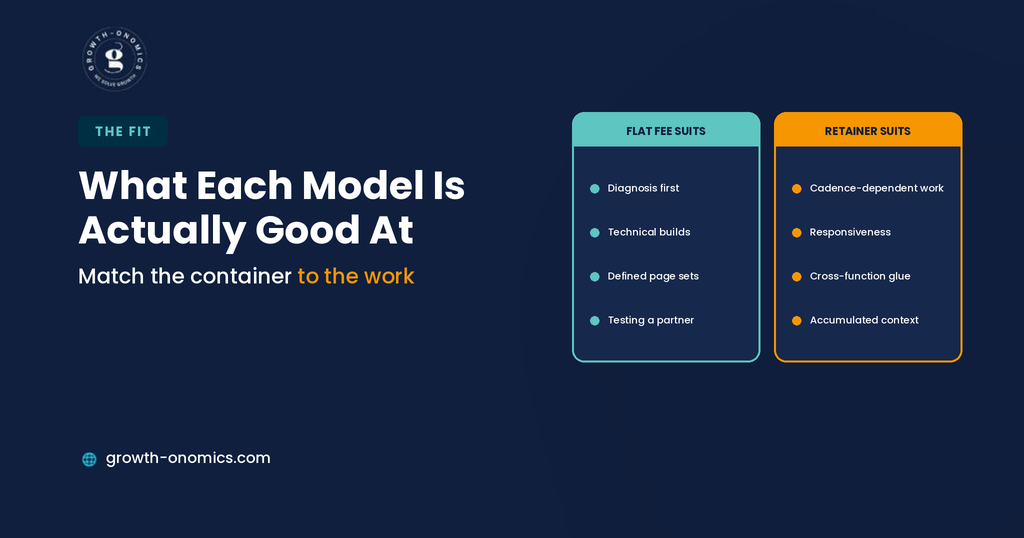
4 situations where a fixed price is clearly the right container.
Diagnosis before commitment. An audit that establishes a baseline, identifies whether your problem is technical, editorial, or off-domain, and produces a prioritized roadmap. This has a definable end, a reviewable output, and it makes you a far better buyer of whatever comes next.
One-off technical builds. Schema implementation across templates, rendering fixes, or a structured data audit. These are projects with a completion state, and paying monthly for something that finishes in 3 weeks is a poor structure for both sides.
Defined content builds. A set of comparison pages, an integration page template rolled out across 20 partners, or a security documentation set. When the scope can be enumerated, a fixed price is honest for everyone.
Testing a relationship. A well-scoped project is the cheapest way to find out whether an agency’s judgment is good, their communication works, and their output meets your standard before committing to 12 months. Agencies confident in their work rarely object to this, which makes the reaction to the suggestion informative in itself.
The pattern across all 4 is that the work has a natural end.
Growth-onomics scopes audits and roadmaps as fixed engagements for that reason: the deliverable answers a question, and once answered, the client should be free to decide what happens next rather than being enrolled in something.
Where Flat Fees Fail
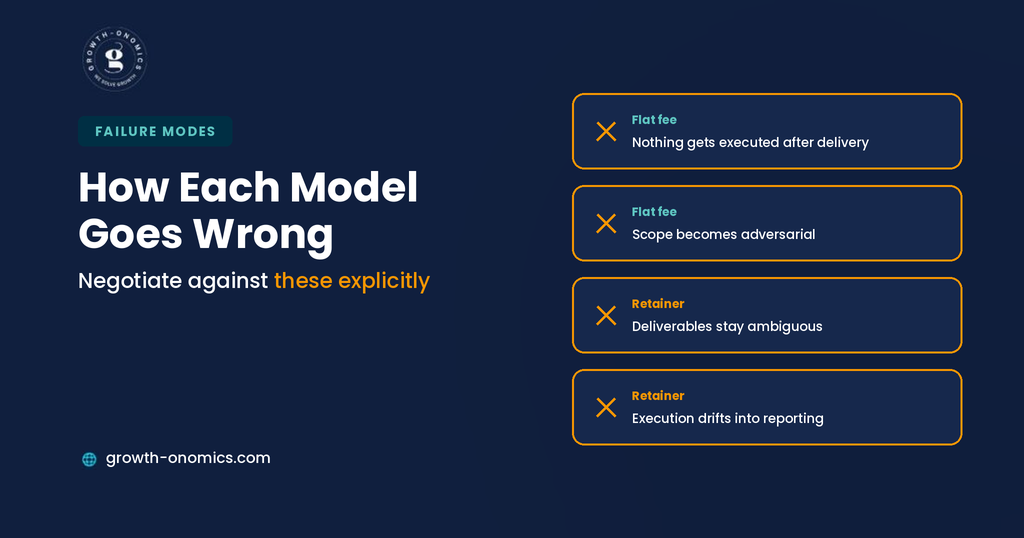
3 failure modes, and the first is by far the most common.
Nothing gets executed. The most expensive outcome in this category is a well-researched strategy document that stays in a shared drive because there’s no capacity to act on it. If the flat fee buys thinking and nobody internally can build, you have purchased a very detailed description of a problem.
Scope becomes adversarial. Fixed price plus unclear scope produces a relationship where every additional request is a negotiation. Both sides start optimizing for the contract rather than the outcome, which is a bad dynamic for work requiring judgment.
Compounding work gets truncated. Authority building, off-domain presence, and content restructuring across a large site never end. Structuring them as projects produces a burst of activity followed by decay, which is more detrimental than a smaller sustained effort.
The test is simple. If the work has a completion state, flat fee is appropriate. If describing completion requires phrases like “an initial set” or “the first phase,” you are pricing ongoing work as a project and it will end badly.
What Retainers Do Well
4 situations where recurring is the honest structure.
Work that only produces results through repetition. Prompt monitoring, review profile maintenance, community participation, and content refreshes are all cadence-dependent. A quarterly burst produces a fraction of the value of monthly attention.
Programs needing responsiveness. Answer engines change, competitors publish, and product launches create new questions. A retainer buys the ability to react within days rather than scoping a change order.
Cross-functional coordination. AEO touches technical SEO, content, product marketing, and off-domain reputation. Someone has to hold those together continuously, and that role does not fit a project shape.
Accumulating context. An agency 3 months into a program knows your product, your objections, and your buying committee. That knowledge is a valuable asset and it is expensive to rebuild, which is why a series of disconnected projects with different vendors frequently costs more in total than a modest sustained relationship.
The strongest argument for a retainer is that AEO’s highest-value work, third-party presence and authority is precisely the work that cannot be completed. It can only be maintained.
Where Retainers Fail
Three failure modes worth negotiating against explicitly.
Ambiguous deliverables. “Ongoing AEO support” with no specified output invites months where activity happens and nothing ships. The fix is naming deliverables per month, even loosely, pages restructured, profiles updated, threads corrected, prompts tracked.
Judgment on lagging metrics. 6 weeks into a retainer, no meaningful citation change has occurred, because none could have. If the contract implies otherwise, both sides spend the early months defending rather than working. Agree what a good month one looks like before signing.
Drift into reporting. The most common way a retainer decays is that execution slows, and the monthly call becomes a dashboard review. If two consecutive months contain more reporting than shipping, the relationship has changed shape and needs a conversation rather than a renewal.
The renewal that nobody examines. Retainers renew by default, which is convenient and dangerous. A scheduled review at 6 and 12 months, what shipped, what moved, what we would do differently is worth building into the agreement rather than trusting to memory.
The Hybrid Most Programs Land On
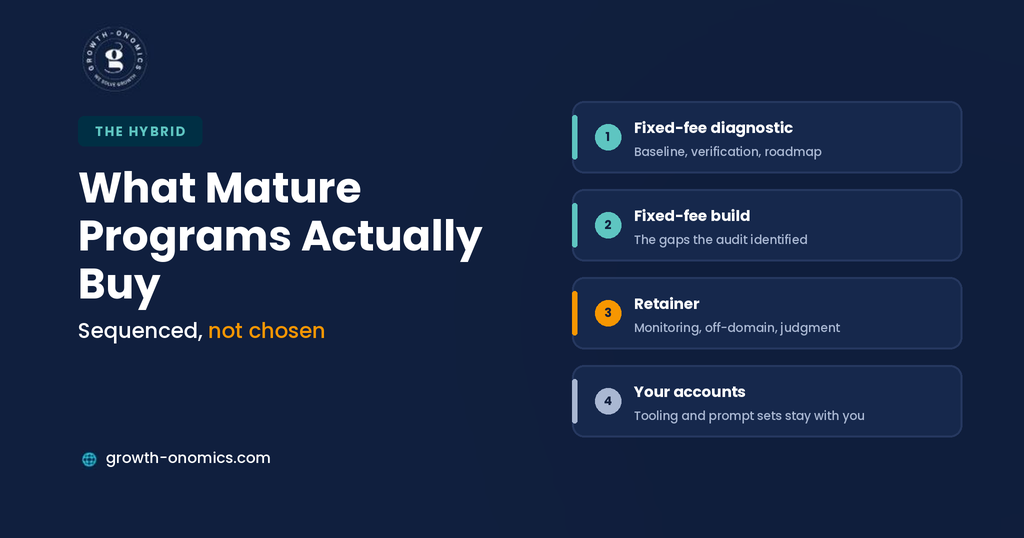
Mature programs rarely choose one model. The pattern is consistent enough to describe.
A fixed-fee diagnostic first. Baseline measurement, technical verification, citation source analysis, and a prioritized roadmap. Weeks rather than months, with a deliverable you can act on independently.
A fixed-fee build for the identified gaps. If the audit finds 12 missing pages and a rendering problem, that is a project with a scope. Pricing it separately keeps it honest and lets you sequence it against engineering capacity.
A retainer for what compounds. Monitoring, off-domain work, content refreshes, and the judgment layer. This is where a smaller ongoing commitment beats a larger intermittent one.
Measurement stays in your accounts. Whichever models you use, the tool subscription, prompt sets, and historical data should sit with you. This is an exit-cost decision that costs nothing at kickoff.
The sequencing matters as much as the split. Growth-onomics runs the diagnostic before scoping anything ongoing, because a retainer priced before anyone has looked at the data is a guess about what the work will be and guesses in either direction are expensive.
Contract Terms That Are More Important Than Price
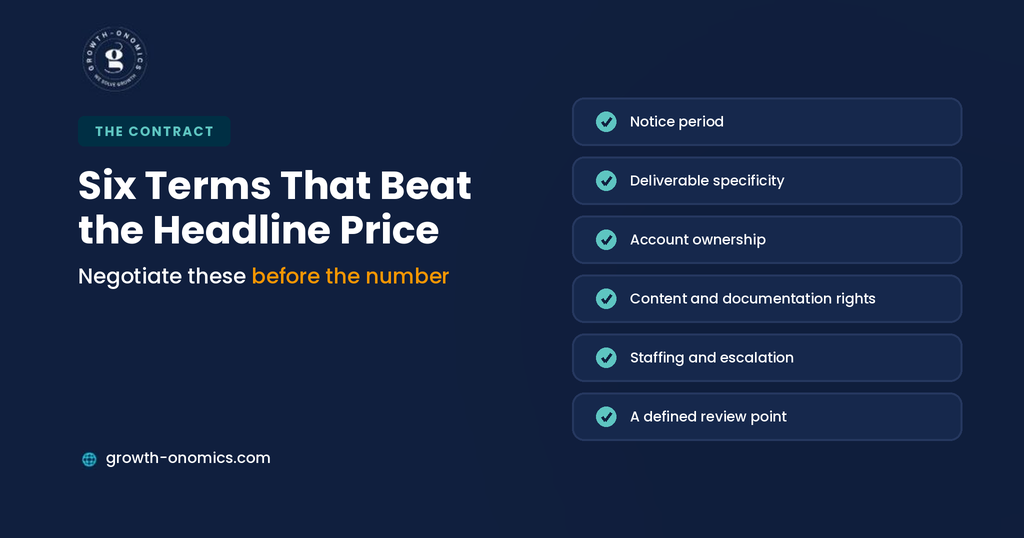
6 terms that affect total cost more than the headline figure.
Notice period. 3 months’ notice on a retainer is effectively a 3-month minimum commitment on top of whatever term you agreed to, and it is easy to miss when reading a contract quickly. 30 days is common and reasonable for most engagements.
Deliverable specificity. Not hours, and not “ongoing support.” Named outputs per month or per quarter, with an agreed mechanism for changing them as priorities shift rather than a renegotiation every time something moves.
Account ownership. Analytics, Search Console, visibility tooling, and prompt sets in your accounts. Negotiate at signing, when it costs nothing.
Content and documentation rights. Everything produced during the engagement stays yours, including briefs, prompt sets, and internal documentation, not just published pages.
Escalation and staffing. Who does the work, whether the person in the pitch is on the account, and what happens if they leave. Agency quality varies more by staffing than by agency.
A defined review point. A scheduled conversation at 3 or 6 months with agreed criteria for continuing. This protects both sides as it gives the agency a fair window to show compounding work rather than being judged at week 6, and it gives you a decision point that is a review rather than a cancellation.
Any agency uncomfortable with all 6 is telling you something useful before you sign.
What Each Model Costs You in Internal Time
The figure on the proposal is one half of the cost. The other half is what the model demands from your team, and it differs enough to change which one is genuinely cheaper.
Flat-fee projects demand a burst. Kickoff, product knowledge sessions, access provisioning, review cycles, and then a concentrated period of internal work when the recommendations arrive. If that burst lands in a quarter where your team has no slack, the deliverable waits which is the single most common way flat-fee value gets destroyed. Buy the audit when you have capacity to act on it, not when you have budget to spend.
Retainers demand a drip. A regular call, ongoing approvals, and someone available to answer questions and unblock work. This is smaller per week but never stops, and it needs a named owner rather than a rotating one. Programs where the internal contact changes every few months lose most of the accumulated context the retainer was buying.
Both demand engineering time you do not control. Technical fixes sit with a team measured on product delivery, and neither pricing model changes that. Scope the engineering dependency honestly at the start, because a program that stalls waiting on a rendering fix is expensive under either model.
The practical implication is that the cheaper model is often the one that matches your team’s availability pattern rather than your budget structure.
Matching the Model to Your Stage
Early stage, small budget. A fixed-fee audit, then execute internally. You will get more from a diagnosis plus your own capacity than from a thin retainer that funds a few hours a month and produces neither momentum nor accountability.
Growth stage, no internal specialist. Fixed-fee diagnosis, then a retainer sized for the workstream with no owner, usually off-domain presence, since content and technical work often have homes already.
Scale-up with an in-house team. Fixed-fee projects for specific builds, plus a small advisory retainer for judgment. Your team executes; you are buying direction and a second opinion, which is a much cheaper commitment than buying execution you already have.
Enterprise or multi-brand. Retainer for coordination and continuity, with fixed-fee projects layered for major builds. The complexity of holding several brands, markets, or product lines together is itself the ongoing work, and it does not reduce over time.
The through-line is that flat fees suit work with an end, retainers suit work that compounds, and most companies need both in a sequence rather than a choice between them.
Conclusion
Pricing model is a question about the shape of the work, not the size of the budget. AEO contains 2 genuinely different kinds of effort, and the mistake is forcing both into whichever container procurement prefers.
Diagnostic and structural work like audits, roadmaps, schema implementation, and defined page builds has a completion state and should be priced as a project.
Compounding work like monitoring, off-domain presence, content maintenance, and the judgment about what to do next cannot be completed and should be priced as an ongoing commitment. Companies that get this wrong end up either with strategies nobody executes or with retainers that quietly become reporting subscriptions.
The practical sequence for most B2B SaaS teams is to buy the diagnosis first at a fixed price, use it to decide what actually needs building, price those builds as projects, and retain only for what genuinely grows. That order costs less in total than either pure model, and it leaves you better informed at every decision point.
If you would like a fixed-scope diagnosis before committing to anything ongoing, Growth-onomics can run the audit and tell you honestly which parts of the work need a retainer and which do not.
FAQs
Is a flat fee always cheaper than a retainer?
Not on total cost, which is the only comparison that matters. A flat-fee audit costs less than twelve months of retainer, but if the audit’s recommendations require capacity you do not have, the total cost includes a strategy that never gets executed. Conversely, a retainer funding work you could have done internally is expensive regardless of the monthly figure. Compare cost per outcome rather than cost per month, and be honest about internal capacity, since that is the variable that determines whether either model delivers anything.
How long should an AEO retainer run before I judge it?
Two quarters for meaningful evidence, with agreed checkpoints earlier. Citation share and content changes register within weeks, so month one should produce visible output like pages restructured, profiles updated, a baseline established. What takes longer is the growing effect of authority and off-domain work, which is genuinely quarters rather than weeks. Agree at signing what a good month one, month three, and month six look like. That conversation prevents the most common failure, which is both sides discovering in month four that they expected different things.
What should a fixed-fee AEO audit include?
4 components, and be suspicious if any is missing. Technical verification of whether machines can read your key pages, since everything else depends on it. A measured baseline on a documented prompt set you keep. Citation source analysis showing which domains answer your category’s questions today. And a prioritized roadmap distinguishing what you can execute internally from what needs help. An audit producing only a visibility score has measured the problem without diagnosing it, and that is the version most likely to sit unread.
Can I switch from retainer to project work later?
Yes, and many programs should. Once the compounding work has a rhythm and your team has absorbed the method, a retainer often becomes advisory rather than execution. This is a smaller commitment and a reasonable evolution rather than a downgrade. Build the option in by keeping account ownership, documentation, and prompt settings under your control from the start. The teams that find switching difficult are usually the ones whose measurement lives in an agency’s tooling, which turns a pricing decision into a data-loss decision.
Should I ever pay for AEO on performance?
Be cautious. Performance pricing sounds like aligned incentives and usually is not, because the metrics available are either too laggy to settle within a contract term or too gameable to be meaningful. Citation share can be inflated by tracking easier prompts, traffic can be inflated by branded terms, and pipeline attribution is contested enough that both sides will disagree about the number. Where it can work is a modest bonus attached to a specific, verifiable outcome agreed in advance not as the primary structure, and not on a metric either party can influence unilaterally.
How do I compare 2 proposals with different pricing models?
Normalize on deliverables rather than price. List what each proposal actually produces in a quarter like pages restructured, profiles updated, technical fixes shipped, prompts monitored, decisions made then compare cost against that list. Add your own internal time to both sides, since neither works without it. Finally, compare the contract terms: notice period, account ownership, and deliverable specificity affect total cost more than a difference in monthly fee. A cheaper retainer with a three-month notice period and no account ownership is frequently the more expensive option.