


Here’s a number that should change how you read your analytics: AI referral traffic accounts for somewhere between one and three percent of sessions on most B2B sites.
Here’s the number worth discussing: those sessions convert several times better than organic search, and in some B2B SaaS datasets the gap runs into double-digit multiples.
Both figures are legitimate, and holding them together is the entire skill in reading this channel. Judged on volume, AI referrals look like a rounding error nobody should staff. Judged on conversion rate, they look like the highest-quality traffic source most teams are not measuring at all. Neither reading alone produces a sensible decision.
Underneath the aggregate there is a second problem. “AI traffic” is not one channel. ChatGPT, Perplexity, and Google AI Overviews cite different sources, send different volumes, and deliver buyers at different stages of a decision. Averaging them into a single line in your dashboard destroys the only information worth having.
This article separates them: what each surface really sends, what published research says and where it disagrees, and what to do differently for each.
Figures cited were published between 2025 and mid-2026, and this category changes frequently enough that any number here should be treated as an indication rather than a constant.
What Data Suggests
3 findings appear consistently across independent studies, and they are worth separating from the noise around them.
Volume is small and growing quickly. Published estimates place AI referrals somewhere between 0.1% and 3% of total website traffic depending on industry and site authority. Growth rates across the same studies run into the hundreds of percent year over year, from a small base.
Conversion rates are substantially higher than organic. Multiple independent analyses published in 2025 and 2026 report AI referral traffic converting at roughly 4 to 5 times organic search on a cross-industry basis, with B2B SaaS at the higher end of the range. Individual company results reported publicly run considerably higher than that average.
Concentration is real but eroding. ChatGPT has consistently dominated measurable AI referrals; figures published across 2025 and 2026 range from roughly 63% to 87% depending on the panel and period. The direction of travel is downward as Gemini, Claude, and Perplexity take share, but ChatGPT remains where most measurable AI traffic originates.
Two caveats go along with all of this. The samples are small and the methodologies differ, which is why the published ranges are so wide. And a substantial share of AI-influenced traffic arrives with no referrer at all, which means every figure quoted is a floor rather than a measurement.
Those caveats are the reason this article gives ranges rather than single figures. Anyone presenting a precise percentage for this channel is reporting one panel over one period, and the underlying market has been moving fast enough that a figure 6 months old describes a different market.
Quick Comparison
| Dimension | ChatGPT | Perplexity | Google AI Overviews |
| Share of AI referrals | Largest by a wide margin | Single digits to mid teens | Hard to isolate |
| Referrer data | Passes referrer | Passes referrer | Counted inside Search Console |
| Citation style | Fewer sources, often product pages | Many sources, citation-dense | Links alongside the answer |
| Buyer stage | Often mid to late evaluation | Research and comparison | Early to mid research |
| What to optimize | Product, docs, comparison pages | Attributable passages, third-party sources | Classic organic plus snippet eligibility |
| Measurable in GA4 | Yes, with a channel group | Yes, with a channel group | Not separately |
1. ChatGPT
Share of measurable AI referrals: The largest by a considerable margin in every published study, though estimates vary widely by panel and period.
What It Sends
The bulk of the AI referral traffic most B2B sites can measure. Reported conversion rates for ChatGPT referrals are consistently among the highest of any traffic source, which is unsurprising given how the click arises: the user has already asked a question, received a synthesized answer, and clicked a specific source out of a small set.
How It Cites
More selectively than Perplexity, with fewer sources per answer. Published citation analysis suggests ChatGPT is considerably more likely than Perplexity to cite product pages directly, which is crucial for B2B SaaS because product, pricing, and integration pages are where commercial questions get answered.
What This Means for You
If you optimize for one platform first, this is it, not because the others aren’t important, but because it is where the measurable volume is and where product page citations concentrate. Prioritize documentation, pricing explanations, integration pages, and comparison content, since those are the assets it reaches for.
The Caveat
Concentration is falling. Published share estimates dropped substantially between 2025 and 2026 as other assistants gained ground, so optimizing exclusively for ChatGPT leaves a growing portion of the channel unaddressed. The trend line points one way, and a strategy built on last year’s concentration will age badly.
2. Perplexity
Share of measurable AI referrals: Smaller than ChatGPT, with published estimates ranging from single digits to the mid teens depending on the study.
What It Sends
Lower volume, high engagement. Perplexity users are typically researching actively rather than asking a passing question, and the interface encourages source-checking, which produces visitors who arrive having already read what you said and clicked to verify it.
How It Cites
Densely, and differently. Perplexity surfaces many sources per answer with inline citations, which means a larger share of answers include a link but each individual link competes with more alternatives. Published analysis suggests it cites product pages far less often than ChatGPT does, favoring editorial, comparative, and third-party sources.
What This Means for You
Perplexity rewards being quotable rather than being a product. Original research, benchmarks, comparison content with clear positions, and presence in the third-party roundups it draws on have more weight than your feature pages do. This is the platform where off-domain authority work shows up most directly.
The Caveat
Its share of B2B referrals is small enough that optimizing for it in isolation is hard to justify on volume alone. The work it rewards, attributable content and third-party presence, benefits every platform, which is the better argument for doing it.
Some B2B SaaS companies also find their own Perplexity share runs well above the category average, so check your own data before deprioritizing it.
3. Google AI Overviews
Share of measurable AI referrals: Genuinely unknown, because Google counts AI Overview and AI Mode clicks inside standard Search Console reporting rather than as a separate referral source.
What It Sends
Volume that dwarfs the others in absolute terms and cannot be isolated. AI Overviews appear on a substantial share of queries, and the clicks they generate land in your organic reporting alongside classic blue-link clicks. You are almost certainly already receiving this traffic and reporting it as organic search.
How It Cites
Alongside the answer, drawing on pages that are indexed and snippet-eligible. Google’s own guidance is that no special markup or technique is required; appearing in AI Overviews depends on the same crawlability, indexing, and quality signals that determine organic visibility.
What This Means for You
Do not treat this as a separate optimization project. The work is classic technical and content SEO, with one addition worth checking: snippet controls. A page carrying nosnippet or max-snippet:0 is ineligible for AI Overviews as well as for rich results, and those directives are frequently inherited from configurations nobody remembers writing.
The Caveat
Because you cannot isolate it in analytics, you also cannot report on it directly. What you can track is whether you appear in AI Overviews for your priority queries, which requires prompt testing rather than analytics.
Why the Conversion Gap Exists
The conversion difference is the most consistently replicated finding in this category, and understanding why it happens tells you how to use it.
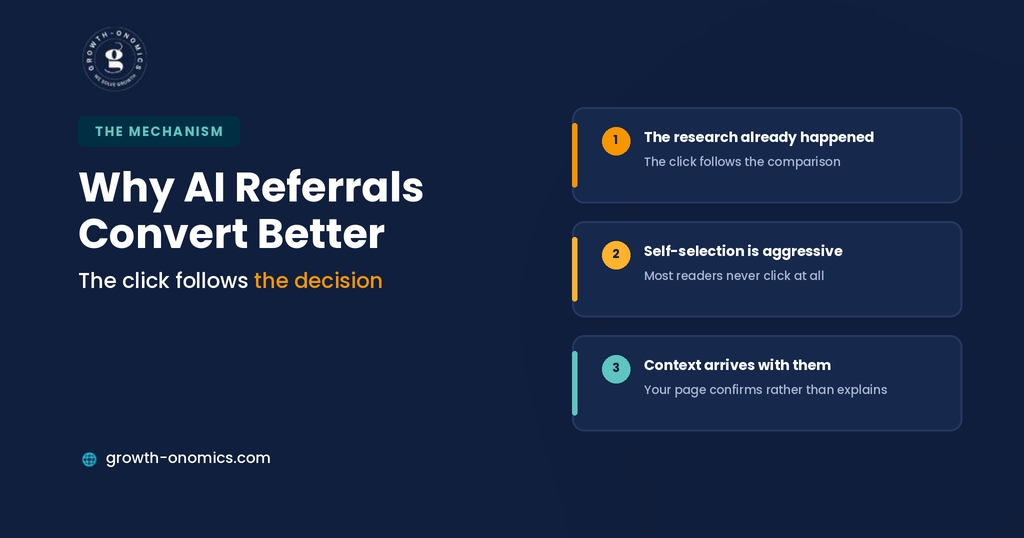
The research already happened. A visitor arriving from an AI answer has had the competitive context synthesized for them and has been told you are a credible option. The click comes after the comparison, not before it which is a fundamentally different arrival than someone browsing search results.
Self-selection is aggressive. Most people reading an AI answer never click anything. The ones who do have a specific reason: they want to verify a claim, see pricing, or check documentation. That filter removes most of the low-intent traffic that dilutes organic conversion rates.
Context arrives with them. The visitor already knows roughly what you do and why you were recommended, which means your landing page does not have to do the explaining. It has to do the confirming, which is a far easier job.
The practical implication is that AI referral traffic should be judged on conversion rate and pipeline contribution rather than volume, and it should have its own landing experience where possible.
Growth-onomics tracks AI referrals as a separate channel in client reporting for exactly this reason; blended into organic search, a small volume of exceptional traffic disappears into an average.
Where the Research Disagrees

Anyone quoting a single confident number about this channel is quoting one study. The published figures diverge substantially, and the reasons are instructive.
Panel composition. Studies measuring ecommerce sites, publisher sites, and B2B SaaS sites produce very different results, and the conversion multiples reported for B2B are among the highest in every dataset. Cross-industry averages understate B2B SaaS considerably.
Attribution method. Some studies count only sessions with an identifiable AI referrer. Others attempt to model the untracked portion, which is estimated to be large. The two approaches cannot be compared directly.
Period. This channel is changing fast enough that a study from early 2025 describes a different market than one from mid-2026. Platform shares in particular have moved substantially within single years.
Definition of conversion. A newsletter signup and a demo request are both conversions, and studies mixing them produce numbers that mean little for a B2B SaaS team measuring pipeline.
The defensible position is to treat published figures as directional evidence that the channel converts well, then measure your own. Your conversion multiple is knowable within a month of setting up the tracking, and it is the only number that applies to your business.
How to Measure This Properly

4 steps, none of which require a platform purchase.
Build a custom channel group. By default, AI referrals scatter across direct and referral in GA4, which is why most teams believe they receive none. A custom channel group matching known AI referrer domains isolates them, and the setup takes under an hour.
Segment by platform, never blended. ChatGPT and Perplexity behave differently enough that an average of the two describes neither. Report them separately even when Perplexity volume is small, because the ratio between them tells you something about your content mix.
Add self-reported attribution. A required “how did you hear about us” field with an explicit AI assistant option is the only view you get of the influence that arrives with no referrer, which published estimates suggest is the majority of it.
Track citation presence separately from traffic. Analytics cannot tell you whether you appear in answers nobody clicked, and for AI Overviews it cannot isolate the traffic at all. Prompt testing against a frozen set of buying-stage questions is the only way to see that surface, which is why Growth-onomics runs it on a schedule alongside analytics reporting rather than treating one as a substitute for the other.
What to Do Differently Per Platform
The overlap is larger than the differences, but the differences are actionable.
For ChatGPT: Prioritize the pages it cites, such as product, pricing, integrations, documentation, and comparisons. Make sure they are crawlable, answer directly, and contain the specifics a buyer would verify. This is also where inaccurate product descriptions do the most commercial damage, so check what it says about you.
For Perplexity: Prioritize being quotable and being present in third-party sources. Original research, clear positions in comparison content, and presence in the roundups and review platforms it draws on are vital more than product page optimization here.
For AI Overviews: Do classic SEO properly and verify snippet eligibility. There is no separate program, and any vendor selling one is selling something Google has explicitly said is unnecessary.
For all three: Fix the technical foundation first. Every one of these surfaces depends on pages that can be crawled, rendered, and parsed, and most crawlers feeding AI answers do not execute JavaScript. A page that fails that test is invisible everywhere at once.
Conclusion
The temptation with this channel is to pick a side. Either it is one percent of traffic and therefore ignorable, or it is the future of search and therefore urgent. Both framings lead somewhere unhelpful.
The accurate reading is narrower and more useful. AI referrals are a small, fast-growing, unusually high-converting slice of traffic that most teams are misattributing to direct and organic. Separating them costs an hour of GA4 configuration and immediately tells you something your competitors probably do not know about their own site.
Beyond that, the platforms are not interchangeable. ChatGPT sends most of the measurable volume and cites product pages readily. Perplexity sends less but rewards being quotable and being present off-domain. AI Overviews sends volume you cannot isolate and rewards the technical and content fundamentals you should already be doing. Optimize for all 3 by fixing the foundation, then weight your effort toward where your own data shows the traffic arriving.
Above all, measure your own numbers rather than quoting anyone else’s. The published research establishes that this channel converts well; it cannot tell you what it does for your business, and that figure is a month of tracking away.
If you want AI referral traffic separated, measured, and reported alongside organic performance and pipeline, Growth-onomics can set up the tracking and the citation monitoring together.
FAQs
How much traffic do AI platforms send to B2B SaaS sites?
Published studies place AI referrals somewhere between 0.1% and 3% of total sessions depending on industry, site authority, and how the study defined an AI referral. B2B and technology sites tend toward the higher end of that range. The important caveat is that these figures count only sessions with an identifiable AI referrer, and a substantial share of AI-influenced visits arrive with none surfacing as direct traffic or a subsequent branded search instead. Treat any published percentage as a floor, and measure your own rather than adopting a benchmark.
Does AI referral traffic really convert better than organic search?
The evidence consistently says yes, though the size of the advantage varies enormously between studies. Cross-industry analyses published in 2025 and 2026 report roughly 4 to 5 times organic conversion rates, with B2B SaaS at the higher end and individual company results reported considerably above that. The mechanism is straightforward: the visitor arrives after an AI has synthesized the competition and positioned you as credible, so the click follows the comparison rather than preceding it. Verify it on your own data, since the published range is wide enough that no single figure transfers.
Which platform should a B2B SaaS company optimize for first?
ChatGPT, on volume grounds, since every published study places it well ahead of the others in measurable referrals and it cites product pages more readily than Perplexity does. But the framing is slightly wrong: most of the work that helps on one platform helps on all of them. Crawlable pages, answer-first structure, accurate product information, and third-party presence are platform-agnostic. Platform-specific optimization influences the margins of which pages you prioritize and which off-domain sources you invest in rather than as separate programs.
Can I track Google AI Overviews traffic separately?
No. Google counts AI Overview and AI Mode clicks within standard Search Console reporting rather than exposing them as a distinct source, so those sessions appear in your organic search numbers alongside classic results. What you can do is track presence rather than traffic: run your priority queries and record whether an AI Overview appears and whether you are cited in it. That requires manual checking or a visibility tool, and it is the only view available. Anyone claiming to isolate AI Overview referral traffic in analytics is estimating rather than measuring.
How should I report this channel to leadership?
Report conversion rate and influenced pipeline rather than session volume, and state the share of total traffic openly rather than hiding it. A channel at one percent of sessions converting several times better than organic is a genuinely interesting finding, and presenting it that way survives scrutiny. Presenting session growth alone invites the obvious question about scale, and presenting conversion rate alone looks like cherry-picking. Add the caveat that a large share of AI influence arrives untracked, so the reported figure is a floor that framing has consistently held up better in board settings than a confident single number.
Why does most AI traffic show up as direct in my analytics?
For two reasons. Some AI interfaces pass no referrer information, so the session arrives with no origin data and defaults to direct. And GA4’s default channel groupings do not recognize AI platform domains, so even sessions that do pass a referrer often land in a generic referral bucket rather than anything identifiable. A custom channel group matching known AI referrer domains fixes the second problem within an hour. The first is structural, which is why self-reported attribution on demo forms has become a genuinely useful supplement rather than a nice-to-have.
