

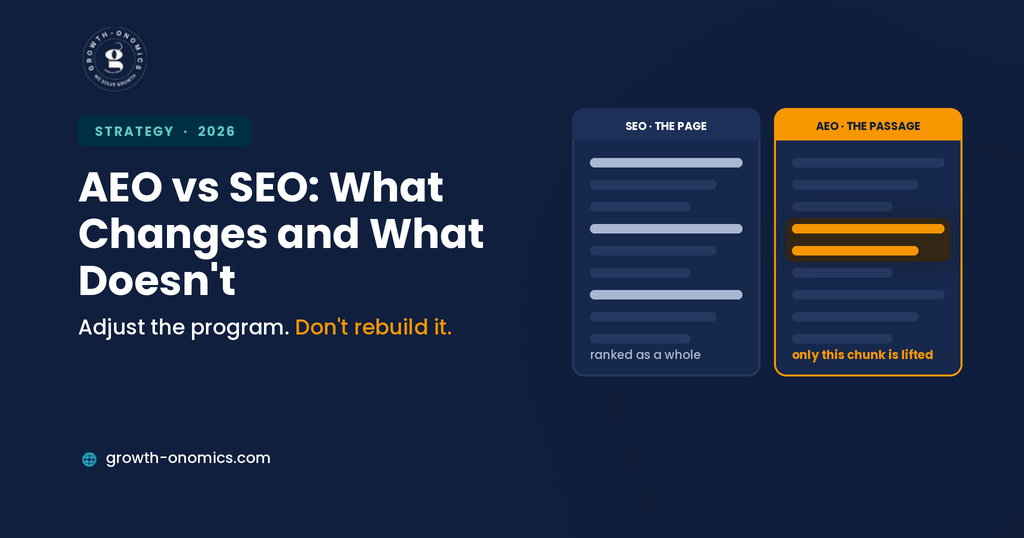
Two claims have been circulating for about 2 years now, and they cannot both be true.
The first is that SEO is dead, replaced by a fundamentally new discipline requiring new tools, new metrics, and probably a new agency.
The second is that nothing has really changed, that good content still wins, and answer engine optimization is a rebrand invented by people who sell services.
Neither survives contact with an actual content program.
Sit down with a B2B SaaS team’s roadmap and work through it item by item, and the situation is far less dramatic and far more useful: roughly two-thirds of the work is unchanged, a handful of things have shifted meaningfully, and two or three assumptions that used to be safe are now wrong.
That’s the honest version, and it is more actionable than either extreme.
This article works through it in 3 parts; what changed, what did not, and what the difference means for how you plan, staff, and report on content.
If you are trying to decide whether your content program needs rebuilding or adjusting, the answer is almost certainly adjusting, and the specifics are important.
Defining the Terms Honestly
Before comparing them, it helps to be clear about what these words are doing, because much of the confusion is terminological rather than substantive.
SEO is optimizing to be found through search engines, historically by ranking in a list of links.
AEO (answer engine optimization), sometimes called GEO (generative engine optimization), is the practice of optimizing to be included and cited in generated answers, whether those answers appear in Google AI Overviews, ChatGPT, Perplexity, or Copilot.
The relationship is the part people get wrong.
AEO is not the successor to SEO, and it is not a separate discipline running alongside it. It is a set of additional considerations layered on top of search optimization, because the systems producing answers still draw heavily on the indexable, crawlable web.
Google’s own position is that appearing in AI Overviews requires no special technique beyond being indexed, snippet-eligible, and useful.
That’s why the honest framing is not “AEO versus SEO.” It is that search optimization now has a second surface to account for, and a handful of practices now carry more weight.
The practical test for any claim in this debate is whether it changes what goes on next quarter’s roadmap. Most of what gets written about AEO does not it describes a shift in vocabulary rather than a work shift. The 4 changes below do change the roadmap, which is why they are worth separating from everything else.
Quick Comparison
| Dimension | Traditional SEO | With AEO Considerations |
| Unit of optimization | The page | The passage |
| Success outcome | A ranked link and a click | Inclusion, citation, accurate description |
| Primary sources | Your indexed pages | Your pages plus third-party sources |
| Measurement | Rankings, traffic, conversions | Plus citation share and answer accuracy |
| Content structure | Comprehensive coverage | Comprehensive, with extractable answers |
| Technical baseline | Crawlable and indexable | Same, and now more consequential |
| Authority | Links and brand signals | Same, weighted across more sources |
| Intent research | Keyword-based | Keyword and question-based |
What Changed
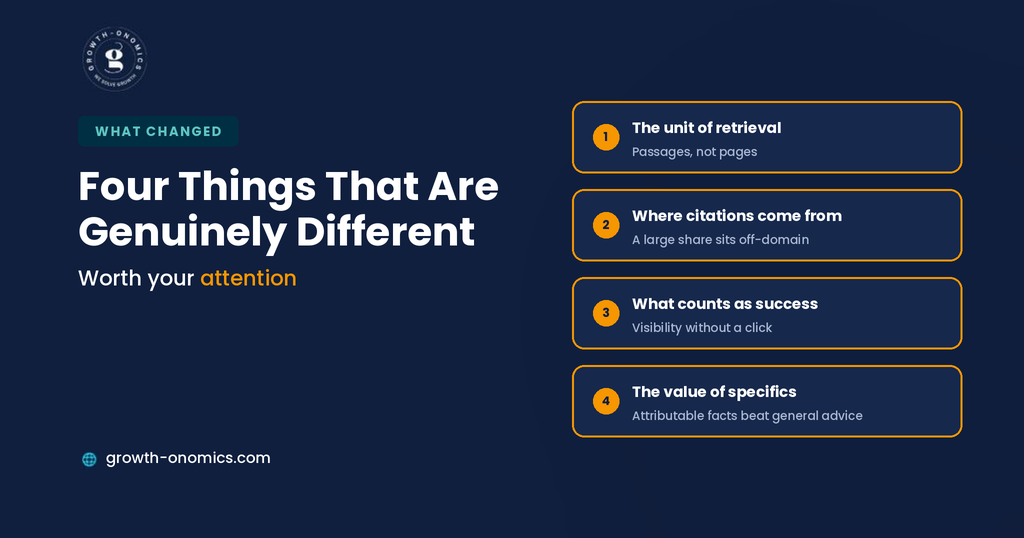
4 things are genuinely different, and they are worth understanding precisely rather than approximately.
1. The Unit of Retrieval
What changed: Answer engines work with passages rather than whole pages.
A retrieval system chunks your content, scores those chunks against a query, and uses the ones that answer it most directly. This means a page can be comprehensive, well-researched, and completely ranked while contributing nothing to an answer, because the relevant chunk was buried inside a section full of unrelated context.
What it means practically: Structure carries more weight than it used to. A definition in the first two sentences under a question-shaped heading is extractable; the same definition in paragraph 9 of a narrative section is not. This is the single most common gap between content that ranks and content that gets cited.
What it does not mean: Shorter content. Length isn’t the variable; a 3,000 word guide with clean section boundaries and direct answers outperforms a 600 word post that meanders.
The main change is the ability of individual sections to stand alone now depends on internal organization rather than word count.
2. Where Citations Come From
What changed: A meaningful share of the sources feeding AI answers resides outside your domain entirely.
Review platforms, community threads, industry publications, and third-party roundups appear frequently when assistants answer evaluative questions, often more so than vendor sites. Models weigh consensus across sources, which means a description that appears only on your own site has nothing corroborating it.
What it means practically: Content strategy now has an off-domain component that most teams have never resourced. Keeping review profiles current, participating honestly in the communities your buyers use, and earning editorial coverage are content activities rather than PR afterthoughts, and they need an owner and a cadence like any other channel. Growth-onomics runs this as a defined brand mentions and listings workstream for that reason; citation source analysis usually shows the gap lying off-domain rather than on it, which is a very different remediation plan than publishing more.
What it does not mean: That owned content had lost its significance. Documentation, pricing pages, comparisons, and integration pages get cited heavily for factual questions. The change is that owned content competes for a share of the citation mix rather than owning it.
3. What Counts as Success
What changed: Visibility can now occur without a click.
A buyer can read an accurate description of your product, form a shortlist, and never visit your site. That influence is evident and largely invisible in analytics, it surfaces later as branded search, direct traffic, or nothing traceable at all.
What it means practically: Reporting needs a second layer. Citation presence for buying-stage questions, share of voice against competitors, and the accuracy of how you are described are now legitimate metrics, and branded search trend becomes a more meaningful supporting indicator than it used to be. Accuracy in particular is worth watching, because being described wrongly is a commercial problem that no ranking report would ever surface.
What it does not mean: That traffic stopped counting. Clicks still convert, high-intent pages still drive demos, and organic sessions remain the most measurable thing you have. The addition is a layer, not a replacement.
4. The Value of Being Specific
What changed: Attributable facts became more valuable relative to general expertise.
Models need something concrete to cite. Original research, named benchmarks, dated figures, stated methodology, and specific constraints give a system something to attribute to you. Generic advice that could have come from 50 sites gives it no reason to prefer yours.
What it means practically: Original data, expert commentary, and specificity in ordinary pages all rose in value. So did honest limitations; a comparison page that states where a competitor is stronger reads as credible to both buyers and models, while a one-sided page gets discounted.
What it does not mean: That well-argued opinion content is worthless. It earns citations too, particularly when attributed to a named expert with a consistent public presence. The change is that vague content lost ground faster than it used to, and that loss concentrated in the middle of competent, unremarkable, indistinguishable content.
What Did Not Change
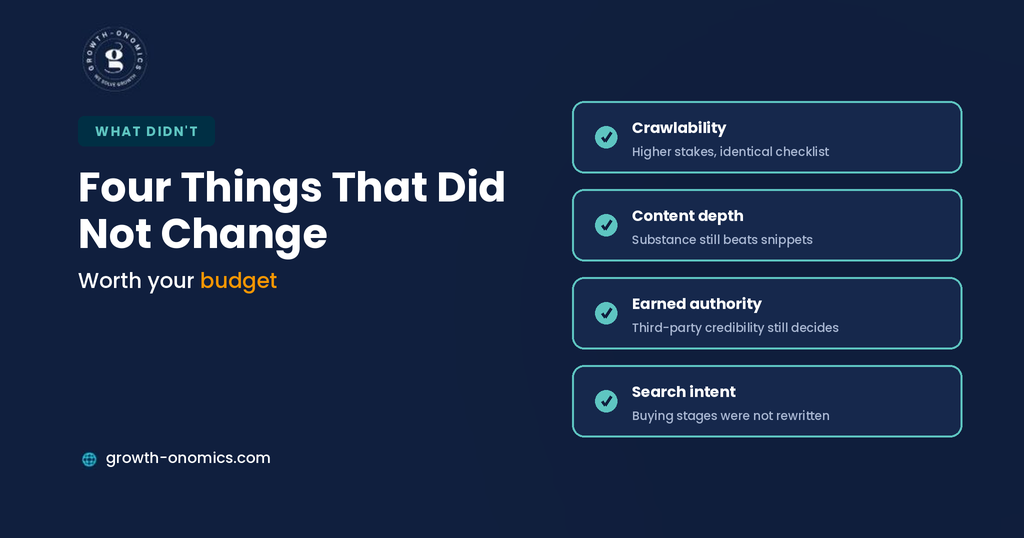
This half of the article matters more, because it is where most of the budget goes and where most of the panic is misplaced.
5. Crawlability and Technical Health
What did not change: A page that cannot be crawled, rendered, and parsed is invisible.
If anything, this has become more consequential rather than less. Google renders JavaScript on a deferred queue; most crawlers feeding AI answers do not render at all, which means client-side content is not delayed for them but permanently absent.
Why the panic is misplaced: Nothing new is required. Server-side rendering, clean site architecture, working canonicals, proper status codes, and unblocked resources were the right answers before and remain the right answers. The stakes rose; the checklist did not change, which means any team that took technical SEO seriously already did most of this work.
The one adjustment: Snippet controls have become more important than teams realize. A page carrying nosnippet or max-snippet:0 is ineligible for AI Overviews and rich results, and those directives are frequently inherited from configurations nobody remembers writing.
6. Content Quality and Depth
What did not change: Substantive, useful, accurate content outperforms thin content.
The theory that AI answers would reward short, machine-optimized snippets has not held up. Depth still wins, because depth is what makes a source worth citing on a specific question.
Why the panic is misplaced: Teams worried that AI would reward keyword-stuffed answer boxes have watched the opposite happen. The content earning citations is the content a knowledgeable person would find genuinely useful, which is what the last decade of guidance already said.
The one adjustment: Depth needs to be organized so individual answers are findable inside it. Same substance, better structure.
7. Authority and Third-Party Validation
What did not change: Credibility earned outside your own site determines whether you are treated as a source.
Links, mentions, reviews, editorial coverage, and expert reputation are as important as ever. The mechanism has shifted slightly; models weigh consensus across sources rather than counting links but the work of earning that credibility is identical.
Why the panic is misplaced: Digital PR, original research, community participation, and review platform management were already the right activities. Nobody needs a new playbook here; they need to do more of the one they had.
The one adjustment: Consistency is more important than anything else. Your product described in 3 different ways across your site, review profiles, and press coverage, complicating entity resolution, and inconsistent entity data is a more expensive problem than it used to be.
8. Search Intent
What did not change: Understanding what the searcher wants remains the foundation of the whole discipline.
Buyers still research categories, compare options, check integrations, and look for reasons to disqualify vendors. The stages of a B2B buying journey have not been rewritten by a new interface.
Why the panic is misplaced: Keyword research is not obsolete. It is incomplete on its own, because conversational queries are longer and more specific than the terms in a keyword tool, but the underlying intent categories are unchanged.
The one adjustment: Add question inventories to keyword research. Pull the questions sales and support hear all time, because those match the phrasing buyers use with an assistant far better than a keyword export does. It is also the cheapest research available, since the answers already exist inside your own organization.
What This Means for Your Program
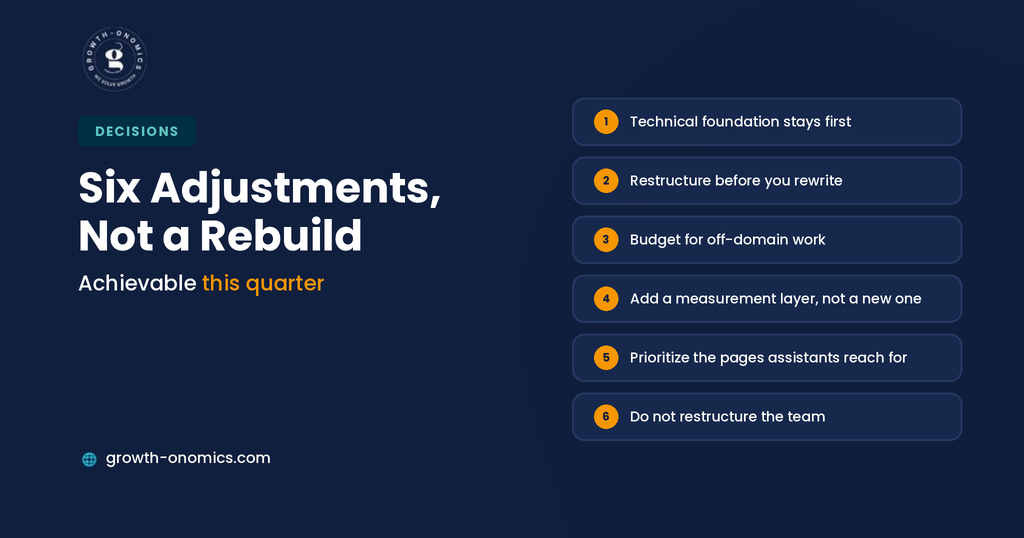
Translate the above into decisions and the situation is rather straightforward.
Keep the technical foundation as your first priority. It got more consequential, not less. If your key pages fail a raw-HTML check, nothing else on this list means anything until that is fixed.
Restructure before you rewrite. Most existing content gains more from reorganization like answer-first openings, question-shaped headings, tables for comparisons than from being replaced. This is the cheapest available improvement in most programs, because the pages are already indexed and already earning traffic, so you are improving an asset rather than starting one.
Budget for off-domain work. If your content plan is entirely a publishing calendar, it addresses roughly half the citation mix. Review profiles, community participation, and earned coverage need an owner and a cadence, and they are the part most likely to have no line in the budget at all.
Add a measurement layer rather than replacing one. Keep rankings, traffic, and conversions. Add citation presence for buying-stage prompts, share of voice, and answer accuracy. Growth-onomics reports these together for exactly this reason; a citation metric presented without organic performance and pipeline context invites the wrong conclusions in both directions.
Prioritize the pages assistants actually reach for. Pricing explanations, integration pages, comparisons, security documentation, and technical docs get cited far more than thought leadership. That was somewhat true before and is emphatically true now, which is an uncomfortable reordering for teams whose roadmap is built around ideas rather than answers.
Do not restructure your team. The skills that produce good SEO content produce good AEO content. What changes is where a few hours go, not who does the work. Splitting the function creates two groups optimizing the same pages and competing for credit on the same outcomes.
Conclusion
The most useful way to think about AEO is as a change in what winning looks like rather than a change in how you win. The mechanics that made a company visible in search, accessible pages, genuinely useful content, credible third-party validation, and honest measurement are the same mechanics that get a company cited in an answer.
What changed is that the outcome is now inclusion in a response rather than a position in a list.
4 things genuinely shifted: passages became the unit of retrieval, off-domain sources gained weight, visibility became possible without a click, and specificity became more valuable.
4 things did not: technical health, content depth, earned authority, and search intent.
The first group deserves attention; the second group deserves your budget, because that is where the compounding is.
Anyone selling a total rebuild of your content program is describing a discipline that does not exist. Anyone telling you nothing has changed has not looked at where their category’s answers are actually being sourced from. The work in between like restructure what you have, resource the off-domain half, add the second measurement layer is unglamorous, achievable this quarter, and where the returns are.
If you want a read on which half of that your program is missing, the Growth-onomics team can audit the technical, content, and off-domain layers together and tell you where the gap actually sits.
FAQs
Is SEO dead, replaced by AEO?
No, and the framing itself causes bad decisions. Answer engines draw on the indexable, crawlable web, which means the systems producing AI answers depend on the same infrastructure SEO has always addressed. Google has stated that appearing in AI Overviews requires no special technique beyond being indexed, snippet-eligible, and useful. What has changed is that ranking is no longer the only outcome worth measuring, and a handful of practices like structure, specificity, and off-domain presence play a more significant role now. Treat AEO as an extension of search optimization rather than a replacement for it.
Do I need a separate AEO strategy and team?
Almost certainly not. The skills that produce content which ranks are the skills that produce content which gets cited, and the technical work is identical. What changes is emphasis: a few hours move from keyword research toward question inventories, from publishing volume toward restructuring existing pages, and from owned content alone toward review profiles and community presence. That is a reallocation within an existing team, not a new function. Companies that build a separate AEO team usually end up with two groups optimizing the same pages and arguing about credit.
What should I stop doing?
Very little, but 3 habits are now actively counterproductive. Publishing thin content at volume was always weak and now fails faster, since generated summaries of what already ranks land in the middle of every category. Gating factual information like pricing structure, security certifications, and case study results hands the answer to third-party sources with worse data. And burying answers beneath long introductions costs you the passage, not just the reader. None of these were good practice before; they are simply more expensive now.
How do I measure AEO alongside SEO?
Add a layer rather than replacing your reporting. Keep rankings, organic traffic, and conversions, and add 3 things: citation presence across a frozen set of buying-stage prompts, share of voice against tracked competitors, and the accuracy of how your product is described. Report them in the same review as organic performance so nobody treats them as competing programs. Branded search trend becomes more useful as a supporting indicator too, since AI-influenced discovery frequently surfaces as a brand search rather than a referral.
How much of my content budget should move to AEO work?
Less than the framing suggests, because most of it is the same budget doing slightly different things. A reasonable split for a program that was already functioning is to move perhaps a fifth of production capacity into restructuring existing pages for the first quarter, and to add a genuinely new line for off-domain work like review profile maintenance, community participation, and earned coverage, which most content budgets do not currently fund at all. The rest stays where it was. If a proposal requires doubling your content spend to address AEO, it is describing a rebuild rather than an adjustment.
What is the fastest improvement I can make?
Restructure your highest-value existing pages so each section answers its heading in the first 2 sentences. It costs a fraction of what new content costs, it applies to pages that are already indexed and earning traffic, and it addresses the most common reason content ranks without being cited. Start with pricing, comparisons, integrations, and security pages, since those are the ones assistants reach for most when answering commercial questions. Publishing new content is the slower and more expensive route to the same visibility.
