

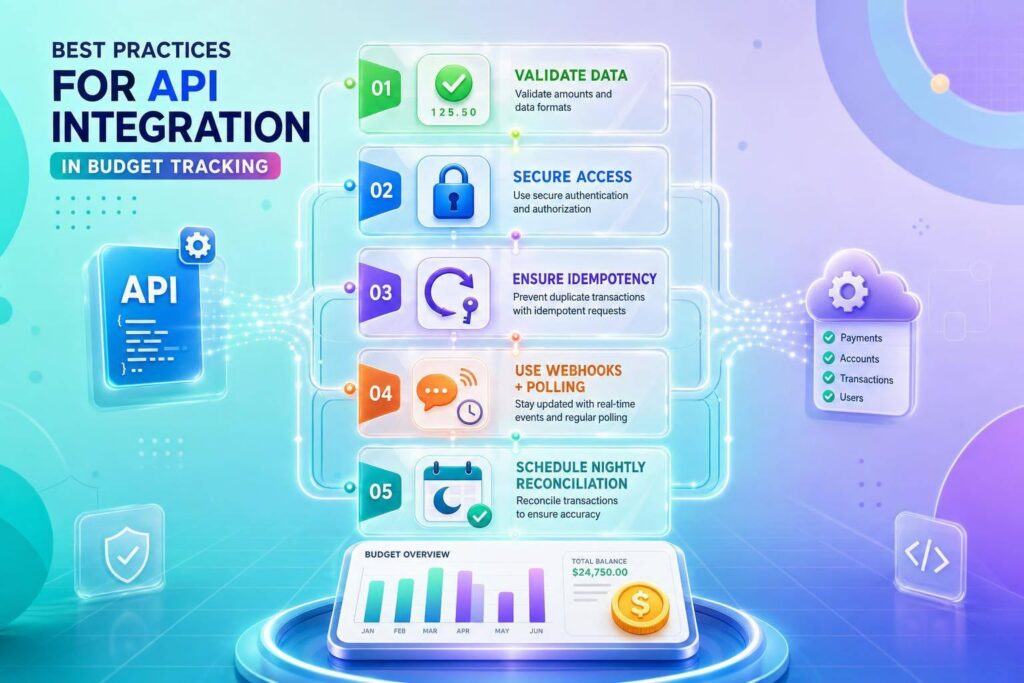
If I want budget tracking that I can trust, I need four things: clean data rules, safe system access, reliable syncs, and tight monitoring. That’s the whole game.
Here’s the short version: I should validate money, dates, currencies, and time zones before data moves. I should use OAuth 2.0 or locked-down API keys, keep secrets out of code, and test in sandbox first. Then I should mix webhooks, polling, backfills, retries, idempotency keys, and reconciliation so my dashboard stays in line with source systems.
In plain English, this article says budget API work goes wrong when teams skip the basics:
- Bad data in: wrong decimals, missing currency codes, and time zone mix-ups
- Bad writes: duplicate transactions from retries without idempotency
- Bad access: broad permissions, exposed secrets, and live testing in production
- Bad sync design: using only webhooks or only polling when both are needed
- Bad oversight: no alerts for stale data, schema drift, or reconciliation gaps
A few points stand out:
- Use fixed decimals for amounts like $1,234.56, not float math
- Keep API dates in ISO 8601, even if the UI shows 08/16/2026
- Use webhooks for spend and payment events, and 15- to 60-minute polling for slower finance updates
- Add idempotency keys to every write so retries don’t create duplicates
- Run nightly reconciliation to compare dashboard totals with the source of record
- Alert when error rates go above 10% on key webhook flows or when API latency moves past 3 seconds
If I had to sum it up in one line, I’d say this: good budget API integration is less about moving data fast and more about making sure every number lands in the right place, one time, with a clear trail.
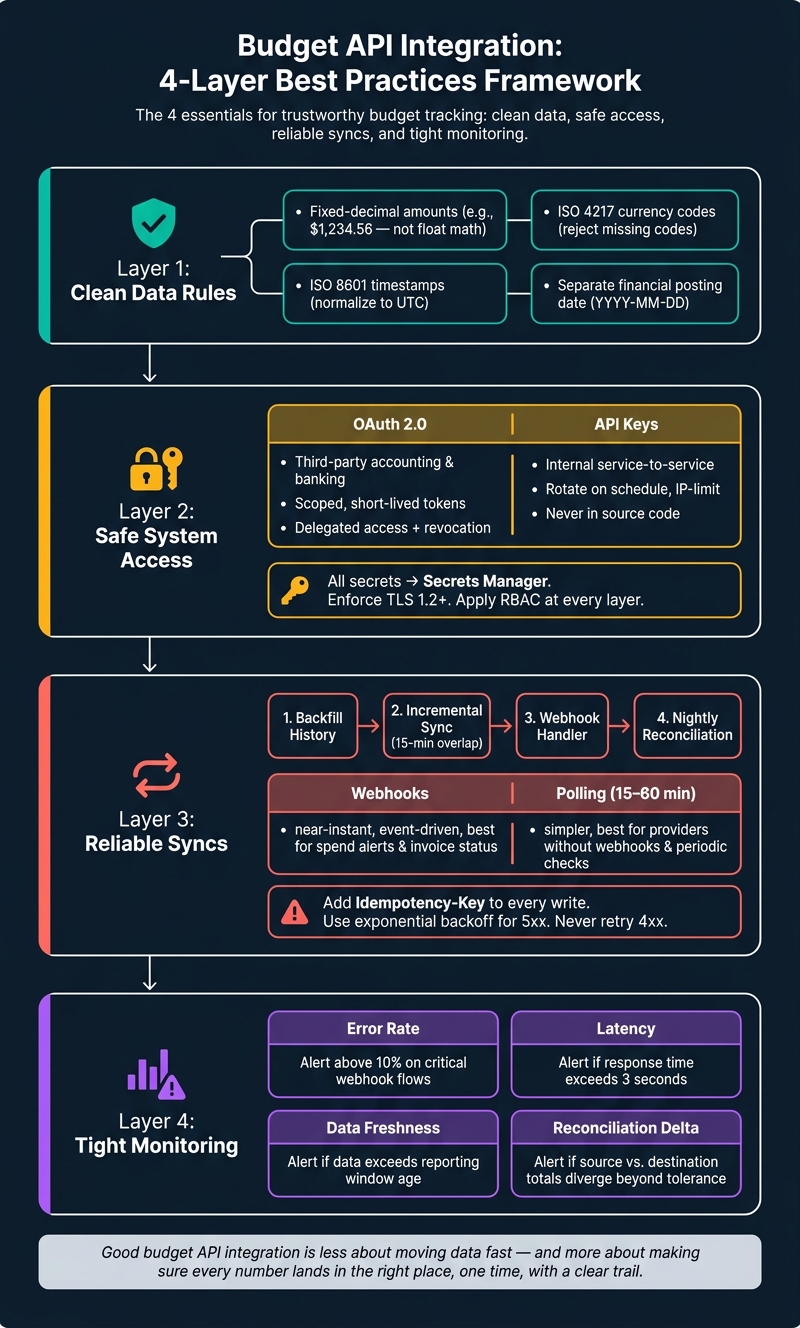
Budget API Integration: 4-Layer Best Practices Framework
Smart Budgeting App using the Plaid API – DB Setup and Initial domain modeling (Part 2)
sbb-itb-2ec70df
Design APIs and Data Models for Budget Accuracy
After sync timing is set, lock down the API contract. Accurate budget data depends on APIs you can predict and data models that don’t shift around. When endpoints stay consistent and data models line up, downstream tools – dashboards, ERPs, and marketing platforms – can join and roll up numbers without guesswork or manual cleanup.
Use Clear Endpoints, Versioning, and Standard Budget Objects
Budget tracking APIs should map to the financial objects your team uses day to day. In practice, that means resource-based endpoints like GET /budgets and POST /transactions.
Each resource should return a consistent JSON schema. For example, a transaction object should include:
transaction_idamountas a fixed-precision decimalcurrencyas an ISO 4217 code such as"USD"transaction_timestampas an ISO 8601 timestampcategorycost_center_id
A shared schema keeps aggregation consistent.
Use explicit URL versioning – https://api.example.com/v1/budgets and https://api.example.com/v2/budgets – with each version guaranteeing stable behavior. Add backward-compatible fields with null defaults. For breaking changes, release a new version and keep the old one active during a documented deprecation window. Run automated contract tests against both versions before rollout so breakage shows up early.[10]
Validate Amounts, Dates, Currencies, and Time Zones Before Syncing
Stable endpoints won’t help much if incoming values are messy. Validate records before sync, and enforce these rules at the ingestion layer.
For amounts, store values as fixed-precision decimals. For USD, accept 1234.56 and reject 1234.567. Binary floating-point arithmetic can introduce rounding errors, and those small errors add up fast across high transaction volume.[4][3] If a record is missing a currency code, reject it unless the system is explicitly set up as single-currency USD. Otherwise, you risk silent misclassification.[2][5]
For dates and time zones, parse U.S.-style MM/DD/YYYY inputs from outside sources before converting and normalizing to UTC. Store a separate financial posting date (YYYY-MM-DD) alongside the full event timestamp, and validate both against the active budget period. Pick one business time zone – such as America/New_York – for all reporting cutoffs. A transaction posted at 11:30 PM Pacific Time becomes 2:30 AM Eastern the next day, which can push it into the wrong budget period if time zones aren’t normalized.[12][13]
Handle Failures with Retries, Idempotency, and Audit Logs
Once data passes validation, protect writes from retries and partial failures. Networks fail. APIs time out. And retries without idempotency can create duplicates that are a headache during month-end close.
Idempotency keys fix that. Add a unique Idempotency-Key header to every state-changing request, usually a UUID generated per logical operation and reused across retries. The server stores that key with the request fingerprint and response in a durable store. If the same key shows up again, the server returns the original result instead of creating a second record.[7][8][9]
Pair that with exponential backoff for transient 5xx errors. Don’t retry 4xx errors, because those usually point to a client or permission problem. If you get 429 Too Many Requests, respect the rate limit and back off instead of hammering the API.
Audit logs are the paper trail. Record every write attempt with a timestamp, idempotency key, payload, status, and correlation ID. That gives finance teams a traceable record for review and compliance.[1][4][6]
| Pattern | Primary Use Case | Key Benefit | Main Consideration |
|---|---|---|---|
| Simple retries | Transient network or server errors on transaction posts | Reduces data loss from temporary failures | Can create duplicate financial entries without idempotency |
| Idempotent writes | Repeated writes due to retries or client errors | Prevents duplicates and makes replays safe | Requires careful key design so distinct entries are not merged |
| Circuit breaker | Protecting systems during upstream API outages | Stops cascading failures and can buffer operations until recovery | Works best with controlled replay and idempotent writes |
Duplicate writes distort actuals and close, so idempotency and audit logs are core budget controls.
Connect Accounting and Financial Software Securely
With your data models checked and duplicate-write safeguards in place, the next move is to pull in the finance data behind budget reporting – without exposing private records or putting live books at risk.
Choose the Right Finance Data Sources for Budget Tracking
Most U.S. organizations need data from more than one system to see the full budget picture. Start with accounting platforms as the main ledger source. They give you chart of accounts data, journal entries, invoices, bills, payment status, and budget-vs.-actuals reporting.
Then bring in banking and fintech aggregators for cash position. That usually includes:
- Bank balances
- Transaction feeds
- ACH and card payments
- Running balances
After the core actuals pipeline is stable, add ad platform APIs for campaign-level daily spend, budget caps, and channel labels. Then map campaign spend to GL accounts and cost centers so channel activity lines up with the ledger.
Once that source order is set, tighten access before you connect any production data.
Use OAuth 2.0, Secret Management, and Role-Based Access Controls
Use OAuth 2.0 for third-party accounting and banking APIs. Use API keys only for internal service-to-service connections where both sides are under your control.
Why does that matter? Because OAuth 2.0 supports delegated access, scoped permissions, and token revocation. That matters when you’re dealing with invoice data, bank transactions, or vendor payment records. Ask only for the scopes your integration needs. A budget-tracking tool that reads invoice totals and GL account balances does not need write access or payroll data.
API keys need hands-on care. Rotate them on a set schedule, limit them by IP where you can, and never place them in source code or client-side code.
| Factor | OAuth 2.0 | API Key |
|---|---|---|
| Setup effort | Higher – requires auth flows, token exchange, redirect URIs | Lower – static token sent in headers |
| Security strength | Strong – scoped, short-lived tokens and easy revocation | Moderate – static, harder to rotate, no built-in scoping |
| Best fit for finance | Third-party accounting platforms, banking aggregators, multi-tenant access | Internal microservices and server-to-server connections with controlled endpoints |
All credentials – OAuth client secrets, refresh tokens, and API keys – belong in a secrets manager, not in source code or plain-text config files. Enforce TLS 1.2 or higher on every API call, check server certificates, and log access for audit purposes.
RBAC should apply at more than one layer. Inside your application, a Marketing Analyst might only see rolled-up spend and invoice status by cost center. A Finance Admin might need full transaction detail for reconciliation. Inside the connected platform, set the integration account to read-only and limit it to the exact objects it needs. Nothing extra.
Separate Sandbox Testing from Live Financial Connections
Before any integration touches live books, run it in a fully separate environment. That means different credentials, different API applications, and synthetic data that looks like real transaction patterns without using actual vendor or employee records. Most major accounting platforms and banking aggregators offer dedicated sandbox instances for this.
Before go-live, check field mappings and reconciliation totals. Production credentials should sit in a separate secrets namespace from sandbox credentials. You also want automated checks that stop sandbox-only config from slipping into production systems.
If reconciliation finds mismatches past a defined threshold after go-live, the system should alert the right team and pause automated posting until someone reviews it.
With secure access and sandbox checks in place, move into live sync and pipeline design.
Build Real-Time Budget Pipelines for Marketing and Operations
With secure connections and sandbox testing in place, the next move is the part that does the heavy lifting: building the data flow that keeps budget numbers current across marketing and operations.
Combine Campaign Spend with Accounting Actuals and Invoice Status
Pull spend, invoices, and payments into one budget pipeline. A good budget dashboard should show spend, commitments, billed amounts, and cash paid out in one view. To do that, you need data from three systems at the same time:
- Ad platforms like Google Ads and Meta Ads for daily campaign spend
- Accounting software like QuickBooks or Xero for posted expenses and payments
- Your invoicing system for receivables and payment status
Use one normalized schema across all three sources. Put every timestamp in one time zone, convert currencies the same way every time, and map each platform’s categories to your chart of accounts. Once that schema is locked in, the pipeline can merge those feeds without manual cleanup.
For example, Google Ads exposes campaign budgets and spend through its API, which lets you compare planned budget against actual spend without exporting files by hand.[17][18][20] On the accounting side, Xero’s invoice API includes status values like AUTHORISED and PAID, so you can split committed costs from cash that has already gone out.[19]
Once the data model is stable, pick the sync method based on how fast each source changes.
Use Webhooks, Incremental Syncs, and Backfills to Keep Data Fresh
Use three layers: backfill history, run incremental syncs, and listen for webhooks.[14][21][22]
A backfill loads prior months of transactions so your reporting layer has context. Use cursor-based pagination and checkpoint each page so long histories don’t time out or run into rate limits.[11]
For incremental syncs, use a 15-minute overlap in your sync windows and deduplicate by object ID. That way, late-arriving records don’t get missed or counted twice.[14]
Webhooks handle the fast-moving events: an invoice marked paid, a campaign budget changed, or a refund issued. Revolut Business, for example, documents syncing account and transaction data into dashboards and reconciliation tools with webhooks for real-time updates.[24]
Here’s how polling and webhooks stack up in a budget pipeline:
| Factor | Webhooks | Polling |
|---|---|---|
| Latency | Near-instant after an event | Delayed by the polling interval |
| API usage | Efficient – only fires when something changes | Higher – many requests return no new data |
| Implementation complexity | Higher – requires endpoint handling, signature validation, retries, and deduplication | Lower – simpler scheduled GET loop |
| Best fit | Spend alerts, invoice status changes, payment events | Providers without webhook support, periodic reconciliation, fixed-interval checks |
Once freshness is handled, the next issue is volume and source-system limits.
Manage Rate Limits, Pagination, Caching, and Reconciliation
Keep API calls under control by caching stable data and paginating transaction history. Cache reference data that rarely changes – account lists, campaign metadata, and vendor records – so you aren’t requesting the same resources on every sync cycle.[15][16]
For transaction history, paginate in small batches with cursor pagination instead of offset-based pagination. Offset pagination can skip or duplicate records when new data lands during a sync.[11] If you hit a 429 response, back off based on Retry-After or rate-limit headers.[11]
Reconciliation is what makes the dashboard dependable when volume spikes. Run a nightly job that compares dashboard totals with source-system totals: total spend by day against the ad platform, paid invoices against the accounting system, and recognized revenue against the billing platform. This helps catch missed webhook deliveries, duplicate records, and partial sync failures before they quietly throw off your budget numbers.[14][22][23]
Run the pipeline in this order: backfill, incremental sync, webhook handler, reconciliation.
Govern, Monitor, and Improve the Integration Over Time
Budget integrations can drift over time. APIs change, auth tokens expire, webhooks miss events, and schemas shift. When that happens, reports can go off without much warning. The fix is simple in theory: use monitoring, testing, and version control so you catch problems before bad data reaches the dashboard.
Track API Health, Data Freshness, and Budget-Impacting Errors
Once backfills, webhooks, and reconciliation are set up, the next job is making sure they still work day after day. Monitoring should focus on three layers: API health, data freshness, and errors that change budget totals.
Break the dashboard out by integration. Then group errors by auth, schema, rate limit, and network failures. That makes triage much easier because each issue points to a different type of fix.
| Monitoring metric | Suggested alert threshold | Response |
|---|---|---|
| Error rate | Above 10% for critical webhook flows | Inspect logs, validate credentials, check schema drift, pause failing writes. [29][30] |
| Latency | Response time above 3 seconds | Scale consumers, reduce synchronous work, queue processing, and re-test endpoint health. [29] |
| Data freshness | Data older than the reporting window | Trigger reconciliation, backfill missing records, verify upstream sync health. [26][27] |
| Reconciliation delta | Source and destination totals diverge beyond tolerance | Run targeted repair jobs and validate mapping rules. [25][28] |
Treat webhooks as best-effort, not as your only line of defense. Back them up with reconciliation.
Monitoring helps you spot live failures. Testing helps you catch the next one before it reaches production.
Prepare for Provider Changes with Testing and Version Control
A small provider change can create a big reporting problem. If a field gets renamed or an enum changes, spend and budget totals can become wrong even if the API still returns a 200 status.
That’s why it helps to use:
- Unit tests for transformation logic
- Integration tests for sandbox and endpoint behavior
- Contract tests for schema and field changes
For example, a contract test can catch a field renamed from amount to total_amount before it corrupts a budget report. [33][35]
Keep integration code in Git, branch by API version, and store mappings and endpoints in environment-specific config. When a provider announces a deprecation, build the update in a dedicated branch, run regression tests, and ship it behind feature flags. [31][32][34]
Conclusion: Keeping Budget Data Accurate and Decision-Ready
Accurate budget reporting depends on stable integrations, monitored freshness, and controlled API changes. Clear ownership matters too. So do acceptable variance thresholds. And every time the business adds a new cost center or marketing channel, the mappings need a review.
For businesses that need help connecting financial data with marketing reporting and analytics architecture, Growth-onomics provides data-driven implementation and ongoing support across data analytics, performance marketing, and customer journey mapping – so the pipeline behind budget decisions stays accurate as systems change.
FAQs
How do I choose between webhooks and polling?
Choose based on how fast you need to act on your data. Webhooks are the best fit for real-time events. They send updates as transactions happen, which helps with immediate decisions and automated workflows.
Polling checks for data on a set schedule. It works well for tasks that aren’t urgent and can handle a delay. If you need frequent monitoring to help prevent overspending, go with webhooks.
What should I reconcile every night?
You don’t need a nightly manual reconciliation process. A better approach is proactive monitoring: use automated health checks, real-time alerts, and scheduled audits so you can catch discrepancies as they happen, not hours later.
It also helps to put a few guardrails in place. Use automated data validation, keep naming conventions consistent, and monitor latency and error rates. Those small habits go a long way toward keeping budget tracking accurate and dependable.
How can I prevent duplicate transactions?
Use event deduplication with unique transaction IDs. Duplicates often show up because of network retries, repeat user actions, or integration mistakes. When you assign steady identifiers like transaction IDs, timestamps, or user IDs, your system has a clear way to spot and filter extra records.
It also helps to run regular data audits. That gives your team a chance to catch and remove duplicates before they distort financial reporting. Growth-onomics notes that setting up these validation checks early supports accurate, real-time budget tracking.