


More affiliate revenue does not always mean more profit. I’d judge any campaign with five checks: set an ROI floor, confirm tracking, watch net-profit KPIs, tune payouts and partner mix, and run one monthly test at a time.
Here’s the short version:
- I’d calculate ROI from net profit, not just sales.
- I’d include all costs: commissions, fees, staff time, refunds, chargebacks, discounts, and fraud loss.
- I’d check tracking before making budget calls.
- I’d review CPA, AOV, conversion rate, EPC, and net revenue every month.
- I’d move budget to affiliates that bring profit, not just volume.
- I’d scale in small steps and cut spend when CPA drifts too far above target.
A simple example shows why this matters: a campaign with $50,000 in revenue and $45,000 in costs gives about 11% ROI, while one with $20,000 in revenue and $8,000 in costs gives 150% ROI. The bigger campaign is not the better one.
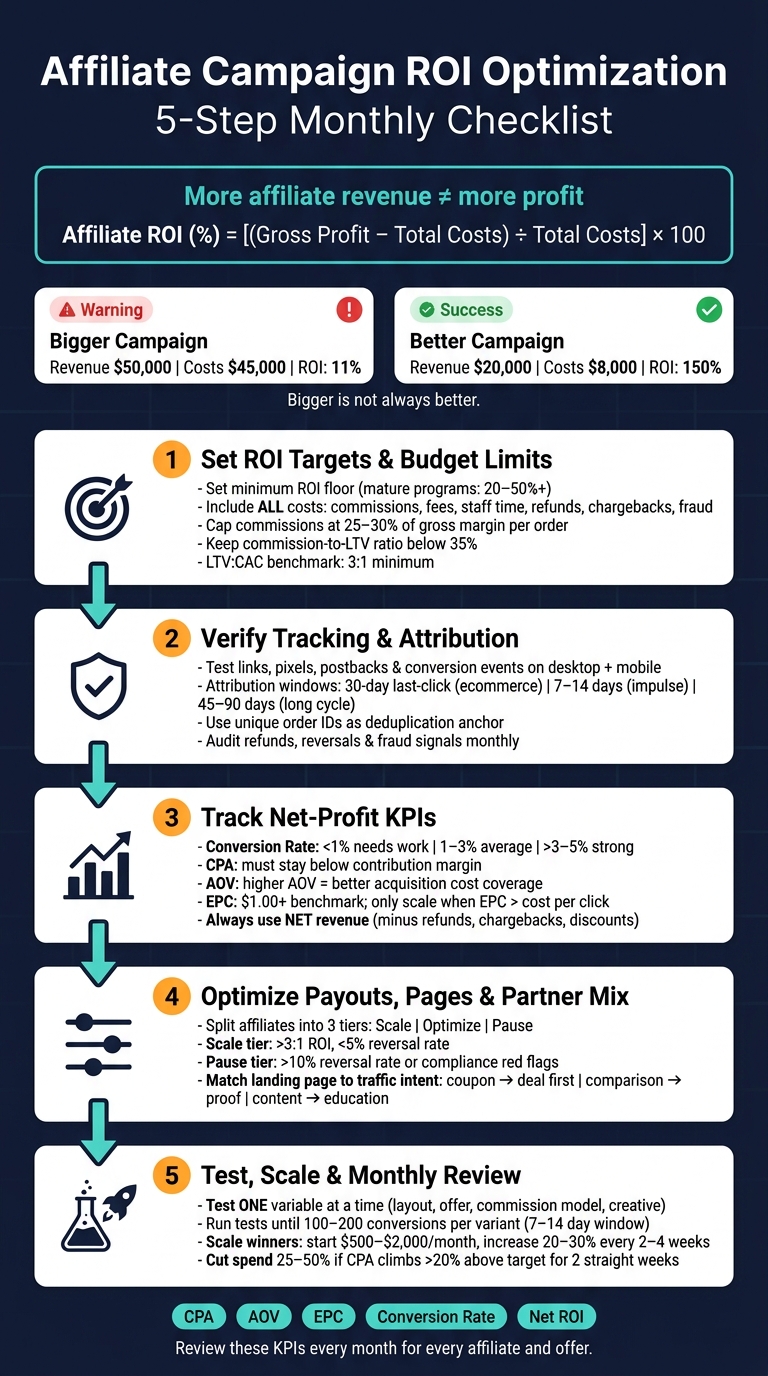
Affiliate Campaign ROI Optimization: 5-Step Monthly Checklist
How to design, scale and measure ROI from Affiliate Marketing in Ecommerce fear Kristina Nolan
sbb-itb-2ec70df
Quick comparison
| Area | What I’d check | Why it matters |
|---|---|---|
| ROI targets | Minimum ROI floor, budget caps, margin limits | Stops me from scaling weak campaigns |
| Tracking | Links, pixels, postbacks, order IDs, attribution rules | Bad data leads to bad budget calls |
| KPIs | CPA, AOV, conversion rate, EPC, net revenue | Shows whether traffic makes money |
| Payouts and partner mix | Commission model, tier changes, lead generation services to replace low-quality traffic | Keeps margin from slipping |
| Testing and review | One-variable tests, monthly review, staged scaling | Helps me make clean decisions |
If I were running an affiliate program, this is the monthly check I’d use to keep spend tied to profit.
1. Set ROI Targets and Budget Limits
Before you look at any affiliate’s results, lock down three things: your profit target, your full cost picture, and commission limits based on your actual margins. If you skip this step, you’re not optimizing. You’re guessing.
Use these limits as the baseline for every affiliate review that comes next.
Set Your ROI Formula and Minimum Acceptable Return
Use the formula from the introduction: Affiliate ROI (%) = [(Affiliate gross profit − Total affiliate program costs) ÷ Total affiliate program costs] × 100.
Example: $7,500 in gross profit on $5,000 in affiliate costs equals 50% ROI. Check every target against your monthly baseline.
Set a minimum ROI floor based on required profit, payback window, and cost of capital. If a campaign falls below that floor, it should not get more budget. Many mature programs want at least 20–50% ROI before they scale, and newer or riskier campaigns often need a higher bar [6]. If a campaign misses the floor, don’t scale it.
Then make sure the cost inputs behind that floor are correct.
List Every Cost That Affects Affiliate Profitability
Build a monthly cost breakdown that includes both direct and indirect expenses. That means commissions, bonuses, platform and SaaS fees, whether fixed or usage-based, creative costs, internal labor, coupon and rebate subsidies, and deductions tied to refunds, reversals, and chargebacks [9][10].
Use net revenue after discounts, refunds, and chargebacks, not top-line sales, when you calculate ROI [2][5][9].
Check Commission Rates Against Margin and Customer Lifetime Value
Payouts need to protect margin before you put more spend behind them. Start with per-order margin. Then check those numbers against lifetime value.
Here’s the basic math: if your AOV is $100, product cost is $40, and variable transaction costs are $5, your gross profit per order is $55. A 20% commission ($20) leaves $35 in net profit per order [1].
After that, compare the result to your LTV:CAC ratio. A common benchmark is 3:1, which means LTV should be at least three times your customer acquisition cost [4][7][8][11]. If you’re below 2:1, acquisition costs too much.
Keep commissions within 10–20% of expected LTV [1]. Once the commission-to-LTV ratio goes above 35%, margin starts to break down [1][3][8]. At that point, tiered payouts can make more sense: lower base rates for standard affiliates, with higher rates saved for partners who keep refund rates low and drive strong repeat purchase behavior.
With targets in place, the next step is making sure tracking and attribution match the numbers.
2. Verify Tracking and Attribution Accuracy
Once ROI targets are set, check the data before you judge performance. Bad tracking leads to bad profit calls. One broken pixel or postback can turn profit into loss on paper.
Test Links, Pixels, Postbacks, and Conversion Events
Every affiliate program depends on four parts working together: tracking links, pixels, postbacks, and conversion events. Use the tracking links, then confirm that the conversion event sends back the right click ID, order ID, and revenue.[13][15]
Use server-to-server postbacks as the main signal and pixels as a backup.[14][16]
Before any campaign goes live, run a simple QA process. Click each affiliate link on desktop and mobile, confirm the click ID, then trigger a test conversion for each main event and make sure it records once with the right parameters.[12][13][16]
Set Clear Attribution Windows and Deduplication Rules
Use a 30-day last-click window for standard ecommerce, 7–14 days for impulse buys, and 45–90 days for longer sales cycles. Then spell it out in your program terms: which window applies, which channel gets priority when there are multiple touches, and which affiliate gets credit if more than one partner touches the same user during the window.[13][15]
Once the window is set, line up your deduplication rules so only one system counts each sale.
Without deduplication, the same sale can show up in affiliate, paid search, and email reports at the same time. Use unique order IDs as the anchor, name one system – usually your ecommerce platform or CRM – as the single source of truth, and apply channel priority rules the same way every time. That keeps commissions tied to incremental value instead of overlap.[13][15][16]
Audit Refunds, Reversals, and Fraud Signals
Calculate ROI from net revenue, not gross sales. Each month, pull your net revenue by subtracting refunds, reversals, and chargebacks from gross affiliate-driven sales before calculating performance metrics. Your commission terms should also say, in plain language, that payouts are reversed or adjusted when orders are refunded or charged back within a set period, usually 30 to 60 days.[15]
On the fraud side, watch for a few clear warning signs during your monthly audit:
- Sudden EPC spikes with no change in the creative or offer
- Conversion rates that look far too high compared with similar affiliates
- Invalid leads, such as fake email addresses or mismatched ZIP codes in U.S.-targeted campaigns
- Traffic coming from outside the target market[15]
Before you pause a partner, ask for traffic samples or placement details. If fraud is confirmed, reverse commissions and update the policy. Flag odd patterns, verify traffic sources, and fix payouts before they skew ROI.
With tracking cleaned up, the KPI review will show which affiliates actually drive ROI.
3. Track the KPIs That Directly Affect ROI
Once tracking and attribution are clean, look at the numbers that tell you if the program is making money: revenue, CPA, AOV, conversion rate, and EPC.
Measure Revenue, CPA, AOV, Conversion Rate, and EPC
Each metric should lead to a clear call.
- Conversion rate = Conversions ÷ Clicks. Benchmarks are usually below 1% for needs work, 1–3% for average performance, and above 3–5% for strong performance.[18] Use this to decide if a partner should stay live, get tuned up, or be paused.
- CPA = Total affiliate cost ÷ Conversions. Compare it with your contribution margin. If CPA is above that margin, you’re losing money on the campaign.
- AOV = Revenue ÷ Orders. When AOV goes up, each order does a better job of covering acquisition cost.
- EPC = Earnings ÷ Clicks. This is one of the most useful single numbers for comparing partners because it blends conversion rate and commission into one figure.[18] An EPC of $1.00 or above is a useful benchmark in many niches.[18] Only scale affiliates when EPC is above your allowed cost per click.
Here’s a quick gut-check. If you have 2,000 clicks, 40 orders, $3,400 in revenue, $800 in commissions, and $600 in refunds, you end up with a 2.0% conversion rate, $20 CPA, $85 AOV, and $0.40 EPC. That’s not strong enough to scale.
Separate Gross Revenue From Net Revenue and True ROI
Gross revenue can make a weak campaign look fine on paper. What matters is net revenue and net profit after refunds, chargebacks, discounts, and fees.
True ROI = net profit ÷ total cost × 100.
Judge each affiliate relationship on net contribution, not top-line revenue. This matters even more with cashback or coupon partners. If a discount cuts into margin, treat that discount as a direct cost, just like a commission.
Break Down Performance by Affiliate, Offer, Device, and Audience
Blended averages can hide bad performance. Segmentation shows which partners deserve more budget and which ones need a different offer or landing page.
Review performance by affiliate, offer, device, creative, and traffic source on a regular basis. Mobile traffic may convert well for impulse buys but fall short on complex or high-consideration products. If an affiliate’s EPC jumps from $0.85 to $1.25 after moving traffic to a more relevant landing page, that’s a strong signal that traffic intent and monetization got better. Rank affiliates by net profit contribution, not clicks or raw sales, and use that ranking to guide budget and commission changes.[18][19][20]
Use those rankings to adjust payouts, landing pages, and your partner mix.
4. Improve Payouts, Landing Pages, and Partner Mix
Use performance marketing data to fine-tune commissions, partner mix, and landing pages.
Adjust Commission Structures Based on Quality and Profit
Not every commission model does the same job. Flat rates are easy to run, but they don’t give partners much reason to grow volume or send better traffic. Tiered payouts can push both volume and quality, but the higher rates should only kick in when your margins can handle them. Bonus-based payouts are best for short bursts, like a product launch or a push toward one specific action.
| Model | How It Works | Impact on ROI | Best Use Cases |
|---|---|---|---|
| Flat | Fixed % or $ per sale (e.g., 10% or $20/lead) | Predictable costs; limited growth incentive | Early-stage programs or low-margin products |
| Tiered | Rate increases at volume thresholds (e.g., 8% for 1–49 sales/month, 10% for 50–199, 12% for 200+) | Protects ROI at low volume; rewards scale | Established programs with quality partners |
| Bonus-based | Conditional incentive (e.g., $500 bonus for $20,000 in net revenue/month) | Short-term lift; flexible targeting | New product launches or behavior nudges |
A good guardrail: cap commissions at about 25–30% of gross margin per referred order. Go past that, and profit can disappear fast once refunds and other costs enter the picture.
Apply these payout rules by partner tier, not as a one-size-fits-all setup.
Focus on High-Value Affiliates and Pause Low-Quality Traffic
Split your affiliate roster into three tiers: Scale, Optimize, and Pause. Base that split on net revenue, true ROI, and customer quality signals like 90-day repeat purchase rate and chargeback rate.
Partners in the Scale tier should be the ones that keep producing above a 3:1 ROI, stay below a 5% reversal rate, and bring in customers who stick around. Give them your best creative, higher caps, and offer access that other partners don’t get.[21][22]
For the Pause tier, start with partners showing reversal rates above 10%, weak conversion quality, or compliance red flags. First, cut commission caps or limit offer access. If the numbers still don’t improve within a set time frame, pause them fully. Write down each step so enforcement stays consistent and easy to defend.[17][21] At the same time, keep recruiting and building relationships with better partners.
Then turn to the traffic you’re keeping and make the page work harder.
Match Offers and Landing Pages to Affiliate Traffic Intent
The landing page should match why the visitor clicked. Coupon traffic wants the deal up front. Comparison traffic wants proof. Content traffic usually needs education first, then a low-friction CTA.
Small page fixes can move the needle more than people expect:
- Improve page speed
- Tighten the mobile layout
- Shorten forms
- Add trust signals
When conversion rate goes up, EPC and ROI can improve without changing commission rates at all.
5. Run Tests and Close With a Monthly ROI Review
After payout and traffic changes, you need to prove they work with controlled tests and a monthly review. Once tracking, payouts, and landing pages are set, testing shows what actually improves ROI.
Test One Variable at a Time With Clear Go or No-Go Rules
The biggest testing mistake is simple: changing too many things at once. If you swap the creative, rewrite the headline, and shorten the form in the same test, you can’t tell what caused the result.
Change one major element at a time:
- landing page layout
- offer structure
- commission model
- ad creative
Keep everything else the same.
Before the test starts, write down your decision rules. For example, define success as ROI of at least 30% and CPA of $35 or lower, with a retest zone if ROI is between 20% and 30% and CPA is between $35 and $40. Set a no-go rule if ROI falls below 20% or CPA goes above $40.
That matters because it removes guesswork when the numbers come in.
Run the test until each variant reaches 100–200 conversions. Then compare the result against your preset ROI and CPA thresholds. Keep the test window steady too, usually 7–14 days, so you account for weekday and weekend behavior differences in U.S. traffic.
Only move winners into scaling after they hit your ROI floor and stay under your CPA ceiling.
Scale Winning Campaigns in Stages With Budget Controls
Scale winners in steps. Start with a budget of $500–$2,000 per month, then increase spend by 20%–30% after CPA and ROI stay steady for two to four weeks.
At each step, check more than top-line revenue. Look at:
- refund rate
- fraud signals
- customer quality
If CPA climbs more than 20% above your target for two straight weeks, cut spend by 25%–50% before the issue gets worse. Set per-affiliate caps too, so one partner doesn’t absorb too much budget before showing durable results.
After each scaling step, roll the data into your monthly review and adjust the next budget cap.
Conclusion: The Core Affiliate ROI Checklist to Run Every Month
Use this monthly loop: set ROI targets, verify tracking, review net-profit KPIs, test one change, scale winners in stages, and cut losers fast.
A structured monthly review should cover net ROI by affiliate and offer, month-over-month changes in CPA, AOV, conversion rate, and EPC, a summary of completed tests and their go/no-go outcomes, any partner tier changes, and the next test roadmap with budget limits attached.
Teams that stick to this loop tend to make steadier ROI calls and scale with less waste.
FAQs
What costs are often missed in affiliate ROI?
The costs people miss most often go well beyond commissions. The true total usually includes:
- operational and overhead costs
- onboarding, training, and ongoing support
- platform fees, technology, and other program expenses
Teams also tend to miss acquisition-related costs and other non-commission expenses needed to keep affiliates active and campaigns running.
How do I know if affiliate tracking is accurate?
Use unique tracking links, UTM parameters, and dedicated landing pages so you can attribute leads the right way. If multiple partners send traffic to the same place without clean tracking, things get messy fast.
Regular audits should include:
- Testing links
- Checking for duplicate transactions
- Cross-verifying data
For better security and more precise reporting, use server-to-server postback tracking. It cuts down on gaps that can happen with browser-based tracking.
You should also watch for fraud signals. Common red flags include unusually high click volume with no conversions or conversion times that happen implausibly fast.
When should I pause or scale an affiliate?
Scale back or pause an affiliate campaign when the numbers stop working.
The clearest warning signs are:
- Falling ROI
- CAC that no longer fits your target 4:1 lifetime value ratio
- Lower conversion rates
You should also stop and reassess when market conditions shift or your audience starts to feel oversaturated. Even a campaign that worked well before can lose steam if the timing changes or people have seen the offer too many times.
Growth-onomics recommends checking performance on a regular basis and using holdout testing to confirm a partner’s incremental contribution before you scale up or make cuts.