


There’s a moment in most SaaS board meetings where SEO stops being interesting. The slide goes up: organic sessions up 40%, keywords in the top 3 up 60%, domain rating up 4 points.
Someone asks how much pipeline that produced. The room waits.
The honest answer is usually that nobody knows, because the tool that produced those numbers has no idea what a pipeline is.
Rank trackers track ranks. They cannot see your CRM, they do not know which sessions became opportunities, and they will happily report a triumphant quarter for a keyword set that generated no revenue at all.
That’s not a criticism of the tools. Ahrefs is excellent at what it does. The mistake is expecting a research and rank-tracking platform to answer a revenue question it was never built for, and then presenting its output as if it had.
Getting from traffic to pipeline requires a stack rather than a purchase. Something to gather search data, something to connect sessions to accounts, something that holds the revenue truth, and increasingly something that tracks whether you exist in AI answers at all.
This is 9 tools worth knowing, what each one genuinely reports, and how they fit together because the useful question is not which tool is best but which layer you are missing.
The 4 Layers of a Pipeline Aware Stack
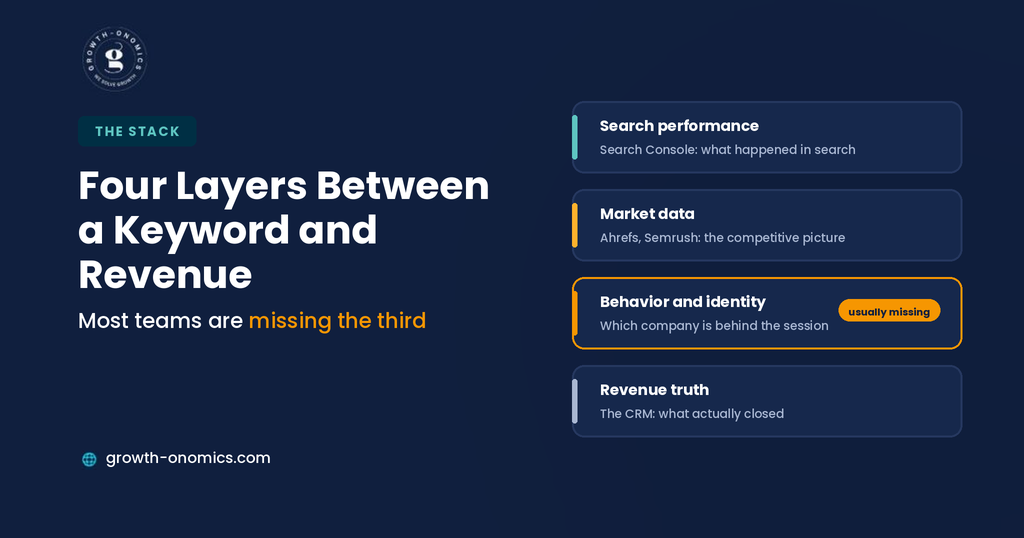
No single tool spans search data to closed revenue, and vendors implying otherwise are describing one layer while gesturing at the others. There are 4.
Search performance. What happened in search: queries, impressions, positions, clicks. Search Console owns this, and nothing replaces it because it is Google’s own record of your property.
Market and competitive data. What the field looks like: keyword difficulty, competitor visibility, backlink profiles. This is what Ahrefs and Semrush are for, and it is research data rather than performance data.
Behavior and identity. What visitors did and, critically, which company they belong to. This is where B2B measurement lives or dies, because credit belongs to accounts rather than sessions.
Revenue truth. What actually closed. Only the CRM knows this, and every workable stack treats it as the source of truth rather than one input among several.
The layer most teams are missing is the 3rd. They have Search Console, a research tool, and a CRM, with nothing connecting a keyword to an account.
That gap is exactly where the board question lands.
It is also why tool comparisons in this category mislead so consistently. A rank tracker and an attribution platform are not competing purchases, and a review comparing them on price or feature count is comparing a hammer to a tape measure.
The right question is which layer you lack, not which product scores higher.
Quick Comparison
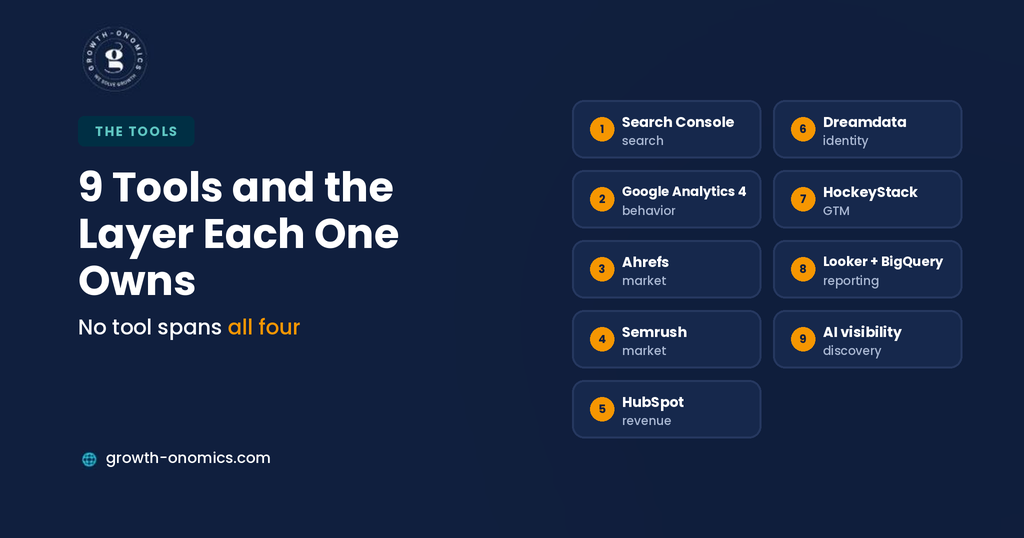
| # | Tool | Layer | Reports Pipeline? |
| 1 | Google Search Console | Search performance | No, and should not |
| 2 | Google Analytics 4 | Behavior | Partially, with work |
| 3 | Ahrefs | Market data | No |
| 4 | Semrush | Market data | No |
| 5 | HubSpot | Revenue truth | Yes, within its own data |
| 6 | Dreamdata | Identity and attribution | Yes, account-level |
| 7 | HockeyStack | Identity and GTM intelligence | Yes, across motions |
| 8 | Looker Studio + BigQuery | Reporting layer | Yes, if you build it |
| 9 | AI visibility platforms | Emerging discovery layer | No, but fills a growing gap |
1. Google Search Console
Layer: Search performance
Cost: Free
Reports pipeline: No, and it never will
What It Reports
Queries, impressions, clicks, average position, and index status for your property, Google’s own record, which makes it the only unarguable source for what happened in search.
Where It Fits
Every stack starts here. It is the ground truth other tools estimate around, and it is the input you join to everything else. Connecting it via MCP or an API pull also turns “which pages lost clicks and did position move” into a question you can ask rather than a report you assemble.
The Limitation
16 months of history, anonymized queries stripped from the report, 2 to 3 days of data lag, and no concept of what happened after the click. It tells you a session arrived; it cannot tell you it became a deal.
2. Google Analytics 4
Layer: Behavior
Cost: Free, or paid at enterprise volume
Reports pipeline: Partially, and only with deliberate configuration
What It Reports
Sessions, conversions, and channel attribution with the important caveat that its default models are session-based and its B2B fit is imperfect. Exporting to BigQuery unlocks the raw event data most teams truly need.
Where It Fits
The default behavior layer, and adequate when conversion events are properly defined and offline conversion data flows back in. The BigQuery export is what turns it from a dashboard into a data source.
The Limitation
Sessions are not accounts. 3 people from the same company researching over 6 weeks look like 3 unrelated journeys, which is precisely the pattern B2B measurement needs to resolve. Attribution windows also expire long before most enterprise deals close.
3. Ahrefs
Layer: Market and competitive data
Cost: Subscription, with credit-based API access
Reports pipeline: No
What It Reports
Backlink profiles, keyword metrics, competitor organic visibility, and traffic estimates, built on one of the largest link indexes available. Brand Radar extends this into AI answer visibility.
Where It Fits
Research and competitive intelligence. This is where you decide what to target and understand why competitors outrank you, and it is genuinely excellent at that job.
The Limitation
Traffic figures are estimates, not measurements, and should never appear in a board deck as if they were. API credits also deplete faster than teams expect when wired into automated reporting, which is a common and avoidable budget surprise; check the credit cost of a daily pull before you build one.
4. Semrush
Layer: Market and competitive data
Cost: Subscription, with add-ons
Reports pipeline: No
What It Reports
Keyword research, competitive visibility, site audits, position tracking, and an AI visibility toolkit reporting mentions, sentiment, and share of voice across AI surfaces.
Where It Fits
The consolidation play. If you want research, auditing, rank tracking, and basic AI visibility in one subscription with client-ready reporting, this is the practical choice.
The Limitation
Breadth over depth in most individual modules, and the same fundamental gap as Ahrefs: it has no view of your CRM. Its reporting features produce professional PDFs about search performance, not about revenue.
5. HubSpot
Layer: Revenue truth
Cost: Tiered, with attribution features on higher plans
Reports pipeline: Yes, for data inside HubSpot
What It Actually Reports
Contacts, companies, deals, and campaign attribution connecting marketing activity to closed revenue with first-touch, last-touch, and multi-touch models available natively.
Where It Fits
For teams already running HubSpot as their CRM, native attribution is the cheapest route to a pipeline number. It requires no new vendor and it uses data your sales team already maintains.
The Limitation
It only sees what enters HubSpot. Anonymous research before a form fill is invisible, self-serve signups may bypass it entirely, and the quality of every report depends on CRM hygiene you do not control. Salesforce-based teams need the equivalent native tooling or a layer above it.
6. Dreamdata
Layer: Identity and attribution
Cost: Published entry pricing from several hundred dollars monthly, scaling with volume
Reports pipeline: Yes, at account level
What It Reports
Full B2B customer journeys from anonymous visit through to pipeline and revenue, mapped at the account level with IP-to-company resolution identifying a substantial share of anonymous company traffic. Multiple attribution models come standard.
Where It Fits
This is the missing 3rd layer for most mid-market SaaS teams. It answers the specific question rank trackers cannot: which content and keywords appear in the journeys of accounts that became opportunities.
The Limitation
Implementation is more involved than an OAuth connection and generally wants ops resource. It also runs its own tracking layer, so if GA4 is your system of record you end up maintaining two, and reconciling them becomes somebody’s job.
7. HockeyStack
Layer: Identity and GTM intelligence
Cost: Enterprise, quoted per account
Reports pipeline: Yes, across sales-led and product-led motions
What It Reports
Attribution as one layer of a broader go-to-market picture: marketing, sales, and product data unified, with account-level analytics, intent signals, and warehouse-native architecture connecting CRMs, ad platforms, and product systems.
Where It Fits
Teams running both sales-led and product-led motions simultaneously, where a pure attribution tool cannot see half the journey. Its Salesforce custom object support matters for complex deal structures.
The Limitation
Attribution serves the broader GTM motion rather than being the end product, so teams whose only need is attribution may find it wider than required. Enterprise pricing and implementation effort follow accordingly.
8. Looker Studio with BigQuery
Layer: Reporting, over everything else
Cost: Free tool, plus warehouse storage and engineering time
Reports pipeline: Yes, if you build it
What It Reports
Whatever you join. Search Console, GA4 exports, CRM data, and ad platform data blended into one view with logic you control and can inspect.
Where It Fits
The layer that turns four disconnected tools into one story. For teams with analytics capability, it is the cheapest path to a defensible revenue view, and the joins are yours to define rather than a vendor’s black box.
The Limitation
It builds nothing by itself. Someone has to model the data, maintain the connectors, and fix things when an API changes. Without a named owner it becomes a stale dashboard nobody trusts, which is the most common failure in this category and the reason so many teams end up back in spreadsheets.
9. AI Visibility Platforms
Layer: Emerging discovery
Cost: Varies widely by platform and tier
Reports pipeline: No, but they close a gap that is growing
What They Report
Whether your brand appears when buyers ask assistants for recommendations: citation frequency, share of voice across a tracked prompt set, how you are described, and which sources are cited instead of you.
Where They Fit
A rising share of B2B research now happens in AI assistants that pass no referrer, which means influence arrives disguised as branded or direct traffic. Neither Ahrefs nor Semrush measures citation rates with the depth a dedicated platform does, and no rank tracker sees this at all.
The Limitation
These are visibility metrics, not revenue metrics, and the honest framing keeps them that way. Growth-onomics reports citation counts and share of voice alongside organic performance and influenced pipeline rather than in isolation, because a citation number presented on its own invites exactly the board question this article opened with.
What None of Them Solve
4 problems persist regardless of how much you spend, and every failed measurement project underestimated at least one.
The lag. With a 90-day sales cycle, this quarter’s revenue came from last quarter’s content. Any report comparing spend and revenue in the same period answers a different question than the one asked, and no tool fixes that; you fix it by agreeing on cohort windows with finance before building anything.
Anonymous research. Buying committees research for weeks before anyone fills a form. IP-to-company resolution recovers some of it, and the rest is genuinely invisible.
AI-assisted discovery. A growing share of research happens in assistants that pass no referrer. It surfaces as branded search, direct traffic, or nothing, which is why self-reported attribution on demo forms has become more valuable rather than less.
CRM hygiene. Every pipeline number inherits the quality of your deal stages, close reasons, and account records. A sophisticated attribution platform on inconsistent CRM data produces confident nonsense faster than a spreadsheet would.
Building the Stack by Stage
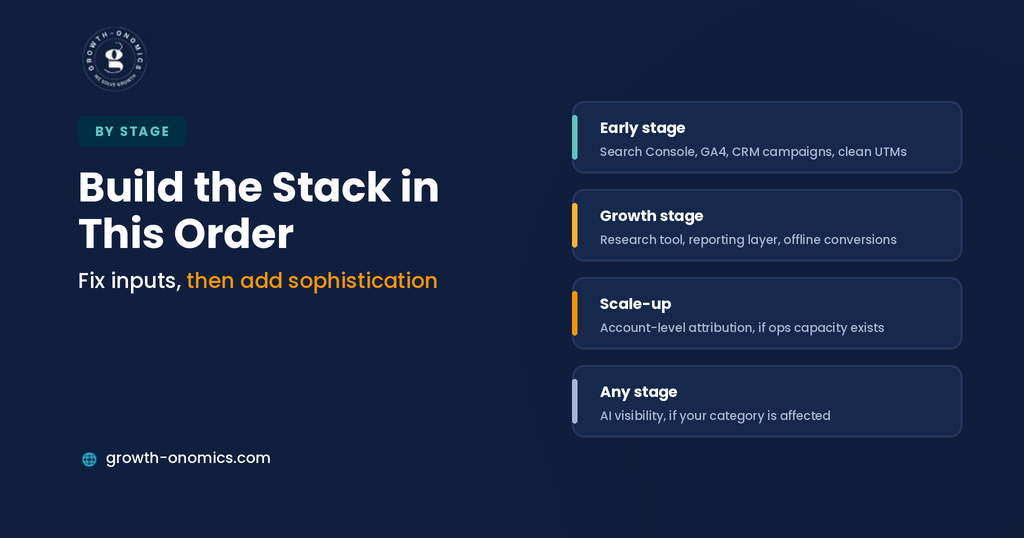
Match the stack to your spend and data maturity rather than to ambition.
Early stage. Search Console, GA4, and CRM campaign tracking with disciplined UTMs. Capture click identifiers on every form. This answers the board question adequately and costs nothing beyond care.
Growth stage. Add a research tool for market data and a reporting layer to stop the manual assembly. Get offline conversion data flowing back to the ad platforms. Most teams find this covers the majority of the pain.
Scale-up. Add a dedicated attribution platform for account-level journeys, provided you have ops capacity to maintain it and CRM hygiene worth modeling. If either is missing, fix that first.
Any stage, if AI matters to your category. Add visibility tracking. This is the one layer where waiting for maturity is a mistake, because the gap it measures is widening now and the historical baseline cannot be recreated later.
The sequencing rule holds throughout: fix the inputs, then automate the assembly, then add sophistication. Growth-onomics scopes reporting engagements in that order, because a platform bought before the tagging is trustworthy produces the same unreliable answer with more confidence and a larger invoice.
Conclusion
The reason SEO struggles in board meetings is not that the work does not produce revenue. It is that the tools most teams use to report on it were built to answer a different question, and nobody replaced them when the question changed.
Rank trackers and research platforms remain essential; you cannot plan without them. They are simply not reporting tools, and asking them to be produces the slide where sessions are up and nobody can say what that bought. The fix is a layer that connects sessions to accounts and accounts to revenue, which is a different purchase with a different price and a real implementation cost.
Start by identifying which of the 4 layers you are missing. For most SaaS teams, it is identity: nothing connecting the keyword to the company. Fix that, agree cohort windows with finance, and the board slide changes from a traffic chart to a pipeline number with a stated methodology. That is a more defensible position than any tool can give you on its own.
If you want search performance reported against pipeline rather than sessions, Growth-onomics can audit your current stack and build the reporting layer around it.
FAQs
Can Ahrefs or Semrush report on pipeline?
No, and it is not a shortcoming as they are research and rank-tracking platforms with no view of your CRM. They tell you what to target, how competitors are performing, and where your visibility sits, all of which is essential for planning. What they cannot do is tell you which keywords appeared in the journeys of accounts that became opportunities, because they have no access to the data that would answer it. Use them to decide what to work on, and a separate layer to report what it produced.
What is the cheapest way to connect SEO to revenue?
Search Console plus GA4 plus disciplined CRM campaign tracking, with click identifiers captured on every form submission and written to the CRM record. That combination costs nothing beyond the care it takes to maintain, and it answers the pipeline question adequately for most teams under significant spend. The reason it usually fails is not the tooling; it’s inconsistent UTM tagging and campaign naming, which quietly breaks the join between a search session and a CRM record. Fix the naming before buying anything.
Do I need an attribution platform for SEO reporting?
Only if 3 things are true: the budget is large enough that a 10-20% reallocation exceeds the platform cost, and sales cycles are long enough that simple models mislead. You have ops capacity to maintain the implementation. Below that, a well-configured CRM and reporting layer gets you most of the way. Buying a platform before CRM hygiene is robust produces a more expensive version of the same unreliable answer, and implementation typically takes weeks that could have gone into fixing the underlying data.
How do I report SEO when AI answers reduce clicks?
Add citation visibility as a reported metric alongside clicks, and treat branded search as a supporting indicator. A growing share of B2B research now happens in assistants that pass no referrer, so influence arrives as branded search, direct traffic, or nothing traceable at all. Track whether you appear in AI answers for your category’s buying questions, watch branded search alongside it, and add a self-reported attribution field to demo forms with an explicit AI assistant option. None of these is attribution; together they stop a real channel from being invisible.
How do I handle the gap between platform numbers and CRM numbers?
Pick the CRM as your source of truth and explain the difference rather than trying to eliminate it. Ad platforms and analytics tools count within their own attribution windows, include view-through credit in some cases, and each claims the same conversion independently, so the totals will never reconcile. What you can do is report one number from the CRM, show platform data as operational context, and document why they differ. A stated methodology that survives questioning is worth more than a reconciled number that took three weeks to produce and still does not match.
Which metric should go on the board slide?
Influenced pipeline from organic, with the methodology stated in the same breath, plus one leading indicator that explains the direction of travel. Sessions and rankings belong in the appendix, they are operational metrics that answer how the work is progressing, not what it produced. State the attribution model, the cohort window, and the known limitations openly. A CMO who volunteers that attribution is imperfect and explains how the program measures around it is far more credible than one presenting a clean number that collapses under a single question.