


Somewhere right now, a marketing team is discovering that their automated review-response system replied to a furious enterprise customer with “Thanks for the feedback! We’re thrilled you’re enjoying the product.”
Nobody chose that outcome.
Someone connected sentiment classification to a response template, tested it on a handful of reviews, and moved on. The system worked exactly as designed for 11 months, and then it did not, in public, on a page prospects read before booking demos.
That’s the shape of every automation failure worth worrying about. Not a machine going rogue, a system operating confidently outside the conditions it was built for, at a speed no human process could match, in a place where mistakes are permanent. And the tasks where that happens are predictable. They share 3 traits: the output is public or irreversible, judgment depends on context the system cannot see, and being wrong costs more than being slow.
This isn’t an argument against automation. Most marketing work should be automated, and the teams doing it well have removed enormous amounts of assembly and coordination. It is an argument for knowing where the line sits, and these 11 tasks are on the far side of it.
The 3 Tests
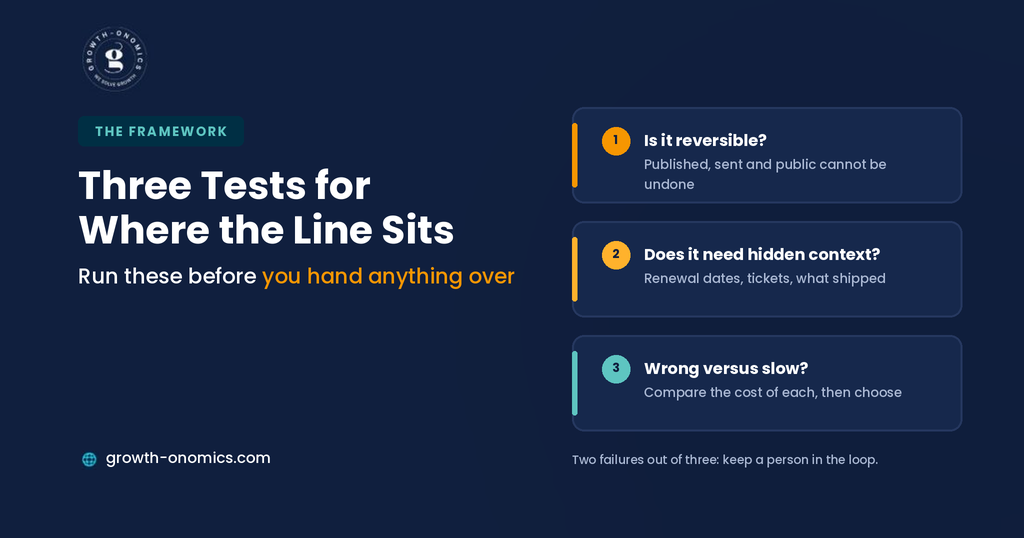
Before the list, the reasoning. 3 questions identify a task that should keep a human in the loop, and any task failing 2 of them belongs on the far side of the line.
Is it reversible? A dashboard number can be recalculated. A published page gets indexed, quoted by AI systems describing your product, and cached in places you do not control. Reversibility is the single strongest predictor of whether automation is safe.
Does judgment depend on context the system cannot see? An agent reading a review knows what the review says. It does not know that the customer is 3 weeks from renewal, that the bug they mention shipped a fix last Tuesday, or that their VP is on your advisory board.
What does being wrong cost relative to being slow? For internal reporting, slow is expensive and wrong is recoverable. For a public claim about your product, the ratio inverts completely.
The pattern across all 11 tasks below: automate the assembly, keep the judgment. Drafting a review response is assembly. Deciding whether that response is right for that customer is judgment. The distinction is not about capability; models produce competent drafts for every task here. It’s about who is accountable when the draft is wrong.
It is worth noting what the tests do not measure. Volume is not a reason to automate a task on this list, and neither is the fact that a competitor does.
Both are the usual arguments raised in the meeting where a gate gets removed, and neither changes the reversibility or the context problem underneath.
Quick Comparison
| # | Task | Automate | Keep Human |
| 1 | Content publishing | Research, drafting, formatting | The final read |
| 2 | Review responses | Detection, classification, drafting | Every send |
| 3 | Complaints and escalations | Routing, context assembly | The reply |
| 4 | Product claims | Variant generation | Claim verification |
| 5 | Competitive positioning | Monitoring, data gathering | The framing |
| 6 | Pricing communication | Structure and consistency checks | Exceptions and negotiation |
| 7 | Community participation | Finding the conversation | Joining it |
| 8 | Outbound personalization | Research and enrichment | The message |
| 9 | Crisis communication | Monitoring and alerting | Everything else |
| 10 | Interpreting metrics | Collection, comparison, anomaly flags | The explanation |
| 11 | Regulated content | Drafting and consistency checks | Compliance sign-off |
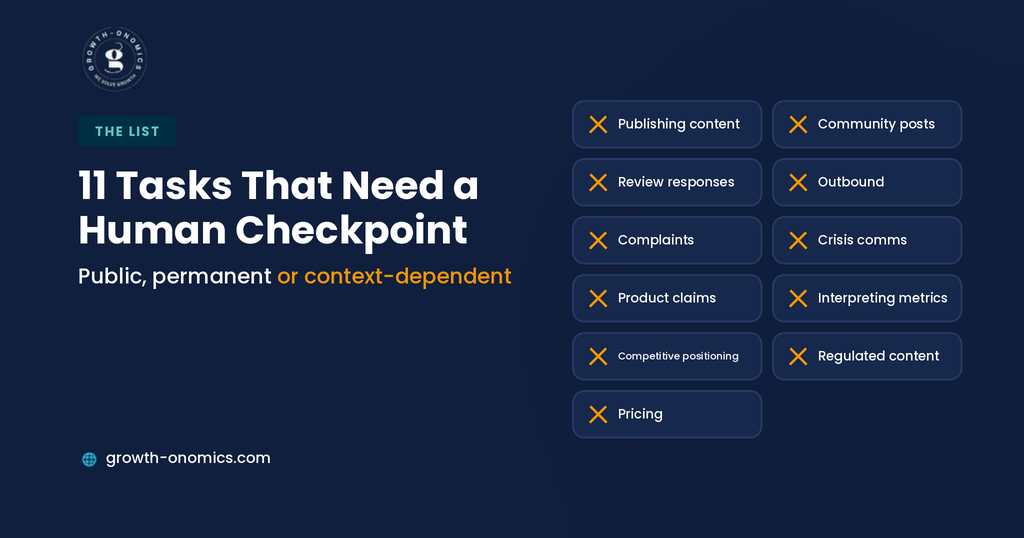
1. Publishing Content Without a Human Read
Automate: Research, brief assembly, drafting, formatting, internal linking, consistency checks.
Keep human: The read before it goes live.
Why
Published content is the least reversible thing a marketing team produces. It gets indexed, cited by AI systems describing your product, scraped, and quoted in places you will never find. A factual error does not get corrected by fixing the page, it persists in every system that already ingested it.
The specific risk in B2B SaaS is confident wrongness about your own product. Generated content describes features by pattern matching what similar products do, which produces plausible sentences about capabilities you do not have.
The Cost of Getting It Wrong
A prospect reads a claim, expects it in the demo, and discovers it does not exist. That is a lost deal and a credibility problem, and it originated in a page nobody read before publishing.
2. Responding to Public Reviews
Automate: Detection, sentiment classification, theme tagging, draft generation, routing with context.
Keep human: Every single send, without exception.
Why
Review responses are permanent, public, read by prospects mid-evaluation, and increasingly cited by AI systems answering questions about your product. They are also the place where tone-deaf automation is most visible; a cheerful reply to a serious complaint reads as contempt.
Context is the deeper problem. A reviewer complaining about a limitation you shipped a fix for last month needs a different response than one describing something still broken, and only a person with product knowledge knows which is which.
The Cost of Getting It Wrong
A screenshot. Review-response failures circulate because they are funny to everyone except the company involved, and the page they live on is the one buyers read before choosing. The reply is also permanent in a way the original complaint is not, because you wrote it.
3. Handling Complaints and Escalations
Automate: Detection, severity classification, routing, and assembling the account context the responder needs.
Keep human: The response itself.
Why
An escalating customer is telling you something about your product, your onboarding, or your support. Automating the reply optimizes for closure rather than learning, and the pattern in those complaints is often the most valuable input your roadmap gets.
There is also a straightforward relationship cost. Customers can tell when a response was generated, and receiving one during a genuine problem confirms exactly what they suspected about how much you care.
The Cost of Getting It Wrong
Churn you never see coming, because the complaint was resolved procedurally and nobody noticed the pattern underneath it.
4. Making Claims About Your Product
Automate: Generating copy variants, checking claims against an approved messaging framework, flagging inconsistencies across assets.
Keep human: Verifying that each claim is true.
Why
Models generate persuasive claims readily, including performance figures, comparative superlatives, and capability statements nobody approved. In ad copy this becomes a compliance problem rather than an editing note, and in B2B it becomes a sales problem when a prospect arrives expecting something the product does not do.
The failure is quiet. An unsubstantiated claim in one variant propagates into landing pages, sales decks, and eventually into how AI systems describe your product, because they are reading the same assets.
The Cost of Getting It Wrong
Regulatory exposure in some categories, deal-stage credibility loss in all of them.
5. Competitive Positioning
Automate: Monitoring competitor pages, tracking messaging changes, gathering feature and pricing data, flagging what moved.
Keep human: What it means and how you respond.
Why
Positioning is a strategic choice about where you are strong and who you are for. An agent comparing feature tables will conclude you should match whatever the competitor added, which is how companies talk themselves into commoditized positioning one feature at a time.
Competitive claims are also the most legally sensitive content most SaaS companies publish, and an automated comparison page repeating a stale or wrong claim about a competitor is a letter waiting to happen.
The Cost of Getting It Wrong
A positioning drift nobody decided. 6 months of reactive messaging, and a category position that describes no one in particular.
6. Pricing Communication
Automate: Consistency checks across pages, flagging where published pricing contradicts the current model, structural documentation.
Keep human: Exceptions, negotiations, and anything customer-specific.
Why
Pricing is where errors become commitments. A generated response quoting a tier that no longer exists, or an automated discount rule applied outside its intended scope, creates an expectation someone has to honor or walk back.
It is also where context is crucial. What a strategic account gets is not what the self-serve page says, and no automated system holds the full picture of a negotiation.
The Cost of Getting It Wrong
Revenue leakage, or a deal that sours when the quoted number changes.
7. Community and Forum Participation
Automate: Monitoring for brand and category mentions, classifying intent, flagging factual errors, building an engagement queue.
Keep human: The participation itself.
Why
Communities detect automated participation quickly and punish it hard. Reddit, Slack groups, and industry forums are exactly the sources AI systems draw on when describing products, which makes them valuable and makes being caught astroturfing expensive in the same channel.
There is also a substance problem. The reason community answers get cited is that they contain real experience. A generated answer contains a synthesis of other answers, which is why it reads as noise to the people who matter.
The Cost of Getting It Wrong
A permanent thread about your company’s fake account, in the community your buyers read.
8. Outbound Personalization at Scale
Automate: Research, enrichment, identifying relevant triggers, assembling context for the sender.
Keep human: The message that actually goes out.
Why
Recipients recognize generated outreach immediately, and the volume of it has raised the bar rather than lowered it. Fully automated personalization also produces the specific failure of confidently wrong personalization like congratulating someone on a funding round that was a different company, or referencing a job change that never happened.
The deliverability consequences land on your domain, and reputation damage there is slow to repair.
The Cost of Getting It Wrong
Domain reputation, brand perception among exactly the buyers you were targeting, and a sender who is now blocked.
9. Crisis and Incident Communication
Automate: Monitoring and alerting. That is the complete list.
Keep human: Every word that goes out.
Why
Incident communication is judgment under pressure with permanent consequences. Tone, timing, what to acknowledge, what’s still unknown, and what commitment to make are decisions requiring information no system holds: legal exposure, engineering reality, customer relationships, and what leadership has already said.
The temptation is present because incidents happen at inconvenient hours and drafting under pressure is hard. That’s precisely when a plausible, slightly wrong statement does the most damage.
The Cost of Getting It Wrong
The incident becomes secondary to the response. Companies recover from outages routinely and from badly handled communication far more slowly.
10. Deciding What a Number Means
Automate: Collection, comparison, anomaly detection, first-draft summaries.
Keep human: The explanation and the decision.
Why
Assembly is most of reporting time and almost none of its value. An assistant will explain a movement confidently, and the explanation will be plausible whether or not it is correct; attributing a traffic decline to an algorithm update when the actual cause was a template change that shipped the same week.
Explaining a number requires knowing what your team did, what sales heard, and what shipped. That context lives in people. Growth-onomics automates collection and comparison in client reporting and keeps the narrative with someone who knows what changed that month, because a confident wrong explanation is worse than an honest gap.
The Cost of Getting It Wrong
Budget moved on the basis of a plausible fiction, and a lost quarter before anyone notices the real cause was never addressed.
11. Anything Touching a Regulated Category
Automate: Drafting, consistency checks against approved language, flagging deviations.
Keep human: Compliance sign-off, always.
Why
If you sell into healthcare, financial services, legal, or any regulated space, claim language is governed by rules a general-purpose model has no reliable knowledge of. Approved terminology, required disclaimers, and prohibited comparisons vary by jurisdiction and change.
This is the one item where the human checkpoint is frequently a legal requirement rather than a best practice, and where the cost of an error is measured in penalties rather than embarrassment.
The Cost of Getting It Wrong
Regulatory action, mandatory corrections, and a review process that slows everything you publish for a year afterward.
Where the Line Actually Sits
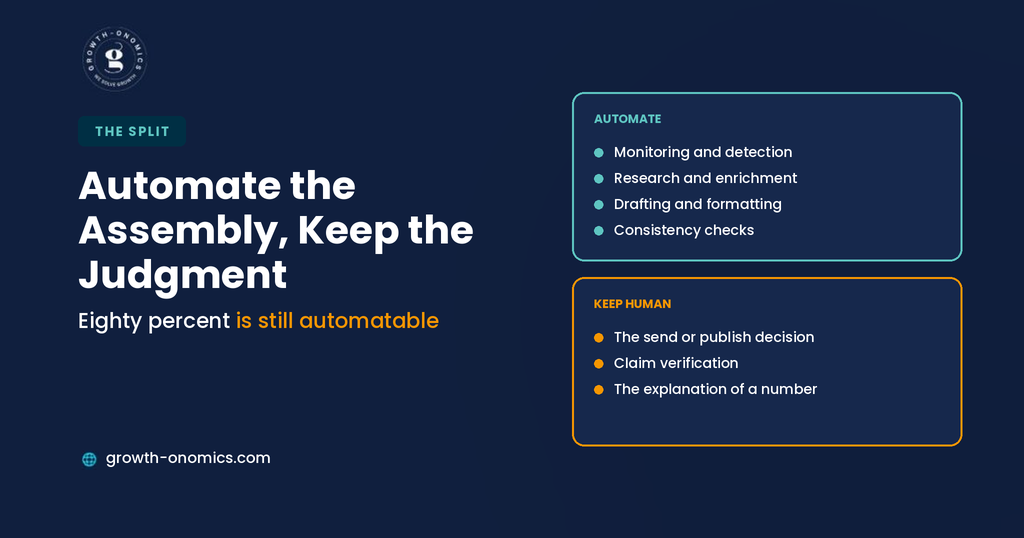
Read the 11 together, and the pattern is consistent. In every case, the automatable part is substantial often 80% of the elapsed time and the human part is small, specific, and irreplaceable.
Automate collection. Monitoring, gathering, enriching, and detecting. Machines are better at this than people and never get bored.
Automate assembly. Drafting, formatting, structuring, and cross-checking. This is where most of the hours are.
Keep the decision. Whether to send, publish, claim, or act. This is minutes of work protecting hours of value.
Keep the interpretation. What the data means, why it moved, and what to do about it. This depends on context that lives in people.
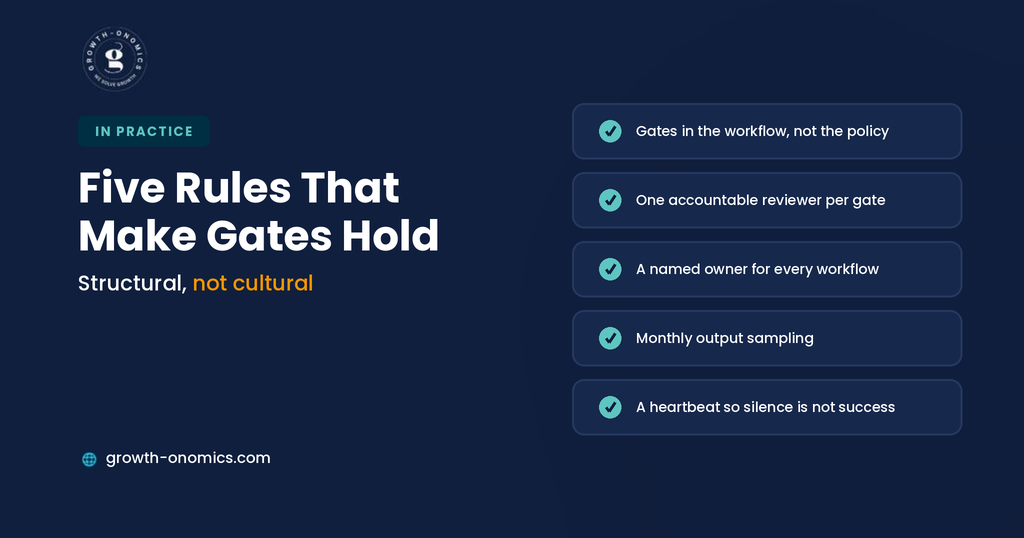
2 practices make that split hold in practice.
First, approval gates need to be structural rather than cultural; a workflow that requires a click, not a policy that asks for care. Cultural gates erode the first time someone is busy.
Second, every automated workflow needs a named owner who checks it monthly, because the failure mode is not dramatic malfunction but silent drift: a system that worked for eleven months and then encountered a situation nobody anticipated.
Growth-onomics builds client workflows with the review step in the pipeline rather than in the documentation for exactly that reason.
Conclusion
The interesting thing about this list is how little of the actual work it protects. Every task here can be 90% automated. What stays human is the final read, the send button, the claim check, the explanation, minutes of attention standing between a competent system and a permanent public mistake.
That’s a good trade, and it is available to any team willing to build the gate into the workflow rather than trusting themselves to remember. The teams that get burned are rarely the ones who thought carefully and chose wrong. They are the ones who automated something adjacent to a safe task without noticing they had crossed a line, then found out eleven months later in public.
Run 3 tests on anything you are about to hand over. Is it reversible? Does the judgment need context the system cannot see? What does being wrong cost compared to being slow? 2 failures out of 3 means keep a person in the loop, and the loss is smaller than you think.
If you want help drawing that line across your own workflows like what to automate, where the gates belong, and who owns each one, Growth-onomics can work through it with you.
FAQs
Is it ever safe to publish content without human review?
For genuinely low-stakes, templated output with verified data like a changelog entry generated from a release note, a status page update from monitoring, the risk is manageable because the content is factual, narrow, and easily corrected. For anything making a claim, describing a capability, or representing the brand’s point of view, no. Published content is indexed, cited by AI systems describing your product, and cached beyond your control, so an error persists long after you fix the page. The read takes minutes; the error does not.
How do I stop automated workflows from drifting over time?
Assign a named owner and a monthly check, and instrument the workflow so failure is loud rather than silent. Most drift isn’t dramatic: rules written for last year’s conditions keep firing against this year’s, or a system encounters a case nobody anticipated and handles it confidently. Review the logic quarterly, sample the outputs monthly against reality, and build a heartbeat so an absence of alerts is distinguishable from a broken pipeline. A monitoring workflow that silently stops running is worse than no monitoring, because silence reads as good news.
What is the difference between a human-in-the-loop and human-on-the-loop?
Human-in-the-loop means a person must act before the output goes anywhere, like approving a send or clicking publish. Human-on-the-loop means the system acts and a person supervises, reviewing samples and intervening when something looks wrong. For the 11 tasks in this article, in-the-loop is the right model, because on-the-loop supervision catches errors after they are public. On-the-loop works well for reversible, high-volume, internal work where the cost of an individual error is low, and the cost of a bottleneck is high.
Won’t approval gates slow us down too much?
Less than teams expect, because the gate applies to minutes of the workflow rather than the whole thing. If an agent handles research, drafting, formatting, and checks, a 5-minute human read still captures most of the time saving. The gates that genuinely slow teams down are the ones requiring multiple approvers or sitting in a separate tool. Build the review step into the workflow itself, assign one accountable reviewer, and set a service-level expectation for turnaround. The alternative is not speed; it is speed until something breaks publicly.
What if a competitor is automating something we are not?
That is a reason to check your reasoning, not to change it. Competitors automate for the same reasons everyone does: capacity pressure and cost, and their choices carry no information about whether the risk is acceptable for you. The relevant comparison is not what they automated but what happens when it fails: their outage, their review reply, their claim in a regulated market. Speed advantages in these 11 tasks are measured in minutes saved per item, while the failures are measured in quarters. Match the gate to your own blast radius rather than to a competitor’s risk appetite.
How do we decide where the line sits for our own workflows?
Run 3 tests. Is the output reversible? Does the judgment require context the system cannot access like customer history, what shipped last week, what legal has said? Does being wrong cost more than being slow? 2 failures out of 3 means keep a person in the loop. Then check the actual blast radius: how many people see the output, how quickly could you correct it, and would you be comfortable if a screenshot circulated? That last question resolves most edge cases faster than any framework.
