


There’s a specific meeting that happens in every scaling SaaS company, usually around the point where content stops being one person’s side project.
Someone puts 3 options on the table: hire an agency, buy a tool, or build the capability in-house. Everyone argues from their priors, somebody wins, and 18 months later the company is quietly running something that resembles none of the 3.
That’s not a failure. It is the actual answer. Content production in 2026 is not a build-or-buy decision, it is a set of decisions about who does strategy, who does drafting, who does subject-matter input, who edits, and who publishes, and AI has changed the economics of each of those independently.
Drafting got cheap. Editing got more valuable. Distribution got harder. The right configuration depends on which of those constraints binds hardest for you.
What follows is 8 production systems that still work for B2B SaaS, described honestly: what each costs in money and management, what quality ceiling each has, and the failure mode each one dies of. They run from fully outsourced to fully internal, with the hybrids in between, which is where most companies end up whether they planned to or not.
The Five Jobs in Content Production
Comparing “agency versus tool” is unhelpful because they are not the same unit. Content production is 5 jobs, and every system on this list resolves them differently.
Strategy. What to publish, for whom, in what order, and why. The decision that determines whether everything downstream matters.
Subject-matter input. The proprietary knowledge that makes a piece worth reading; how the product actually works, what customers say, what the numbers show. This is the scarcest input in B2B and the least outsourceable.
Drafting. Turning a brief into prose. The job AI changed most, and the reason the economics of everything else shifted.
Editing. Judgment about accuracy, argument, and voice. Relative value went up sharply as drafting cost fell, because the bottleneck moved.
Distribution and maintenance. Publishing, internal linking, refreshing, measuring. The job that quietly determines whether content compounds or decays, and the one most systems underinvest in.
When you evaluate any option below, ask which of the 5 it actually takes. A tool that drafts leaves you 4 jobs. An agency that drafts and edits leaves you 3. Nobody takes subject-matter input off your hands, whatever the pitch says.
That framing also explains why cost comparisons across these options mislead so consistently. A platform quoting a few hundred a month and an agency quoting 5 figures are not competing for the same work, and comparing the invoices tells you nothing about which produces more published, differentiated pages per quarter.
Quick Comparison
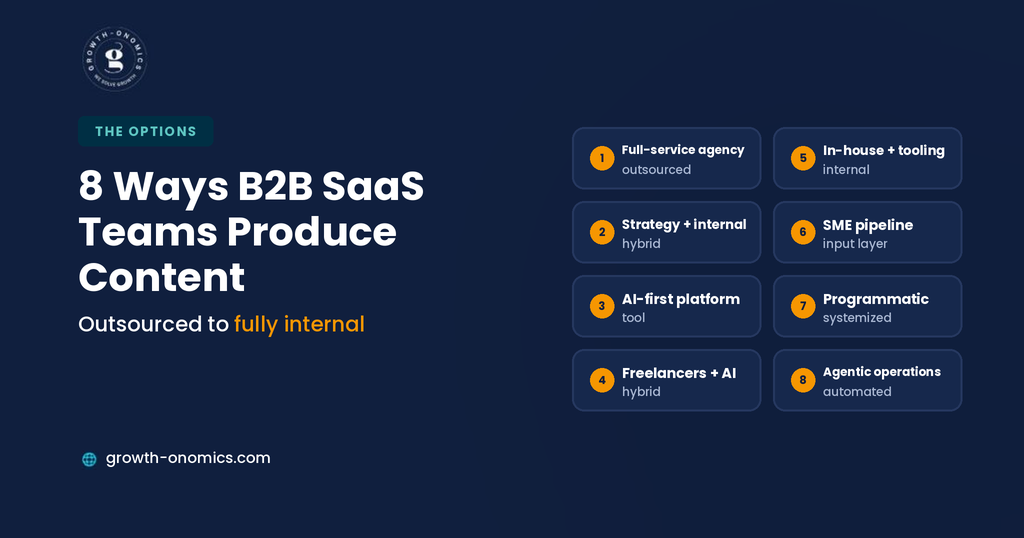
| # | System | Takes Off Your Plate | Management Load |
| 1 | Full-service agency | Strategy, drafting, editing, publishing | Low |
| 2 | Strategy agency + internal | Strategy and direction | Medium |
| 3 | AI-first platform | Drafting at volume | Medium-high |
| 4 | Freelancers + AI assist | Drafting, some editing | High |
| 5 | In-house team + tooling | Everything, internally | High but owned |
| 6 | SME pipeline | Nothing; adds the scarce input | Medium |
| 7 | Programmatic production | Volume for structured topics | Low after build |
| 8 | Agentic operations | Research, drafting, formatting, QA | Medium, technical |
1. Full-Service Agency
Who does what: Agency owns strategy, drafting, editing, and often publishing. You own subject-matter input and approval.
Realistic cost: Mid 4 figures to low 5 figures monthly depending on volume and depth
Management load: Low, by design
Where It Works
Teams with budget and no content function, or teams whose internal capacity is fully consumed by product marketing and campaigns. A good agency brings pattern recognition across dozens of similar companies, which is genuinely difficult to replicate internally.
Where It Breaks
Subject-matter depth. An agency writer covering 6 clients cannot hold your product knowledge the way your solutions engineer does, and the gap shows in exactly the technical content that earns citations and closes deals. The fix is structured SME access, recorded interviews, a review step, a named internal expert per topic, and agencies that do not ask for it are producing content that reads like everyone else’s.
The Failure Mode
Volume without differentiation. 12 competent posts a month that any competitor could have published, and a decline chart nobody can explain. The early warning sign is a content calendar that could belong to any company in your category.
2. Strategy Agency Plus Internal Execution
Who does what: Agency owns strategy, briefs, and quality standards. You own drafting, editing, and publishing.
Realistic cost: Lower monthly retainer, higher internal time
Management load: Medium
Where It Works
Companies with capable writers who lack strategic direction, or teams that have published consistently for a year without commercial results. Buying the thinking and keeping the execution preserves your voice and product knowledge while fixing the part that was broken.
Where It Breaks
When internal capacity is the actual constraint rather than direction. A brilliant content strategy with nobody to execute it produces a document, instead of results.
The Failure Mode
Strategy documents that never become published pages. Watch for a gap between briefs delivered and pieces shipped; if it widens for 2 consecutive months, the constraint was capacity all along.
3. AI-First Content Platform
Who does what: Platform handles research and drafting at volume. You own strategy, editing, SME input, and publishing.
Realistic cost: Hundreds to low thousands monthly, plus significant internal editing time
Management load: Medium to high, and consistently underestimated
Where It Works
Teams with a clear strategy and editing capacity who need throughput. Platforms that combine search data with generation can produce an effective structural first draft quickly, which shifts your writers from blank page to revision.
Where It Breaks
The editing assumption. Vendors price against writer salaries and quietly assume light editing. In practice, technical B2B content generated without SME input needs substantial rework; often enough that the time saved on drafting reappears as editing time. The saving is real but smaller than the pitch.
The Failure Mode
Published volume with no citations, rankings, or pipeline. Generated content that synthesizes what already ranks tends to land in the middle of the category, which is precisely where nothing gets cited. Volume then becomes the reported metric because it is the only one moving.
4. Freelance Network Plus AI Assist
Who does what: Freelancers draft with AI assistance. You own strategy, briefing, editing, and coordination.
Realistic cost: Variable, often the cheapest per published piece
Management load: High and persistent
Where It Works
Teams with a strong editor and a clear brief template. Specialist freelancers who genuinely know your category, like former practitioners, technical writers with domain experience, produce content agencies struggle to match, because depth beats process.
Where It Breaks
Coordination overhead. 6 freelancers means 6 relationships, 6 invoices, 6 onboarding curves, and 6 different interpretations of your voice. It scales poorly without someone whose actual job is managing it.
The Failure Mode
Voice drift and quality variance. Readers notice; so do models building a picture of your brand from inconsistent source material.
5. In-House Team With AI Tooling
Who does what: Everything, internally, with AI accelerating research, drafting, and formatting.
Realistic cost: Salaries, plus tooling
Management load: High, but it is a capability you own
Where It Works
Companies where content is a primary growth channel and the category is technical enough that outside writers cannot get there. An in-house writer with product access, customer call recordings, and a Slack channel of engineers produces work no agency can match.
Where It Breaks
Hiring and bandwidth. One content hire is a single point of failure, and the first 3 months are onboarding rather than output. Teams also underestimate how much of a content marketer’s week is distribution and maintenance rather than writing.
The Failure Mode
The team of one, absorbed into campaign support. Content becomes whatever demand gen needs this week, and the strategic program quietly stops.
6. Subject-Matter Expert Pipeline
Who does what: Internal experts supply the substance through structured interviews. Writers or AI handle the shaping.
Realistic cost: Low direct cost, real internal time
Management load: Medium, mostly scheduling
Where It Works
Alongside any other system on this list. This is not a standalone production model; it is the input that makes the others produce something differentiated. 30 minutes with a solutions engineer, recorded and transcribed, yields more citable substance than a week of desk research.
Where It Breaks
Calendar reality. Experts have day jobs, and a pipeline dependent on voluntary participation dies quietly in a busy quarter. It needs an owner, a schedule, and executive backing.
The Failure Mode
Enthusiasm for 2 months, then nothing. Fix it with recurring calendar holds and a short list of questions sent in advance, so the expert arrives prepared and the session takes 30 minutes rather than 90.
7. Programmatic and Templated Production
Who does what: A system generates many pages from structured data and a template. You own the template, data quality, and quality control.
Realistic cost: Front-loaded build, low marginal cost
Management load: Low once built, but requires ongoing QA
Where It Works
Genuine structured use cases: integration pages, comparison pages, location or industry variants, and glossary sets. If your product connects to 200 tools, 200 integration pages answering a specific question each are a legitimate and valuable asset.
Where It Breaks
When the underlying data is thin. Templated pages built on nothing but a name and a logo are the definition of scaled content abuse, and search systems have gotten steadily better at recognizing it.
The Failure Mode
Hundreds of near-duplicate pages that dilute site quality signals. The rule that holds: every generated page must answer a question a real person would ask, with information that page uniquely contains.
8. Agentic Content Operations
Who does what: Connected agents handle research, brief assembly, drafting, formatting, internal linking, and QA checks. Humans own strategy, SME input, editing, and approval.
Realistic cost: Tooling plus meaningful setup time
Management load: Medium, but technical rather than editorial
Where It Works
Teams already comfortable with connected tooling who want to remove assembly work rather than writing. Agents pull search data, competitor coverage, and internal analytics into a brief automatically, then run consistency checks before publication. It is the newest configuration here and the fastest-moving.
Where It Breaks
Governance. Automated pipelines produce automated mistakes at scale, and content is the highest-visibility place for that to happen. Approval gates before publication are not optional. Growth-onomics builds these pipelines with the same discipline it applies to reporting workflows: collection and assembly automated, editorial judgment and the final read kept human.
The Failure Mode
Publishing without review. One factually wrong page gets indexed, quoted by AI systems describing your product, and cannot be quietly retracted.
What Never Gets Cheaper
Whichever system you choose, 4 costs do not go away, and every failed content program underestimated at least one.
Subject-matter input. No system supplies your proprietary knowledge. Content that differentiates requires time from people who understand the product and the customer, and that time has to be scheduled rather than hoped for.
Editorial judgment. Deciding what’s true, what’s interesting, and what sounds like you. Drafting cost fell; this did not, which is why the ratio of editing to writing time has inverted for most teams.
Distribution. Publishing isn’t distribution. Content that nobody promotes, links to, or updates decays regardless of how it was produced, and a growing share of AI citations comes from sources you influence off-domain rather than pages you publish.
Maintenance. Every published page is a small ongoing liability. Pricing changes, features get renamed, competitors ship, and stale pages misrepresent you to both readers and the systems describing you.
A useful test when comparing options: add the internal hours for these 4 to whatever the vendor quoted. The cheapest system on paper is frequently the most expensive in practice.
How to Choose by Constraint
Pick by what’s actually blocking you, not by what sounds most sophisticated.
No strategy, capable writers. Strategy agency plus internal execution. Buy the thinking, keep the voice.
Clear strategy, no capacity. Full-service agency or freelance network, depending on budget and whether you have an editor.
Capacity but no depth. SME pipeline, layered onto whatever you already run. This is the highest-return fix in B2B and the most commonly skipped.
Volume constraint on structured topics. Programmatic production, with a hard rule that every page answers something legitimate.
Content is your primary channel. In-house team with tooling, supported by an SME pipeline. Expensive and slow to build; nothing else reaches the same ceiling.
Assembly work is the bottleneck. Agentic operations, with approval gates. Removes the coordination tax without touching editorial quality.
Most companies run 2 or 3 of these simultaneously, and that’s the correct answer rather than a compromise. It’s important that every job: strategy, SME input, drafting, editing, distribution has a named owner. Growth-onomics scopes content engagements around exactly that mapping, because the most common failure is not a bad system but an unowned job that everyone assumed someone else had.
Conclusion
The agency-versus-tool framing survives because it is easy to put in a slide, not because it describes the decision. What you are choosing is which of 5 jobs to hand over and which to keep, and AI moved the price of each one independently.
The pattern across every system here is the same. Anything that can be assembled like research, structure, first drafts, formatting, and consistency checks got dramatically cheaper and will keep getting cheaper.
Anything that requires knowing something proprietary or exercising taste did not, and its relative value rose accordingly. Systems that lean into that split work. Systems built on the assumption that AI removed the need for expertise produce competent, unremarkable content that gets published, ranks nowhere, and gets cited by nothing.
Choose by constraint, name an owner for each of the 5 jobs, and budget the 4 costs that never get cheaper. Then reassess in 2 quarters, because the economics underneath this decision are still moving.
If you want help mapping which of those jobs your team should own and which are worth handing over, Growth-onomics can work through it with you.
FAQs
Can AI replace content writers for B2B SaaS?
Not in the roles that count, though it has genuinely replaced parts of the job. Drafting from a clear brief is largely automatable, and teams that used writers primarily for volume have felt that. What has not been replaced is editorial judgment, subject-matter depth, and the ability to turn a customer conversation into an argument nobody else is making. In practice most B2B teams now employ fewer pure writers and more people who edit, interview experts, and own topics. The skill that gained value is knowing what is worth saying, not the ability to produce prose.
How much editing does AI-generated content actually need?
More than vendor pricing assumes. Structural drafts arrive quickly and competently, then need fact-checking against your actual product, replacement of generic claims with specifics only you have, voice correction, and usually a rethink of the angle because generated content synthesizes what already ranks and lands in the middle of the category. Budget roughly half the time you would have spent writing, and expect that ratio to be worse for technical topics and better for straightforward explainers. Teams that plan for light editing consistently publish content that reads as competent and forgettable.
Should we use a content tool or hire an agency?
They solve different constraints, so the question is which one you have. A tool addresses drafting throughput and assumes you have strategy, editing capacity, and SME access. An agency addresses strategy and execution together and assumes you can supply product knowledge and approvals. If your problem is that nobody knows what to publish, a tool will produce more of the wrong thing faster. If your problem is that briefs pile up unwritten, an agency or freelancers solve it directly. Diagnose the constraint before comparing vendors.
How do we keep AI-assisted content from sounding generic?
Feed it something proprietary. Generic output is almost always a symptom of generic input: a brief assembled from what already ranks produces a synthesis of what already ranks. The fixes are structural: record subject-matter expert interviews and use the transcripts as source material, include real customer language from calls and support tickets, publish original data where you have it, and take a position competitors would not. Style guides and prompt engineering help at the margin. Proprietary substance is what actually differentiates, and no configuration of tooling supplies it.
How many pieces should we publish per month?
Fewer than most calendars assume, and the right number falls out of capacity for the jobs that cannot be automated rather than from a benchmark. A team producing 4 genuinely differentiated pieces a month, each with subject-matter input, real editing, and a distribution plan reliably outperforms one publishing 16 assembled from desk research. The practical test is whether every published piece has a named owner for the substance and a distribution step after publication. If either is missing, the cadence is too high for the system you have.
Is programmatic content still safe for SEO and AI visibility?
Yes, when each page has a genuine reason to exist. Integration pages, comparison pages, and structured resource sets that answer real questions with unique information perform well and get cited. What fails is templated pages generated from thin data: a name, a logo, and boilerplate, which search systems now identify readily as scaled content abuse. The test is simple: would a specific person searching a specific thing find this page useful, and does it contain information they could not get from the template alone? If not, do not publish it.